Find Your Document Processing Bottleneck First
RedHub AI Editorialupdated August 18, 20263 min read

Jump to a section7
TL;DR
- What it is: the single stage in your document pipeline that caps how fast everything else can go.
- Who it's for: teams about to spend on automation — see intelligent document processing.
- How it works: the slowest stage sets the pace; find it, fix it, and the whole line speeds up.
- Bottom line: the annoying stage and the bottleneck stage are often different. Measure, don't guess.
What is a document processing bottleneck?
A document processing bottleneck is the one stage in your pipeline that limits total throughput — the slowest link that everything else has to wait on. Because a document can't finish faster than its slowest stage, upgrading any other stage produces no real gain until the bottleneck is fixed. Finding it is the highest-leverage thing you can do before spending a dollar on automation, and it's rarely the stage that feels most annoying.
Best for: teams tempted to buy the flashy fix. Score every stage to find the real one.
The most expensive mistake in document automation is fixing the wrong stage. It feels productive — you bought a tool, something got faster — but the backlog doesn't move, because the stage you upgraded wasn't the constraint. Here's how bottlenecks work in a document pipeline, and how to find yours before you spend.
The slowest stage sets the pace
A document pipeline behaves like any line of work: throughput is governed by the slowest stage, full stop. If validation can only clear 40 documents a day, it doesn't matter that extraction can read 400 — 40 is your daily number until validation is fixed. Every dollar spent speeding a non-bottleneck stage is a dollar widening a part of the pipe that was never the constraint.
Annoying ≠ bottleneck. The stage that irritates people most (often manual data entry) isn't always the one capping throughput. The bottleneck is wherever documents pile up waiting — measure the queue, not the annoyance.
How to spot the real bottleneck
Two honest signals point to it. First, where do documents physically pile up — which stage has the longest queue or the biggest inbox? That's the constraint. Second, if you doubled the speed of one stage tomorrow, would total output rise? If not, that stage isn't the bottleneck. Run those two checks across all six stages and the real constraint usually declares itself.
| Symptom | Likely bottleneck |
|---|---|
| Documents pile up unsorted | Classification |
| Data is entered but waits for sign-off | Validation / approval |
| Read documents sit before going anywhere | Routing |
| Errors surface late, after the fact | Matching / reconciliation |
Score it instead of guessing
Eyeballing queues works, but a structured score is more reliable and harder to argue with. The Document Processing Pipeline Diagnostic grades all six stages and, where a stage is short, names the weakest and routes you to the specific fix — so the decision is based on the whole line, not the loudest complaint. When the weak stage is unchecked data, that's the field validator; when it's sorting, the classify-and-route kit.
Fix the constraint, not the complaint
Score all six stages, find the one capping throughput, and get routed to the fix that actually moves the backlog.
Get the Pipeline Diagnostic — $79 →The bottleneck is one lens on the pipeline. See all six stages in the intelligent document processing guide.
Decision Guide
Find the bottleneck if: you're about to buy an automation tool — this decides which one is worth it.
Don't guess if: the "obvious" annoying stage is your instinct — it's often not the constraint.
Best first step: check where documents pile up, then score all six stages to confirm.
Common Questions
What is a document processing bottleneck?
The slowest stage in your pipeline — the one that caps total throughput. Everything else waits on it, so fixing any other stage produces no real gain until it's cleared.
How do I find my bottleneck?
Look for where documents pile up, and ask whether doubling a stage's speed would raise total output. If not, that stage isn't the constraint.
Isn't the bottleneck just the most annoying step?
Often not. The most irritating stage (usually manual entry) may not be where documents actually queue. Measure the pile-up, not the annoyance.
Why does fixing the wrong stage waste money?
Throughput is set by the slowest stage. Speeding a faster one just widens a part of the pipe that wasn't the constraint — output doesn't move.
Can a tool tell me my bottleneck?
Yes — a scoring diagnostic grades all six stages and, where a stage is short, names the weakest, which beats guessing from the loudest complaint.
What if two stages are equally weak?
Fix the earlier one first — a downstream stage can't outrun the bad output feeding it from upstream.
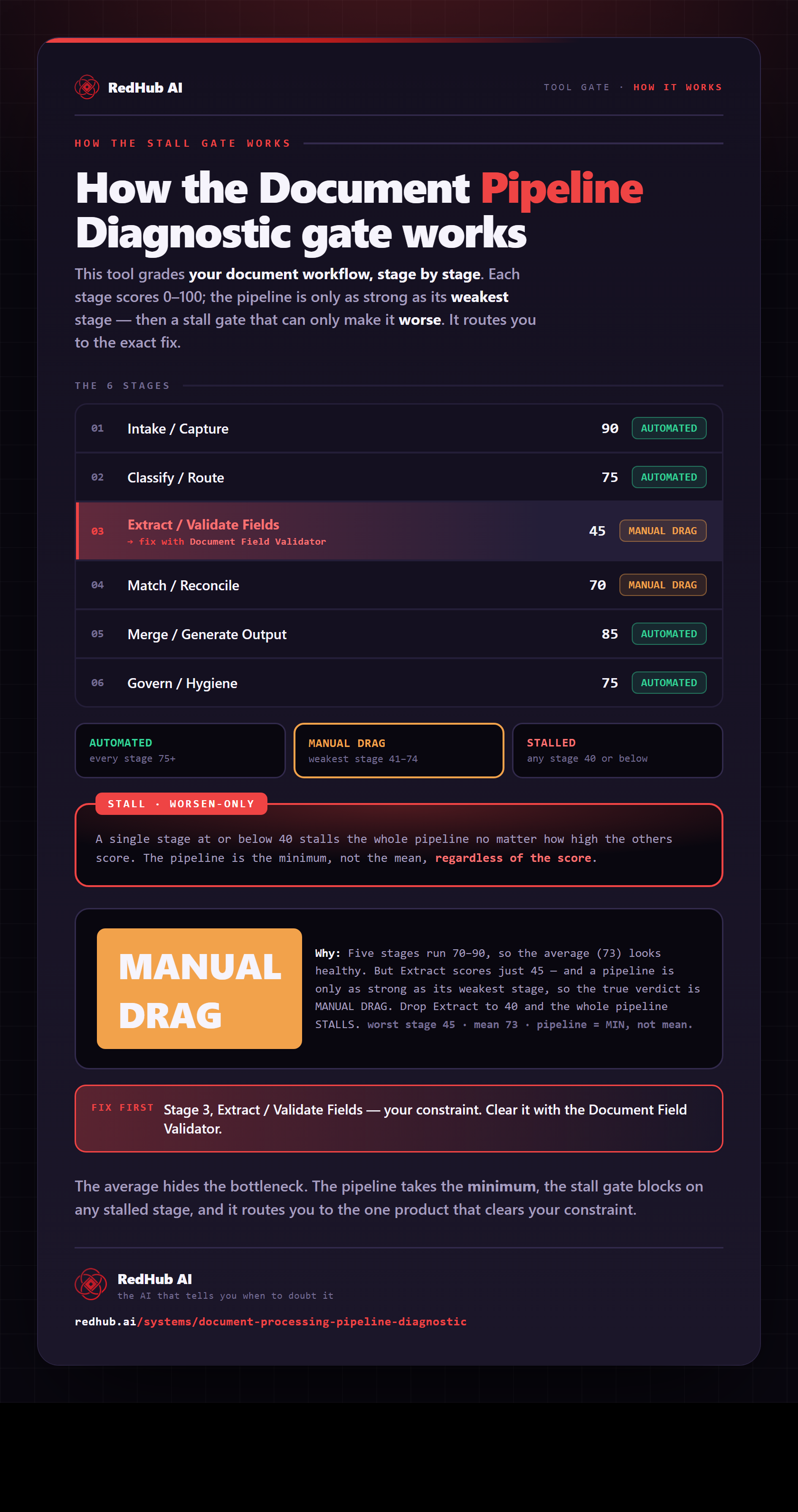
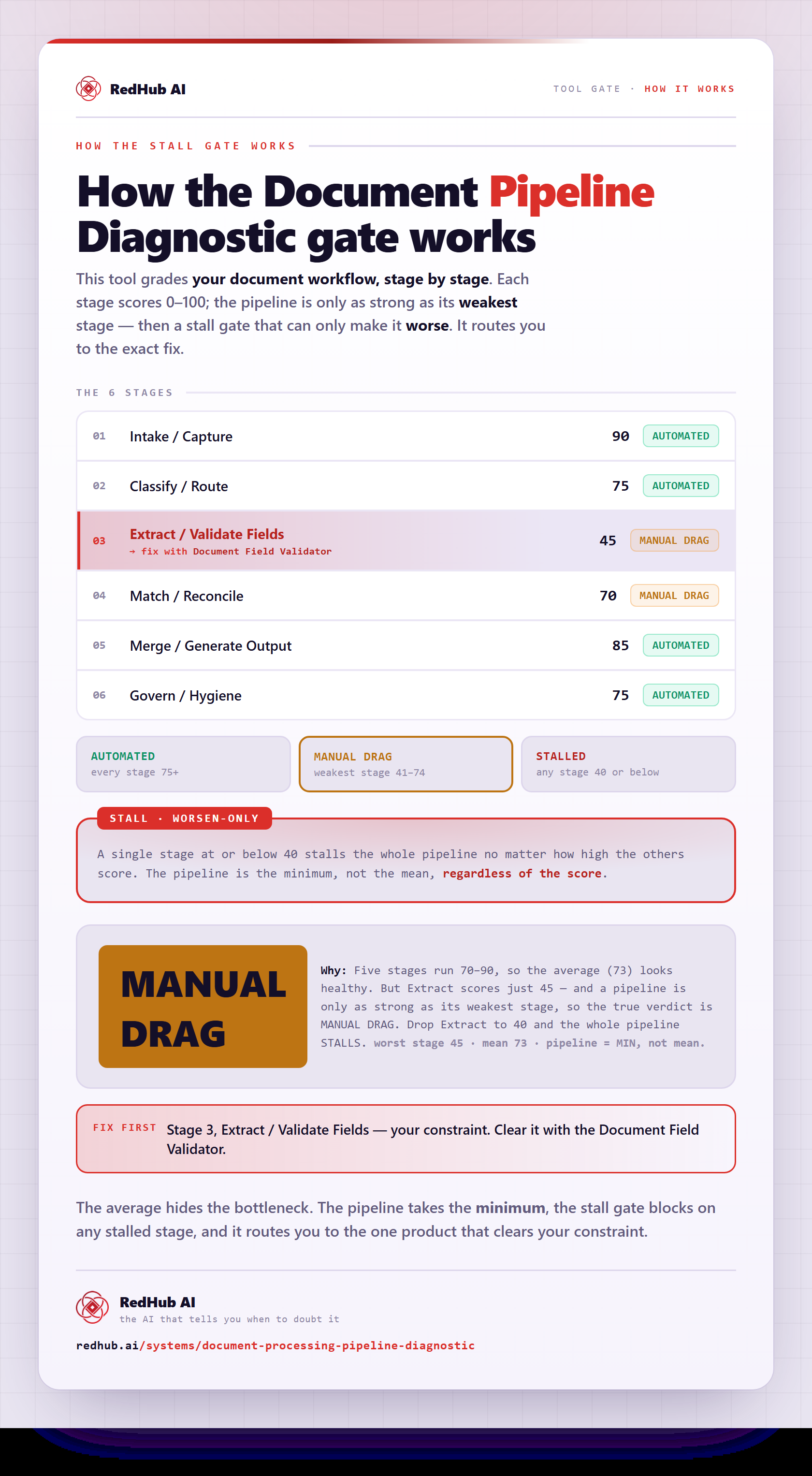
The gate this post refers to, drawn from the tool’s own logic. See the tool.