How to Review a Financial Model Before It Goes to the Board
RedHub AI Editorialupdated October 4, 20265 min read

Jump to a section7
If a model is going to a board, do the financial model review in two passes. The first checks how the model is built: no hardcoded placeholders, no broken references, no formula that breaks from its row. The second checks what it claims: the assumptions, the timing and the story in the deck. Keep them apart, because a model that is wrong in its mechanics can still produce a reasonable-looking number, and a reviewer reading the story will not catch it.
TL;DR: Before a board model ships, check the formula layer on its own, then the assumptions. Resolve every flagged cell to a reason you can say out loud, and keep a record of what you checked. Then ask the question neither pass covers: is each key formula the calculation the modeler meant? The Spreadsheet Formula & Model Integrity Auditor ($69) checks the mechanics on your real file. For the broader framework, see the pillar guide: Spreadsheet Errors: How to Find Them Before They Cost You.
Why board models break where nobody looks
A board model is usually assembled under deadline. Tabs come from earlier versions, inputs come from other people, and last-minute changes land the night before the deck goes out. Each step is a chance for a formula to break quietly: a row inserted below a sum range, a placeholder from an earlier draft that never got reconnected, a link to a file that has since moved.
None of that shows when someone walks the board through the numbers. It shows a week later, when a director asks a follow-up and the number that comes back does not match the one presented.
The formula pass checks three things
- Hardcoded numbers where a formula should be. A placeholder like
=C14*1.2from three revisions ago keeps applying 20% growth after the plan moved to 12%. - Broken or stale references. A deleted row, a renamed tab or a moved source file can leave a formula returning an error or the last stored value.
- Consistency across each row and column. If every month in a row follows one formula except March, March needs an explanation before it goes in front of the board.
The review sequence
- Audit the formulas first. Keep this pass apart from the narrative. The story you plan to tell should not influence how carefully you check the arithmetic under it.
- Give every flag a reason. "That's intentional because the March contract was prorated" is fine. "I'm not sure why that's different" is not something to find out live in the boardroom.
- Read the key formulas against their intent. For the five or six numbers the deck leads with, say in words what each one should calculate, then read the formula and confirm it does.
- Only then, review the assumptions and the narrative: growth rates, timing, the story the deck tells.
- Keep a record of what you checked. If a director asks how confident you are, "we audited the formula layer and resolved every flag" is an answer, not a hope.
A formula can be consistent and still wrong
Step three exists because the two passes have a seam between them. JPMorgan Chase's own management task force report, published January 16, 2013, on the 2012 losses in its Chief Investment Office, describes a risk model that "operated through a series of Excel spreadsheets, which had to be completed manually, by a process of copying and pasting data from one spreadsheet to another." It also describes the error found in that model: after subtracting the old rate from the new one, "the spreadsheet divided by their sum instead of their average, as the modeler had intended." The report says this likely muted volatility by a factor of two.
The arithmetic is simple. The average of two rates is half their sum, so dividing by the sum gives a result half the size. A formula-layer check would not flag that kind of mistake, and that includes ours. A formula like that carries no error value and no stray constant, and if every row uses it, it is perfectly consistent. An assumptions review would not have caught it either, because nothing about the assumptions was wrong. Only a person who knew what the cell was meant to calculate could see it. That takes review time no formula check can save you.
Why the bar is higher at board level
A planning model used inside the team has room for a mistake caught later. Someone notices, it gets fixed. A model presented to a board is a record of what leadership said was true on a given date. A formula error found afterward is a credibility problem as much as a math problem, and the bar for that model is a list of what you checked.
Check the mechanics before the board sees the model
The Spreadsheet Formula & Model Integrity Auditor reads the real .xlsx and grades each formula cell SOUND, REVIEW or BROKEN, with one model verdict and, where a cell falls short, the cell to fix first. A single error value or broken external link makes the model BROKEN, whatever its integrity score. It flags and points to cells, and it never edits the file. Not accounting or audit advice.
Get the Spreadsheet Formula & Model Integrity Auditor — $69Pairs well with
If the model pulls numbers from several systems that should agree, the Multi-Source Data Reconciliation Engine ($89) rolls them up to RECONCILED, FIX or NOT RECONCILED, and a single DISPUTED key forces NOT RECONCILED. If the actuals in the model come from the monthly close, the Finance & Reporting Automation Kit ($129) labels every tie-out Ties out, Review or Does not reconcile, with one close status. And if the inputs arrive as a CSV export, grade that file first with the CSV / Data-Export Schema & Quality Gate ($69).
More in this guide
What should I check first before a board meeting?
Audit the formula layer on its own: hardcodes, broken references and row and column consistency. Then review whether the assumptions and the story make sense.
Does a formula audit check whether my board model's numbers are accurate?
No. It checks the model's mechanics: that formulas are consistent, references resolve and nothing is hardcoded. It does not evaluate your assumptions, your accounting or whether the resulting numbers are correct, and it is not financial, accounting or investment advice.
Why separate the mechanical review from the narrative review?
Because a reviewer focused on whether the story makes sense is not also checking whether a specific cell was hardcoded. Two passes give each question full attention.
Can a formula be consistent and still wrong?
Yes. A formula that divides by a sum where it should divide by an average can be identical in every row and free of errors, so a mechanical check passes it. Only someone who knows what the cell should calculate will catch it.
Should I keep a record of what I audited?
Yes. If a director asks how confident you are in the model, saying what you checked and resolved is a stronger answer than a general assurance that the numbers look right.
Is this the same as an accounting audit?
No. This checks a spreadsheet's formula layer for structural soundness. It is not an accounting, financial or investment review, and it does not substitute for one where that is what you need.
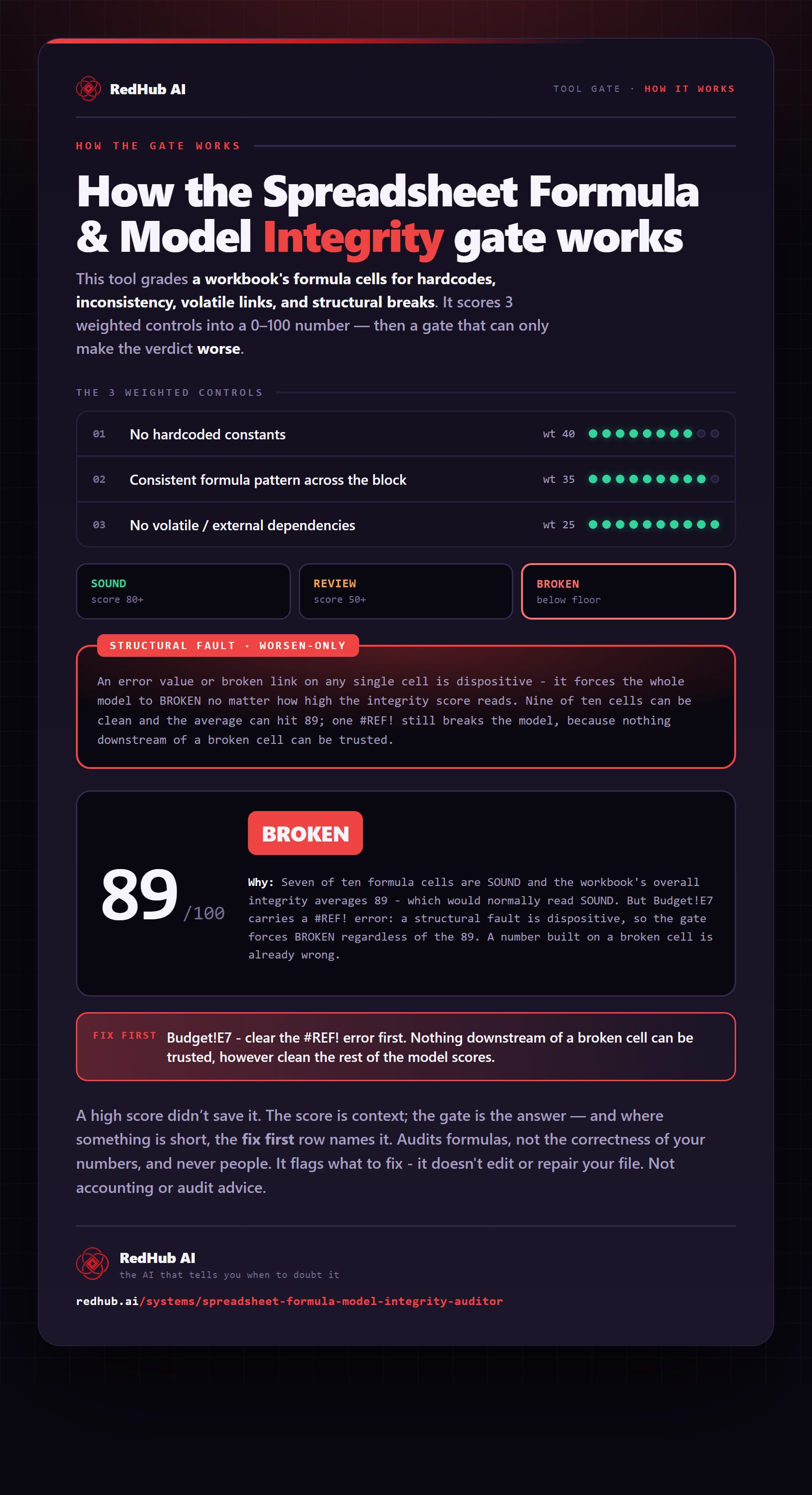
The gate this post refers to, drawn from the tool’s own logic. See the tool.