How to Fix a Leaking Lead Funnel (One Stage at a Time)
RedHub AI Editorialupdated October 7, 20266 min read

Jump to a section7
To fix lead funnel leaks, change one stage, measure the one number that stage should move, and only then choose the next. Start with the weakest stage, because a funnel produces only what that stage lets through. A full overhaul feels faster. It usually is not, because when five things change in the same month and bookings rise, nobody can say which change did it, and the ones that did nothing keep costing money.
TL;DR: Find the weakest stage. Apply the fix built for that stage. Measure one number before and after. Rate the funnel again and take the new weakest stage. Stop when the next stage down is not costing real pipeline. Two exceptions: a stage that is not working at all gets fixed today without an experiment, and a low-volume funnel may not have enough leads to read one change per month. The Lead-Gen Funnel Diagnostic ($79) names the stage and the kit for it, where a stage is short. Start with the pillar: The Lead-Generation Funnel: Find Your One Bottleneck.
The loop
- Find the weakest stage. Rate each stage against what is true today and take the lowest. Where you have counts, check the rating against them with the method in where leads drop off.
- Apply the fix built for that stage. The table below matches each stage to a first move.
- Measure one number. Choose it before you make the change. For a speed fix it is the share of new leads reached, or the time to first reply.
- Rate the funnel again. A different stage is now the lowest.
- Stop when the next stage is not worth it. No funnel needs six perfect stages.
Match the fix to the stage
The first moves below follow the routing playbook that ships with the Lead-Gen Funnel Diagnostic. The right-hand column is the kit the Diagnostic names for each stage.
| Weakest stage | First move | Kit it routes to |
|---|---|---|
| Capture | Sharpen one offer and cut the form to the fields you need | Lead-Capture Page Kit |
| Speed-to-lead | Route every new lead to a named owner and cover after hours | Speed-to-Lead Routing Kit |
| Qualification | Write an explicit rubric and drop the leads that fail it | Inbound Lead Qualification Engine |
| Definition and handoff | Agree one measurable definition each for MQL and SQL, with an owner and a deadline on the handoff | MQL to SQL Definition & Handoff Kit |
| Nurture | Make a decision per lead: advance, nurture, recycle or drop | Lead Nurture Decision System |
| Source ROI | Track cost and yield per source and cut what does not pay back | Lead Source ROI Scorecard |
None of these is hard to describe. The trouble is that each one is useless on the wrong stage. A rewritten landing page does nothing for a shared inbox that nobody checks on Saturday. The six lead funnel stages explains how to tell them apart.
What one round looks like
The Diagnostic's worked sample scores Capture 80, Speed-to-lead 46, Qualification 80, Definition and handoff 73, Nurture 73 and Source ROI 74. The funnel score is the lowest stage, 46, and the verdict is LEAKING. It names Speed-to-lead and the Speed-to-Lead Routing Kit.
Suppose the team fixes routing and coverage, and honest ratings now put Speed-to-lead at 80. We ran the shipped engine with that one change. The funnel score becomes 73 and the verdict becomes FLOWING. One stage moved the verdict.
The engine now names no stage. Every stage is at 70 or above, so it prints "NOTHING TO FIX FIRST". The lowest stages are still Definition and handoff and Nurture, tied at 73. Whether a 73 is worth another month of work is the team's call, and the tool leaves it to them. It names a stage again only when one falls below 70.
When one at a time is the wrong speed
The one-change rule assumes you can afford to wait for a clean reading. Sometimes you cannot.
If a stage is not working at all, there is nothing to measure against. A form that delivers nothing, or leads that nobody owns, should be fixed today. In the Diagnostic, any stage at 25 or below reads CLOGGED. Treat that as a repair, and skip the experiment. If two stages are both that low, fix both.
Low volume is the harder case. A firm with 15 leads a month that changes one thing per month is reading a rate where one lead is almost 7 points. A real improvement and an ordinary month look alike. You can wait a quarter per change, which is slow, or you can change two things and accept that you will not know which one worked. We do not have a clean answer for where that line sits. If you bundle changes, bundle the ones aimed at the same stage, so that you at least learn which stage responded.
Keep the before-and-after honest
Three things spoil a comparison. The first is choosing the measure after you see the results. The second is changing the definition of a lead halfway through. The third is a seasonal month on one side. Write the measure and the definition down first, and compare with the same month's pattern if you have last year's numbers. The lead funnel metrics guide covers which numbers hold up.
Then rate the stage again from the evidence. A fix you worked hard on can still leave the rating where it was.
Let the lowest stage set the order
The Lead-Gen Funnel Diagnostic scores six stages from 0 to 100 using your own 0 to 5 ratings and returns FLOWING, LEAKING or CLOGGED from the lowest one. Where a stage is short, it names that stage and the kit built for it. Run it again after each fix. A Python engine and a workbook give the same result, and it comes with a routing playbook for each stage. It does not do the repair.
Get the Lead-Gen Funnel Diagnostic — $79Pairs well with
Three of the repairs from the table. The Lead-Capture Page Kit ($79) grades an opt-in page on six weighted levers, returns GO LIVE, TIGHTEN or REWORK, and names each page's weakest lever where one is below 5. The Lead Nurture Decision System ($69) scores each captured lead and returns ADVANCE, KEEP NURTURING, RECYCLE or DROP, holding high-fit leads that have gone cold in nurture. The Website Lead-Leak & Form-Failure Gate ($49) is for the fix-it-today case: you test each form yourself, and one with no verified delivery reads BLACK HOLE whatever else is right with it.
More in this guide
How do I fix a leaking lead funnel?
One stage at a time. Find the weakest stage, apply the fix built for it, measure one number before and after, then rate the funnel again and take the new weakest stage.
Why not fix the whole funnel at once?
If several things change together and results improve, you cannot tell which change did it. You keep paying for the ones that did nothing, and you cannot repeat the one that worked.
Which stage do I fix first?
The lowest-scoring one. A funnel produces only what its weakest stage lets through, so work on a stronger stage changes little. If two stages tie, the earlier one usually comes first.
Is there a case for fixing two stages together?
Yes, in two situations. A stage that is not working at all should be fixed right away without waiting for a clean test. And a funnel with few leads may take a quarter to read a single change, so bundling changes aimed at one stage can be the practical choice.
How do I know a fix worked?
Choose one number before you make the change, keep the definition of a lead the same on both sides, and compare. With small counts, read the individual leads as well as the rate.
When do I stop?
When the next stage down is not costing enough pipeline to justify the work. In the Diagnostic's worked sample, lifting Speed-to-lead from 46 to 80 moves the verdict from LEAKING to FLOWING with the lowest stage at 73. Going further is a judgment call.
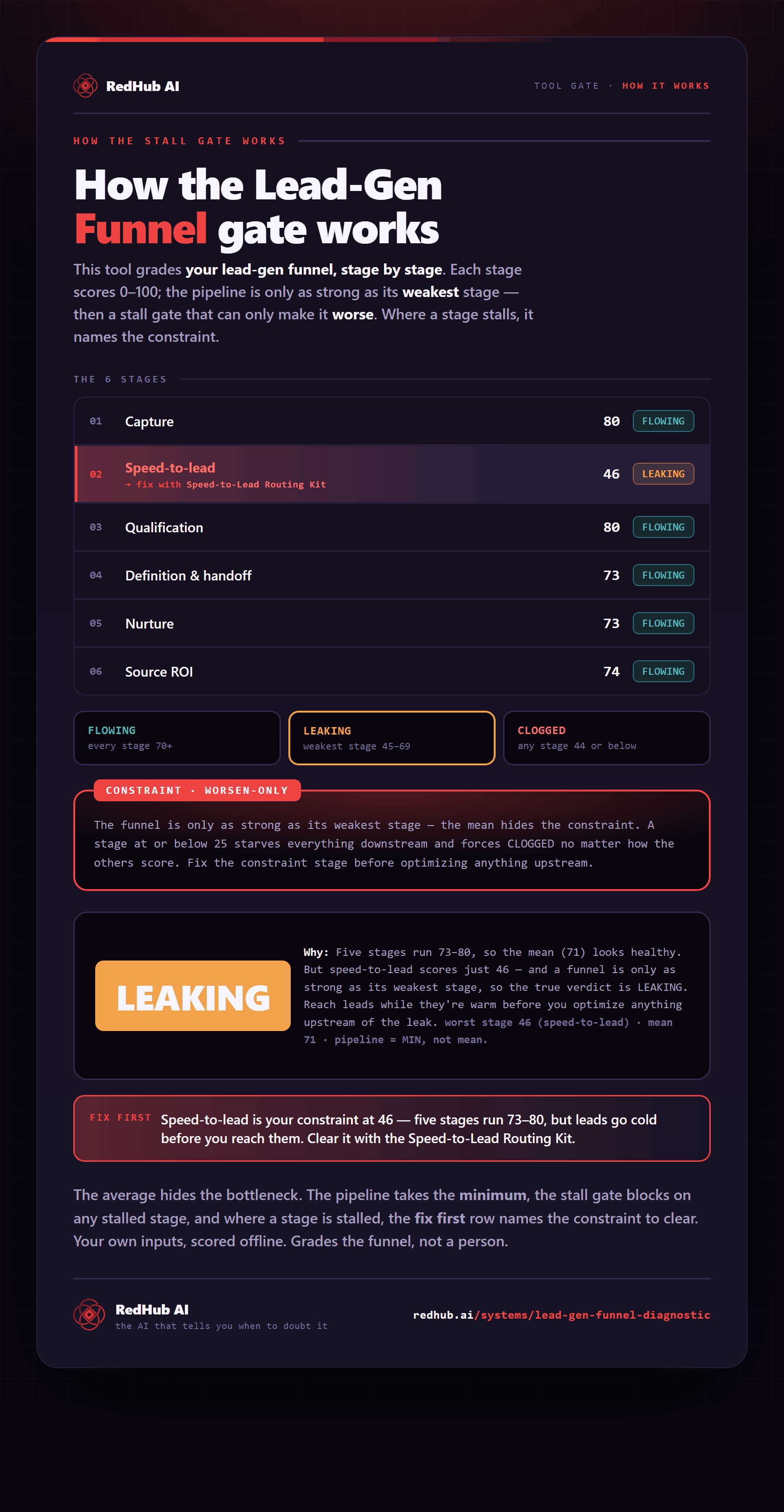
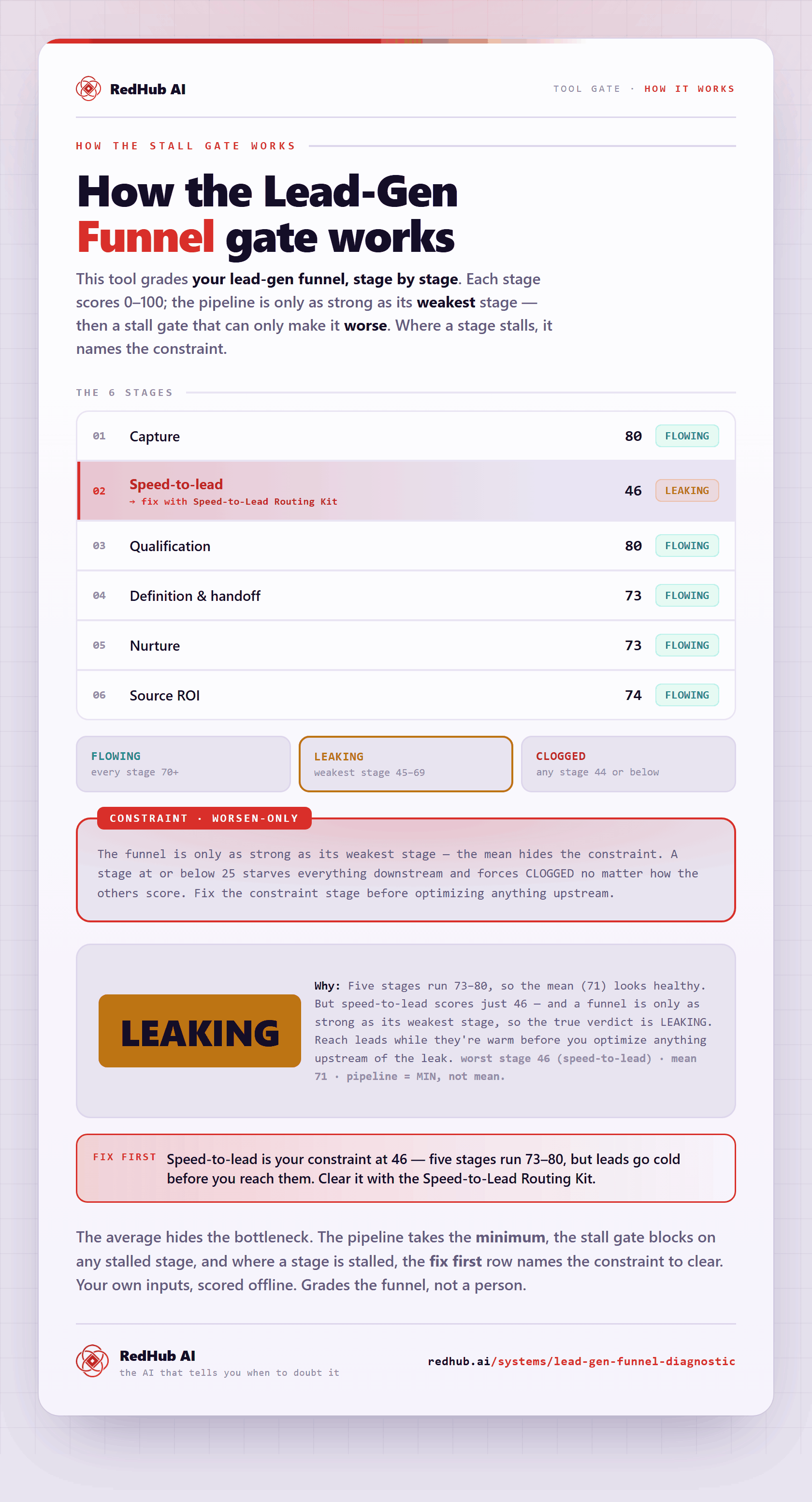
The gate this post refers to, drawn from the tool’s own logic. See the tool.