The Stages of a Lead-Gen Funnel (and Where They Break)
RedHub AI Editorialupdated October 7, 20266 min read

Jump to a section6
There are six lead funnel stages worth rating separately: capture, speed-to-lead, qualification, definition and handoff, nurture, and source ROI. Each one answers a different question about how a stranger becomes a lead your sales side can work. Each one also breaks in its own way, and the signs are easy to mix up. A team that says "we have a lead problem" might mean a weak page, a slow reply, or two departments that disagree about what a lead is.
TL;DR: Capture fails as visitors who leave. Speed-to-lead fails as leads who wait. Qualification fails as time spent on bad fits. Definition and handoff fails as leads lost between marketing and sales. Nurture fails as one drip email for everyone. Source ROI fails as a budget that never moves. The Lead-Gen Funnel Diagnostic ($79) scores all six from your own ratings. Start with the pillar: The Lead-Generation Funnel: Find Your One Bottleneck.
The six stages, and how each one fails
The descriptions of the low end below come from the rating anchors in the Lead-Gen Funnel Diagnostic, which asks you to mark each item from 0 to 5.
- Capture. Visitors arrive and do not become leads. At the low end the offer is a vague "contact us" and the form is a wall of required fields.
- Speed-to-lead. Leads come in and nobody reaches them while they still care. At the low end the first touch takes days, leads sit in a shared inbox, and nights and weekends drop.
- Qualification. Sales is busy and wins little. At the low end the rubric is gut feel, and everything that fills in a form is "a lead."
- Definition and handoff. Marketing says the leads are good. Sales says they are not. At the low end there are two definitions of "qualified" and no owner for the handoff.
- Nurture. Leads who are not ready yet get one drip sequence, the same email as everyone else, and are never scored again.
- Source ROI. Money goes out across channels and nobody can say which ones pay back. At the low end you know only the blended number.
Read the list again and look at who owns each repair. Capture belongs to whoever runs the website. Speed-to-lead belongs to whoever runs the phones and the inbox. No single person owns all six, which is part of why a weak stage can sit unnoticed for a year.
Two of the six are not steps in a line
A funnel diagram shows stages stacked top to bottom, and the first four fit that picture. A lead is captured, reached, qualified, and handed to sales, in that order.
Nurture does not fit. It is a side loop for leads who are not ready, and a lead can sit in it for months before returning to qualification or dropping out. Source ROI fits even less. No lead passes through it. It is a read across the whole funnel that asks whether the channels feeding the top are worth their cost.
This matters when you rank the stages. The Diagnostic treats all six the same way and reports the lowest score. When two stages tie, it names the earlier one in its list, on the reasoning that an upstream block starves everything after it. That reasoning is sound for capture and speed. It is weaker for Source ROI, which sits last in the list but decides what enters first. If Source ROI ties with an earlier stage, read both before you choose.
Where the leaks hide: the seam between two owners
Most stages fail inside one team. Definition and handoff fails between two. Marketing counts a lead as delivered when the form fires. Sales counts a lead as received when a rep opens it. Anything that happens between those two moments belongs to nobody.
The sign is an argument, not a number. If your pipeline meeting keeps returning to "the leads are bad" against "sales does not follow up," the trouble is probably neither the leads nor the follow-up. Our post on MQL vs SQL covers what the two terms mean and where leads get stuck.
The same seam shows up earlier, in plumbing. A form can accept a submission and never deliver it. That looks like a capture problem and is closer to a handoff between systems. Where leads get lost between click and inbox covers that chain.
From a map to a score
Naming the stages gets you a list. Rating them gets you an order. For each stage, mark what is true today, not what you plan to build, and then find the lowest. A stage you work hard on can still score low, because effort is not throughput.
The speed stage is easy to rate from memory and get wrong. Check a few real timestamps first. Our post on speed to lead covers why the first hour matters. Then find where leads drop off with counts, so the ratings have something to answer to.
Score all six stages in one sitting
The Lead-Gen Funnel Diagnostic has you rate three items per stage from 0 to 5, turns each stage into a 0 to 100 score, and reports the lowest stage as your funnel score with a verdict of FLOWING, LEAKING or CLOGGED. Where a stage is short, it names that stage and the kit built for it. You get a Python engine, a workbook and two playbooks.
Get the Lead-Gen Funnel Diagnostic — $79Pairs well with
Three kits for three of the stages above. The Inbound Lead Qualification Engine ($99) reads a CRM or CSV export and returns PURSUE NOW, NURTURE or DISQUALIFY per lead, from your own marks on fit, intent, timeline, authority and recency. The Lead Nurture Decision System ($69) scores each captured lead and returns ADVANCE, KEEP NURTURING, RECYCLE or DROP. It reads and scores only, and never sends. The Lead Source ROI Scorecard ($49) grades each lead source and returns SCALE, FIX or CUT, with a floor that blocks SCALE for a source whose leads rarely qualify.
More in this guide
What are the stages of a lead-gen funnel?
This guide uses six: capture, speed-to-lead, qualification, definition and handoff, nurture, and source ROI. Other models cut the funnel differently. These six are the ones the Lead-Gen Funnel Diagnostic scores, and each maps to a different repair.
How does each stage break?
Capture breaks as visitors who do not convert. Speed-to-lead breaks as slow first replies. Qualification breaks as time on bad-fit leads. Definition and handoff breaks as leads lost between marketing and sales. Nurture breaks as one drip for everyone. Source ROI breaks as spend nobody can trace.
Are the six stages a strict sequence?
The first four are. Nurture is a side loop for leads who are not ready, and source ROI is a read across the whole funnel, not a step a lead passes through. Keep that in mind when two stages score the same.
Why do leads get lost at the handoff?
Because the handoff sits between two owners. Marketing counts a lead as delivered when the form fires, and sales counts it as received when a rep opens it. Without a shared definition, a named owner and a response deadline, nobody is responsible for the gap.
What if more than one stage is weak?
Start with the lowest. A funnel produces only what its weakest stage lets through, so work on a stronger stage changes little. Once the lowest is repaired, rate again and take the next one.
How do I rate a stage honestly?
Rate what is true today, not what you plan to build, and check the rating against real records where you can, such as reply timestamps for speed-to-lead. A second rater helps, because people tend to mark up the stage they already suspect.
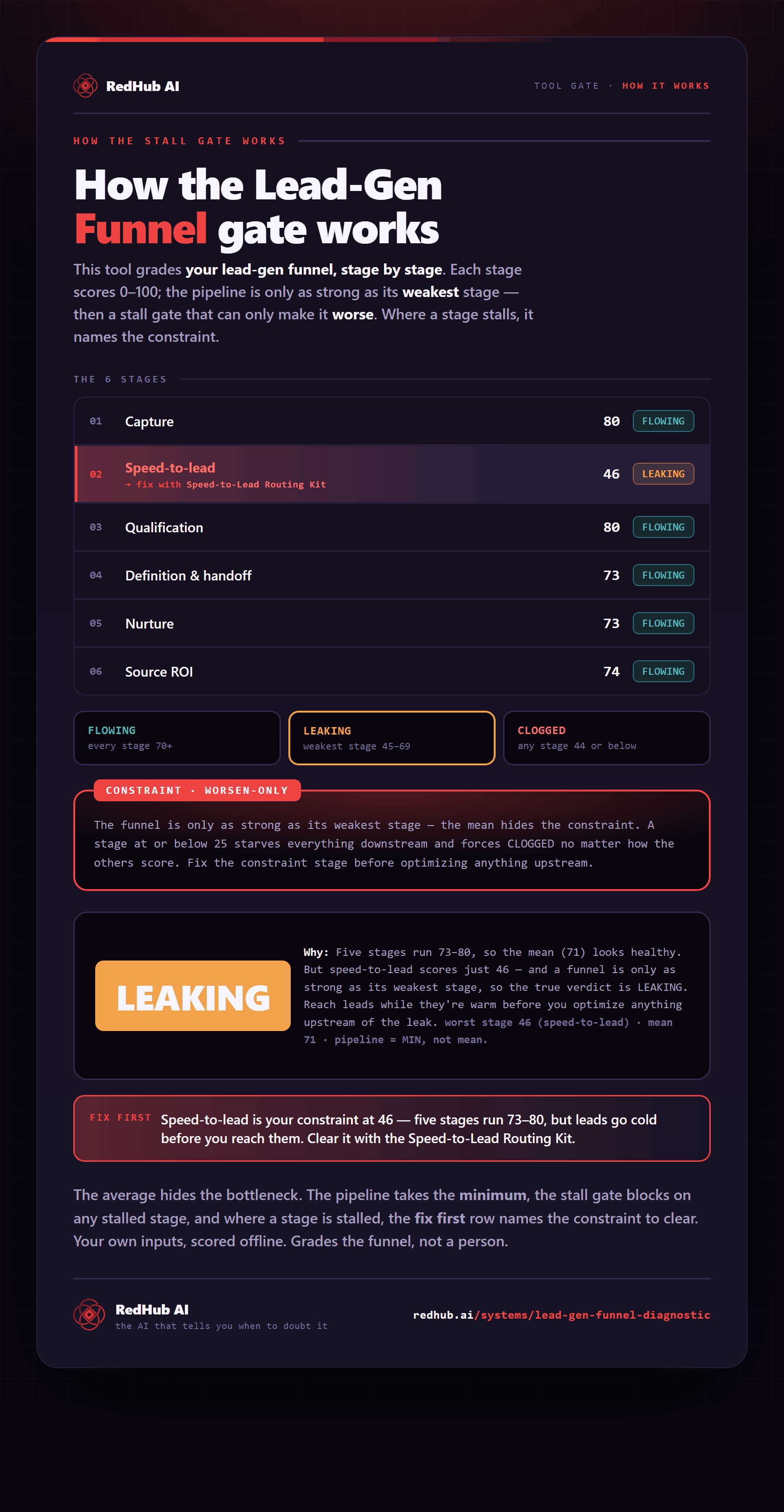
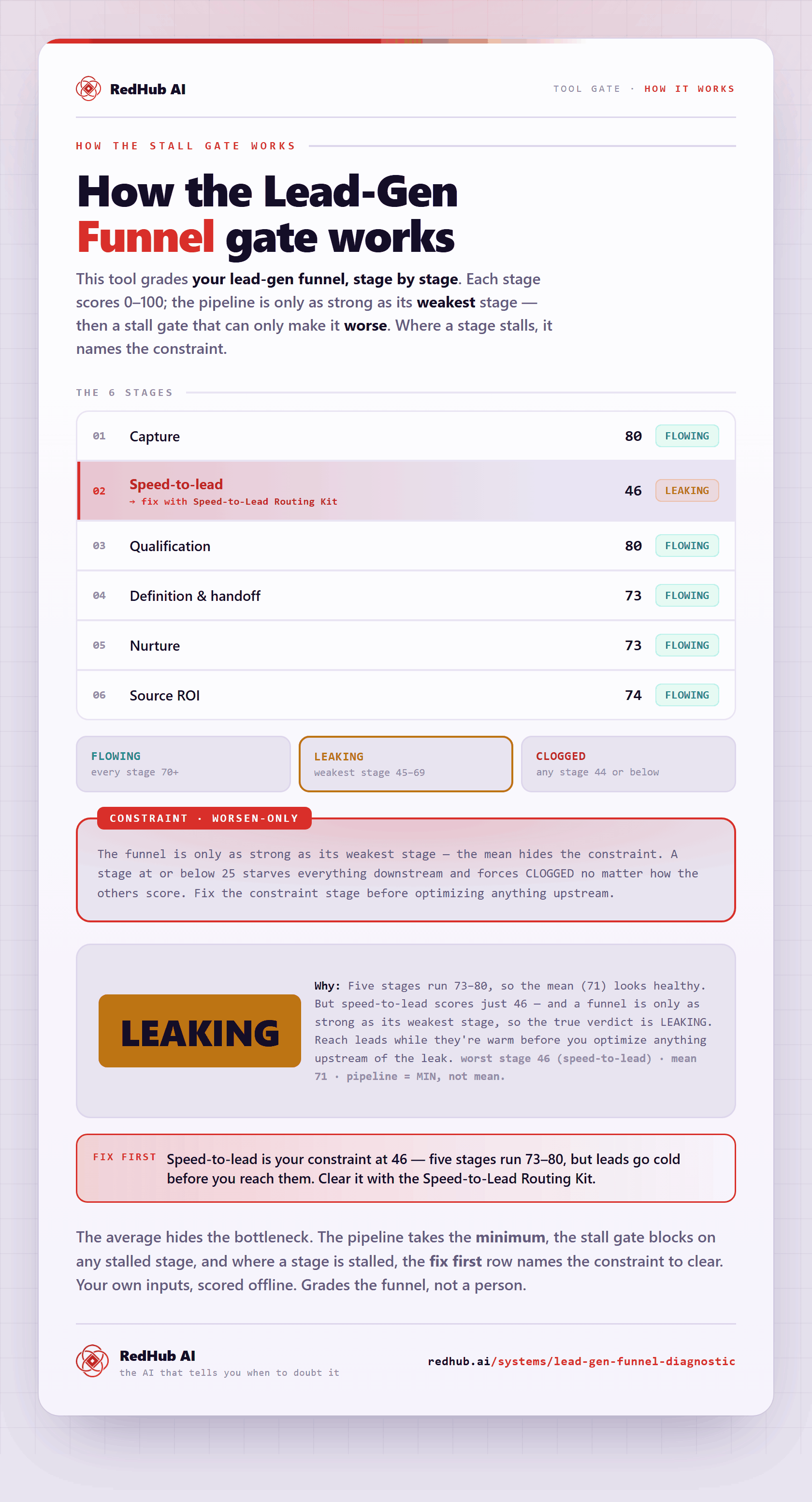
The gate this post refers to, drawn from the tool’s own logic. See the tool.