How to Get Customers to Pay Invoices Faster
Todd Brooks, Founderupdated July 22, 20268 min read

Jump to a section11
- TL;DR
- How do you get customers to pay invoices faster?
- Why invoices go unpaid (it's usually not malice)
- Prevent late payment before it starts
- The real fix: chase in the right order
- The words matter: courtesy collects
- Measure it: your DSO is the scoreboard
- Receivables are one leak — check the others
- Where to go deeper
- Decision Guide
- FAQ
TL;DR
- What it is: Getting customers to pay invoices faster is a system, not a personality trait — clear terms, easy payment, and a follow-up sequence that runs in the right order.
- Who it's for: Small businesses, agencies, freelancers, and services firms doing their own collections — browse the RedHub Quick Kits.
- How it works: Prevent late payment up front, then rank every overdue invoice by amount, age, and risk — and chase the money most likely to come in first, with courteous, escalating emails.
- Bottom line: The fastest cash you will raise this quarter is the cash you have already earned. Most of it is sitting in a pile you are chasing in the wrong order.
How do you get customers to pay invoices faster?
You get customers to pay invoices faster by doing three things in order: invoice cleanly (right amount, right contact, clear due date, easy way to pay), follow up before the due date instead of after it, and chase overdue balances in a ranked order — by amount, age, and collection risk — with a courteous, escalating email sequence. Most late payments are not refusals. They are invoices that got lost, disputed, or deprioritized, and a specific, polite follow-up moves them to the top of the pile.
Best for: owners with a pile of unpaid invoices and no system for chasing them — start with the Accounts Receivable Recovery Kit.
Every owner who invoices customers eventually asks the same question: how to get customers to pay invoices without turning into a full-time debt collector. The honest answer is that late payment is rarely about the customer being a deadbeat. Payment-practice surveys regularly find that a large share of B2B invoices are paid late — and the most common reasons are boring: the invoice went to the wrong person, it is missing a PO number, it is sitting in an approval queue, or it simply fell down the list because nobody followed up.
That is good news. Boring problems have boring fixes. You do not need to be aggressive. You need to be organized — before the due date, and especially after it.
Why invoices go unpaid (it's usually not malice)
Think about how your own company pays bills. The invoices that get paid first are the ones that are correct, easy to process, and actively followed up. The ones that slip are vague, disputed, or silent. Your customers work the same way. An unpaid invoice usually means one of four things:
- It got lost. Wrong inbox, wrong contact, spam folder, or a person who left the company.
- It got stuck. Missing PO number, missing detail, or an approval chain nobody is pushing.
- It got disputed. The customer disagrees with an amount or a line item — and never told you.
- It got deprioritized. Cash is tight on their side, and the quiet vendors get paid last.
Only the last one is really about money. The first three are process failures you can fix this week. And even the last one responds to follow-up, because businesses under cash pressure pay the vendors who ask — specifically, politely, and repeatedly.
Prevent late payment before it starts
The cheapest overdue invoice is the one that never goes overdue. Four habits do most of the preventive work:
- Agree on terms before the work starts. Payment terms belong in the proposal, not as a surprise on the invoice. Net 15 or Net 30, stated plainly, and confirmed by the person who will actually approve payment.
- Invoice immediately and correctly. Send the invoice the day the work ships, to the confirmed billing contact, with the PO number, a clear due date, and an itemized amount. Every error resets the clock.
- Make paying easy. A payment link beats "mail a check." Every extra step between "I should pay this" and "paid" costs you days.
- Send a friendly nudge before the due date. A short "just confirming this landed and is queued for payment" a few days ahead catches lost and stuck invoices while they are still current — before they are a problem.
Do those four things and your late pile shrinks. But it will not disappear — which brings us to the part most owners get wrong.
The real fix: chase in the right order
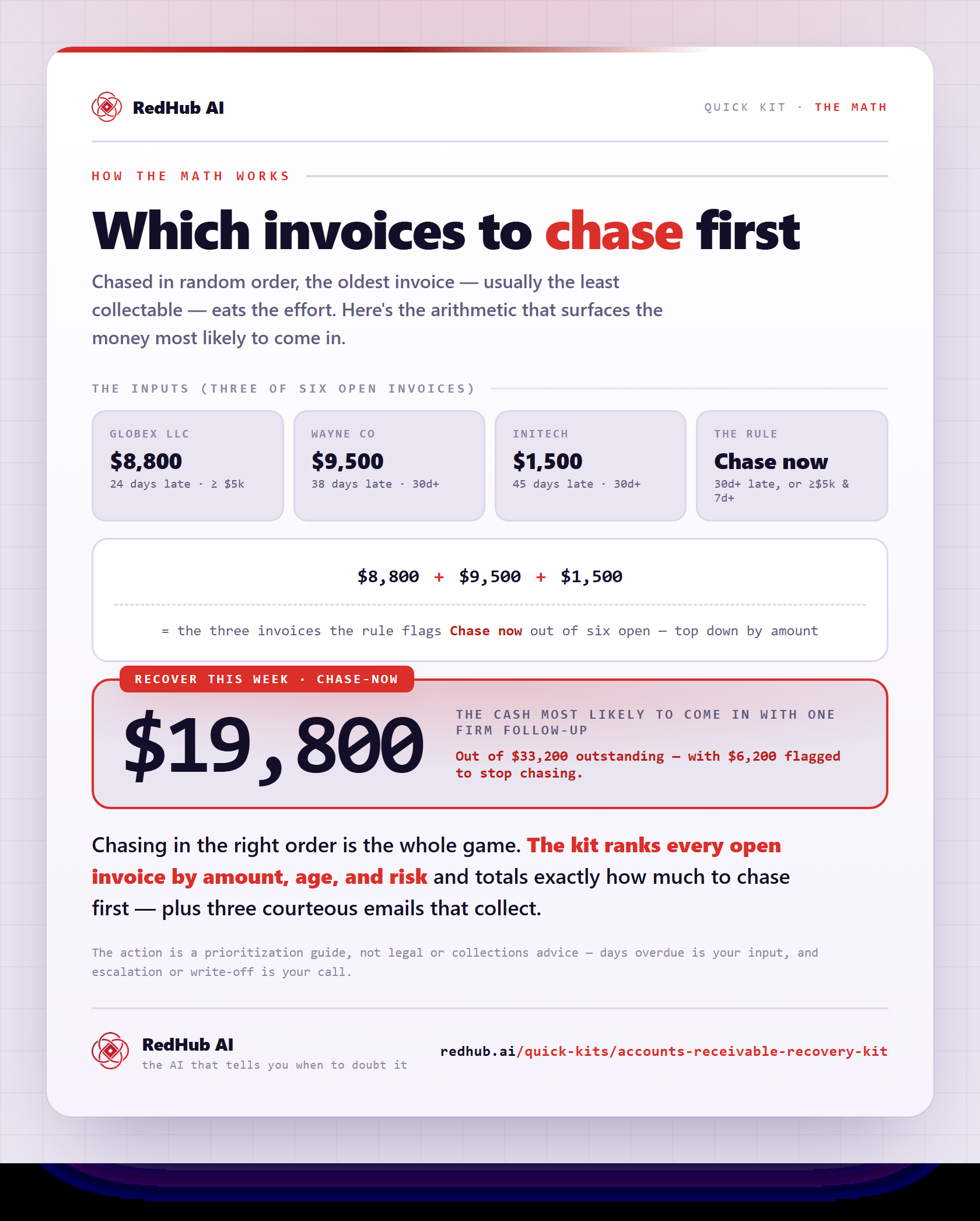
When the overdue pile builds up, most businesses chase it in random order — the oldest invoice, the loudest annoyance, or whichever customer comes to mind in the shower. That feels productive. It is usually backwards, because the oldest invoice is typically the least collectable one. The longer an invoice ages, the harder it gets to collect — which means your best recovery odds are sitting in the middle of the pile, not at the bottom of it.
The fix is to rank every open invoice by three things together — amount, age, and customer risk — and sort each one into an action:
| Bucket | What qualifies | What you do |
|---|---|---|
| Current | Not yet due | Nothing — watch the due date |
| Remind | Recently overdue, modest balance | A gentle, friendly nudge |
| Chase now | Over 30 days late — or a large balance more than a week late | A firm, specific follow-up, top down by amount |
| Write-off review | Very old (120+ days, or old and high-risk) | Decide: escalate, settle, or stop chasing |
This ordering does two things at once. It points your energy at the chase-now money — the balances big enough to matter and fresh enough to collect. And it gives you permission to stop chasing the write-off pile, which is where owners burn hours on money that is realistically gone. We go deeper on the ranking logic in accounts receivable aging: which invoices to chase first.
Those figures come from the worked example that ships inside the Accounts Receivable Recovery Kit — six sample invoices, ranked. They are not a claim about your business. They are what a random pile looks like once it is sorted: a clear this-week target, and a clear stop-wasting-time flag.
Key insight: a vague anxiety ("we're owed a lot of money") becomes a 30-minute task ("send three firm follow-ups, top down by amount"). That conversion — from worry to a ranked list — is the whole game.
The words matter: courtesy collects
The second half of getting paid is what you actually say. Threatening emails feel strong and work badly. They give the customer a reason to go quiet, and they burn a relationship you probably want for repeat business. What collects is courteous and specific: the invoice number, the amount, the days overdue, and a clear ask — escalating in firmness across three stages:
- The gentle reminder — friendly, assumes good faith, makes paying easy.
- The firm follow-up — still polite, but direct: this is overdue, here is the amount, here is the date we need it by.
- The final notice — calm and clear about what happens next, sent before you escalate.
We break down the exact structure, timing, and templates in payment reminder email templates that get you paid, and the full escalation playbook — including when to stop — in how to collect overdue invoices without losing clients.
Measure it: your DSO is the scoreboard
How do you know any of this is working? One number: days sales outstanding (DSO) — the average number of days it takes you to collect after invoicing. If your terms are Net 30 and your DSO is 52, your customers are quietly using you as a free line of credit. Track it monthly; watch the trend. The formula, a calculator, and the levers that move it are in how to reduce days sales outstanding.
Turn your invoice pile into a ranked chase list — today
The Accounts Receivable Recovery Kit is a $39 one-time spreadsheet. Enter each open invoice's amount, days overdue, and customer risk; it sorts every one into Current, Remind, Chase now, or Write-off review, shows the chase-now money you can recover this week, and includes three courteous, escalating chase emails — ready to send. Works in Excel, Google Sheets, or Numbers. 30-day guarantee.
Get the AR Recovery Kit — $39 →Receivables are one leak — check the others
Collecting what you are owed is the fastest cash lever, but it is one of several. If certain customers are chronically late and low-margin, the account itself may be the problem — the Profit Leak Finder flags the accounts that cost more than they pay. And if you want an ongoing watch on the cash position those receivables feed, the Cash-Flow Sentinel monitors the runway side of the same equation. Get paid, plug the leaks, watch the balance — in that order.
Where to go deeper
This guide is the map. Each piece has its own playbook:
- How to reduce days sales outstanding (DSO) — the one metric that tells you whether you are getting paid faster, plus a calculator.
- How to collect overdue invoices without losing clients — the escalation playbook, from first nudge to final notice.
- Accounts receivable aging: which invoices to chase first — why oldest-first is backwards, and the ranking that fixes it.
- Payment reminder email templates that get you paid — the three-stage sequence, with structure and timing.
Decision Guide
Use this approach if: you invoice customers, carry unpaid or overdue balances, and do your own collections — and you can list each invoice's amount and days overdue at least roughly.
Skip it if: you get paid at the point of sale, or you need a collections agency or legal escalation rather than a prioritization system.
Best first step: list every open invoice with its amount and days overdue. Rank them by amount, age, and risk. Send three firm, courteous follow-ups today — top down by amount.
FAQ
How do I get customers to pay invoices on time?
Agree terms before the work starts, invoice immediately and correctly to the confirmed billing contact, make payment easy, and send a friendly nudge a few days before the due date. Most late payments are process failures — lost, stuck, or disputed invoices — not refusals.
What should I do when an invoice goes overdue?
Rank it against your other open invoices by amount, age, and customer risk, then act by bucket: a gentle reminder for recent, modest balances; a firm follow-up for anything over 30 days late or any large balance more than a week late; a write-off review for very old balances.
Should I chase the oldest invoice first?
Usually not. The oldest invoice is typically the least collectable. Chase by recoverable amount and age together — the large, recently-late balances are where a single firm follow-up recovers the most cash.
Do polite payment reminders actually work?
Yes. Courteous, specific reminders — invoice number, amount, days overdue, clear ask — typically collect better than threats, because they make paying easy and give the customer no reason to go quiet. Firmness can escalate across stages without ever getting hostile.
How do I measure whether I'm getting paid faster?
Track days sales outstanding (DSO): your accounts receivable balance divided by credit sales, times the number of days in the period. If DSO is well above your stated payment terms, your follow-up system is the first place to look.
When should I stop chasing an invoice?
When it hits write-off review territory — roughly 120+ days overdue, or 90+ days with a high-risk customer. At that point, decide deliberately: escalate, settle, or write it off. Continuing to chase it casually just burns hours. This is a prioritization guide, not legal advice — escalation and write-offs are your call.
What does the Accounts Receivable Recovery Kit actually do?
It's a $39 one-time .xlsx (works in Excel, Google Sheets, or Numbers). You enter each open invoice's amount, days overdue, and customer risk; it sorts every one into Current, Remind, Chase now, or Write-off review, totals the chase-now money you can recover this week, and includes three courteous, escalating chase emails. It ships with a worked example and a 30-day guarantee.
Recover the cash you're already owed
One spreadsheet ranks who to chase — plus three emails that actually collect. Collecting one overdue invoice usually covers the $39 many times over.
Get the AR Recovery Kit — $39 →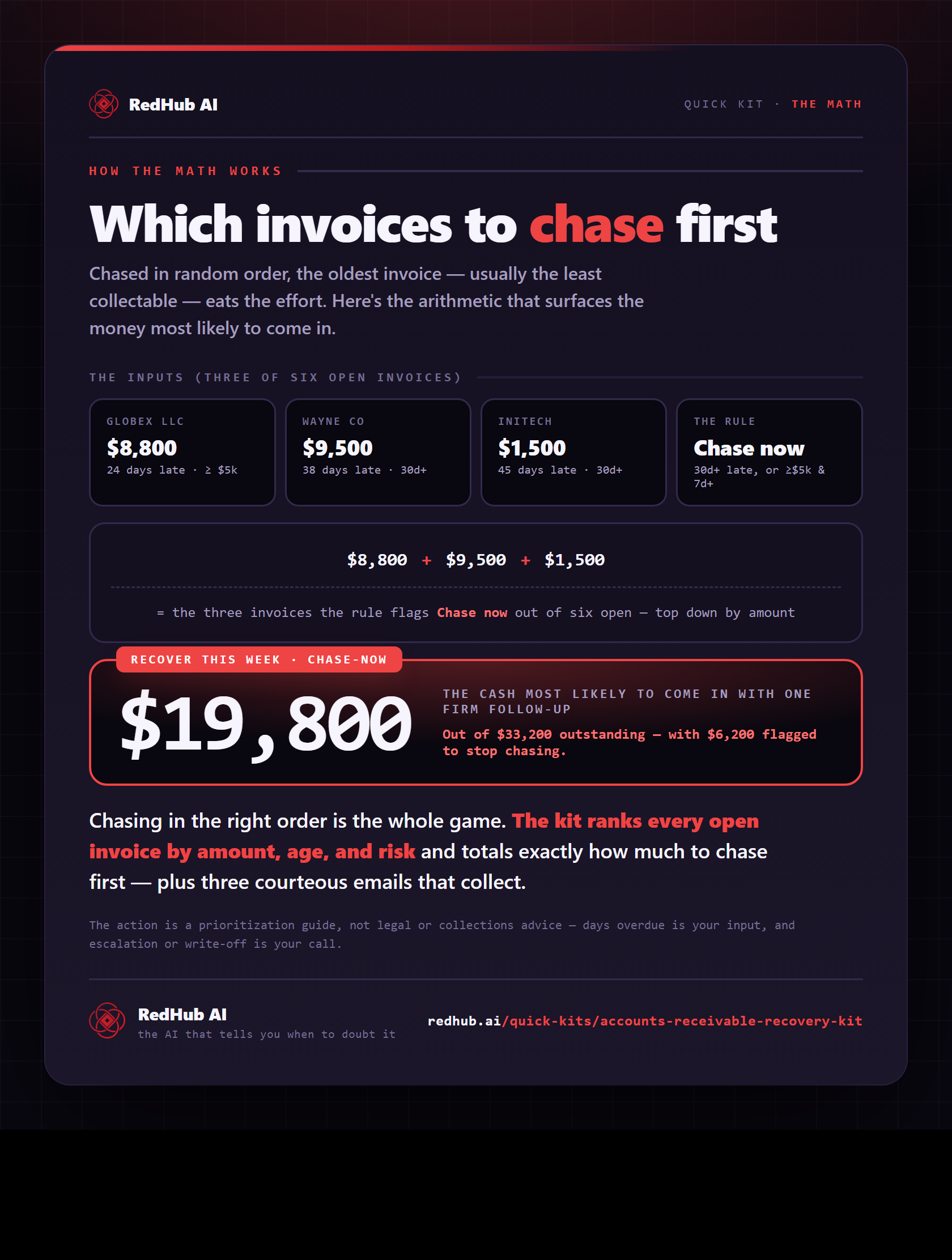
The gate this post refers to, drawn from the tool’s own logic. See the tool.