Accounts Receivable Aging: Which Invoices to Chase First
Todd Brooks, Founderupdated July 22, 20266 min read

Jump to a section8
TL;DR
- What it is: An accounts receivable aging report groups your unpaid invoices by how overdue they are — 0–30, 31–60, 61–90, 90+ days.
- Who it's for: Anyone staring at an aging report wondering where to start — see the RedHub Quick Kits.
- How it works: Aging tells you how old the money is, not which money to chase. Rank by amount, age, and customer risk together, and sort each invoice into an action.
- Bottom line: Oldest-first is backwards. The oldest invoice is usually the least collectable — your best recovery odds are the large, recently-late balances.
What is an accounts receivable aging report?
An accounts receivable aging report is a list of your unpaid invoices grouped by how long they have been outstanding — typically 0–30, 31–60, 61–90, and 90+ days past due. It shows how old your receivables are and where late payment is concentrating. What it does not do is tell you which invoice to chase first: age alone ignores the two other things that decide whether chasing will pay off — the size of the balance, and how risky the customer is to collect from.
Best for: turning the aging report into an action list — the Accounts Receivable Recovery Kit does the ranking for you.
Every accounting tool can print an accounts receivable aging report. Almost none of them tell you what to do with it. So most owners default to the obvious reading: the 90+ column looks scariest, so that is where the chasing starts. That instinct feels responsible — and it quietly wastes your best collection hours. Here is how to read the report properly, and how to turn it into a ranked chase list. (This is the deep-dive on ordering; the full system is in how to get customers to pay invoices faster.)
Why oldest-first is backwards
Collections professionals have said it for decades, and small-business experience backs it up: the longer an invoice ages, the harder it typically gets to collect. Contacts change, disputes fossilize, the customer's memory of the work fades, and businesses in real trouble go quiet. Which means the 90+ column — the one that pulls your attention — generally holds your worst recovery odds per hour of effort.
Meanwhile, the invoice with your best odds is often sitting quietly in the 31–60 column: a large balance, recently late, from a customer who is still responsive. One firm, courteous follow-up on that invoice can recover more cash than a month of emailing the old stuff.
Key insight: an aging report answers "how old is the money?" A chase list answers "where should the next 30 minutes go?" They are different documents, and the second one is the one that pays.
The three factors that actually rank an invoice
- Amount. A $9,000 invoice and a $200 invoice do not deserve the same effort. Standard aging treats them identically if they are the same age.
- Age. Still matters — but as a decay signal, not a priority signal. Older means act differently, not chase harder.
- Customer risk. A reliable repeat client who is late is a nudge. A customer who has burned you before, gone quiet, or is visibly struggling is a different conversation — and very old plus high-risk is usually dead money.
Cross those three and every invoice lands in one of four actions:
| Action | Rule of thumb | Why |
|---|---|---|
| Current | Not yet due | Nothing to chase — watch the due date |
| Remind | Recently overdue, modest balance | A friendly nudge usually clears it |
| Chase now | Over 30 days late, or ≥$5,000 and over a week late | Big enough to matter, fresh enough to collect |
| Write-off review | 120+ days, or 90+ and high-risk | Decide deliberately: escalate, settle, or stop |
Notice the large-balance override in the chase-now rule: a $5,000+ invoice does not get 30 days of grace just because it is young. Big money more than a week late is already a priority — that is exactly the invoice standard aging buries in the "0–30" column where nobody looks.
What a ranked pile looks like
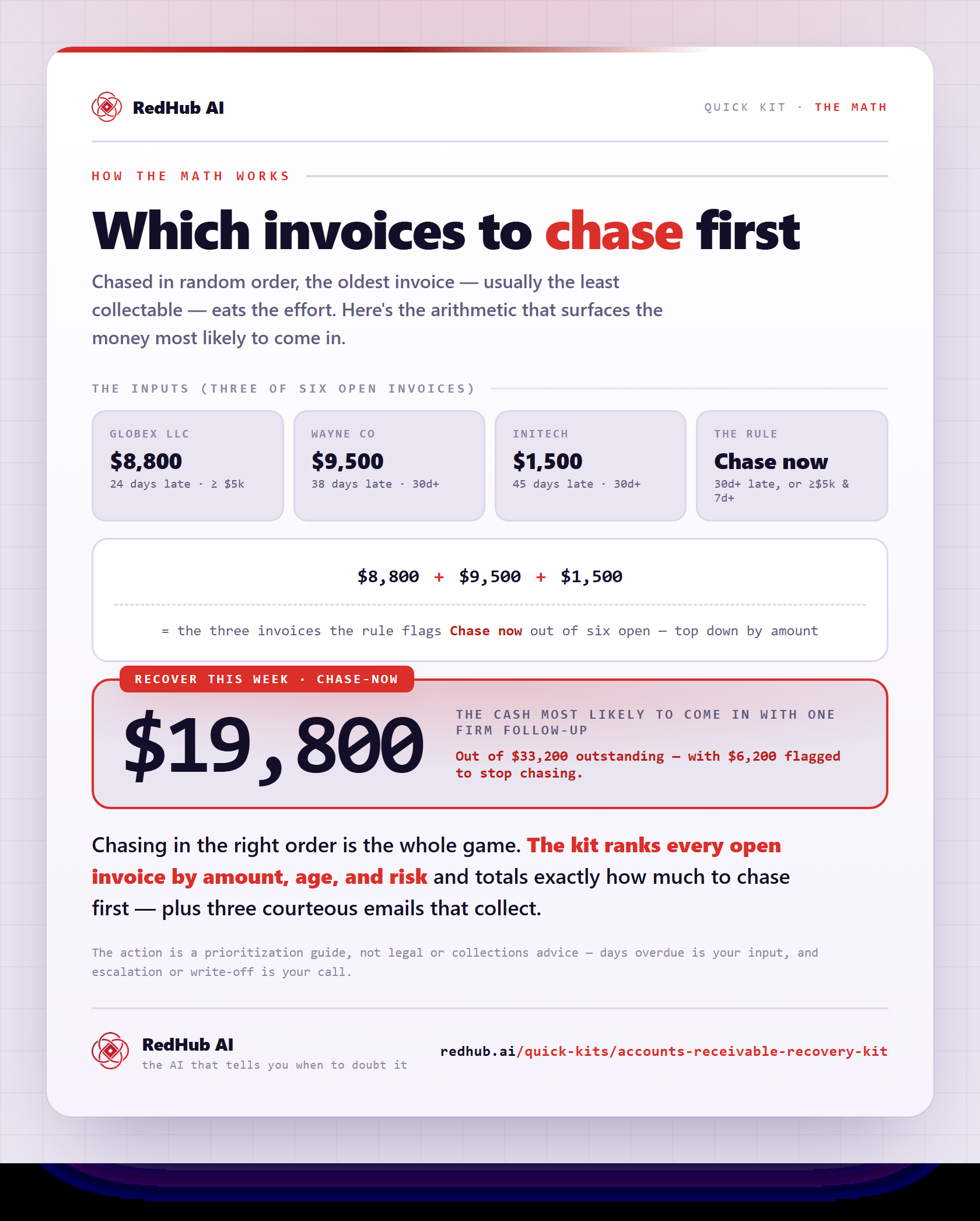
Here is the worked example that ships inside the Accounts Receivable Recovery Kit: six open invoices, $33,200 outstanding. Ranked by amount, age, and risk, the pile sorts into 0 Current, 2 Remind, 3 Chase now, and 1 Write-off review:
From the kit's seeded sample invoices — not a claim about your business. The shape is the lesson: $19,800 of the $33,200 is a this-week task (three firm follow-ups, top down by amount), and $6,200 is a deliberate decision, not a weekly email. A vague anxiety becomes a 30-minute plan.
Run the ranking on your own book
- List every open invoice with its amount, due date, days overdue, and a simple customer-risk read (reliable / unknown / high-risk).
- Sort each into an action using the rules above — Current, Remind, Chase now, or Write-off review.
- Total the chase-now money. That number is your recoverable-this-week target, and it is more motivating than any aging column.
- Work chase-now top down by amount with a firm, courteous follow-up — the wording playbook is in how to collect overdue invoices without losing clients.
- Decide the write-off pile once — escalate, settle, or write off — and stop letting it eat your attention. Then re-rank weekly; it takes minutes once the list exists.
One more pattern worth watching: if the same customer keeps landing in your chase-now bucket month after month, the problem may be the account, not the invoice. The Profit Leak Finder flags customers that cost more to serve — and to chase — than they actually pay.
Your aging report, turned into a chase list
The Accounts Receivable Recovery Kit ($39, one-time) is the ranking done for you: enter amount, days overdue, and risk per invoice, and the sheet sorts every one into Current, Remind, Chase now, or Write-off review — with a dashboard totaling your chase-now money and three ready-to-send chase emails. Excel, Google Sheets, or Numbers. 30-day guarantee.
Get the AR Recovery Kit — $39 →Decision Guide
Use this approach if: you have an aging report (or even a rough invoice list) and more overdue balances than you can chase at once.
Skip it if: you carry one or two open invoices — just follow up on them directly; you don't need a ranking system yet.
Best first step: find the invoices that are large AND recently late. Those are your chase-now money — start there today, not with the 90+ column.
FAQ
What is an accounts receivable aging report?
A list of unpaid invoices grouped by how long they've been outstanding — typically 0–30, 31–60, 61–90, and 90+ days past due. It shows where late payment is concentrating, but not which invoice deserves your next 30 minutes.
Which overdue invoices should I chase first?
The large, recently-late balances from collectable customers — not the oldest ones. Rank by amount, age, and customer risk together, and work the chase-now bucket top down by amount.
Why shouldn't I chase the oldest invoices first?
Because collectability typically drops as invoices age — contacts change, disputes harden, struggling customers go quiet. The 90+ column usually offers your worst recovery odds per hour of effort, while a big invoice in the 31–60 column often clears with one firm follow-up.
When does an invoice become a write-off candidate?
As a working rule, at 120+ days overdue — or 90+ days when the customer is high-risk. That doesn't mean automatically writing it off; it means making a deliberate decision to escalate, settle, or stop. Write-offs can carry tax implications, so this is a prioritization guide, not accounting or legal advice.
How is customer risk judged without credit data?
A simple honest read works: has this customer paid reliably before, gone quiet, disputed invoices, or shown signs of financial trouble? A rough reliable/unknown/high-risk rating is enough to change the chase order in the right direction.
How often should I re-rank my receivables?
Weekly. Days-overdue values shift, payments land, and new invoices go late. Once the list exists, a re-rank takes minutes — and it keeps your 30 minutes of chasing pointed at the right money.
Chase the right money this week
One $39 spreadsheet ranks the pile and hands you the emails. Part of the full system in how to get customers to pay invoices faster.
Get the AR Recovery Kit — $39 →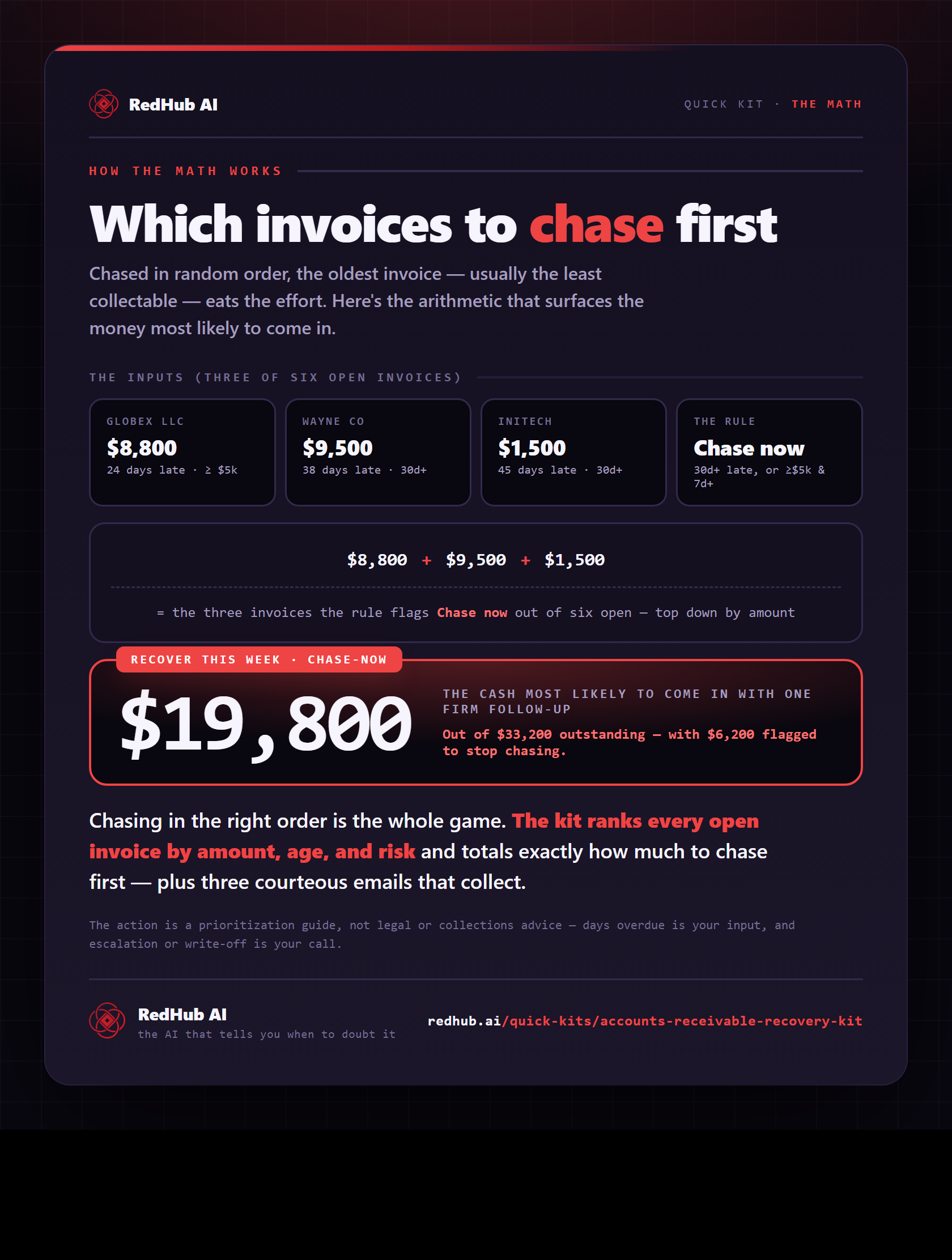
The gate this post refers to, drawn from the tool’s own logic. See the tool.