How to Reduce Days Sales Outstanding (DSO)
Todd Brooks, Founderupdated July 22, 20266 min read

Jump to a section8
TL;DR
- What it is: Days sales outstanding (DSO) is the average number of days it takes you to collect payment after invoicing.
- Who it's for: Any business that invoices on terms — small firms, agencies, and freelancers doing their own collections. See the RedHub Quick Kits.
- How it works: DSO = (accounts receivable ÷ credit sales) × days in the period. Reduce it with tighter terms, cleaner invoices, easier payment, and a ranked follow-up system.
- Bottom line: Cutting DSO frees cash without selling anything new. Every day you shave off releases one day of sales from other people's bank accounts into yours.
What is days sales outstanding, and how do you reduce it?
Days sales outstanding (DSO) is the average number of days between sending an invoice and getting paid. You calculate it as accounts receivable divided by credit sales, multiplied by the number of days in the period. You reduce days sales outstanding by tightening payment terms, invoicing immediately and correctly, making payment easy, and — the biggest lever for most small businesses — running a consistent, ranked follow-up system on overdue invoices instead of chasing them in random order.
Best for: owners who want the follow-up half of the fix done for them — the Accounts Receivable Recovery Kit ranks the chase list and ships the emails.
If you want to reduce days sales outstanding, start by understanding what the number is really telling you. DSO is not an accounting curiosity. It is the answer to a blunt question: how long does your money sit in your customers' bank accounts after you have earned it? If your terms say Net 30 and your DSO is 52, your customers are taking an extra three weeks of free credit — funded by you.
This post is part of our full guide on how to get customers to pay invoices faster. Here we go deep on the metric itself: the formula, what "good" looks like, and the six levers that actually move it.
The DSO formula
For a given period (a month, a quarter, a year):
DSO = (accounts receivable ÷ total credit sales) × number of days in the period. Use sales made on terms, not cash-at-sale revenue. Example: $45,000 in receivables against $400,000 of annual credit sales is (45,000 ÷ 400,000) × 365 ≈ 41 days.
Run your own numbers here:
DSO calculator: how much cash would a lower DSO free?
Simple period-end estimate — a directional number, not an accounting statement. One day of DSO equals roughly one day of sales in cash.
What's a good DSO?
There is no single healthy number — it depends on your terms and your industry. Two honest benchmarks matter more than any league table:
- Your own terms. If you invoice Net 30, a DSO in the mid-30s means the system works. A DSO of 50+ means a third of your book is running late.
- Your own trend. A DSO drifting up month over month is an early cash-flow warning, even if the absolute number still looks fine.
Payment-practice surveys regularly find that a large share of B2B invoices are paid late, so a gap between terms and DSO is normal. Left unmanaged, it grows.
Six levers that reduce days sales outstanding
- Invoice the same day. The clock starts when the invoice lands, not when the work finishes. Every day between delivery and invoicing is a day of DSO you donated.
- Get the invoice right the first time. Correct contact, PO number, itemized amounts, clear due date. Errors and missing details are the most common legitimate reason invoices stall in approval queues.
- Make paying easy. Add a payment link. Accept the methods your customers actually use. Friction converts directly into days.
- Nudge before the due date. A short, friendly confirmation a few days ahead catches lost or stuck invoices while they are still current.
- Chase overdue invoices in ranked order. Rank by amount, age, and customer risk — and work the chase-now balances top down by amount. This is the single biggest lever for most small firms, and it is the one most skip. The ranking logic is covered in accounts receivable aging: which invoices to chase first.
- Escalate with courtesy, on a schedule. A gentle reminder, then a firm follow-up, then a final notice — polite at every stage, sent on time, every time. The playbook is in how to collect overdue invoices without losing clients.
| Lever | Where the days come from | Effort |
|---|---|---|
| Same-day invoicing | Days lost before the clock even starts | Low — a habit |
| Clean invoices | Approval-queue stalls and re-sends | Low — a checklist |
| Easy payment | Friction between "should pay" and "paid" | Low — one setup |
| Pre-due nudge | Lost and stuck invoices caught early | Low — one email |
| Ranked chasing | The overdue pile, collected in the right order | 30 min/week with a system |
| Scheduled escalation | Silent invoices that would otherwise age out | Low — templates + a calendar |
Key insight: DSO is the scoreboard, not the game. You do not lower it by staring at it. You lower it by fixing the invoice process on the front end and running a ranked, courteous chase system on the back end — then watching the number follow.
The fastest win: collect the chase-now money
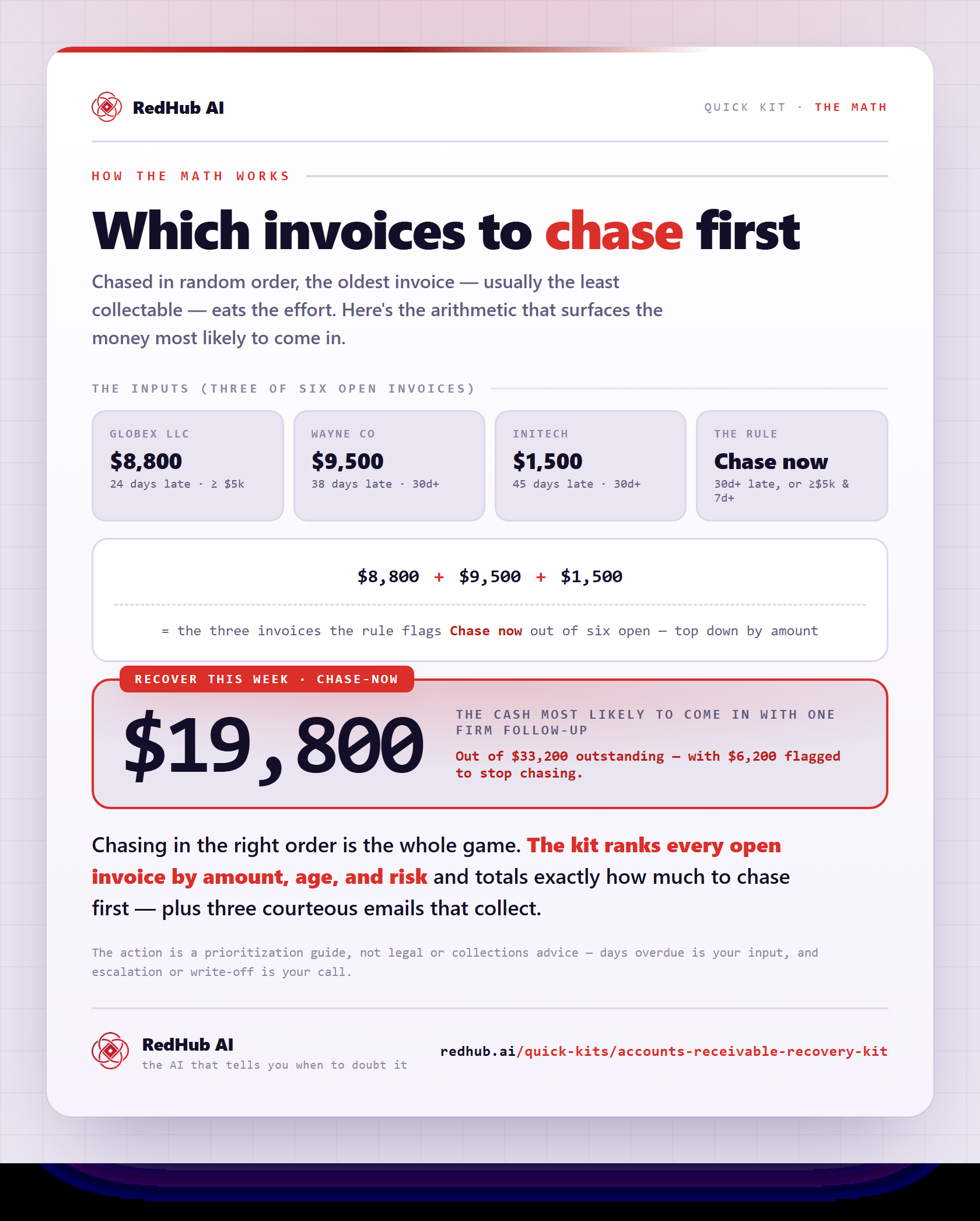
The quickest DSO improvement is not a policy change. It is collecting the overdue balances that are big enough to matter and fresh enough to collect. In the worked example that ships inside the Accounts Receivable Recovery Kit, six open invoices totaling $33,200 sort into $19,800 of chase-now money — recoverable with firm follow-ups this week — and $6,200 flagged for write-off review. Sample figures, not a promise about your book. But that shape — most of the recoverable cash concentrated in a few chase-now invoices — is what most piles look like once they are ranked.
Cut your DSO the direct way: collect what's already owed
The Accounts Receivable Recovery Kit ($39, one-time) ranks every open invoice into Current, Remind, Chase now, or Write-off review, totals your chase-now money, and includes three courteous, escalating chase emails. One .xlsx — Excel, Google Sheets, or Numbers. 30-day guarantee.
Get the AR Recovery Kit — $39 →And once the receivables side is moving, keep an eye on the destination: the Cash-Flow Sentinel watches the cash position and runway that faster collections feed.
Decision Guide
Use this approach if: you invoice on terms, know (or can pull) your receivables balance and credit sales, and your DSO runs meaningfully above your stated terms.
Skip it if: you get paid at the point of sale — you have no DSO to reduce.
Best first step: compute your DSO with the calculator above. If it is 10+ days over your terms, rank your overdue pile and start chasing in order this week.
FAQ
What does DSO mean?
Days sales outstanding — the average number of days it takes to collect payment after invoicing. It is the standard measure of how fast your receivables turn into cash.
How do I calculate days sales outstanding?
DSO = (accounts receivable ÷ total credit sales for the period) × number of days in the period. Use sales made on terms, not point-of-sale revenue.
What is a good DSO for a small business?
Judge it against your own payment terms rather than a universal number. Within about a week of your terms is healthy; 20+ days over your terms means a meaningful share of your book is running late. The trend matters as much as the level.
How much cash does reducing DSO free up?
Roughly one day of credit sales per day of DSO reduction. A business doing $400,000 a year on terms frees about $1,100 in cash for every day of DSO it cuts.
What reduces DSO fastest?
Collecting the overdue balances that are large and recently late — the chase-now money. Ranked, courteous follow-up on those invoices moves DSO faster than any policy change, because the cash arrives this month, not next quarter.
Does offering early-payment discounts lower DSO?
It can, but it costs real margin — a 2% discount for paying 20 days early is expensive credit. Try the free levers first: same-day invoicing, clean invoices, easy payment, and a consistent chase system. Discount only if you still need the days.
The scoreboard moves when the chase list is ranked
Stop chasing invoices in random order. $39, one spreadsheet, three ready-to-send emails — and the full guide lives in how to get customers to pay invoices faster.
Get the AR Recovery Kit — $39 →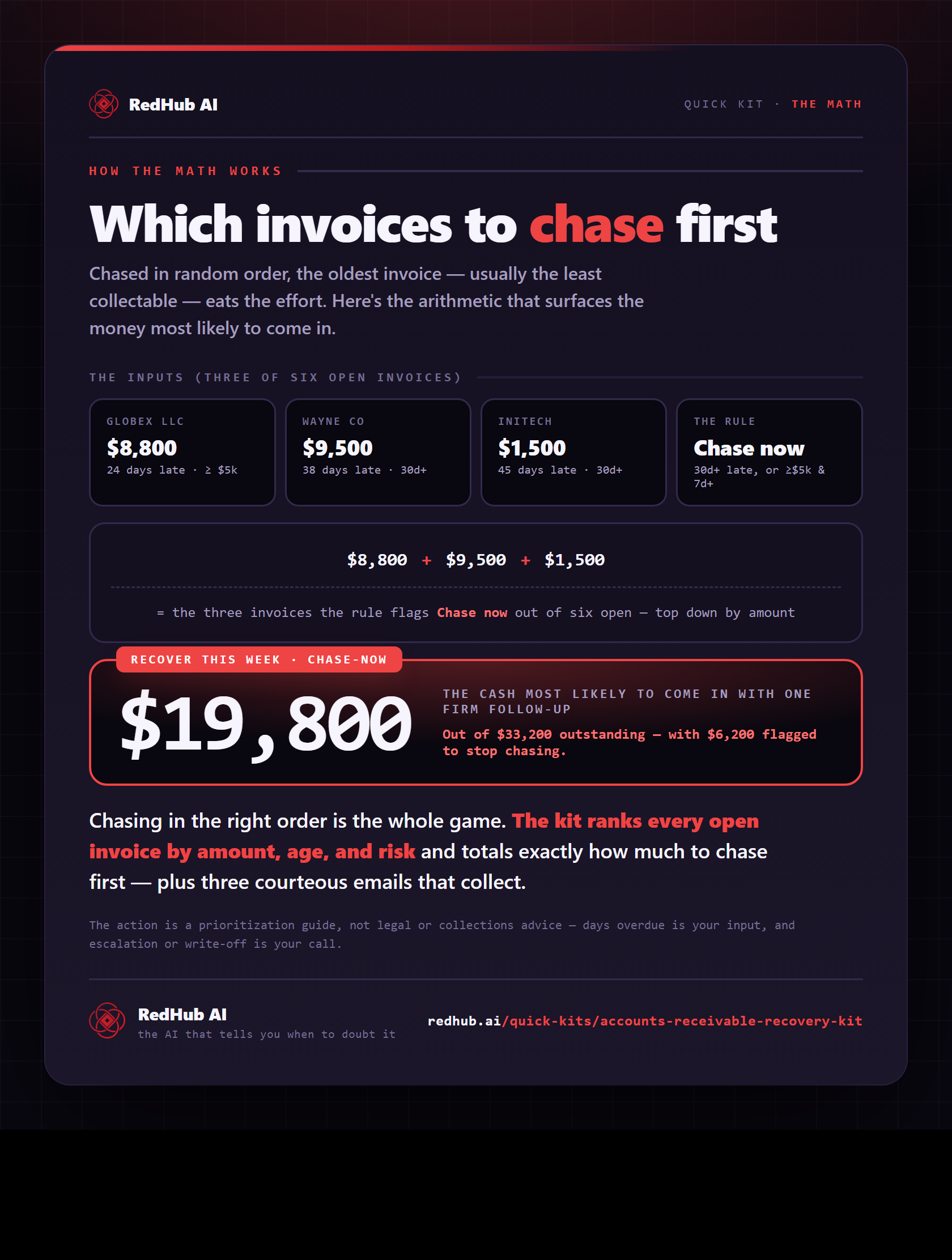
The gate this post refers to, drawn from the tool’s own logic. See the tool.