Payment Reminder Email Templates That Get You Paid
Todd Brooks, Founderupdated July 22, 20266 min read

Jump to a section8
TL;DR
- What it is: A payment reminder email is a short, specific message that moves an unpaid invoice to the top of the customer's pile.
- Who it's for: Small businesses, agencies, and freelancers chasing their own invoices — see the RedHub Quick Kits.
- How it works: Three stages — gentle reminder, firm follow-up, final notice — each naming the invoice number, amount, and days overdue, with a payment link and one clear ask.
- Bottom line: Courtesy plus specificity collects. Vague "checking in" emails get ignored; threats get silence. Specific, polite, on a schedule wins.
What should a payment reminder email say?
A payment reminder email should name the invoice number, the exact amount, the due date (and days overdue, if late), and one clear ask — with the invoice attached and a payment link included. Keep it short, courteous, and factual. As an invoice ages, escalate through three stages: a gentle reminder just after the due date, a firm follow-up with a specific pay-by date once it is meaningfully late, and a calm final notice before you escalate further. The tone hardens; the courtesy never drops.
Best for: owners who want the full escalating set ready to send — the Accounts Receivable Recovery Kit ships all three, plus the ranked chase list that tells you who gets which.
Most payment reminder emails fail for one of two reasons. They are so vague the customer can ignore them ("just circling back on that invoice…"), or so aggressive the customer goes quiet. The fix is the same in both cases: be specific, be courteous, and escalate on a schedule. This post gives you the structure and a working skeleton for each of the three stages. It is part of our full guide on how to get customers to pay invoices faster.
The anatomy of a reminder that gets paid
Every effective payment reminder email — at any stage — has five parts:
- A subject line that names the thing. "Invoice #1042 — $4,800, due June 30" beats "Following up." The subject alone should let the customer find and pay the invoice.
- The facts, up front. Invoice number, amount, due date, days overdue. No wind-up paragraph.
- An easy path to pay. Attach the invoice again and include the payment link. Never make them search.
- One clear ask. A question ("Can you confirm when this will be paid?") or a date ("We need payment by Friday, August 1"). Questions demand answers; statements get archived.
- An open door. One line inviting them to flag any problem with the invoice. It surfaces disputes early — the silent dispute is the one that ages your receivable to death.
The three stages, with templates
Which stage an invoice gets depends on where it sits in your ranked pile — recently overdue and modest gets a reminder; over 30 days late (or large and more than a week late) gets the firm follow-up; the very old balances get the final notice. The ranking logic is in accounts receivable aging: which invoices to chase first. Here is the skeleton of each message:
When: a few days past due, modest balance. Tone: friendly — assume the invoice got lost or stuck.
Subject: Invoice #[number] — friendly reminder ($[amount], due [date])
Hi [name] — a quick note that invoice #[number] for $[amount] was due on [date]. I've attached it again with the payment link for convenience. If it's already in your payment queue, no action needed — and if anything on it looks off, just let me know and I'll sort it out. Thanks!
When: over 30 days late, or a large balance more than a week late. Tone: direct, still polite.
Subject: Invoice #[number] — $[amount], now [X] days overdue
Hi [name] — invoice #[number] for $[amount] is now [X] days past its [date] due date. Can you confirm when this will be paid? We'd like to receive payment by [specific date]. The invoice and payment link are attached. If there's an issue holding this up, tell me and we'll resolve it — otherwise I'll look for your confirmation this week.
When: very late — the write-off review zone. Tone: calm, factual, clear about what happens next.
Subject: Final notice — invoice #[number], $[amount], [X] days overdue
Hi [name] — despite previous reminders, invoice #[number] for $[amount] remains unpaid, now [X] days past due. If we don't receive payment or hear from you by [date], we'll have to [next step — e.g., pause work / refer the balance for collection]. We'd much rather resolve this directly — the payment link is attached, and I'm available to discuss any concerns this week.
Skeletons to adapt, not legal language. What you promise in a final notice — late fees, collections, pausing work — has to match your agreed terms, and escalation steps can carry legal implications. When in doubt, get professional input. The full when-to-stop playbook is in how to collect overdue invoices without losing clients.
Timing: the schedule matters as much as the words
| Moment | Message | Why then |
|---|---|---|
| 3–5 days before due | Pre-due nudge ("confirming this is queued") | Catches lost/stuck invoices while still current |
| 3–7 days overdue | Gentle reminder | Most invoices clear here — it was just buried |
| 30+ days overdue (or big + 7 days) | Firm follow-up, specific pay-by date | The invoice is now a priority, and your email should say so |
| Very late (90–120+ days) | Final notice | Last message before a deliberate escalate/settle/stop decision |
Key insight: consistency is the multiplier. One perfectly-worded email sent randomly collects less than three decent emails sent on schedule, every time, to the right invoices. Customers learn whether your due dates are real from your behavior, not your wording.
Five mistakes that get reminders ignored
- Vagueness. "Checking in on that invoice" gives the reader nothing to act on and no reason to act now.
- Apologizing for asking. "So sorry to bother you about this…" frames your own invoice as an imposition. It is not.
- Making them hunt. No attachment, no link, no invoice number — every minute of friction is a day of delay.
- Skipping stages. Jumping from silence to threats converts a process problem into a conflict, and burns accounts you wanted to keep.
- Sending to the wrong pile. Perfect emails aimed at the least collectable invoices still collect nothing. Rank first, then write.
All three emails, plus the list that tells you who gets which
The Accounts Receivable Recovery Kit ($39, one-time) ships the gentle reminder, firm follow-up, and final notice — courteous, specific, fill-the-brackets-and-send — inside a spreadsheet that ranks every open invoice into Current, Remind, Chase now, or Write-off review and totals the chase-now money you can recover this week. Excel, Google Sheets, or Numbers. 30-day guarantee.
Get the AR Recovery Kit — $39 →Decision Guide
Use these templates if: you chase your own invoices by email and want a repeatable sequence instead of writing each message from scratch.
Skip them if: the account is already in dispute or legal territory — that conversation needs specifics, not a template.
Best first step: pick your largest recently-late invoice and send it the firm follow-up today, with a specific pay-by date and the payment link attached.
FAQ
What should I write in a payment reminder email?
The invoice number, exact amount, due date, and days overdue — plus the attached invoice, a payment link, and one clear ask (a confirmation question or a specific pay-by date). Short, courteous, factual.
How do I politely remind a customer to pay an invoice?
Assume good faith and be specific: "Invoice #1042 for $4,800 was due June 30 — attaching it again with the payment link. Let me know if anything looks off." Polite and specific beats apologetic and vague.
How many payment reminders should I send?
Three overdue-stage messages is the standard sequence: gentle reminder, firm follow-up, final notice. After the final notice, more emails rarely help — the invoice needs a deliberate decision: escalate, settle, or write off.
When should I send the first reminder?
Within 3–7 days of the due date — plus, ideally, a friendly pre-due nudge a few days before. Fast, consistent follow-up teaches customers your due dates are real.
Should a payment reminder threaten late fees or collections?
Not in the early stages. Consequences belong in the final notice only, stated calmly and only if they match your agreed terms — and escalation steps can carry legal implications worth professional input. Threats before then mostly buy silence, not payment.
Do email reminders really work, or do I need to call?
Email collects most of what is collectable, because most late invoices are lost, stuck, or deprioritized — not refused. A phone call is a good addition for large balances after a firm follow-up goes unanswered; the email trail still matters if things escalate.
Stop writing collection emails from a blank page
$39 once: the three-stage email set and the ranked chase list that aims it. The full system lives in how to get customers to pay invoices faster.
Get the AR Recovery Kit — $39 →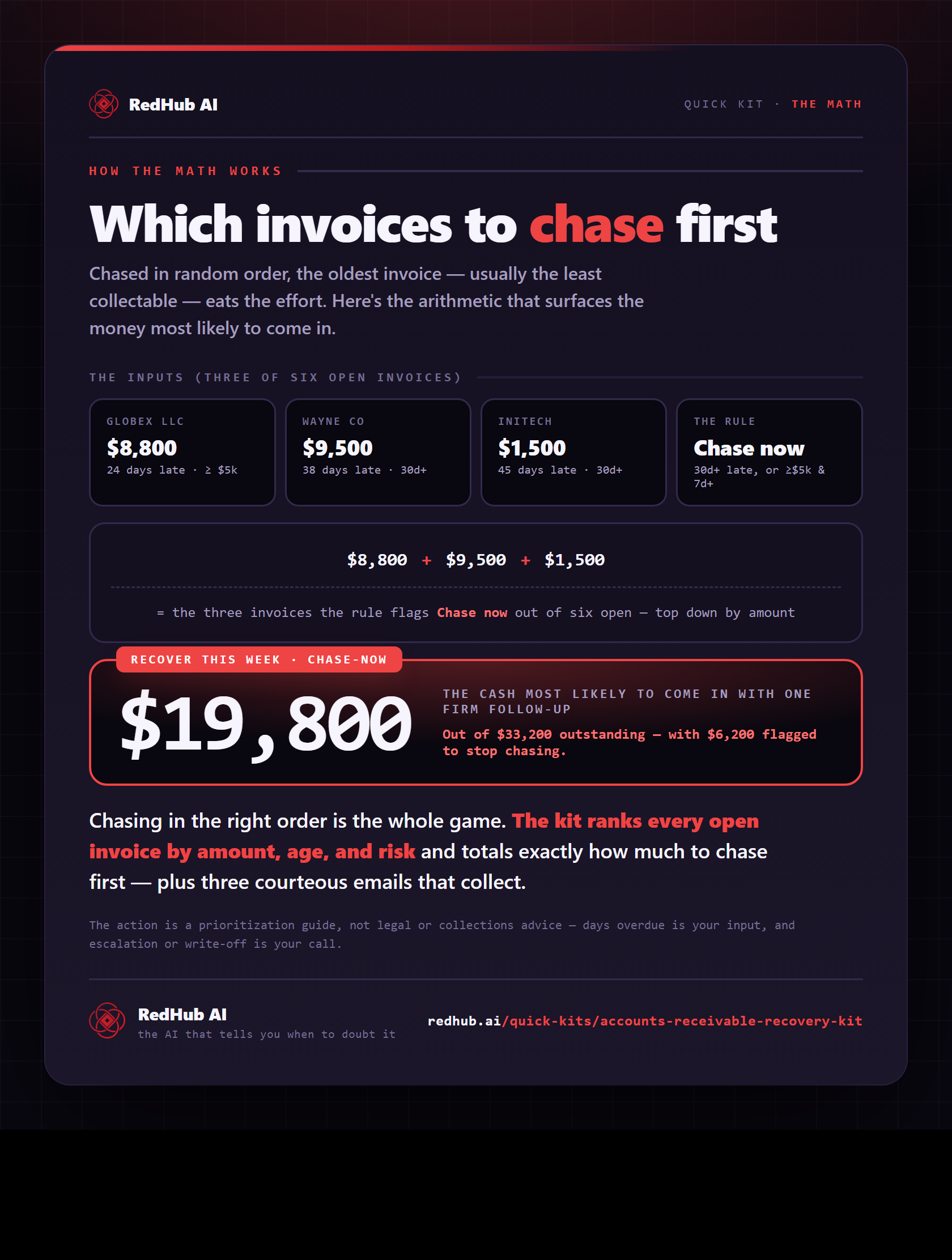
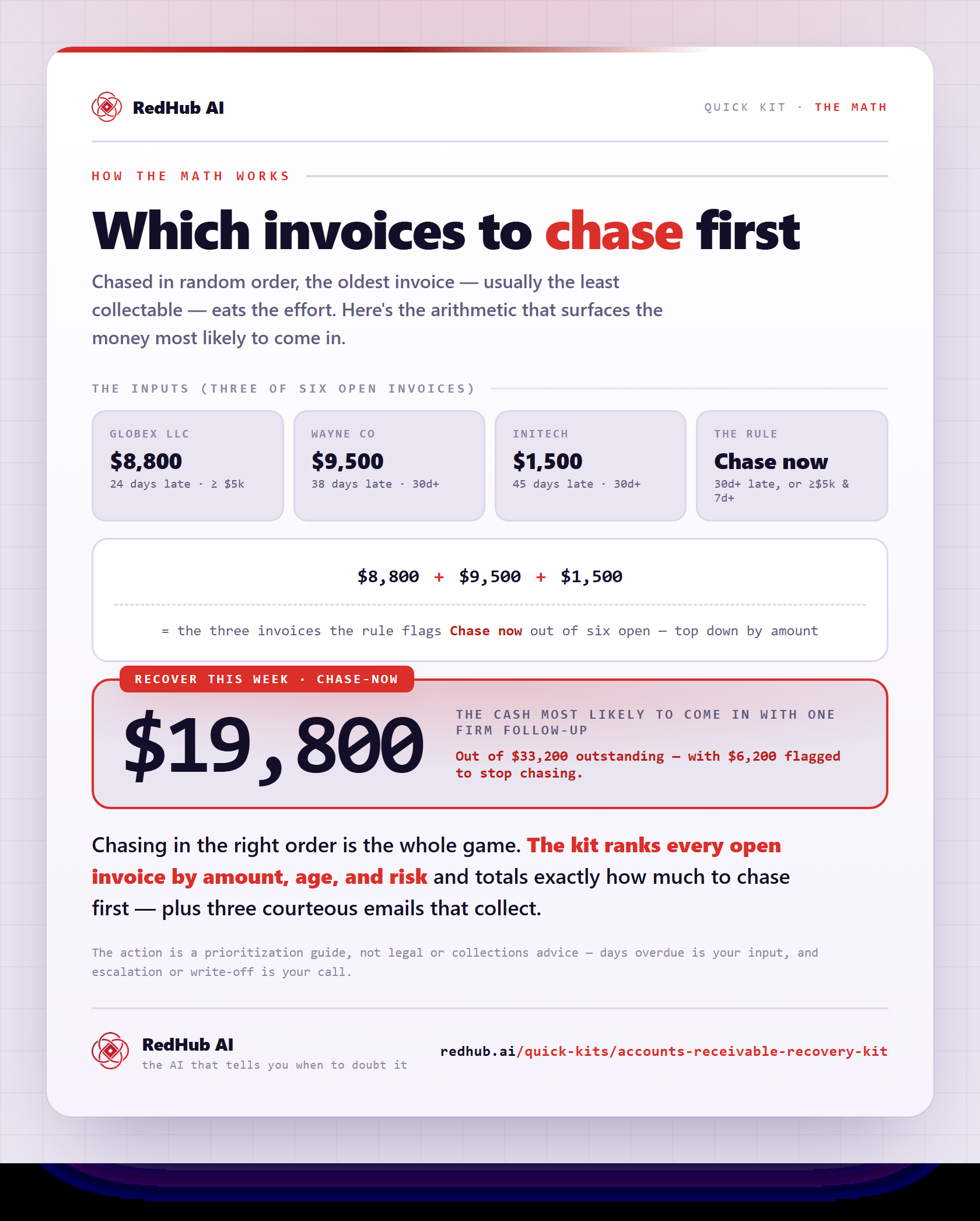
The gate this post refers to, drawn from the tool’s own logic. See the tool.