How to Repurpose a Podcast Episode (Without Burning a Whole Day)
RedHub AI Editorialupdated October 7, 20266 min read

Jump to a section9
How to repurpose a podcast comes down to two decisions, made in order. First: is this episode ready to go out at all? Second: which moments in it are worth reusing? Clips, audiograms, quote cards and show notes all come from the moments you marked, so the marks set the ceiling. A lively interview might give you seven. A quiet solo episode might give you two, and a plan for two is the right plan for that episode.
TL;DR: Score the episode Publish, Tighten or Hold before you repurpose anything, and treat bad audio as a hard stop. Then mark the moments that stand on their own and build only from those. In the Podcast Production & Repurposing Engine ($79), clips, audiograms and quote cards are capped by your marks, clips are also capped at one per 8 minutes, and chapters follow the runtime. Four deep dives cover the parts: cutting clips, show notes, the weekly workflow and audiograms.
Why a good episode ends up as one feed entry
Most shows publish on schedule and stop there. The reason is rarely laziness. Repurposing by hand means listening to the whole episode again, noting timestamps, cutting audio, writing captions and drafting notes. No single task is hard. Together they are a job nobody scheduled, so it moves to next week, and next week has its own episode.
A second problem sits upstream. Some episodes should not have gone out as recorded. If the guest's mic clipped for forty minutes, ten clips cut from it are ten copies of the same clipping. So the order matters: readiness first, repurposing second.
First decision: is the episode ready?
A verdict you can repeat needs fixed criteria. The Engine scores six, each from 0 to 5, with weights that add up to 100.
| Criterion | Weight |
|---|---|
| Audio is clean: levels, noise, no clipping | 25 |
| Strong open in the first 30 seconds | 20 |
| Clear structure and segments | 15 |
| Tight edit: dead air and rambles cut | 15 |
| At least 3 clip-worthy moments | 15 |
| Show notes and chapters drafted | 10 |
A total of 75 or more is Publish. From 55 to under 75 is Tighten. Below 55 is Hold. On a Tighten or a Hold, the Engine lists the two lowest-scoring criteria so you fix those and skip another full edit pass. On a Publish it lists nothing.
Second decision: which moments stand alone?
Once the episode clears, go through it and write down a timestamp for each moment that works without the minutes around it: a firm opinion, a story with an ending, one piece of advice someone could act on. That list is your raw material. A clip, an audiogram or a quote card each needs one of those timestamps behind it, which means nothing gets invented to make the output look bigger.
The Engine's planner hands you slots to fill with a timestamp. It does not write quotes. Our post on repurposing video content across platforms covers the same idea for video-first shows.
What sets the count for each format
Each format has its own rule in the planner, and only some depend on your marks.
| Format | How the Engine counts it | Guide |
|---|---|---|
| Short clips | The lower of your marked moments and one per 8 minutes of runtime | Turning One Podcast Episode Into Short Clips |
| Audiograms | One per marked moment, up to 3 | Audiograms: How to Promote a Podcast on Social |
| Quote cards | One per marked moment | Audiograms: How to Promote a Podcast on Social |
| Show notes | One per episode | Writing Podcast Show Notes That Do Their Job |
| Chapters | One per 10 minutes of runtime, never fewer than 3 | A Podcast Production Workflow You Can Repeat |
Chapters and show notes come from the runtime and the transcript. A 20-minute episode with no marked moments still gets a plan for show notes and three chapters, and no clips at all.
A 55-minute panel with seven marks
Take an illustrative episode: two co-hosts, 55 minutes, seven moments marked. Scored 4 on audio, open, structure, edit and notes, and 5 on clip-worthy moments, it totals 83 and gets a Publish. With clips, audiograms, quote cards, show notes and chapters switched on, the planner returns 22 assets: 6 clips, 3 audiograms, 7 quote cards, 1 set of show notes and 5 chapters.
Seven marks, six clips. Fifty-five minutes divided by 8 rounds down to 6, so the seventh moment gets no clip. The rule exists to stop you slicing filler out of a long recording, and on most episodes it never binds. On a dense panel it can hold back a moment that deserved a cut. The seventh mark still gets a quote card, and nothing stops you cutting the clip anyway. Whether one clip per 8 minutes is the right ceiling for a fast two-host show is a fair question, and the planner does not settle it for you.
The cap runs the other way far more often. In the sample that ships with the Engine, a 75-minute Q&A has two marked moments, and the plan is two clips, not nine.
A held episode still gets a plan
The Engine prints a repurposing plan under every verdict, including Hold. In the same sample, a 24-minute solo episode scores 54 out of 100 with audio at 1 out of 5. The audio gate trips, and directly under the Hold sits a plan for 10 assets, labeled "repurpose after PUBLISH". Read that plan as what you build after the fix. Cutting ten assets from audio the scorer just refused to pass spreads the defect across ten posts.
Where podcast repurposing stops
The Engine is a readiness scorer and a planner, plus five Claude skills that draft show notes, chapters, clip ranges, audiogram quotes and titles from a transcript you paste in. It does not transcribe, host or edit audio. You bring the transcript and you make the cuts. A written blog companion to the episode is one of its optional formats, but tuning that text for search is a different job. Our AI content repurposing workflow walks through that side.
Score the episode, then plan what it can give you
The Podcast Production & Repurposing Engine scores an episode on six weighted criteria and returns Publish, Tighten or Hold, with a hard gate on audio. Then it plans clips, audiograms, quote cards, show notes and chapters from the runtime and the moments you marked. You get a Python engine, a workbook with the same math, five Claude skills and two playbooks. Lifetime access, 12 months of updates.
Get the Podcast Production & Repurposing Engine — $79Pairs well with
The AEO-Aware Content Repurposing System ($79) takes the written companion from here: it turns one anchor asset into pieces for each channel, with a readiness scorer that returns Ship, Tighten or Rework. The Organic Social & Short-Form Video System ($79) is the creation layer for short video, with content pillars, a hook scorer and a posting cadence. The Brand Voice Engine ($59) turns your voice into a written spec, so show notes and captions drafted by a model still sound like the host.
More in this guide
How do I repurpose a podcast episode?
Decide first whether the episode is ready, with a Publish, Tighten or Hold verdict and a hard stop on bad audio. Then mark the moments that stand on their own and build clips, audiograms, quote cards and show notes from those marks.
How many clips should I get from one episode?
No more than the moments you marked. The Podcast Production & Repurposing Engine also caps clips at one per 8 minutes of runtime, so a 55-minute episode with seven marks gets a plan for six clips, and a 75-minute episode with two marks gets a plan for two.
What happens if an episode has great content and bad audio?
It is held. In the Engine, a clean-audio score of 1 or 0 out of 5 caps the verdict at Hold whatever the total is. An episode can total 80 out of 100 and still be held on audio alone.
Does a repurposing plan write the quotes for me?
No. The Engine's planner returns counts and slots to fill with timestamps you marked. Its drafting skills work from a transcript you paste in and leave a marked gap where a link or detail is not in the episode.
Do chapters depend on the moments I marked?
No. The planner counts chapters from runtime: one per 10 minutes, with a minimum of three. Clips, audiograms and quote cards are the formats capped by your marks.
Is the Engine a transcription or editing tool?
No. It scores readiness and plans the asset set, and its skills draft from a transcript. You supply the transcript and do the audio editing in your own tools.
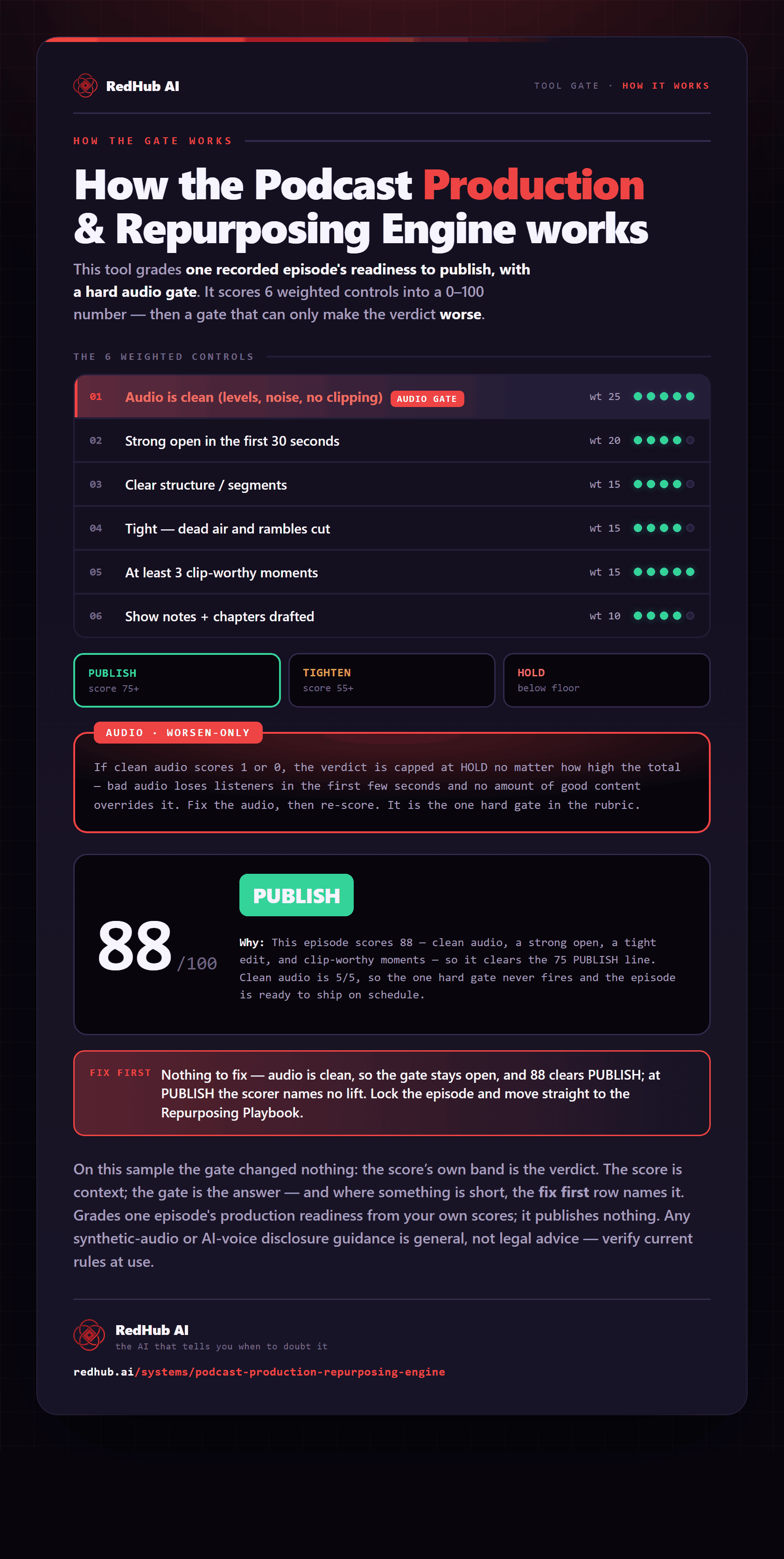
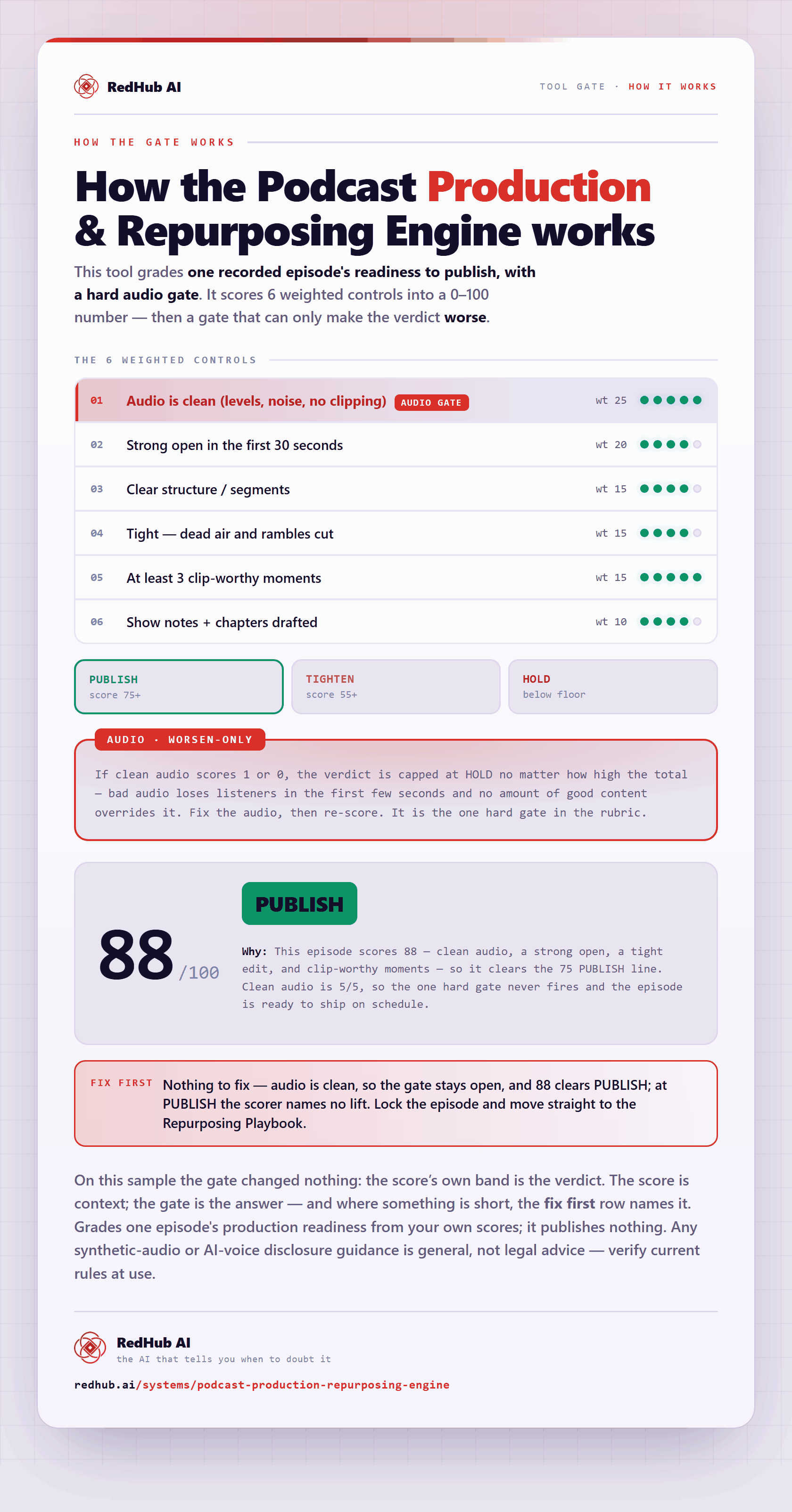
The gate this post refers to, drawn from the tool’s own logic. See the tool.