A Podcast Production Workflow You Can Repeat
RedHub AI Editorialupdated October 7, 20266 min read

Jump to a section8
A podcast production workflow is repeatable when the same episode would get the same verdict on a tired Friday as on a fresh Monday. That takes three steps in a fixed order: score the episode against written criteria, act on the verdict, then repurpose the moments you marked. The tools matter less than the order. A show can own every tool it needs and still have no rule for "ready."
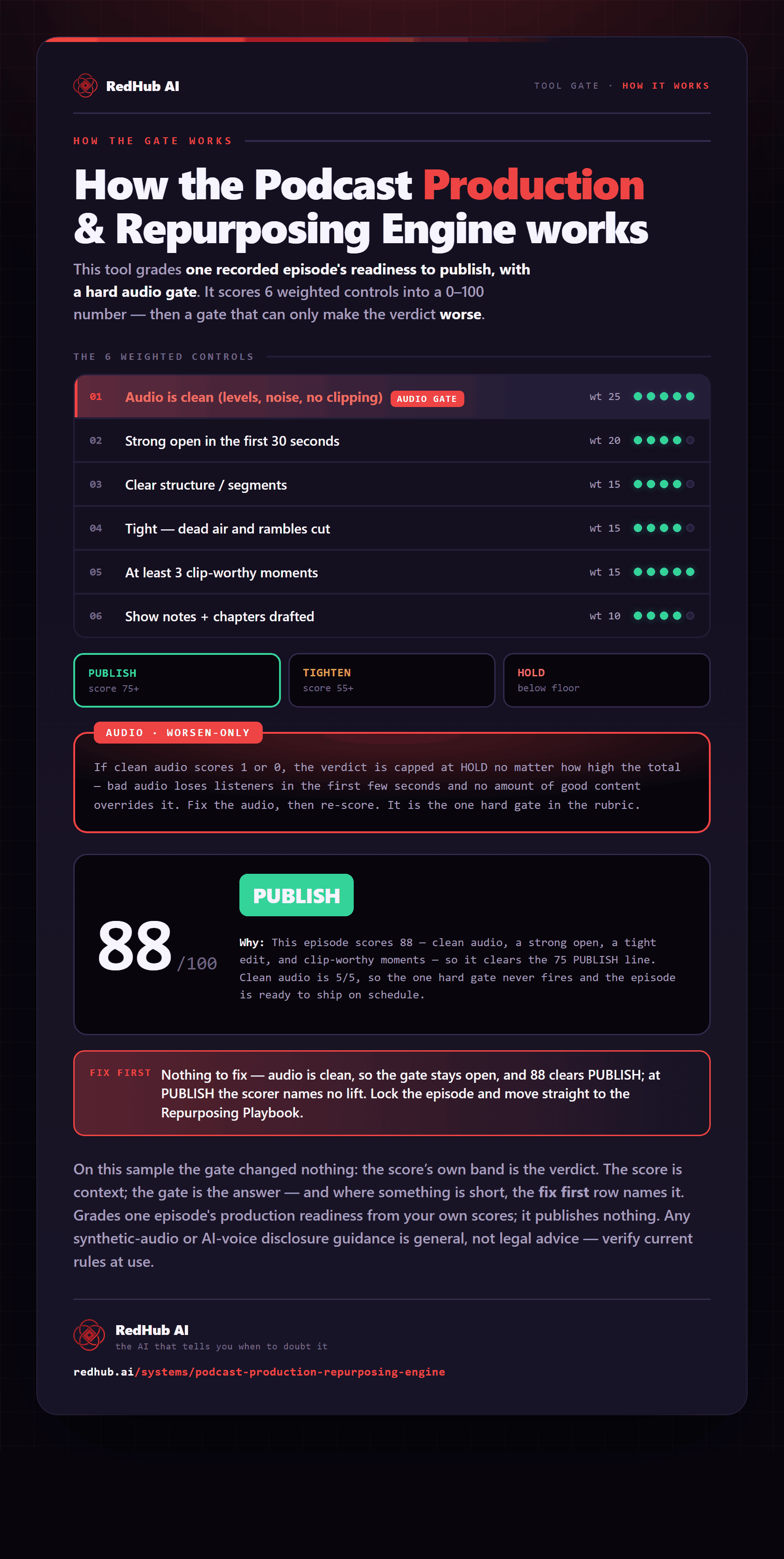
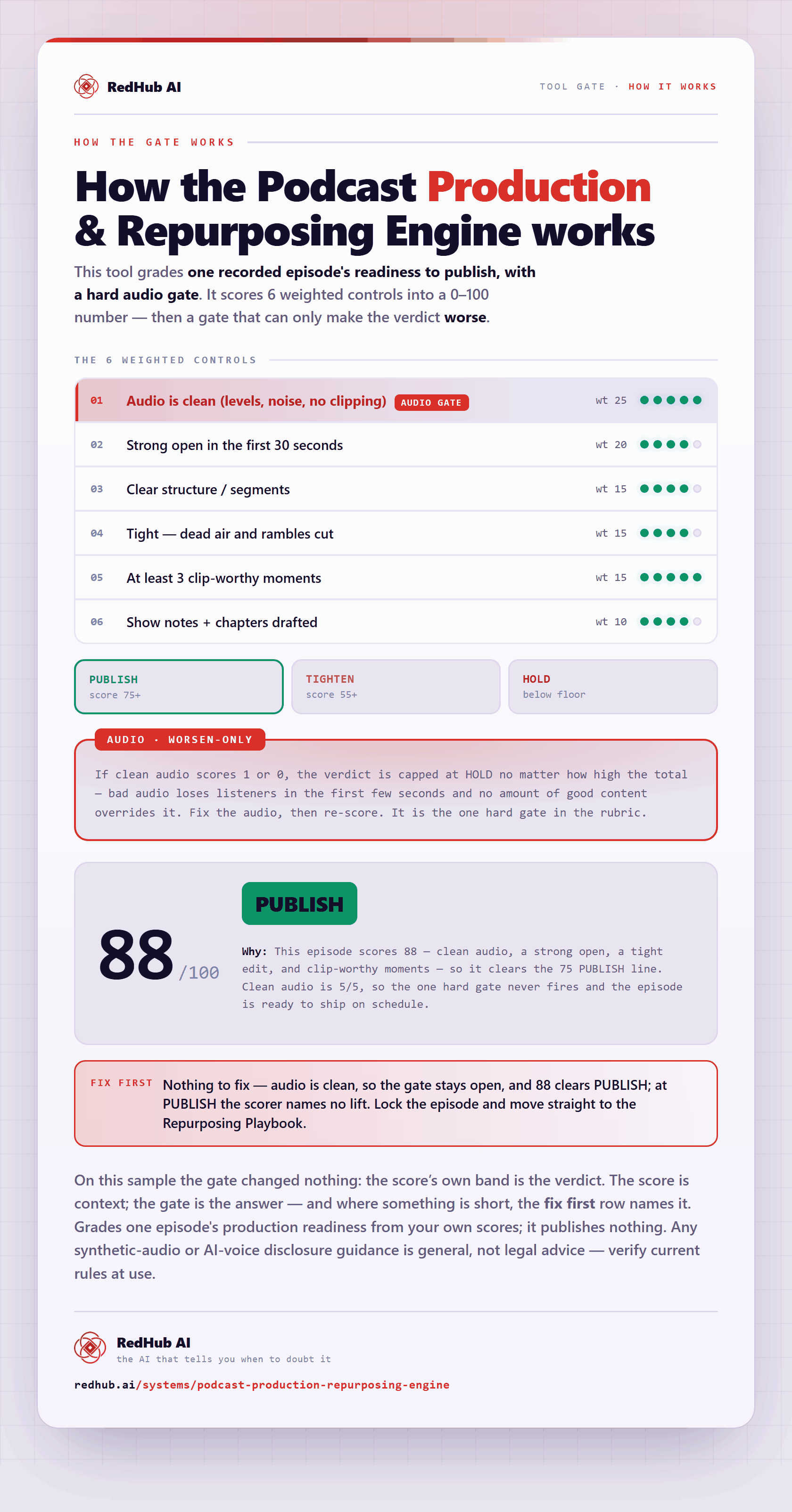
TL;DR: Score, act, repurpose. Score six criteria from 0 to 5 for a total out of 100: Publish at 75 or more, Tighten from 55 to under 75, Hold below 55. Clean audio scoring 1 or 0 forces a Hold. Fix what the verdict points at, then build assets from your marks. The Podcast Production & Repurposing Engine ($79) runs the scoring and the plan. The gate is only as strict as the score you give your own audio. Start with How to Repurpose a Podcast Episode.
What goes wrong without a rule
A new show runs on energy. Record, edit a bit, publish, clip it if there is time. By the tenth episode the pattern shows. Some episodes have show notes and some do not. One was re-edited three times and another went out with a guest who sounded like a phone call. Nobody decided any of that. It happened because "is this ready?" got a different answer depending on the week.
The three steps
- Score the episode. After the first edit pass, rate six things from 0 to 5: clean audio, the open in the first 30 seconds, structure, how tight the edit is, clip-worthy moments, and whether notes and chapters are drafted. Mark your clip-worthy moments with a timestamp during this pass, since you are listening anyway.
- Act on the verdict. Publish means lock it and ship. Tighten means fix the lowest-scoring criteria and score again. Hold means a core element needs real work before the episode goes out.
- Repurpose from your marks. Once the episode is locked, plan the clips, audiograms, show notes and chapters from the runtime and the moments you flagged in step one.
The Engine's playbook adds one habit after these: log the score, so you can see whether your production quality is trending up or down across a season.
Four episodes, one process
The Engine ships with a four-episode sample. Run it and this is what comes back.
| Episode | Score | Verdict | What the report says to lift |
|---|---|---|---|
| Ep 41, pricing your first deal, 48 min | 88 | Publish | Nothing |
| Ep 42, guest interview, 62 min | 66 | Tighten | Notes and chapters (2 of 5), the open (3 of 5) |
| Ep 43, quick solo, 24 min | 54 | Hold | Audio (1 of 5), then structure (3 of 5) |
| Ep 44, rambly Q&A, 75 min | 40 | Hold | The edit (1 of 5), notes and chapters (1 of 5) |
Episode 42 is the useful one. It is a decent interview, and the report does not say "make it better." It names two things: draft the notes and fix the first 30 seconds. That is a job with a known end, which is different from a fourth edit pass.
The report names something to lift only on a Tighten or a Hold. Episode 41 gets a Publish and no fix list.
The audio gate, and its soft edge
Clean audio carries 25 of the 100 points, the largest weight. It also has a rule no other criterion has: a score of 1 or 0 caps the verdict at Hold. Score the audio 1 and everything else a perfect 5, and the total is 80. The verdict is Hold.
Now move the audio score up one notch. Audio at 2, everything else at 5, totals 85 and gets a Publish. One point separates the two verdicts, and you are the one who assigns it.
Two habits help. Write one line for your show on what a 1 sounds like and what a 2 sounds like, with an example episode for each. And when two people produce, have the one who did not edit the episode score the audio. Neither removes the judgment. A fixed scale makes two people's judgments easier to compare.
A plan appears under a Hold too
The Engine prints a repurposing plan under every verdict. Episode 43 is held on audio and still shows a plan for 10 assets, labeled "repurpose after PUBLISH". The playbook's order is clear: on a Publish, lock the episode and move to repurposing. So treat a plan under a Hold as a preview of what the fix will earn you.
Old episodes are a different job
This workflow runs on each new episode. Going back through sixty old ones is an audit, and it needs its own pass. If your episodes are also on YouTube, our post on running a channel audit shows how to find the few back-catalog videos worth another look.
Give every episode the same test
The Podcast Production & Repurposing Engine scores six weighted criteria and returns Publish, Tighten or Hold, with a hard gate on audio. On a Tighten or a Hold it lists the two lowest-scoring criteria. Then it plans the asset set from the runtime and your marked moments. It runs offline as a Python script or as a workbook with the same formulas.
Get the Podcast Production & Repurposing Engine — $79Pairs well with
The Channel Audit & Back-Catalog Optimizer ($49) is for shows with a YouTube channel: one spreadsheet that ranks your existing videos Refresh, Leave or Retire against your own medians. The AEO-Aware Content Repurposing System ($79) picks up the written companion to an episode. The Organic Social & Short-Form Video System ($79) turns a pile of clips into a cadence, with content pillars and a hook scorer.
More in this guide
What does a repeatable podcast production workflow look like?
Three steps in the same order for every episode: score it against written criteria for a Publish, Tighten or Hold verdict, act on that verdict, then repurpose the moments you marked. The criteria do not change from one episode to the next.
What scores mean Publish, Tighten and Hold?
In the Podcast Production & Repurposing Engine, six criteria scored 0 to 5 are weighted to a total out of 100. A total of 75 or more is Publish, 55 to under 75 is Tighten, and below 55 is Hold.
Why does audio get a hard gate?
Because a strong total can hide it. With audio at 1 and every other criterion at 5, the total is 80, which would be a Publish on points. The gate caps that episode at Hold until the audio is fixed.
Can the audio gate be fooled?
Yes, by a generous score. The Engine reads the number you enter and does not analyze the audio file. An audio score of 2 with everything else at 5 totals 85 and gets a Publish, so the gate depends on scoring a real defect as a 1.
What is the difference between Tighten and Hold?
Tighten means the episode is close: fix the lowest-scoring criteria and score it again. Hold means a core element, often audio or structure, needs real work before the episode goes out.
How do two producers stay consistent?
Use one written scale with an example episode for each audio score, and have the person who did not edit the episode score the audio. That will not make two people agree every time. It makes the disagreements visible.
The gate this post refers to, drawn from the tool’s own logic. See the tool.