Audiograms: How to Promote a Podcast on Social
RedHub AI Editorialupdated October 7, 20265 min read

Jump to a section8
Audiograms are short pieces of podcast audio with a moving waveform and captions laid over a still background. They let an audio-only show post something that plays in a video feed without filming anyone. You make one from a moment you already marked in the episode, a line that makes sense alone, and the work is mostly choosing. A good audiogram is the right 40 seconds with clean sound and readable captions.
TL;DR: Pick the line, check how it sounds alone, caption it. The Podcast Production & Repurposing Engine ($79) plans one audiogram per marked moment and stops at three per episode, however many moments you marked. An episode can pass on audio as a whole and still have a moment that fails once it is isolated, so listen to each pick by itself. The full sequence is in How to Repurpose a Podcast Episode.
What you are building
Three layers. The audio, cut to one complete thought. A waveform that moves with the voice. Captions, so the line reads with the sound off. The background is usually the show's cover art or the guest's name. The waveform and the captions are generated from the audio and a transcript, which is why this takes less time than editing a video of someone talking.
Audiogram or clip?
Both start from the same marked moment. If you recorded video and the speaker's face adds something, cut a clip. If the show is audio-only, or the moment is all in the voice, make an audiogram. The Engine's repurposing playbook routes them to different places: clips to TikTok, Reels and Shorts, and audiograms to Instagram, LinkedIn and X. For a show with no camera, audiograms are the clips.
Which moments work
- A line that reads well as text. The caption does half the job. A sentence full of "you know" and restarts looks worse written down than it sounded.
- A voice doing something. A laugh, a pause, a change of pace. The waveform moves with it, and a flat read gives a flat picture.
- One complete thought. The Engine's clip-finder skill looks for moments that stand alone in 30 to 60 seconds, and that range suits an audiogram too.
The audiogram skill in the Engine picks quotes word for word from your transcript, with a timestamp and a note on the surrounding context. It is told never to choose a line that only lands without its qualifier. Say a guest's line is "I'd never hire an agency, at that stage, with that budget." Cut it after the fourth word and the guest said something else.
Why the plan stops at three
The Engine's rule for audiograms is the lower of your marked moments and 3. Mark two and you get two. Mark nine and you get three. The reasoning in its configuration is short: audiograms are work, so plan up to three of the best.
Take an illustrative 30-minute solo episode with four marked moments and audio scored 3 out of 5. With the other criteria at 4, it totals 75 and gets a Publish. With clips, audiograms, quote cards, show notes and chapters switched on, the plan is 14 assets: 3 clips, 3 audiograms, 4 quote cards, 1 set of show notes and 3 chapters. Four marks, three audiograms. One mark is a spare, and you will want it in a minute.
A moment can fail alone
That episode passed. A 3 on audio is a middling score, and across 30 minutes a light room hum sits under everything and nobody minds. Now export the first pick as a 40-second audiogram. There is no music bed and no second voice. The hum is plainly there.
If one of the three fails that test, swap in the spare fourth moment, or run a noise pass on the clip. The moment you dropped is still good for a quote card, which is text only, and for the show notes.
How much hum is too much has no fixed answer here. The Engine's gate trips at an audio score of 1 or 0 for the episode. For a single isolated moment, the call is yours, and it will depend on your show: listeners forgive a field recording things they would not forgive from a studio.
After the audiogram exists
Building it is production work. Deciding how often to post, what the first line on screen should be, and how the same moment gets reused next month is strategy. Our post on short-form video strategy covers that side.
Plan the audiograms an episode can support
The Podcast Production & Repurposing Engine scores an episode Publish, Tighten or Hold with a hard gate on audio, then plans up to three audiograms from the moments you marked, alongside clips, quote cards, show notes and chapters. Its audiogram skill picks word-for-word quotes from your transcript with timestamps. It does not render the audiogram; you build that in your own tool.
Get the Podcast Production & Repurposing Engine — $79Pairs well with
The Organic Social & Short-Form Video System ($79) scores an opening line Ship, Tighten or Rework and gives you content pillars and a cadence to post against. The Brand Voice Engine ($59) writes your voice down as a spec, so the post text around each audiogram sounds like the show. If you also upload full episodes to YouTube, the YouTube Packaging & Retention Engine ($99) diagnoses each video SHIP, TIGHTEN or REWORK against your own channel baseline.
More in this guide
What is a podcast audiogram?
A short piece of podcast audio shown with a moving waveform and captions over a still background. It lets an audio-only show post in video feeds without filming anyone.
How many audiograms should I make from one episode?
One per strong moment, and no more than three. The Podcast Production & Repurposing Engine plans the lower of your marked moments and 3, so two marks give two audiograms and nine marks give three.
Do audiograms work for shows without video?
Yes. An audiogram needs audio, a waveform and captions, and no footage of the speaker. For an audio-only show it does the job a video clip does for a filmed one.
Can an episode pass on audio and still make a bad audiogram?
Yes. A readiness score rates the whole episode. A hum that goes unnoticed across 30 minutes can be obvious in a 40-second clip with nothing else playing, so listen to each pick alone before you build it.
What is the difference between an audiogram and a short clip?
A clip is edited video, usually with the speaker on camera. An audiogram's picture is generated from the audio and the captions. Both come from the same marked moment.
Does the Engine make the audiogram file?
No. It plans how many to make and its skill picks the quotes from your transcript. You render the audiogram in a tool of your choice.
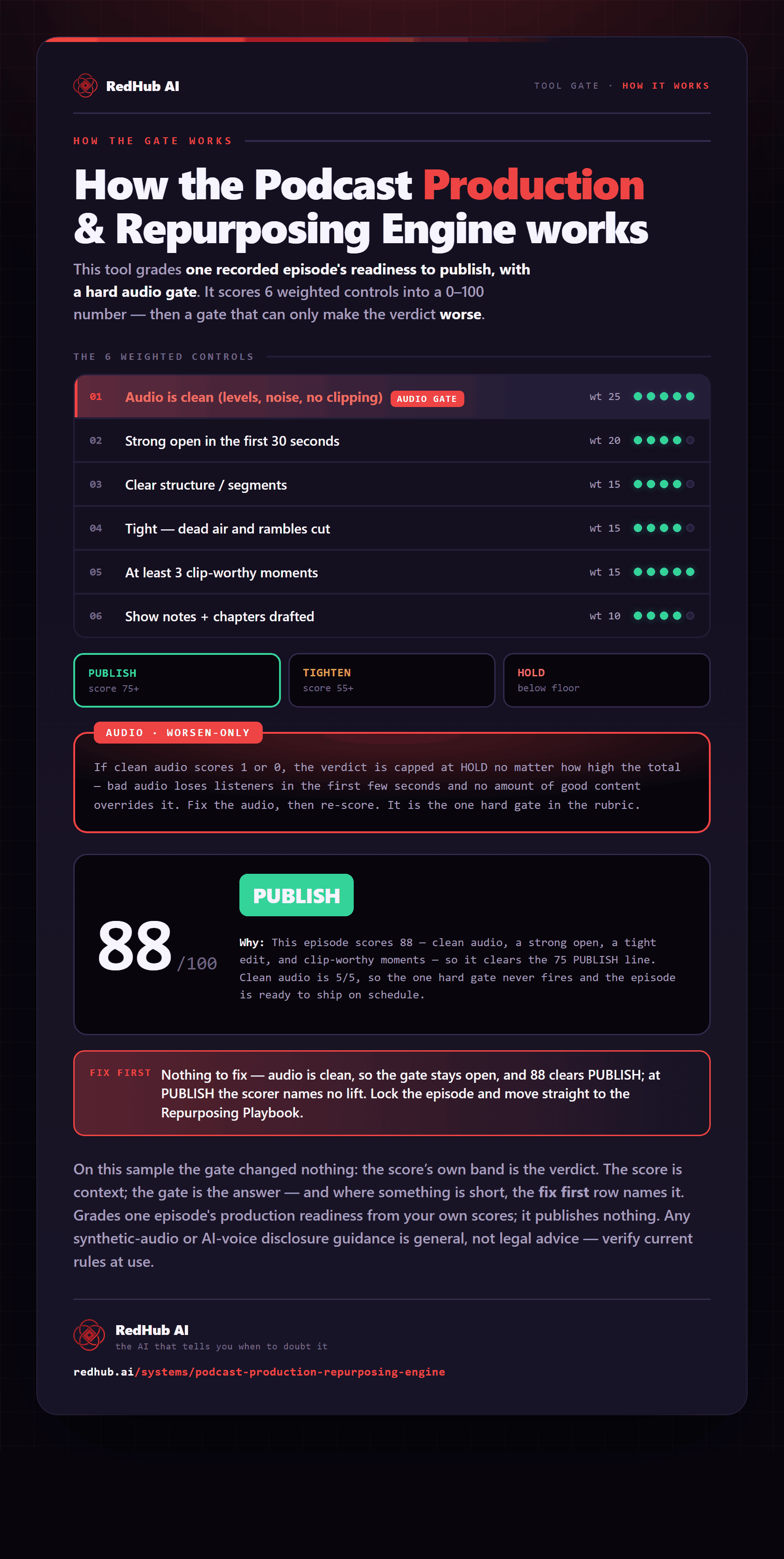
The gate this post refers to, drawn from the tool’s own logic. See the tool.