Writing Podcast Show Notes That Do Their Job
RedHub AI Editorialupdated October 7, 20265 min read

Jump to a section7
Podcast show notes have two readers. One is deciding whether to press play. The other will never listen and only wants the point, the timestamp or the link the guest mentioned. Notes serve both when they are drafted from the transcript: a short summary, timestamped chapters, a few takeaways and the links that were said out loud. Notes written from memory on publish day tend to be three sentences and a guest bio.
TL;DR: Good show notes are a second, written version of the episode. Build them from the transcript and the moments you marked, and leave out anything the episode did not say. The show-notes skill in the Podcast Production & Repurposing Engine ($79) drafts them from a transcript you paste in and leaves a marked gap wherever a link or detail is missing. For the full sequence, read How to Repurpose a Podcast Episode.
What goes in
The skill's output has six parts, and they make a sound checklist whether or not a model writes the draft.
- A summary of 2 to 3 sentences, specific enough that a reader can tell if the episode is for them.
- Timestamped chapters, each titled for what the segment covers.
- Key takeaways, 3 to 6 bullets.
- A guest bio and links, when there is a guest.
- Resources and tools mentioned in the episode.
- A subscribe or next-step line.
The moments you marked for clips feed the takeaways. If you flagged a timestamp for a story at 14:20, that story is a bullet, and the reader can jump to it.
What stays out
Anything the episode did not say. A related book the guest never named, a statistic you remember from somewhere else, a link added because it fits the topic. The skill is told to pull every fact, name and link from the transcript. Where a detail is missing it writes a slot such as [ADD: link] for you to fill, so the draft arrives with holes.
Those holes are the draft working as intended. A guest says "the pricing book I mentioned" and never gives the title. A model that fills that in is guessing. A slot sends you back to the audio or to the guest.
Notes for a 35-minute episode
Take an illustrative 35-minute episode on pricing with three marked moments: a common mistake, a client who undercharged for years, and one fix. Enter 35 minutes and three marks with show notes and chapters switched on, and the Engine plans one set of notes and three chapters.
The finished notes are a two-sentence summary, three timestamped chapters, three takeaways that match the three marks, and one resource line with an [ADD: link] slot because the guest named a tool without a URL. That is a complete write-up. A ten-bullet list padded with general pricing advice would describe an episode nobody recorded.
Notes are scored before publish, and missing notes do not stop it
The Engine's readiness scorer has six criteria, and "show notes and chapters drafted" is one of them, worth 10 of the 100 points. So notes are meant to exist before the episode goes out.
The weight is small, and that has a consequence. Score an episode a perfect 5 on the other five criteria and 0 on notes, and the total is 90, a clear Publish. The scorer will not hold an episode because the notes are missing. Clean audio is the only criterion that can force a Hold by itself. If you want notes to be mandatory on your show, that is a rule you add yourself. Whether notes deserve a gate of their own depends on how much of your audience reads and never listens, and most shows do not know that number.
Search, and what the platforms already do
Show notes used to be the only text attached to an episode. That has changed on at least one large platform. Apple's podcaster support page (opens in a new tab) says Apple "automatically generates transcripts after a new episode is published," and that listeners can search an episode for a word or phrase. So the notes are no longer the only words a listener can search.
They are still the words on a page you control: your site, your host's episode page, a YouTube description. Write them to describe the episode accurately and they will carry the right topic language without any stuffing. Adding keywords for topics the episode skipped sets up a reader to be disappointed in minute two.
[mm:ss — ADD] for you to fill from the audio.Draft notes that only say what the episode said
The Podcast Production & Repurposing Engine includes a show-notes skill and a chapter-marker skill for Claude. Both work from your transcript, and both leave a marked slot where a link, timestamp or detail is missing. The same kit scores the episode Publish, Tighten or Hold and plans the rest of the asset set.
Get the Podcast Production & Repurposing Engine — $79Pairs well with
The Brand Voice Engine ($59) writes your voice down as a spec a model can follow, which is what the show-notes skill asks for when it says to write in the host's voice. Our post on what brand voice is explains the idea. The AEO-Aware Content Repurposing System ($79) is where a full written companion to the episode goes to be structured for search and answer engines. If your older blog posts are the bigger problem, the Content Refresh & Publishing Engine ($129) grades a WordPress library and sorts each post from REFRESH NOW to REWRITE OR RETIRE.
More in this guide
What should podcast show notes include?
A summary of 2 to 3 sentences, timestamped chapters, 3 to 6 key takeaways, a guest bio and links when there is a guest, the resources mentioned in the episode, and a subscribe or next-step line.
How long should show notes be?
As long as the episode supports. A focused episode with three marked moments needs three takeaways and three chapters. Padding the notes past what was said describes a different episode from the one a listener will hear.
Do show notes still matter if platforms generate transcripts?
Yes. Apple says it automatically generates transcripts for new episodes, so notes are no longer the only searchable text. They remain the summary on pages you control, and the fastest way for a reader to decide whether to listen.
Should show notes include timestamps?
Yes. Take them from the transcript. If the transcript has no timestamps, mark each chapter as a gap and fill it from the audio. A guessed timestamp sends the listener to the wrong place.
Can a model write my show notes?
It can draft them from a transcript. The show-notes skill in the Podcast Production & Repurposing Engine is told to pull every fact and link from the transcript and to leave a marked slot where one is missing, so you check and fill the gaps before publishing.
Will the Engine hold an episode that has no show notes?
No. Notes and chapters are one of six readiness criteria, worth 10 of 100 points. An episode can score 0 there and still reach Publish. Clean audio is the only single criterion that forces a Hold.
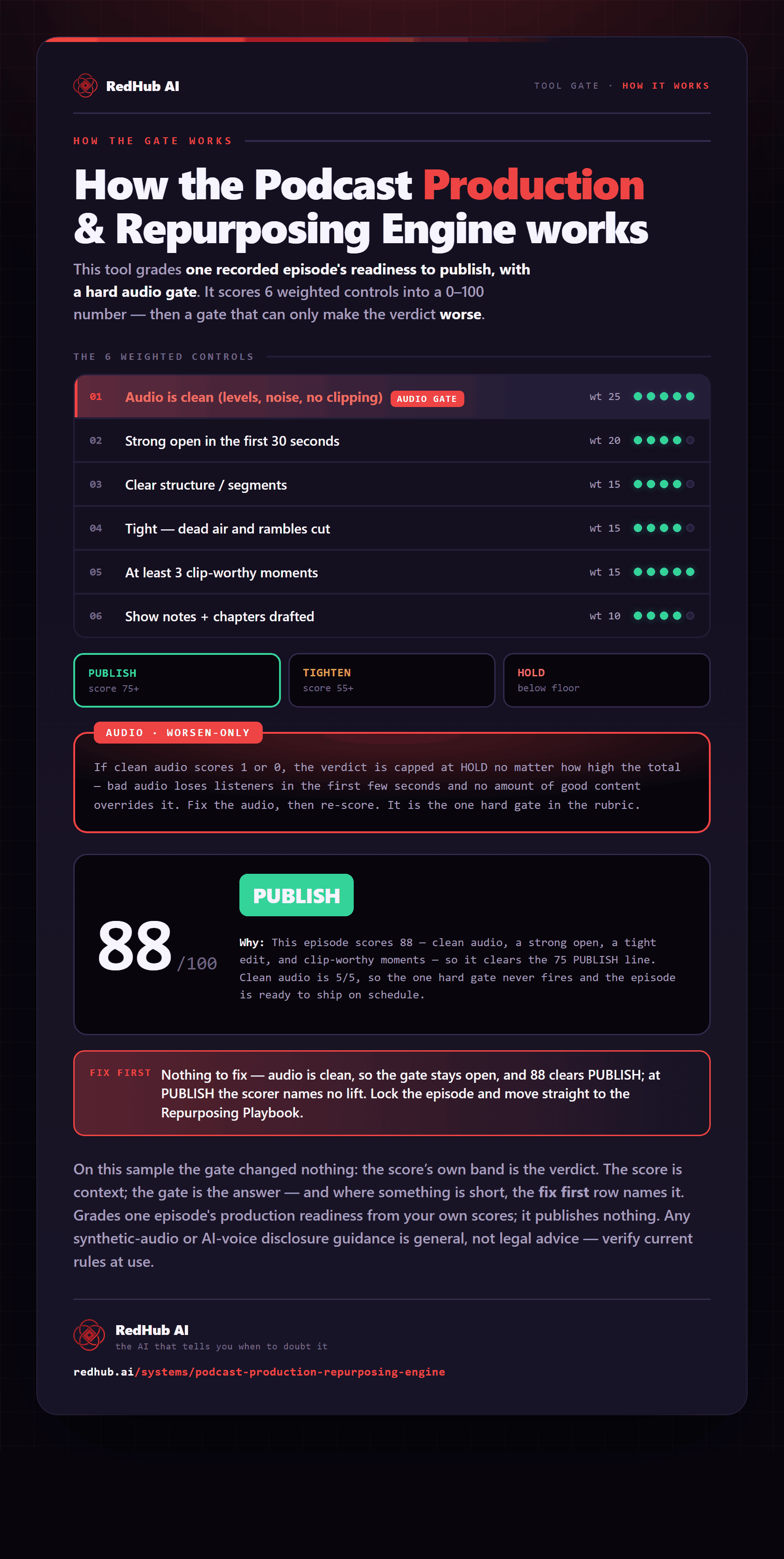
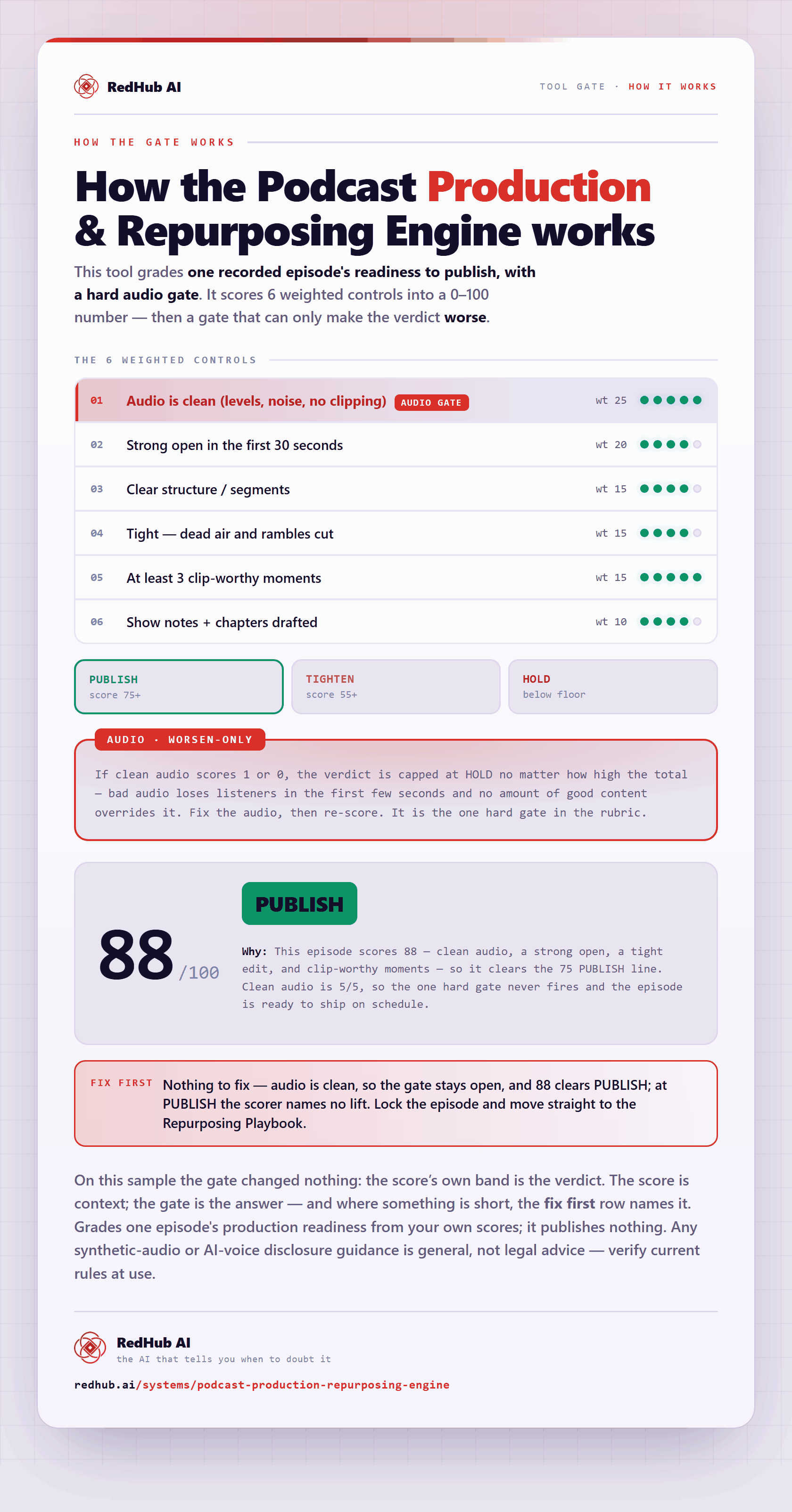
The gate this post refers to, drawn from the tool’s own logic. See the tool.