How to Actually Retain What You Learn
RedHub AI Editorialupdated November 5, 20266 min read

Jump to a section8
Most advice on how to retain what you learn says to study more. The research points somewhere else: test yourself instead of re-reading, spread the reviews out, and keep a dated record so the next review happens. The change is where the time goes, not how much of it you spend.
TL;DR: Retention comes from recalling, not re-reading. In a 2006 study in Psychological Science, students who re-read did better five minutes later, and students who practiced recalling did better a week later. Space the reviews out, and wait before the first one. Then keep a record of when each skill was last reviewed. The Spaced-Repetition AI Skills Tracker ($39) is that record: one spreadsheet that returns FRESH, FADING or COLD for each skill from your own dates. This post is part of Spaced Repetition for Skills You Can't Afford to Forget.
Why finishing a course feels like knowing it
In a 2006 study in Psychological Science (opens in a new tab), students studied prose passages. Some then studied them again. Others took recall tests, with no feedback. Tested five minutes later, the group that restudied did better. Tested two days or a week later, the group that had practiced recalling did substantially better. Restudying had also made students more confident that they would remember.
That is the end of a training day, measured. The material is fresh, it looks familiar, and confidence is high. None of the three tells you what is left next month.
Three habits that hold up
| Habit | What you do | What supports it |
|---|---|---|
| Recall instead of re-reading | Close the notes and produce the answer, or do the task, from memory. | A 2013 review in Psychological Science in the Public Interest rated practice testing high utility and rereading low. |
| Spaced review | Come back after a gap, then after a longer one. | The same review rated distributed practice, meaning study spread over time, high utility. |
| A dated record | Write down when you last reviewed each skill. | No study. This one is bookkeeping: without a date, nothing tells you a review is due. |
The 2013 review (opens in a new tab) rated ten techniques in all. Only those two got the top rating. It also noted that most students report relying on rereading and highlighting, which do not consistently help.
What recall looks like for an AI skill
Recall does not have to mean flashcards. For a prompt you built last month, close the saved version, write it again from memory, then compare the two. For checking output, pull up an old AI answer where you already know what was wrong and see whether you catch the error again. If you can, the skill is holding. If you have to look up the basics, you have learned that it needs a review now.
If you need material to drill on, our post on prompt engineering exercises has five drills to start with.
Where this advice runs out
Both studies used students and study material. A sales lead checking an AI-drafted quote is not a student with a prose passage, and those experiments did not measure that job. The direction probably holds. The size of the effect for your skill is unknown.
The five-minute result also cuts the other way. If you need something for a meeting this afternoon and never again, re-reading may serve you better. Recall practice is for what you still need in three months, and it costs something up front. A recall attempt after a gap is harder than a re-read and feels worse. It is easy to mistake that feeling for the method failing.
Wait before the first review
A 2007 study in the Journal of Experimental Psychology: Learning, Memory, and Cognition (opens in a new tab) compared review schedules for vocabulary word pairs. Delaying the first test improved long-term retention, however the later tests were spaced. The researchers concluded that the important factor was making that first recall difficult.
That argues against the common way of catching up, which is to review a neglected skill three times in one sitting. Three reviews in one sitting give you one gap, not three. It also explains why a flat reminder falls short. A skill you have recalled five times can wait longer than one you learned last week, and a single weekly slot treats them the same. The Leitner system is the box method that gives each skill its own gap, and the forgetting curve explains why the early gap matters most.
Keep the record
The Spaced-Repetition AI Skills Tracker ($39) handles the third habit and none of the studying. Put each skill in a Leitner box from 1 to 5 and log the date you last reviewed it as YYYY-MM-DD. The sheet compares the days since with that box's gap and returns FRESH, FADING or COLD. When a skill is FADING or COLD, the Dashboard names one to review first. When none is and every row was read, it says nothing is due.
It is one spreadsheet. No AI runs and nothing is uploaded. It cannot tell a real recall attempt from a glance at your notes, so the verdict is as good as the dates you log. For which AI skills belong on the list, see how to keep your AI skills sharp.
The dated record, already built
A Leitner box and a last-reviewed date for each skill, and a FRESH, FADING or COLD verdict from the days since. One .xlsx with a worked six-skill example. No AI, nothing uploaded.
Get the Spaced-Repetition AI Skills Tracker — $39Pairs well with
The Tracker tells you a review is due. The Prompt Practice Lab ($69) gives you something to do in it: you write a prompt, score it 0 to 5 on six criteria, and get a band of STRONG, WORKABLE or WEAK. The AI Fluency Diagnostic ($79) comes before either, scoring six AI skills from your own marks so you know where to start. Once a skill holds, the Claude Project Blueprint Library ($79) supplies ten Claude Project blueprints, each with custom instructions, a knowledge-base map and starter prompts.
More in this guide
What is the best way to retain what you learn?
Recall it instead of re-reading it, space the reviews out, and keep a dated record so the reviews happen. A 2013 review in Psychological Science in the Public Interest rated practice testing and distributed practice as the two high-utility study techniques out of ten.
Does re-reading notes help retention?
It helps in the short term. In a 2006 study in Psychological Science, students who restudied did better five minutes later, and students who practiced recalling did better two days and a week later. Restudying also left students more confident that they would remember.
Is reviewing three times in one sitting as good as spacing it out?
Probably not for long-term retention. A 2007 study of vocabulary word pairs found that delaying the first test improved long-term retention. Reviews stacked in one sitting leave no gap between them.
How do I know when a skill needs a review?
Keep the date you last reviewed it and a gap that fits how well it has held. The Spaced-Repetition AI Skills Tracker ($39) turns those two inputs into FRESH, FADING or COLD for each skill.
Does this research apply to work skills?
Not directly. The studies cited here used students and study material such as prose passages and word pairs. Applying them to a work skill is a reasonable extension. The direction probably holds, and the size of the effect is unknown.
Is a tracker enough, or do I need practice too?
You need both. A tracker tells you when a review is due and cannot do the review. The practice is the recall attempt: doing the task from memory and checking the result.
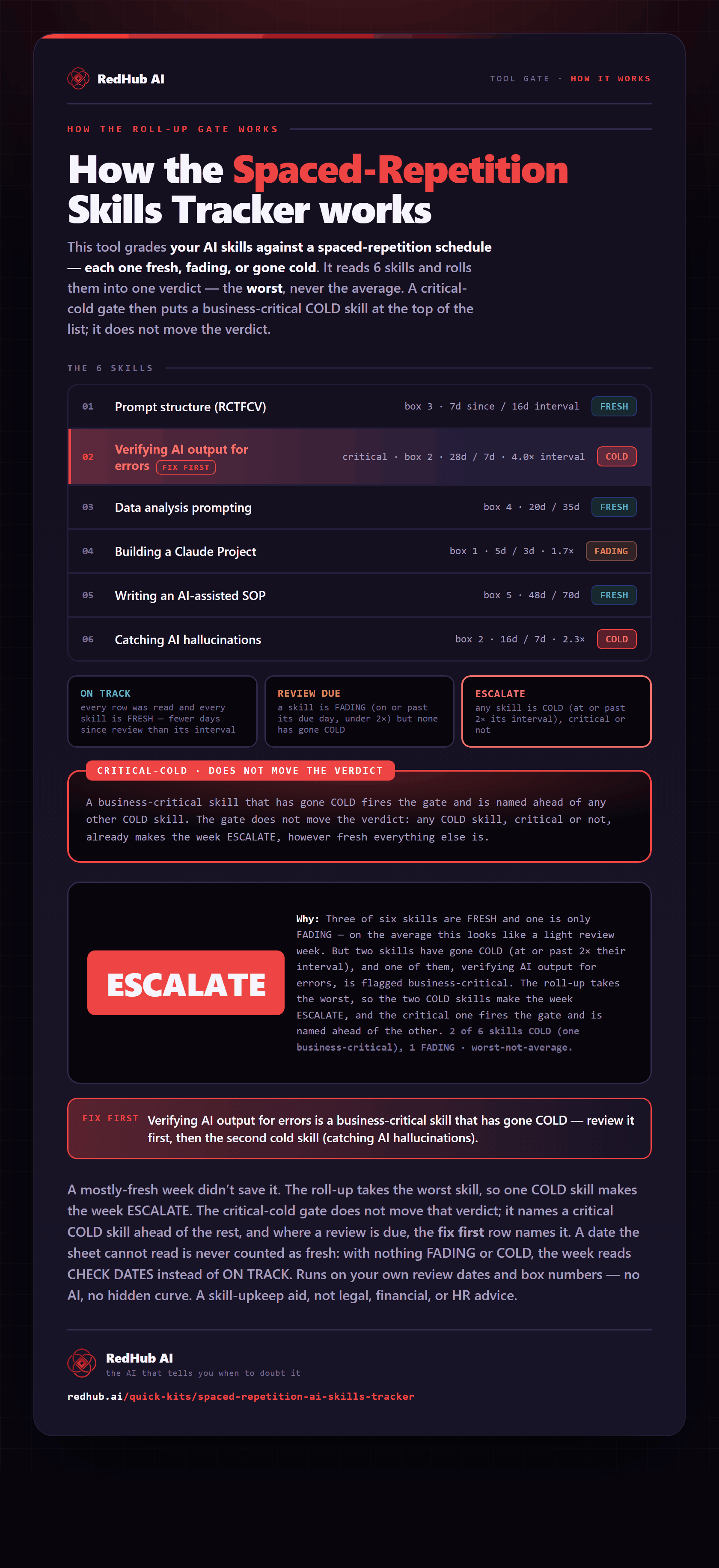
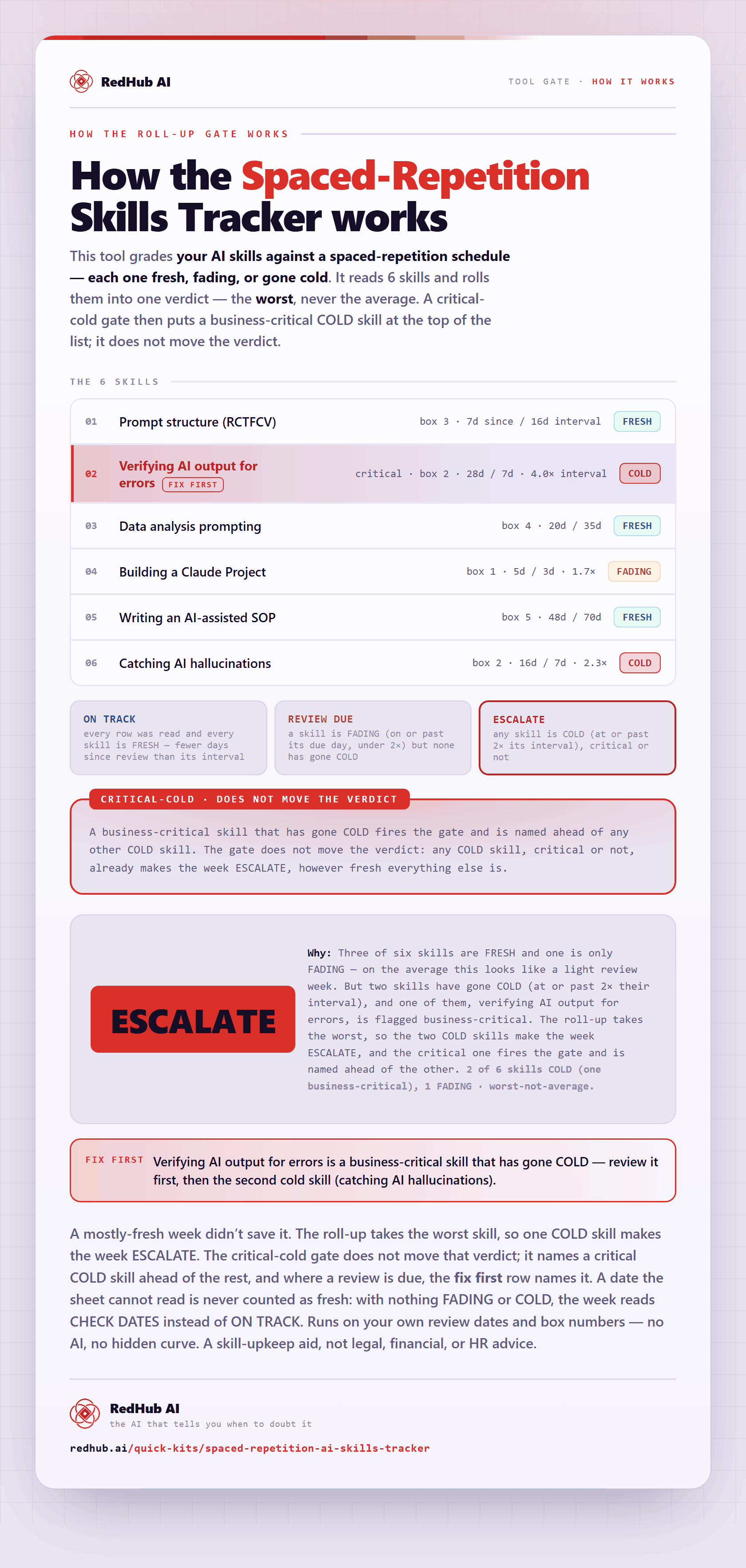
The gate this post refers to, drawn from the tool’s own logic. See the tool.