Spaced Repetition for Skills You Can't Afford to Forget
RedHub AI Editorialupdated November 5, 20267 min read

Jump to a section8
A skill holds when you come back to it on a schedule: a few days after you learn it, then a week or two later, then a month later. That schedule is spaced repetition, and each review that holds earns a longer gap before the next one. The idea is easy to agree with. The hard part, for skills, is knowing which one is due on a given Monday. This guide covers what the research supports, where it stops, and how to run the schedule with boxes and dates instead of an app.
TL;DR: Recall fades fastest right after you stop practicing, and a review before it is gone is the countermeasure. The research behind spacing is strong for recalling facts. For job skills it is a reasonable bet, not a measured result. The Leitner system turns the idea into numbered boxes, each with its own review gap. The Spaced-Repetition AI Skills Tracker ($39) runs five boxes at 3, 7, 16, 35 and 70 days in one spreadsheet and returns FRESH, FADING or COLD for each skill from your own dates. Four posts go deeper: the forgetting curve, how to retain what you learn, the Leitner system and how to keep your AI skills sharp.
Why a skill fades after you learned it
Learning a skill well does not protect it. Recall drops when nothing asks you to produce the skill, and it drops fastest early. That pattern is the forgetting curve. A skill you use every day never meets it, because the job is the review. The exposed skills are the ones you need a few times a year.
The worked example that ships inside the Tracker shows what that looks like. One of its six sample skills is "Verifying AI output for errors." It sits in box 2, which is due every 7 days. Its last review is dated May 20, and the sheet is evaluated on June 17. That is 28 days against a 7-day gap, four times the gap, and the sheet marks it COLD. In the example nobody chose to stop checking AI output. A month went by.
What the research supports
Two findings carry most of the weight. A 2013 review in Psychological Science in the Public Interest (opens in a new tab) rated ten common study techniques. Two were rated high utility: practice testing, and distributed practice, which is the researchers' term for spreading study out over time. Rereading was one of five rated low.
The second finding is about timing. A 2006 meta-analysis in Psychological Bulletin (opens in a new tab) pulled together 839 assessments from 317 experiments on spaced practice. It found that the gap producing the best retention grew as the time people needed to remember grew. That is a reason to use longer gaps for long-term skills. The habits behind both findings are in how to retain what you learn.
Where the evidence stops
The Psychological Bulletin review covered verbal recall tasks, and the 2013 review was written about students. Checking an AI answer for a wrong number is not a recall test, and you are not sitting an exam. Using spaced review for work skills extends the finding past what those studies measured. We think the bet is sound because the cost is one short review. It is still a bet.
The second open question is what counts as reviewing a skill. For a fact, you recall it or you don't. For a skill, our working answer is to do the task cold: close the notes, write the prompt or run the check from memory, then compare the result with an example you trust. Reading your old notes and nodding is closer to rereading, the technique the 2013 review rated low. We have not seen that comparison run on prompt-writing, so treat the rule as ours and not the research's.
Boxes instead of a flat calendar
A flat reminder, such as "review AI skills every Friday," gives a skill you drilled for months the same slot as one you learned last week. The Leitner system fixes that with numbered boxes. A new or shaky skill starts in box 1 and comes up often. Each review that goes well moves it up a box, where the gap is longer. A review that goes badly moves it back down.
The Tracker uses five boxes with gaps of 3, 7, 16, 35 and 70 days. Those numbers are the product's convention, printed on its first tab. They are not a research result, and the workbook has no hidden forgetting formula behind them.
Run it yourself in five steps
- List the rarely used skills. Skip anything the job makes you do daily. Track the ones you need a few times a year.
- Box each one. New or shaky goes in box 1. Something you have drilled for months can start higher.
- Log the real date. Write down the day you last did the skill from memory, not the day you meant to.
- Flag what is critical. Mark the skills where a lapse costs money or trust, such as catching a bad AI output before it reaches a client.
- Review, then update. Do the task cold, log the new date, and move the skill up a box if it held or down a box if it did not.
What the Tracker returns
The Spaced-Repetition AI Skills Tracker ($39) is one .xlsx with three tabs: Start Here, Dashboard and Tracker. For each skill you enter a box from 1 to 5, a last-reviewed date as YYYY-MM-DD, and a yes or no for critical. The sheet counts the days since that review and compares them with the box's gap. A skill is FRESH inside its gap, FADING once it reaches the gap, and COLD at twice the gap.
The Dashboard rolls the skills up to one verdict for the week: ON TRACK, REVIEW DUE or ESCALATE. A fourth result, CHECK DATES, takes the place of ON TRACK when a row could not be read. Any COLD skill makes the week ESCALATE. If that skill is one you flagged as critical, the Dashboard also shows the critical-cold gate as fired and names that skill first in its Review first line. When nothing is FADING or COLD and every row was read, that line says nothing is due.
The evaluation date is a cell you set, not today's date, so a saved file gives the same verdicts every time you open it. No AI runs and nothing is uploaded. The sheet does not teach a skill, grade a review, or score people. It tracks how long it has been.
One spreadsheet for the skills you can't afford to lose
Five Leitner boxes, your own review dates, and a FRESH, FADING or COLD verdict for each skill. One .xlsx with a worked six-skill example. No AI, nothing uploaded.
Get the Spaced-Repetition AI Skills Tracker — $39Pairs well with
The AI Fluency Diagnostic ($79) scores six AI skills from your own 0 to 5 marks and reports the lowest of the six as the headline, which tells you what belongs in box 1. The Prompt Practice Lab ($69) supplies the reps: prompt drills you score against six criteria, on a Leitner schedule of its own that counts sessions instead of calendar days. The Claude Project Blueprint Library ($79) has ten Claude Project blueprints, one per business function, for putting a skill you have kept sharp to work.
More in this guide
What is spaced repetition?
It is a review schedule. You revisit something a few days after learning it, then at longer and longer gaps, and each review that holds earns a longer wait before the next one. The aim is to review before the skill is gone, not after.
Does spaced repetition work for skills, or only for facts?
The strongest research is on recalling facts and study material. A 2006 meta-analysis in Psychological Bulletin covered verbal recall tasks. Using spaced review for work skills extends that finding. We think it is a sound bet because a review is cheap, but it has not been measured the same way.
How is spaced repetition different from a recurring reminder?
A recurring reminder gives every skill the same slot. Spaced repetition gives each skill its own gap, short for new or shaky skills and long for well-drilled ones, and changes the gap after each review. A box system such as the Leitner method is the usual way to track that.
Is the Spaced-Repetition AI Skills Tracker a course or an AI tool?
No. It is one spreadsheet. No AI runs and nothing is uploaded. You enter a Leitner box and a last-reviewed date for each skill, and it returns FRESH, FADING or COLD from your own dates. It does not teach the skill or do the review for you.
What happens when a critical skill goes COLD?
Any COLD skill makes the week's verdict ESCALATE. When the COLD skill is one you flagged as critical, the Dashboard also shows the critical-cold gate as fired and names that skill first to review. Review it, log the new date, and the gate releases.
Do I need this if I already took an AI course?
It depends on how often the job makes you use what the course taught. A skill you use daily needs no tracker. A skill you use a few times a year has nothing bringing you back to it, and that is the case a review schedule is for.
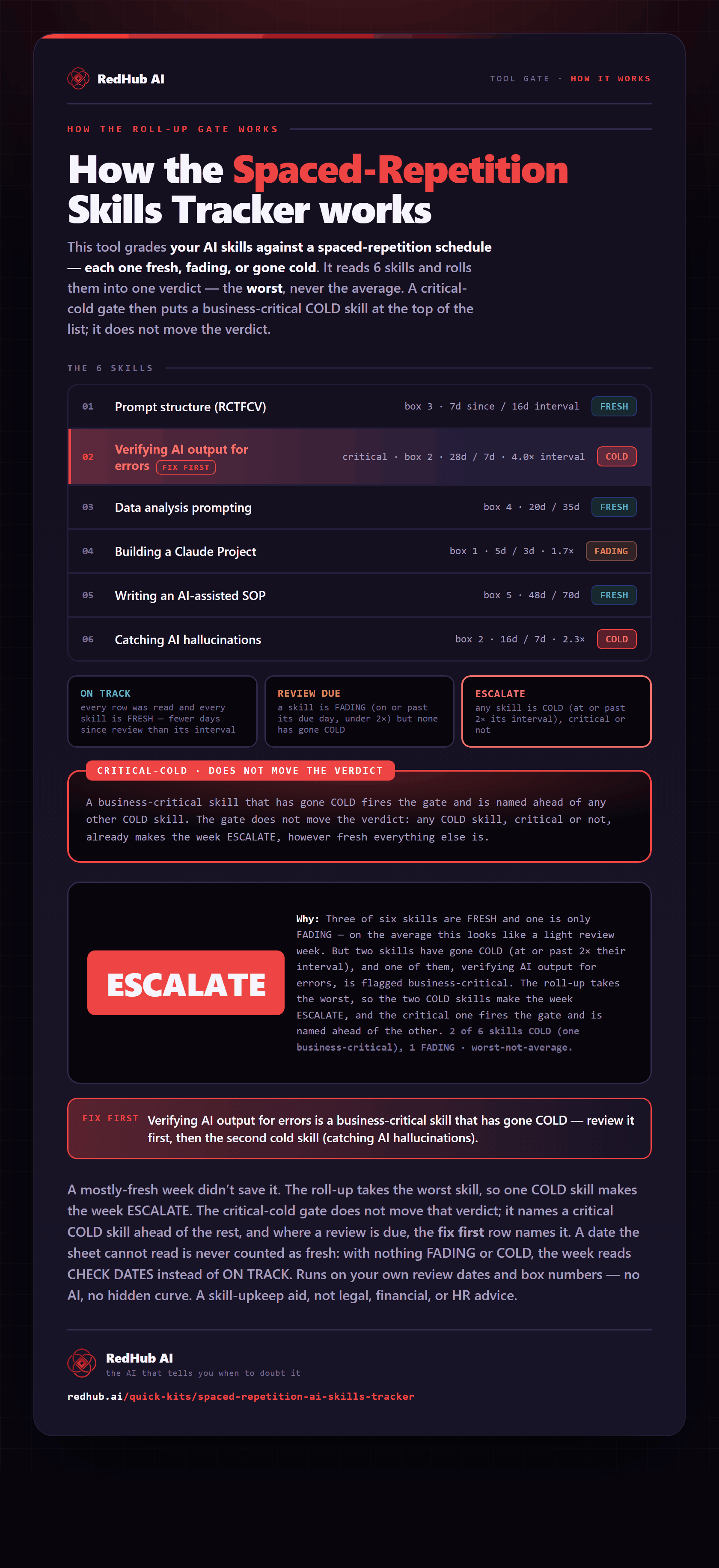
The gate this post refers to, drawn from the tool’s own logic. See the tool.