The Leitner System: Spaced Repetition Without an App
RedHub AI Editorialupdated November 5, 20265 min read

Jump to a section6
The Leitner system is a set of numbered boxes and one rule. Everything you are learning sits in a box, each box has its own review gap, and after every review the item moves up or down. Strong items drift toward long gaps. Weak ones stay where they come up often. It was built for flashcards, and the same rule can run a short list of skills.
TL;DR: In the Leitner system, a low box means frequent review and a high box means rare review. A review that holds moves the item up a box, and one that fails moves it down. The Spaced-Repetition AI Skills Tracker ($39) puts this in one spreadsheet with five boxes at 3, 7, 16, 35 and 70 days. The growing gaps are the least proven part of the method. The sorting is the part that saves you time. This post is part of Spaced Repetition for Skills You Can't Afford to Forget.
How the boxes work
Start everything in box 1. Review box 1 often. When a review goes well, the item moves to box 2, which you review less often, and so on up. When a review goes badly, the item moves back. In the common flashcard version, a missed card goes all the way to box 1. A gentler version moves it back one box. Either works, as long as you pick one and keep to it.
The result is a sort that maintains itself. Compare it with a flat reminder such as "review AI skills every Friday." The reminder gives a skill you have drilled for months the same slot as one you learned last week. You either waste Fridays on what you know or under-review what you don't. The boxes route the attention without a decision from you each time.
The five boxes in the Tracker
The Spaced-Repetition AI Skills Tracker ($39) uses five boxes. A skill reads FRESH inside its gap, FADING once it reaches the gap, and COLD at twice the gap.
| Box | Review gap | Reads COLD at | Typical skill |
|---|---|---|---|
| Box 1 | 3 days | 6 days | New, shaky, or back from a failed review |
| Box 2 | 7 days | 14 days | Held once |
| Box 3 | 16 days | 32 days | Held a few times |
| Box 4 | 35 days | 70 days | Well practiced |
| Box 5 | 70 days | 140 days | Drilled for months |
You enter the box and the date of the last review. The sheet does the day count. It does not move a skill between boxes for you, because it has no way to know how the review went. You make that call and change the box number yourself.
The part the research does not settle
The boxes assume that gaps should grow. That is the least proven part. A 2007 study in the Journal of Experimental Psychology: Learning, Memory, and Cognition (opens in a new tab) compared growing gaps with equal gaps for vocabulary word pairs. Growing gaps helped on a test ten minutes later. Two days later, equal gaps did better. Across three experiments, the researchers reported that expanding the gap between repeated tests had little effect on long-term retention.
That study tested word pairs after ten minutes and after two days, not job skills over months, so it does not settle the question for a tracker either way. It does mean the numbers 3, 7, 16, 35 and 70 should be read as a convention. Nobody can tell you that 16 days is better than 14 for your skill.
The reason to keep the boxes is the workload. Over 70 days, a skill checked every 3 days takes 23 reviews. The same skill in box 5 takes one. With ten skills on the list, that difference is most of the workload. So the boxes earn their place as a budget for your attention, and whether they also match how memory works is an open question.
What the boxes leave to you
Three things stay manual. You decide whether a review held. You do the review, which for a skill means doing the task from memory, as how to retain what you learn describes. And you keep the dates accurate, because a well-formed but wrong date produces a wrong verdict with no warning.
The Tracker adds two things a paper box does not have. Any COLD skill makes the week's verdict ESCALATE. And you can flag a skill as critical: when a flagged skill goes COLD, the Dashboard shows a critical-cold gate as fired and names that skill first to review. Which skills deserve the flag is covered in how to keep your AI skills sharp, and the reason any of this is needed is the forgetting curve.
Five Leitner boxes in one spreadsheet
Enter a box and a last-reviewed date for each skill. The Tracker counts the days and returns FRESH, FADING or COLD against that box's gap. Three tabs, a worked six-skill example, no AI, nothing uploaded.
Get the Spaced-Repetition AI Skills Tracker — $39Pairs well with
The Prompt Practice Lab ($69) runs a Leitner schedule of its own for prompt drills, with boxes that come back after 1, 2, 4, 8 and 16 sessions, counted in sessions and not calendar days. The AI Fluency Diagnostic ($79) scores six AI skills from your own 0 to 5 marks, which is one way to decide what starts in box 1. For a team that has not been taught yet, the AI Literacy & Workforce Training Kit ($199) is the program to run first: a deck, a workbook, a knowledge check, a certificate and a completion log.
More in this guide
What is the Leitner system?
It is a way to schedule reviews with numbered boxes. Each box has its own review gap. An item moves up a box, to a longer gap, when a review goes well, and moves back down when it does not.
Do I need flashcards to use the Leitner system?
No. It was built for flashcards, but the box rule only needs a list of items and a record of the last review. The Spaced-Repetition AI Skills Tracker ($39) applies it to a list of AI skills in a spreadsheet.
How many boxes should I use?
There is no fixed number. The Tracker uses five, with gaps from 3 to 70 days. Fewer boxes are easier to manage and give you coarser gaps.
What happens when I forget something in a high box?
It moves back down. In the common flashcard version it returns to box 1, and in a gentler version it drops one box. Either way it comes up for review sooner than it did before.
Are growing review gaps proven to work better than equal ones?
No. A 2007 study of vocabulary word pairs in the Journal of Experimental Psychology: Learning, Memory, and Cognition found that equal gaps did better two days later. The boxes still save review time, because strong items come up less often.
Can the Leitner system tell me whether a review went well?
No. It tracks timing. You decide whether the review held and move the item up or down a box yourself.
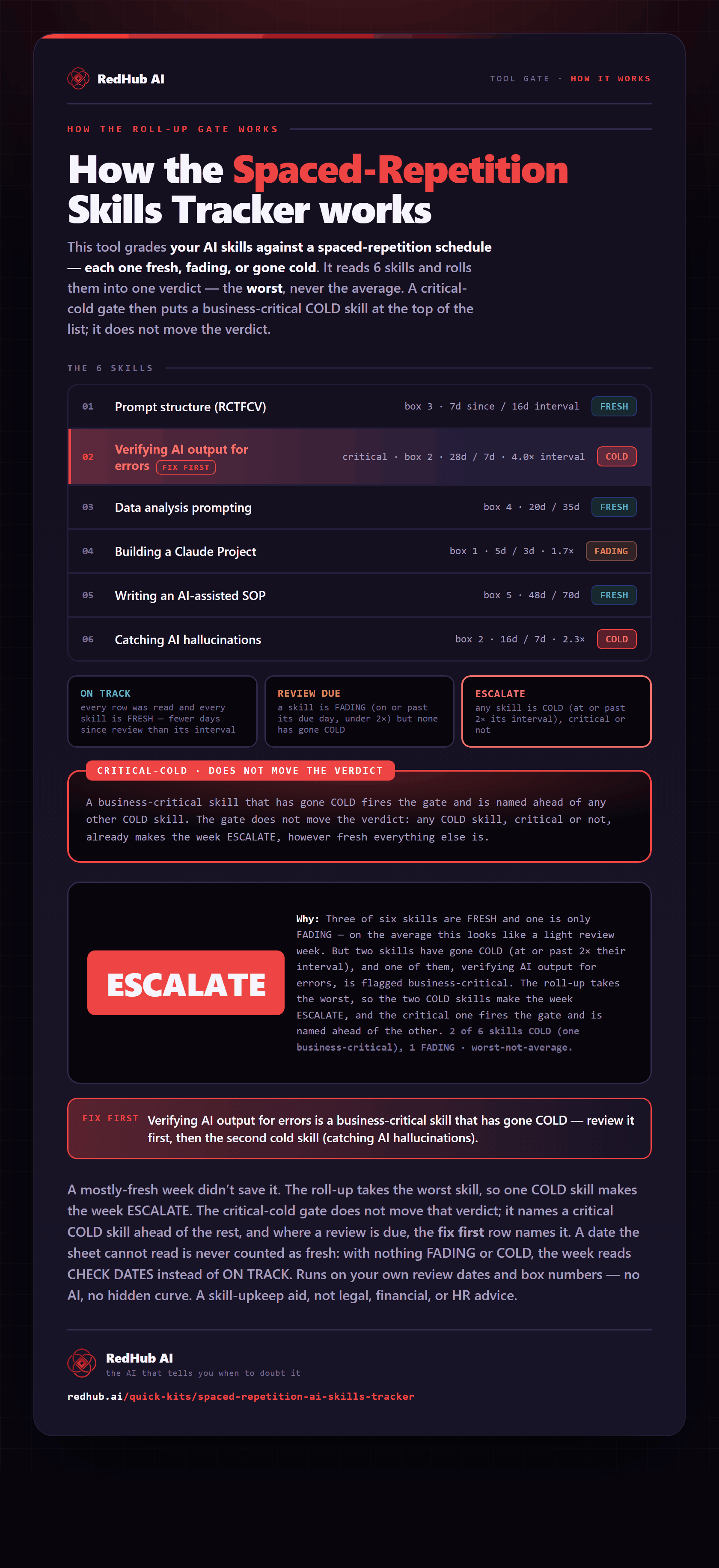
The gate this post refers to, drawn from the tool’s own logic. See the tool.