The Forgetting Curve: Why You Lose Skills You Don't Use
RedHub AI Editorialupdated November 5, 20265 min read

Jump to a section7
You lose a skill you don't use because nothing asks you to recall it. The forgetting curve is the name for how that loss runs: steep at first, then slower. The first days without practice cost more than the weeks that follow. That shape is why a workshop skill can feel gone a month later, and why the timing of the first review matters.
TL;DR: The forgetting curve describes recall falling quickly after learning and then leveling off. A 2015 replication in PLOS ONE reproduced the shape, using one person and memorized lists. It gives no percentage for how fast your own skill fades, and we will not quote one. What we carry over is the shape: the loss comes early, and you do not feel it. Spaced review is the countermeasure, and the Spaced-Repetition AI Skills Tracker ($39) keeps the dates for it. This post is part of Spaced Repetition for Skills You Can't Afford to Forget.
What the forgetting curve describes
Learn something, stop using it, and test yourself at intervals. Recall falls quickly, then the fall slows. Plotted on a chart, the line drops like a slide and flattens out near the bottom.
The finding has been re-checked. A 2015 study in PLOS ONE (opens in a new tab) re-ran the original experiment. One person spent 70 hours learning lists and relearning them after 20 minutes, 1 hour, 9 hours, 1 day, 2 days and 31 days. The researchers reported results similar to the original data. They also reported that the curve is not perfectly smooth. It showed a jump upward starting at the 24-hour point.
What it does not tell you
That study had one subject, and the material was memorized lists. A work skill is a different thing. Writing a clear prompt or spotting a wrong figure in an AI answer takes judgment and practice. So we are not going to give you a figure for how much of a skill is gone by day seven. A number borrowed from a list-learning experiment would tell you nothing true about your skill.
What we are willing to carry over is the shape. The loss is front-loaded, and you cannot feel it happening. You find out when you reach for the skill and it comes back slow, or wrong. How fast that happens for one person and one skill is a question the curve cannot answer, and neither can we.
Why rarely used skills are the exposed ones
A skill you use daily gets reviewed by the work. The curve bites on the skills you need a few times a year. With AI, those include some with a lot riding on them: the careful check of an answer that looks fine, the prompt built for a quarterly report, the call that a task needs a person and not a model. A prompt for a quarterly report gets four uses a year.
AI adds a second problem that the curve does not describe. The tool can change under a skill you remember perfectly. A model update can shift how the same prompt behaves, which our post on AI model upgrades covers. Remembering a skill and the skill still being right are separate questions.
Flatten it with spaced review
You cannot stop the curve. You can review before the skill is gone, and then wait longer before the next review. A 2006 meta-analysis in Psychological Bulletin (opens in a new tab) covering 317 experiments found that the gap producing the best retention grew as the time people needed to remember grew. The longer the goal, the longer the best gap.
The practical trouble is the bookkeeping. "Review it before you forget" is not a schedule. For each skill you need the date of the last review and the gap it has earned. The Leitner system is the box method that sets those gaps, and how to retain what you learn covers what a useful review looks like.
Tracking it without an app
The Spaced-Repetition AI Skills Tracker ($39) is one spreadsheet. Each skill gets a box from 1 to 5 and a last-reviewed date. A box 1 skill is due every 3 days and reads COLD at 6 days. A box 5 skill is due every 70 days and reads COLD at 140. The sheet returns FRESH, FADING or COLD for each skill from your dates and nothing else.
It is not a course, and no AI runs. It does not know whether a review went well. You decide that when you move a skill up or down a box. Which skills deserve a row at all is the subject of how to keep your AI skills sharp.
Know which skill is due before you need it
Set a Leitner box and a last-reviewed date for each skill. The Tracker returns FRESH, FADING or COLD from the days since, against that box's gap. One .xlsx, no AI, nothing uploaded.
Get the Spaced-Repetition AI Skills Tracker — $39Pairs well with
If you do not know which skills are weak to begin with, the AI Fluency Diagnostic ($79) scores six AI skills from your own 0 to 5 marks and makes the lowest one the headline. For the reviews themselves, the Prompt Practice Lab ($69) is a set of prompt drills you score against six criteria. When the job is teaching a team from the start, the AI Literacy & Workforce Training Kit ($199) is a plain-language program with a 28-slide deck, a workbook, a knowledge check, a certificate and a completion log.
More in this guide
What is the forgetting curve?
It is the pattern recall follows when you learn something and then stop using it. Recall falls quickly at first and then more slowly. The early days without practice cost more than the later weeks.
How fast do you forget a skill?
There is no figure we can give you. The well-known measurements come from memorized lists, not work skills, and a 2015 replication in PLOS ONE used one person. The shape is the part worth keeping: the loss comes early.
Has the forgetting curve been replicated?
Yes. A 2015 study in PLOS ONE had one person spend 70 hours learning lists and relearning them at gaps from 20 minutes to 31 days. The researchers reported results similar to the original data, with a curve that was not perfectly smooth.
Can spaced repetition stop the forgetting curve?
No. It works against it. A review before the skill is gone restores it, and a longer gap can follow. Stop reviewing and the fade starts again.
Does the forgetting curve apply to skills or only to memorized facts?
It was measured on memorized material. Applying it to a work skill is a reasonable extension, not a measured result. Treat the shape as a guide and ignore any exact percentage.
Do I need an app to use spaced review?
No. You need a record of when you last reviewed each skill and a gap for the next review. The Spaced-Repetition AI Skills Tracker ($39) keeps that in one spreadsheet, with no app, subscription or AI.
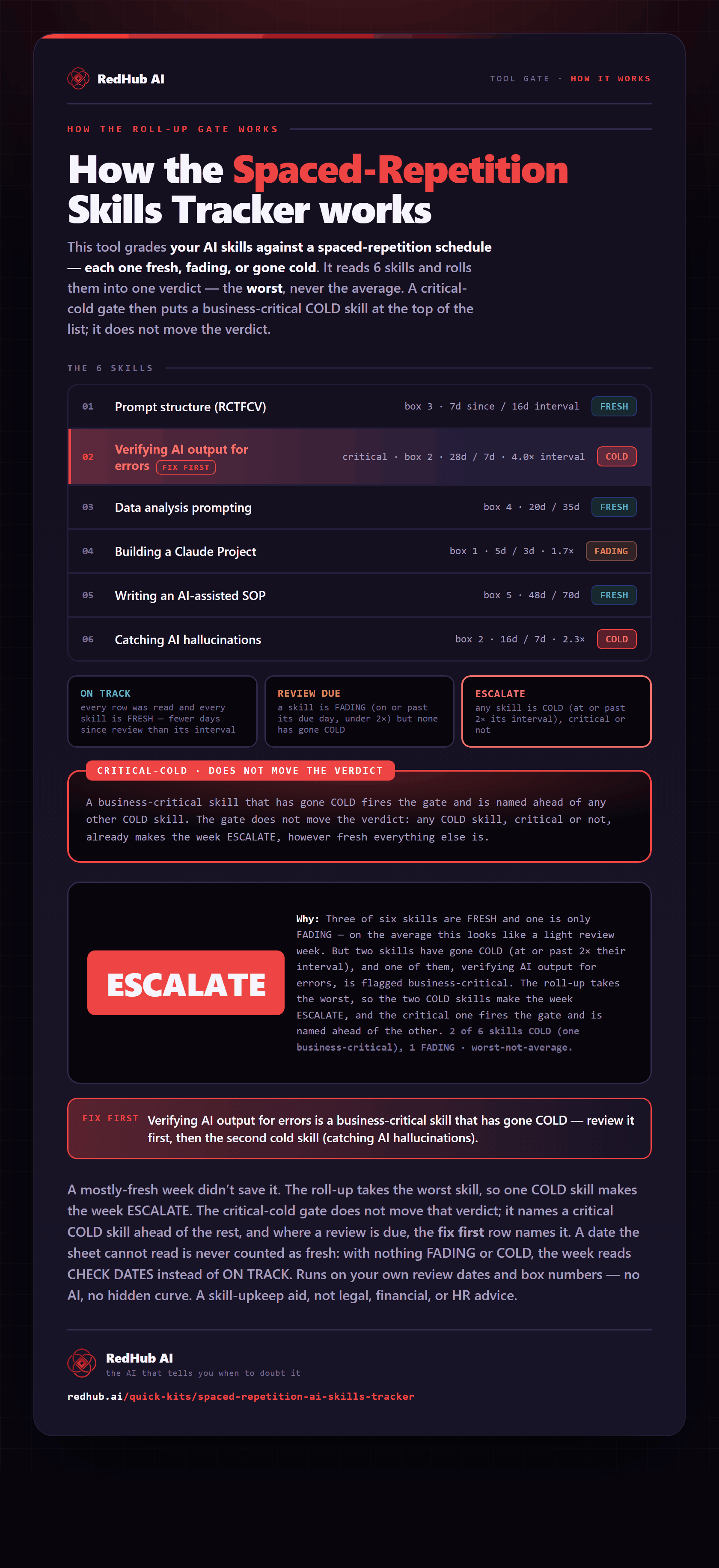
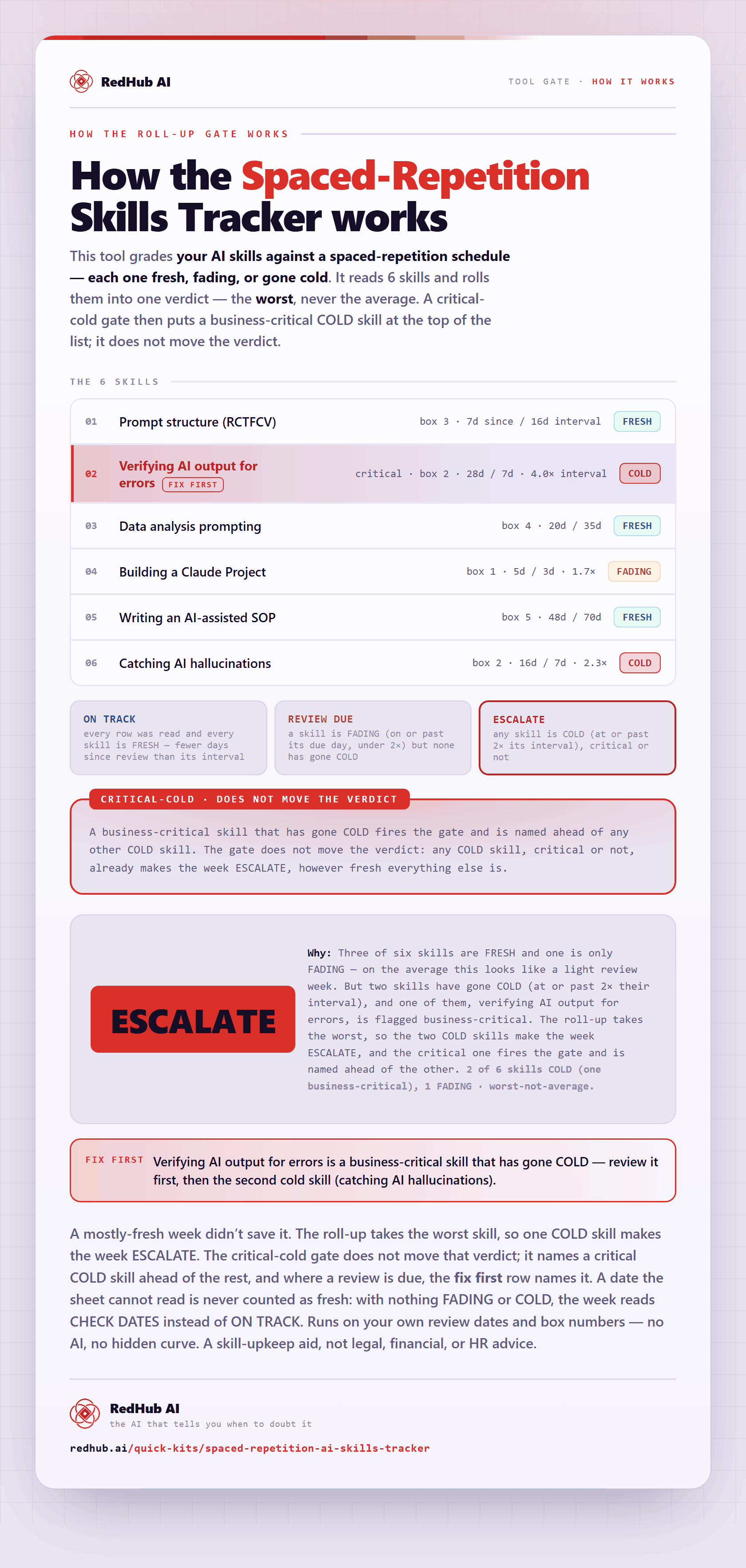
The gate this post refers to, drawn from the tool’s own logic. See the tool.