Input vs Output Tokens: Why Your AI Bill Is Higher Than You Expect
RedHub AI Editorialupdated October 4, 20267 min read

Jump to a section9
An AI bill usually runs high for two reasons on opposite sides of the call. Input vs output tokens is the split that explains both. Output, the text the model writes back, carries the higher rate: Claude Sonnet 5.5 output costs $10 per million tokens on Anthropic's October 2026 price sheet, against $2 for input. Input, everything you send, carries the lower rate but grows quietly, because a chat re-sends its whole history on every turn. Budget with one blended rate and you miss both. Split the bill in two and the surprise turns into arithmetic.
TL;DR: Input tokens (prompt, instructions, context, history) and output tokens (the response, plus any reasoning the model bills as output) have separate rates, and output costs more on every price sheet quoted here. Long answers push cost up on the output side. Re-sent history pushes it up on the input side, though caching can bill most of that history at a tenth of the input rate. The Token Economics Workbook ($59) models both sides separately. Background: the full budgeting guide and how LLM API pricing works.
Two prices for one call
Each call has an input count and an output count, and each is billed at its own rate. On Sonnet 5.5 the output rate is five times the input rate. On DeepSeek V4.1 Flash, DeepSeek's pricing page lists $0.15 and $0.60 per million off-peak as of October 2026, four times. Price every token the same and you will underestimate any workflow that writes a lot. The LLM API cost guide covers the full rate card. This post stays on why the split exists and what it does to real workflows.
Why writing costs more than reading
The vendors' price sheets do not explain the gap, so treat this as the usual technical account rather than anyone's stated reason. A model reads your prompt in one parallel pass. It writes its answer one token at a time, and each new token depends on all the ones before it. That makes generation the slower, more sequential job. The exact ratio is a pricing decision, and it differs by vendor and model.
Which side of the bill your workflow lands on
Workflows with similar total token counts can cost very different amounts, because the mix differs by task:
| Workflow type | Token profile | Cost tendency |
|---|---|---|
| Document classification or tagging | Long input, very short output | Cheaper per call: most tokens hit the lower input rate |
| Summarization | Long input, medium output | Moderate, with some exposure to the output rate |
| Drafting or content generation | Short input, long output | Expensive per call: most tokens hit the higher output rate |
| Multi-turn chat | Growing input (re-sent history) plus per-turn output | Compounds over the conversation, since input grows even when replies stay short |
The category tells you where to look first. A drafting task benefits from tighter output. A chat product benefits more from managing how much history goes back each turn. The cost-reduction guide covers tactics for both.
Output you pay for and never read
Reasoning models add a third kind of token to the output side. Anthropic's adaptive-thinking documentation lists the tokens Claude uses while thinking as "billed as output tokens." It also says you are billed for the full thinking tokens even when the response shows only a summary of them. So the output you are billed for can run well past the output you see.
The same page notes that thinking blocks from earlier turns that stay in context are billed as input. Reasoning therefore costs you twice in a chat: once as output on the turn that produced it, and again as input on the turns that carry it forward. The DeepSeek V4.1 Flash pricing post shows the same pattern from another vendor, where higher reasoning effort means more thinking tokens billed as output.
The compounding cost of re-sent history
Anthropic's documentation says its Messages API "is stateless, which means that you always send the full conversational history to the API." Every new message goes out with everything before it.
Illustrative example on Sonnet 5.5: a support chat with a 1,000-token system prompt, 150-token user messages and 250-token replies. The first turn sends 1,150 input tokens. The twentieth sends 8,750, because it carries nineteen earlier exchanges. Over 20 turns that adds up to 99,000 input tokens and 5,000 output tokens, about $0.25 for the conversation. Price it as twenty copies of the first turn and you would expect about $0.10. The real conversation costs 2.6 times the naive estimate, and every cent of the gap is input.
What caching does to that bill
Prompt caching changes the history math, which complicates the warning above. Anthropic's pricing page says cache reads cost 0.1 times the base input rate, $0.20 per million on Sonnet 5.5, and 5-minute cache writes cost 1.25 times. Re-run the same 20-turn chat with every turn reading the earlier conversation from cache and writing only the new tokens, and the conversation drops to about $0.09, a little under the naive estimate. In that best case the history premium disappears.
Real usage lands above that, and how far above depends on behavior you do not control. Anthropic's cheaper cache option is valid for five minutes. A customer who steps away for coffee comes back to a cold cache, and the next turn pays the write rate on the whole history again. The 1-hour option costs twice the input rate to write. Which one pays depends on how your users pause, and only your own usage data can settle it. For agent workloads, the DeepSeek pricing post shows a 20-turn run that is about five and a half times cheaper with its shared context cached.
Modeling both sides properly
A real forecast prices the two sides separately and applies each provider's current rate to each. A single blended average understates output-heavy workflows and overstates input-heavy ones. It also hides the one setting, caching, that can move the input side by a factor of ten. Put input, cached input and output on separate lines and the forecast follows the way your usage is shaped.
Forecast input and output on separate lines
The Token Economics Workbook prices input, cached input and output tokens separately for up to three models, with a cache hit rate you set, and returns cost per task, cost per user and monthly spend. Its caching patterns cover prompt, response, semantic and per-tenant caching.
Get the Token Economics Workbook — $59Pairs well with
The AI Cost-Per-Task Calculator ($29) sets an output-heavy task's AI cost against the human hours it replaces and returns Automate, Review or Skip. If the worry is a bill spiking without warning, the AI Spend Runaway & Billing-Safeguard Gate ($49) grades six safeguards and reads RUNAWAY RISK when no hard spend cutoff exists. The AI & SaaS Subscription Auditor ($49) covers the AI spend that sits outside your token bill, with a keep, right-size, consolidate or cut verdict on each tool.
More in this guide
Why are output tokens more expensive than input tokens?
Vendors do not explain the gap on their price sheets. The usual technical account is that a model reads a prompt in one parallel pass but writes its answer one token at a time. As of October 2026, Anthropic prices Claude Sonnet 5.5 output at five times its input.
Which workflows cost the most per call?
Workflows that turn short prompts into long responses, such as drafting and content generation, because most of their tokens hit the higher output rate. Classification and tagging, which read a lot and return a short answer, tend to cost less per call.
Why does a long chat conversation get so expensive?
Each new message goes out with the whole prior conversation as input. In this post's illustrative 20-turn chat on Claude Sonnet 5.5, that makes the conversation cost about 2.6 times what twenty copies of the first turn would.
Am I billed for reasoning I never see?
Often, yes. Anthropic's documentation says thinking tokens are billed as output, and that you pay for the full thinking even when the response shows only a summary. Thinking kept in context on later turns is billed again as input.
Does prompt caching fix the re-sent history problem?
It can shrink it a lot. Anthropic bills Claude Sonnet 5.5 cache reads at $0.20 per million tokens, a tenth of the input rate. But a 5-minute cache expires, and a user who pauses longer makes the next turn pay to write the history again.
Does total token count tell me the total cost?
Not on its own. Two calls with the same total can cost different amounts depending on how the count splits between input and output, and on how much of the input was a cache hit.
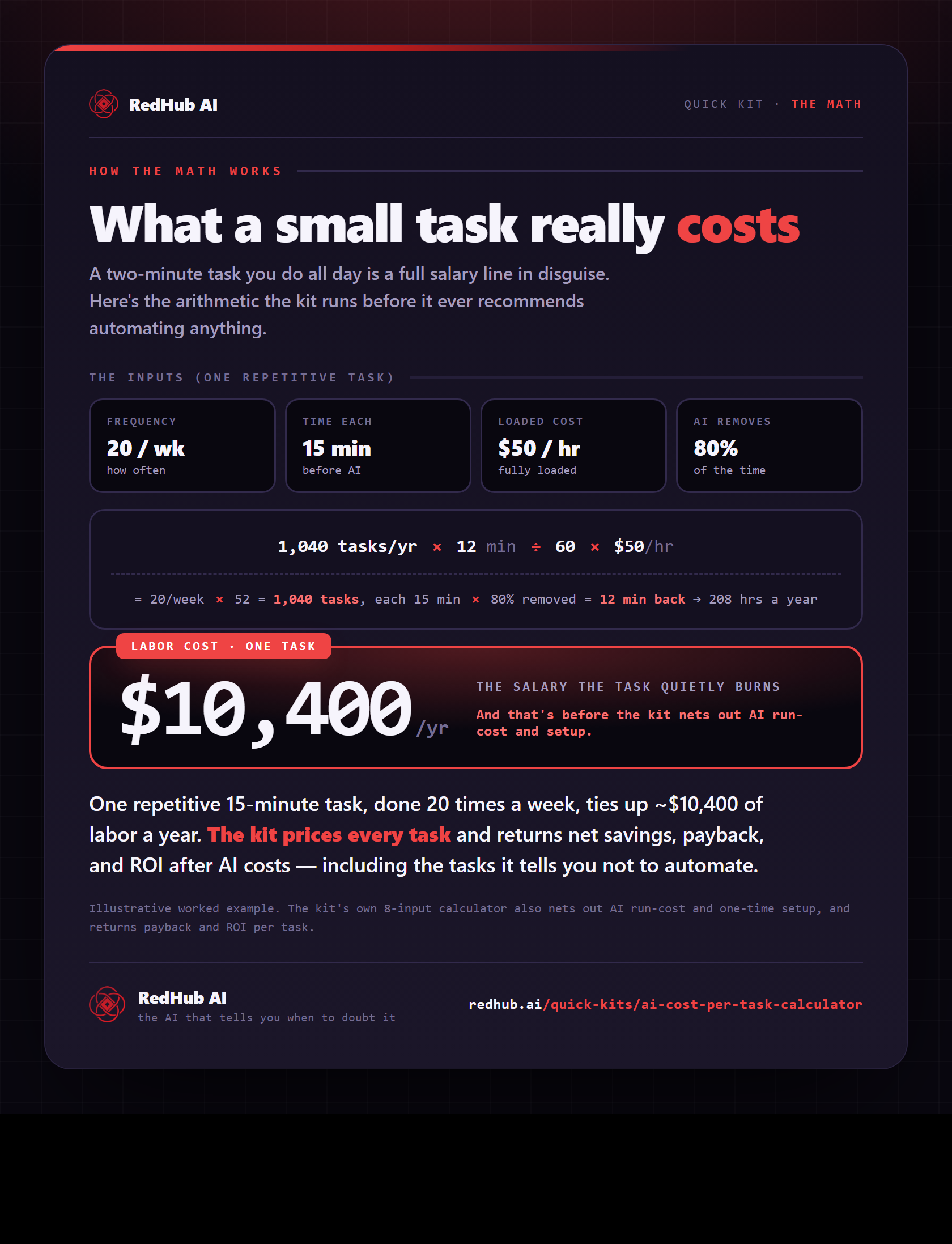
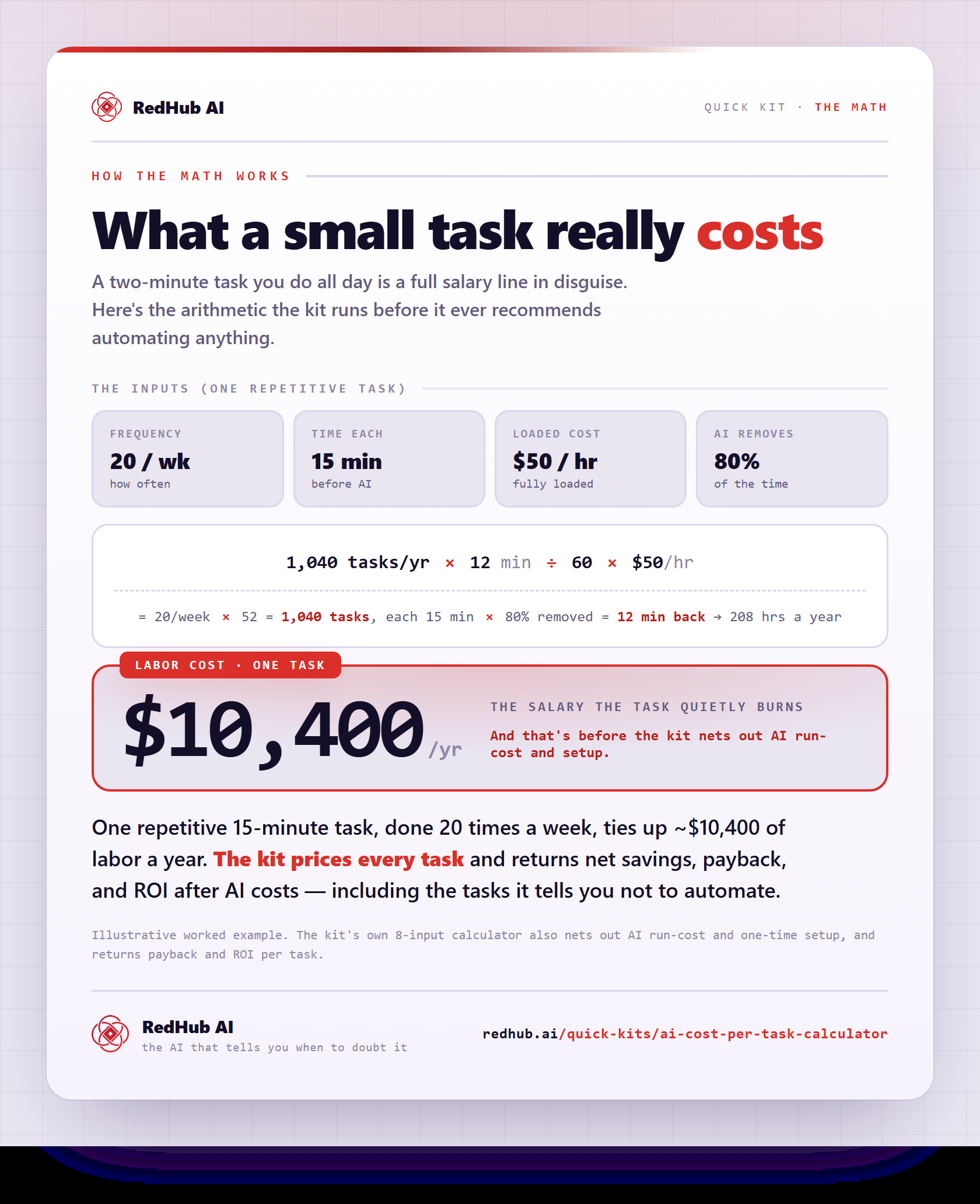
The gate this post refers to, drawn from the tool’s own logic. See the tool.