What Is a Token in AI? (And Why It Costs You Money)
RedHub AI Editorialupdated October 4, 20266 min read

Jump to a section7
A token is the small chunk of text a language model reads or writes in one step: sometimes a whole word, sometimes part of one, sometimes a single character or a punctuation mark. That is the short answer to what is a token in AI, and it matters for money because LLM APIs bill by the token, not by the word or by the call. Google's Gemini documentation says a token is about 4 characters for Gemini models. Anthropic's glossary says a token is about 3.5 English characters for Claude. Multiply your token count by your provider's per-token rate and you have the mechanism behind every LLM bill.
TL;DR: A token is the unit an LLM reads and writes in, roughly a word or a piece of one. Providers bill per token, separately for input and output, so cost tracks how much text moves, not how many calls you make. The same text can count differently on different models, so count with the model you will run. The Token Economics Workbook ($59) turns a token count into a monthly forecast. Next, see how to budget the total or how input and output pricing works.
Tokens are pieces of words
A model does not read letter by letter or word by word. It splits text into tokens from a fixed vocabulary of common chunks. Google's token guide gives the range: tokens "can be single characters like z or whole words like cat," and long words are broken into several tokens. Spaces and punctuation count as well.
The vendors' rules of thumb turn that into arithmetic. A 1,000-character paragraph comes to about 250 tokens by Google's 4-characters rule and about 286 by Anthropic's 3.5. Google also says 100 tokens is about 60 to 80 English words. Treat all three as estimates for plain English. Code, tables, jargon and other languages can tokenize differently, which is why a word count is a weak proxy for a bill.
Why the token is the billing unit
Every token you send is input the model has to process, and every token it writes is output it has to produce. Billing per token charges for that work directly. A one-line question and a ten-page contract cost very different amounts, even though each is one call.
Providers then price the two sides separately. Anthropic's October 2026 price sheet puts Claude Sonnet 5.5 input at $2 per million tokens and output at $10. So a token is not one price. It is two prices, depending on direction, and input vs output tokens goes through why the written side costs more.
The same text, a different count
This is what catches teams during a model change. Each model family has its own tokenizer, so the same sentence can be a different number of tokens on two models. Anthropic says its Claude 4.7 and later models use a newer tokenizer that "produces approximately 30% more tokens for the same text," with the exact increase depending on the content.
Run that against a real migration. Anthropic lists Claude Sonnet 4.5 at $3 per million input tokens and $15 per million output, and Sonnet 4.5 retires on November 30, 2026. Its replacement, Sonnet 5.5, lists at $2 and $10. On the price sheet that is a one-third cut. But if the same text now counts about 30% more tokens, a prompt that cost $3 to send on Sonnet 4.5 costs about $2.60 on Sonnet 5.5 ($2 × 1.3). That is a cut of about 13%, not 33%, and the output side works out the same way. Illustrative math, using Anthropic's approximate 30%.
A second claim pushes the other way. Anthropic says Sonnet 5.5 "typically needs far fewer tokens to do the same work," though that comparison is against Sonnet 5, not Sonnet 4.5. Which effect wins on your workload is something no price sheet can tell you. Our Claude Sonnet 4.5 retirement checklist covers re-baselining cost as part of the move.
Count, don't guess
Anthropic's token-counting documentation tells migrating teams not to reuse counts from an older model, and to "count your prompts with the model ID you plan to use." Its token-counting endpoint is free to use, subject to rate limits, as of October 2026. Google's Gemini API has its own count_tokens method. A real count on a sample of your own prompts beats any characters-per-token rule.
Tokens you pay for and never see
Users see their own message and the reply. The bill sees more:
- System prompts. Instructions that tell the model how to behave go out as input tokens on every call.
- Tool definitions. Anthropic's pricing page counts the tools parameter, meaning tool names, descriptions and schemas, as input.
- Retrieved context. Documents injected to ground an answer can outweigh the question many times over.
- Conversation history. In a multi-turn chat, prior turns are sent again so the model has context, so each new message costs more than the last.
Each of these is billed at the ordinary input rate, which is exactly why they are easy to miss. To turn a count into dollars, the main token-cost guide has a calculator, and the guide on reducing LLM costs covers which of these four you can trim safely.
From a token count to a monthly number
The Token Economics Workbook takes your input, cached and output tokens per task and prices them against up to three models' rate cards that you enter. Re-run it with the counts from your new model before a migration changes the bill.
Get the Token Economics Workbook — $59Pairs well with
When a model change moves your token counts, the AI Unit-Economics & Token-Shock Exposure Kit ($59) has a Model Swap tab that checks whether a cheaper model is still cheaper per finished task, and returns ROUTE DOWN, KEEP or UNMEASURED. The AI Burn-Rate & Budget Blowout Forecaster ($49) projects your AI spend across the budget year from your current monthly spend and growth rate, and names the month you would blow the budget. If a token count spikes in production, the AI Spend Runaway & Billing-Safeguard Gate ($49) grades whether the bill would be stopped.
More in this guide
What is a token in AI, in plain terms?
A token is a small chunk of text, often a word or part of a word, that a language model reads or writes one step at a time. It is the unit nearly every LLM API uses to measure and bill usage, rather than words or calls.
How many characters or words is one token?
It depends on the model. Google's documentation says about 4 characters for Gemini models, with 100 tokens equal to about 60 to 80 English words. Anthropic's glossary says about 3.5 English characters for Claude. Code and other languages vary more.
Does the same text cost the same number of tokens on every model?
No. Each model family has its own tokenizer. Anthropic says its Claude 4.7 and later models produce about 30% more tokens for the same text than earlier models, so count your prompts with the model you plan to run.
Why do I get charged for tokens I never see?
The system prompt, tool definitions, retrieved context and, in a chat, the prior conversation are all sent as input tokens on every call, even though the user only sees their own message and the reply.
How do I turn a token count into a dollar estimate?
Multiply your monthly call volume by the average input and output tokens per call, then apply your provider's current input and output rates separately. The main token-cost guide has a calculator for that.
Does cutting tokens always mean worse AI output?
Not necessarily. Tightening a bloated system prompt, trimming irrelevant context or asking for a shorter answer can cut tokens without hurting results, but test each change on real examples. The guide on reducing LLM costs covers how.
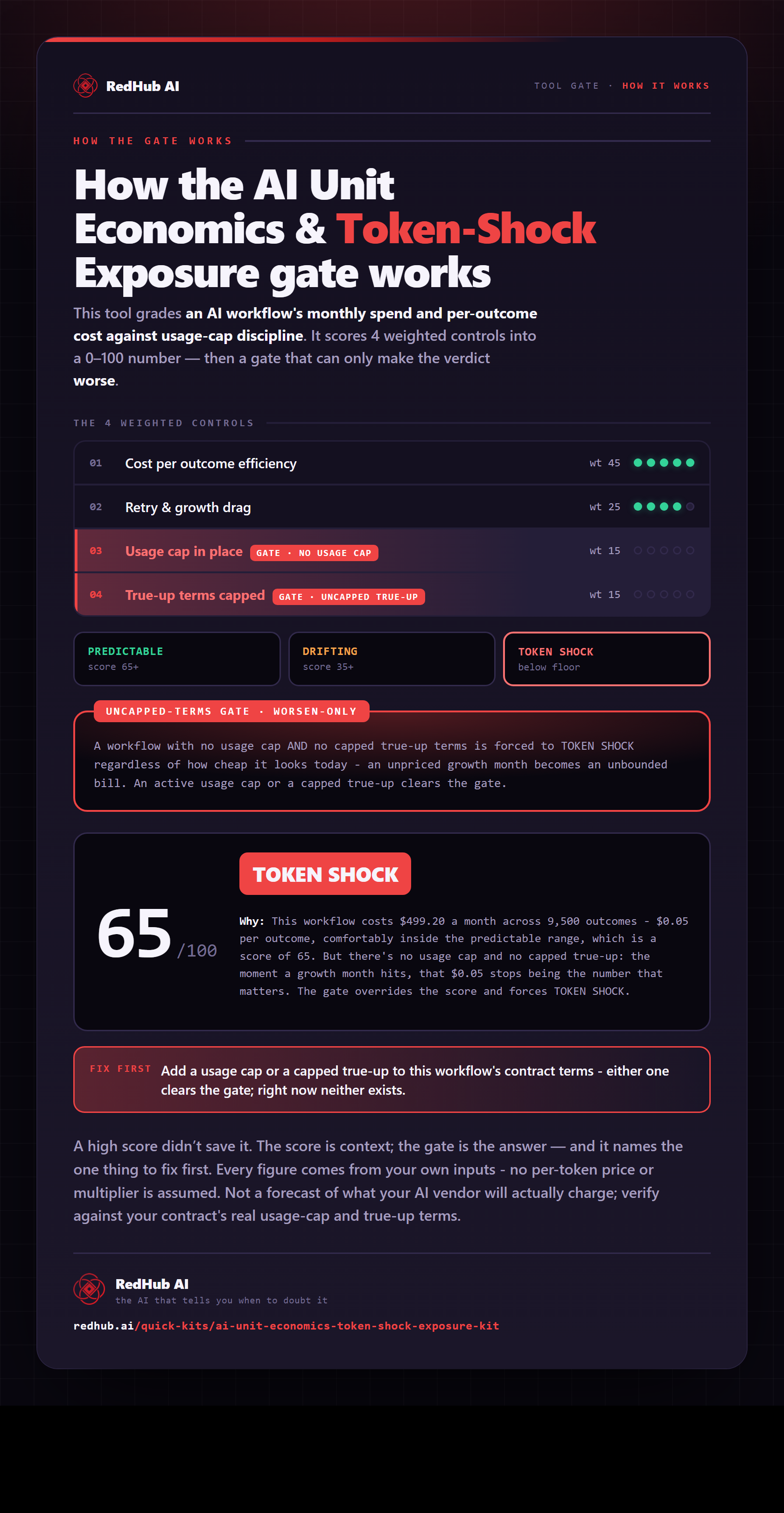
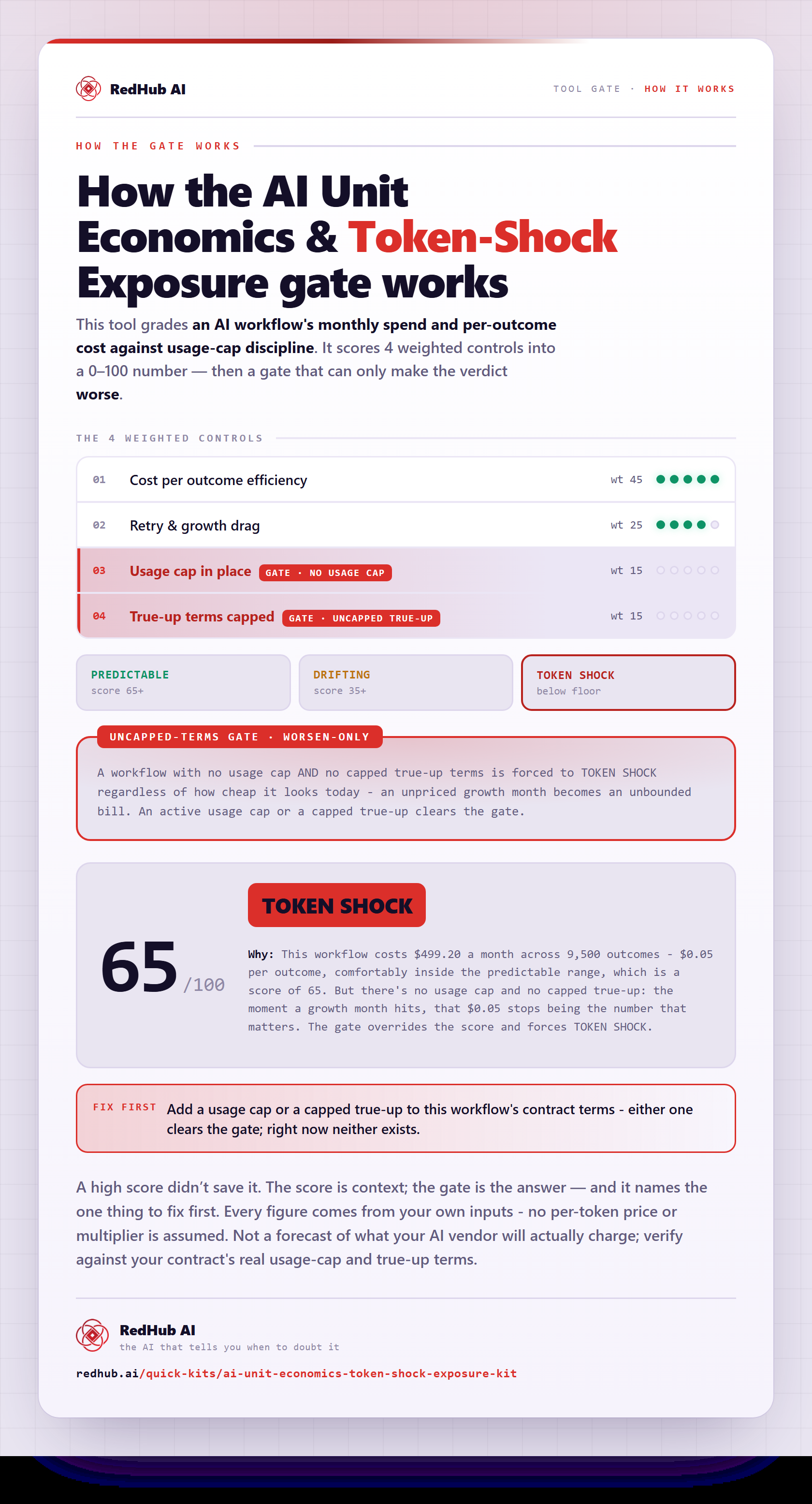
The gate this post refers to, drawn from the tool’s own logic. See the tool.