How Much Does an LLM API Cost? (Input vs Output, Explained)
RedHub AI Editorialupdated October 4, 20266 min read

Jump to a section7
Every LLM API cost starts as two numbers on a price sheet: one rate per million tokens you send, and a higher rate per million tokens the model sends back. As of October 2026, Anthropic's pair for Claude Sonnet 5.5 is $2 and $10. Your bill is those two rates applied to however many tokens you push through in a month, so there is no single price of the API the way there is a price for a software seat. The honest answer to "how much does it cost" is a calculation: your volume, your prompt size, your answer size and today's rate card.
TL;DR: LLM APIs bill input and output tokens at separate rates, and output is the pricier side on every sheet quoted here. Monthly cost = calls × tokens per call × current rate, done once per side. The shape of a call matters as much as its size, and the real rate card adds cache, batch and regional modifiers on top of the two headline numbers. The Token Economics Workbook ($59) models it with your own rates, and the main token-cost guide has a live calculator.
Two meters on every call
A provider prices each model with two rates: dollars per million input tokens and dollars per million output tokens. Anthropic charges five times as much for Sonnet 5.5's output as for its input, at $2 and $10. DeepSeek's own pricing page lists DeepSeek V4.1 Flash at $0.15 for input and $0.60 for output off-peak, as of October 2026, which is four to one. The ratio differs by vendor. The direction has not, on any sheet we checked.
So the cost of one call depends on its shape, meaning how much you sent versus how much came back, and not only on its total size. Why output carries the higher rate is its own question, covered in input vs output tokens. For budgeting, the direction is enough.
Shape beats size
Take two calls on Sonnet 5.5, illustrative numbers. Call A sends an 8,000-token document and gets back a 50-token label. Call B sends a 500-token request and gets back a 2,000-token draft. Call A moves 8,050 tokens and costs about $0.0165. Call B moves 2,500 tokens and costs $0.021. The smaller call costs more, because 80% of its tokens sit on the expensive side.
| Side of the call | What is in it | Typical cost behavior |
|---|---|---|
| Input tokens | User message, system prompt, tool definitions, retrieved context, chat history re-sent each call | The cheaper rate, but often the larger count, especially in long conversations |
| Output tokens | Everything the model generates, including any reasoning it bills as output | The pricier rate, growing with response length and verbosity |
If you are comparing two feature ideas on cost, sketch the expected answer length as carefully as the prompt. A report generator and a classifier can send the same prompt and land far apart on the bill.
What counts as input
Input is more than the user's question. It is the question plus your system prompt, plus any documents or examples you inject, plus, in a chat product, the conversation so far. Anthropic's pricing page says tool use is priced on the total input tokens sent, "including in the tools parameter," so your tool names, descriptions and schemas count too.
That adds up fast. An 800-token system prompt sent on 50,000 calls a month is 40 million input tokens before any user types a word. At Sonnet 5.5's $2 input rate, that is $80 a month for instructions nobody reads. At Anthropic's $0.20 cache-read rate it would be $8, plus the cost of writing the cache, which is why caching a fixed prompt is often the first cut worth making. The cost-reduction guide covers when it pays.
The price sheet has more than two numbers
Two rates are the right starting model. They are not the whole sheet. Each line below changes what a token costs, and none of them shows up in a headline price:
| Modifier | What the vendor says, as of October 2026 |
|---|---|
| Cache reads | Anthropic: Sonnet 5.5 cache reads at $0.20 per million, a tenth of the input rate |
| Cache writes | Anthropic: 1.25 times the input rate for a 5-minute cache, 2 times for 1 hour |
| Batch processing | Anthropic: a 50% discount on input and output for asynchronous batch requests |
| US-only inference | Anthropic: a 1.1 times multiplier on Claude 4.6 and later models |
| Time of day | DeepSeek: peak-hour rates are double the off-peak rates |
| Introductory pricing | Google: Gemini 4 Argon's $2 and $10 rise to $4 and $20, no date given |
The same workload can therefore carry several prices on one vendor. A nightly batch job with a cached system prompt pays a fraction of the headline rate. A real-time chat with a cache that keeps expiring pays the headline rate plus the write premium. Which of those you are depends on how the feature is built, and you only find out from the usage report. So model the modifiers you use, and treat everything else on the sheet as zero until your logs say otherwise.
Compare providers on your call shape
Two headline prices are not comparable until you run your own call shape through both. A provider that is cheaper on input but pricier on output can lose on an output-heavy feature and win on a classifier. Run your volume, input size and output size against each provider's current sheet, with the modifiers you will use. Our posts on Gemini 4 Argon vs Claude Sonnet 5.5 and DeepSeek V4.1 Flash pricing work through two of those comparisons, and both end at the same place: cost per finished task, not cost per token.
Turn two rates into a forecast
The Token Economics Workbook prices one task against up to three models' rate cards that you enter, with a cache hit rate, and returns cost per task, cost per user, gross margin and monthly spend. It ships with a model-routing matrix, caching patterns and 15 anonymized production teardowns.
Get the Token Economics Workbook — $59Pairs well with
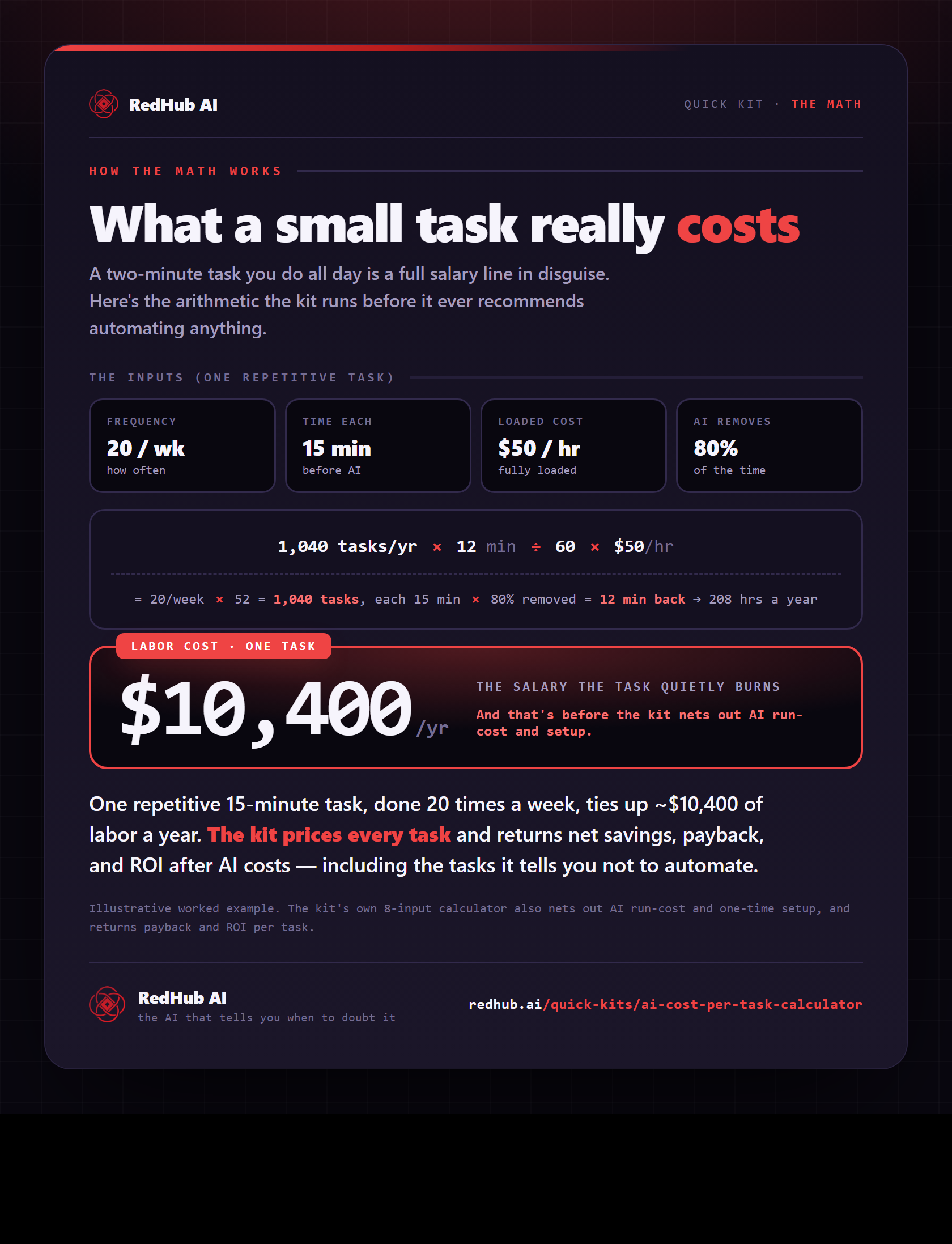
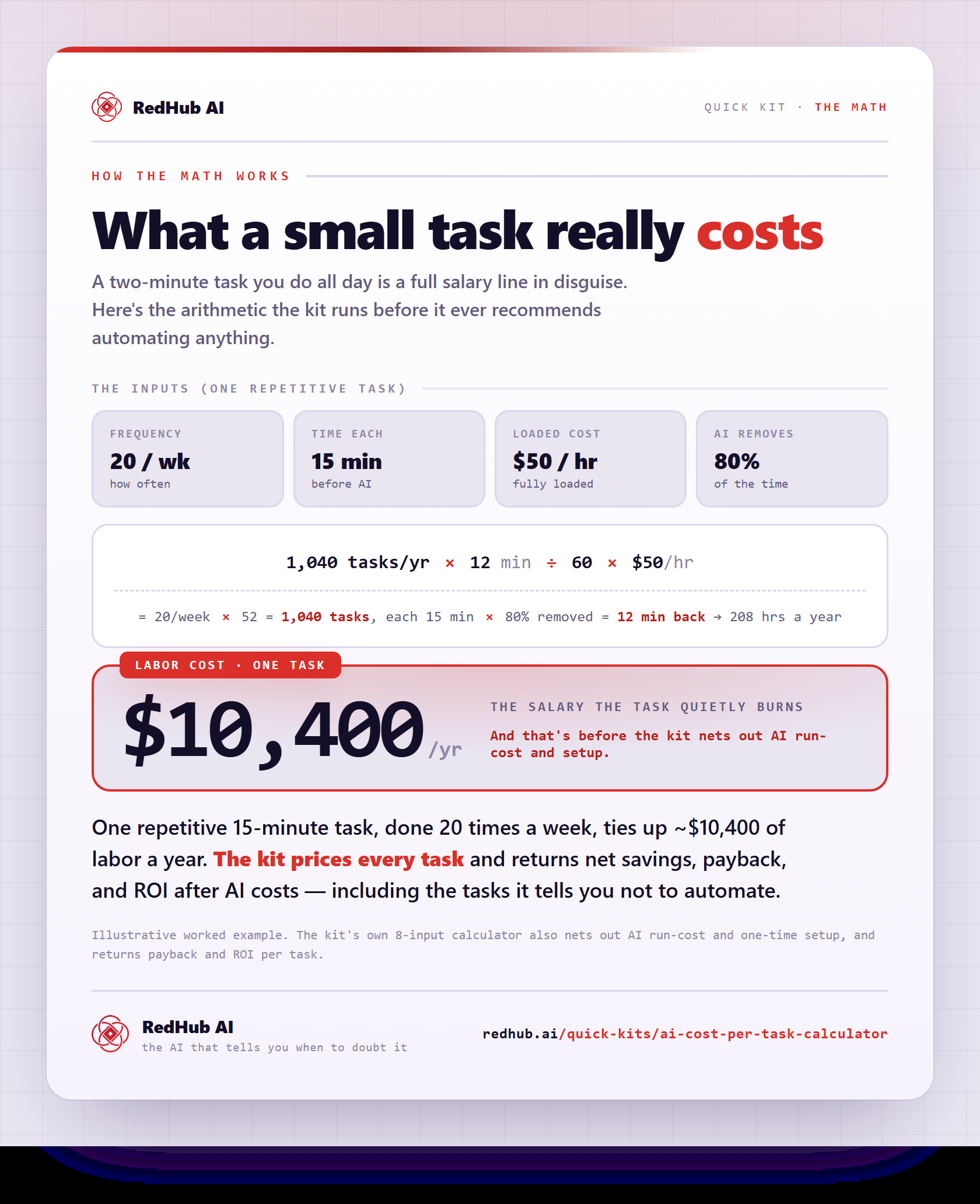
To judge whether one automated task is worth its per-call cost, the AI Cost-Per-Task Calculator ($29) compares it against the human hours it replaces and returns Automate, Review or Skip. The AI Unit-Economics & Token-Shock Exposure Kit ($59) computes the fully loaded cost per successful outcome for each workflow and bands it PREDICTABLE, DRIFTING or TOKEN SHOCK. And because a pricing model cannot stop a bill mid-month, the AI Spend Runaway & Billing-Safeguard Gate ($49) grades whether a runaway would be cut off.
More in this guide
How much does an LLM API cost?
It depends on your call volume, your input and output tokens per call, and the provider's current rates for each side. Anthropic's rates for Claude Sonnet 5.5, as of October 2026, are $2 per million input tokens and $10 per million output tokens. You calculate your cost from your own usage shape.
Why do input and output tokens have different prices?
The price sheets do not say why. The usual technical explanation is that a model reads a prompt in one parallel pass but writes its answer one token at a time. On every price sheet quoted in this post, output costs more.
What hidden costs push an LLM API bill up?
Context re-sent on every call: system prompts, tool definitions, retrieved documents and chat history. An 800-token system prompt on 50,000 calls a month is 40 million input tokens before any user types a word.
Can I compare two LLM providers by their headline price?
Not reliably. A headline rate hides the input and output split, and the sheet adds modifiers such as cache reads, batch discounts and peak-hour rates. Run your own volume, input size and output size against each provider's current sheet.
Is there a way to pay less than the headline rate?
Often. As of October 2026, Anthropic bills Sonnet 5.5 cache reads at $0.20 per million tokens and takes 50% off batch requests. Whether you qualify depends on how your feature sends requests, so check the provider's documentation.
Does the Token Economics Workbook tell me what my provider charges?
No. You enter each model's input and output rate yourself from the provider's pricing page. The Workbook ($59) then prices a task across up to three models, so no rate in it goes stale without you knowing.
The gate this post refers to, drawn from the tool’s own logic. See the tool.