Lead to Meeting Conversion: Book More Sales Calls
Todd Brooks, Founder8 min read

Jump to a section11
- How to Turn Leads Into Booked Meetings
- TL;DR
- What is lead to meeting conversion?
- Leak one: the first reply is too slow
- Leak two: every lead gets the same effort
- Leak three: the reply doesn't ask for the meeting
- What the fixed path looks like
- One honest boundary before you start
- Where to go deeper
- Decision Guide
- FAQ
How to Turn Leads Into Booked Meetings
TL;DR
- What it is: Lead to meeting conversion is the share of your inbound leads that end up as booked sales calls — not just replies, actual meetings on the calendar.
- Who it's for: Founders, agencies, and small sales teams handling inbound leads — browse the RedHub Systems catalog.
- How it works: Three leaks kill it — the slow first reply, equal effort on unequal leads, and a first email that never proposes a time. All three are fixable.
- Bottom line: You don't need more leads. You need the leads you already have to hit a fast, prioritized, calendar-first reply.
What is lead to meeting conversion?
Lead to meeting conversion is the percentage of inbound leads that become booked meetings on your calendar. It is a different number from lead volume and a different number from reply rate. A team with strong lead to meeting conversion answers fast, spends its effort on the leads that can actually buy, and proposes real meeting times in the first email. A team with weak conversion answers tomorrow, treats every lead the same, and closes with "let me know what works for you."
Best for: teams already collecting inbound leads in a CRM like HubSpot or GoHighLevel — the Lead-to-Meeting Engine runs this whole path as one workflow.
Most teams that want more sales calls go looking for more leads. That is usually the expensive fix for the wrong problem. The cheaper fix is lead to meeting conversion: getting a bigger share of the leads you already have onto the calendar. The leads exist. The meetings don't. The gap between those two facts is where this article lives.
Watch what happens to a typical inbound lead. A form-fill arrives Tuesday morning. Someone sees it Tuesday afternoon. They judge it by gut, write a reply from scratch, and close with an open-ended "happy to chat sometime." The lead reads it Thursday, and by then they've already talked to the competitor who answered in forty minutes with two concrete time slots. Nothing in that story is dramatic. That's why it repeats every week.
Those first two figures are widely reported industry ranges, not measurements of your pipeline. But they point at the same truth: the meetings you're missing are mostly lost in the first hour and to the wrong leads — not to a weak pitch.
Leak one: the first reply is too slow
Inbound leads decay by the hour. A lead who just filled out your form is thinking about the problem right now. Tomorrow they are back in their own week, and your reply lands as an interruption instead of an answer. Speed to lead — the time between the lead arriving and your first real reply — is the single biggest lever on whether a meeting gets booked at all.
The trap is that slow replies rarely come from laziness. They come from the manual path: open the lead, judge it, write the reply, open the calendar, find open slots, type them out. Per lead. When five leads arrive during a client call, the backlog does the damage for you. We break down the fix in speed to lead: why the first hour books the meeting.
Leak two: every lead gets the same effort
Not every lead deserves a meeting slot. Some are a perfect fit with budget and a timeline — they should hear from you within the hour, with times attached. Some are curious but can't buy yet — they need a useful nurture note, not a calendar link. And some were never going to buy anything. When all three get the same treatment, the ready leads wait behind the hopeless ones, and your best-quality hours go to your worst-quality pipeline.
The fix is a readable scoring model with a hard gate: no budget authority or no near-term timeline means no meeting slot yet, no matter how exciting the lead looks. Score first, then spend the effort where the score says. We cover the full model in meeting-ready leads: who actually gets a slot.
Key insight: a "hot" lead with no budget authority is not a meeting — it's a future meeting. Booking it now burns a rep hour and teaches the lead that your time is free. A gate that caps that lead at nurture isn't losing you a call. It's saving one.
Leak three: the reply doesn't ask for the meeting
Here's the quietest leak. A fast reply to the right lead can still book nothing, because it ends with "let me know what time works." That sentence hands the lead homework: check their calendar, guess at yours, write back, wait. Every step is a place to stall. The replies that book meetings do the opposite — they propose two or three real open times and make saying yes a one-line job.
That takes calendar awareness at drafting time, which is exactly the step most teams skip because it's tedious. We show the anatomy in the first email that books the meeting. And when the first email gets no answer, most teams stop — which is why the follow-up cadence is its own discipline: the follow-up sequence that books meetings.
| The leak | What it feels like | What actually fixes it |
|---|---|---|
| Slow first reply | "We got back to them the next day" | A prioritized queue and a first-hour standard |
| Equal effort, unequal leads | "We treat every lead seriously" | A scored verdict: book now, nurture, or decline |
| No time proposed | "We told them we're happy to chat" | Real open slots, read from the calendar, in email one |
| One-touch follow-up | "They never got back to us" | A short, spaced cadence with a next step each time |
What the fixed path looks like
You don't need a bigger team or a new lead source. You need the path from "lead in" to "meeting booked" to run the same way every time. Here is the sequence.
- Read every new lead in one place. Form-fills, inbox replies, chat captures — pulled from the CRM and inbox you already use, not a new tool to check.
- Score each one against a model you can read. Fit, intent, timeline, authority, recency — weighted, with a gate that holds back leads who can't buy yet. The verdict is book now, nurture, or decline.
- Draft the meeting ask for the ready ones. A first-touch reply in your voice that proposes two or three real open times pulled from your actual calendar — not "let me know."
- Work the queue in priority order. Highest score first. A speed-to-lead tracker shows who's been waiting longest, so the first hour stops being luck.
- Review, send, and follow the cadence. You read every draft, you press send, and non-responders get a short, spaced follow-up sequence instead of silence.
Steps one through four are the exact loop the Lead-to-Meeting Engine runs. Four Claude Skills read your new inbound leads through your own HubSpot or GoHighLevel CRM and Gmail, score each one on a five-signal model, draft the first-touch reply with real open times from your Google Calendar, and assemble the prioritized queue. It reads and drafts only — it never sends a message and never books a slot. You stay the one who presses send, which is exactly where the judgment belongs.
Collapse the manual path to review-and-send
The Lead-to-Meeting Engine ($149, one-time) ships four Claude Skills, a runnable scoring engine, a workbook that reproduces every number, a first-touch and cadence playbook, and a speed-to-lead tracker. Drafts only — you send, you book.
Get the Lead-to-Meeting Engine — $149 →One honest boundary before you start
A scored lead and a drafted reply mean the lead is worth your time. They do not mean the lead has consented to be contacted. Fresh inbound leads who just filled out your form are one thing. A dormant list from two years ago is another — run a consent check like the Database Reactivation Readiness Engine before you touch a cold list. Booked meetings aren't worth a compliance problem.
Where to go deeper
This pillar is the map. Each leak has its own guide:
- Speed to lead: why the first hour books the meeting — the decay curve and how to beat it without living in your inbox.
- Meeting-ready leads: who actually gets a slot — the five-signal model and the gate that protects your calendar.
- The first email that books the meeting — the reply anatomy, with a stall-vs-book comparison.
- The follow-up sequence that books meetings — the cadence for the leads that don't answer email one.
Decision Guide
Use this approach if: you get real inbound leads every week, they live in HubSpot or GoHighLevel, and your first replies go out hours or days after leads arrive.
Skip it if: you have no inbound flow yet — this converts leads you already have; it doesn't create them.
Best first step: measure your current speed to lead this week. If your median first reply is over an hour, that's the leak to fix first.
FAQ
What is a good lead to meeting conversion rate?
There's no single benchmark that fits every business — it varies widely by industry, offer, and lead quality. The useful move is to measure your own rate this month, fix the three leaks (speed, prioritization, the meeting ask), and compare next month against your own baseline.
Why do my leads reply but never book a call?
Usually because the reply never proposed a concrete time. "Let me know what works" hands the scheduling work to the lead, and busy people stall on homework. Propose two or three real open times and the yes becomes a one-line answer.
Does speed to lead really matter that much?
Yes. Industry studies consistently suggest that reaching a lead within the first hour produces several times more meaningful conversations than waiting until the next day. The lead's attention is highest right after they raise their hand.
Should every inbound lead get a meeting offer?
No. Leads without budget authority or a near-term timeline shouldn't be offered a slot yet — they belong in nurture. Offering meetings to leads who can't buy fills your calendar without filling your pipeline.
Can I automate the whole lead-to-meeting path?
You can automate the reading, scoring, and drafting. You shouldn't automate the sending. A human review before send catches tone problems, bad-fit edge cases, and consent issues that no scoring model sees. The Lead-to-Meeting Engine is built on exactly that line: it drafts, you send.
What do I need to run the Lead-to-Meeting Engine?
Your own CRM (HubSpot or GoHighLevel), Gmail, and Google Calendar, connected through MCP. You bring your own leads — it's not a contact database or an email finder. It's $149 one-time, with the scoring engine and workbook included.
Does it work for cold or dormant lists?
It scores and drafts, but a draft is not permission to contact anyone. For dormant or cold lists, run a consent and compliance check first — the Database Reactivation Readiness Engine returns a per-contact contact/re-permission/suppress verdict before any outreach.
Stop losing meetings to a slow reply
Four Skills read, score, and draft the meeting outreach for the leads that can actually buy — with real open times from your own calendar. You review, you send, you book.
Get the Lead-to-Meeting Engine — $149 →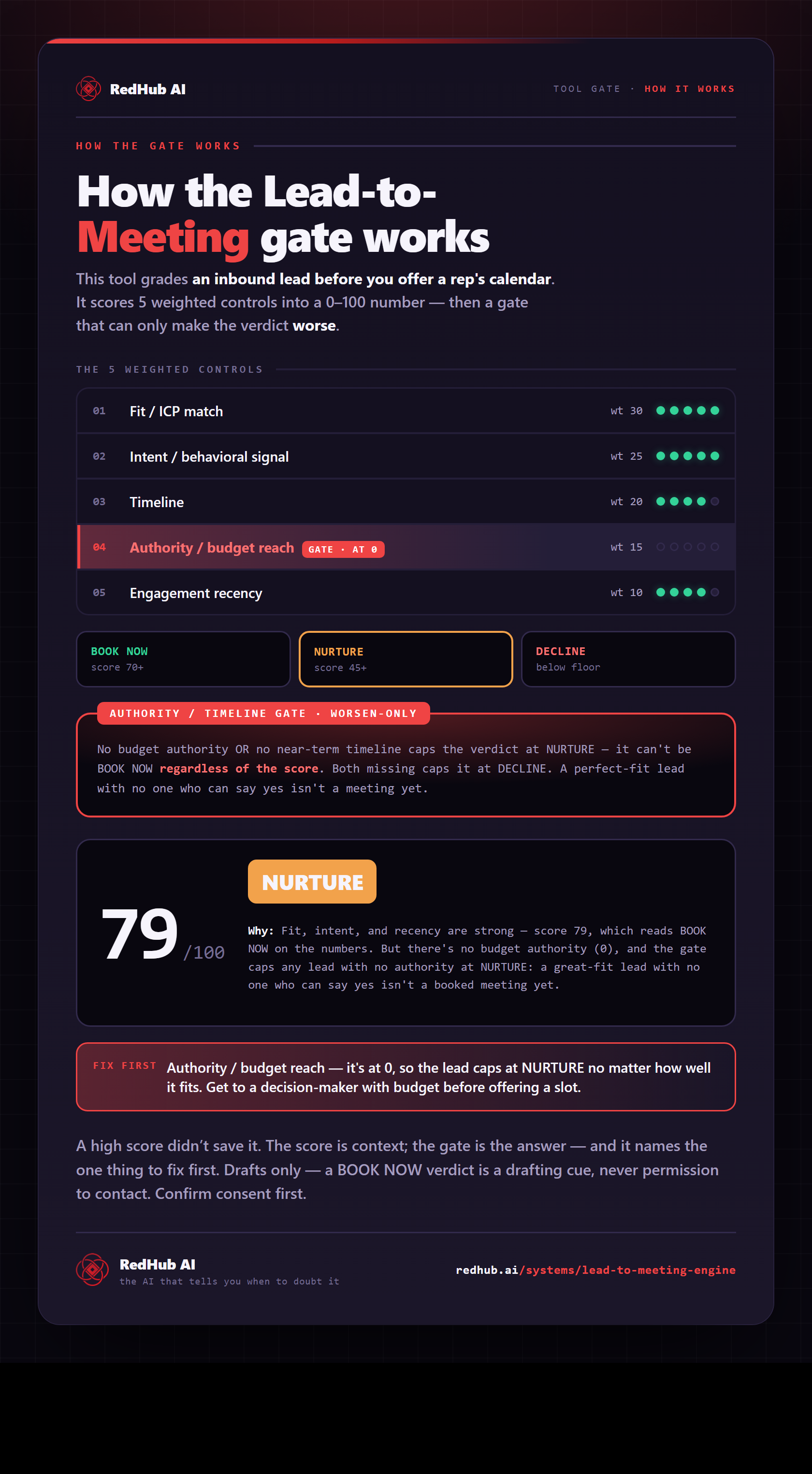
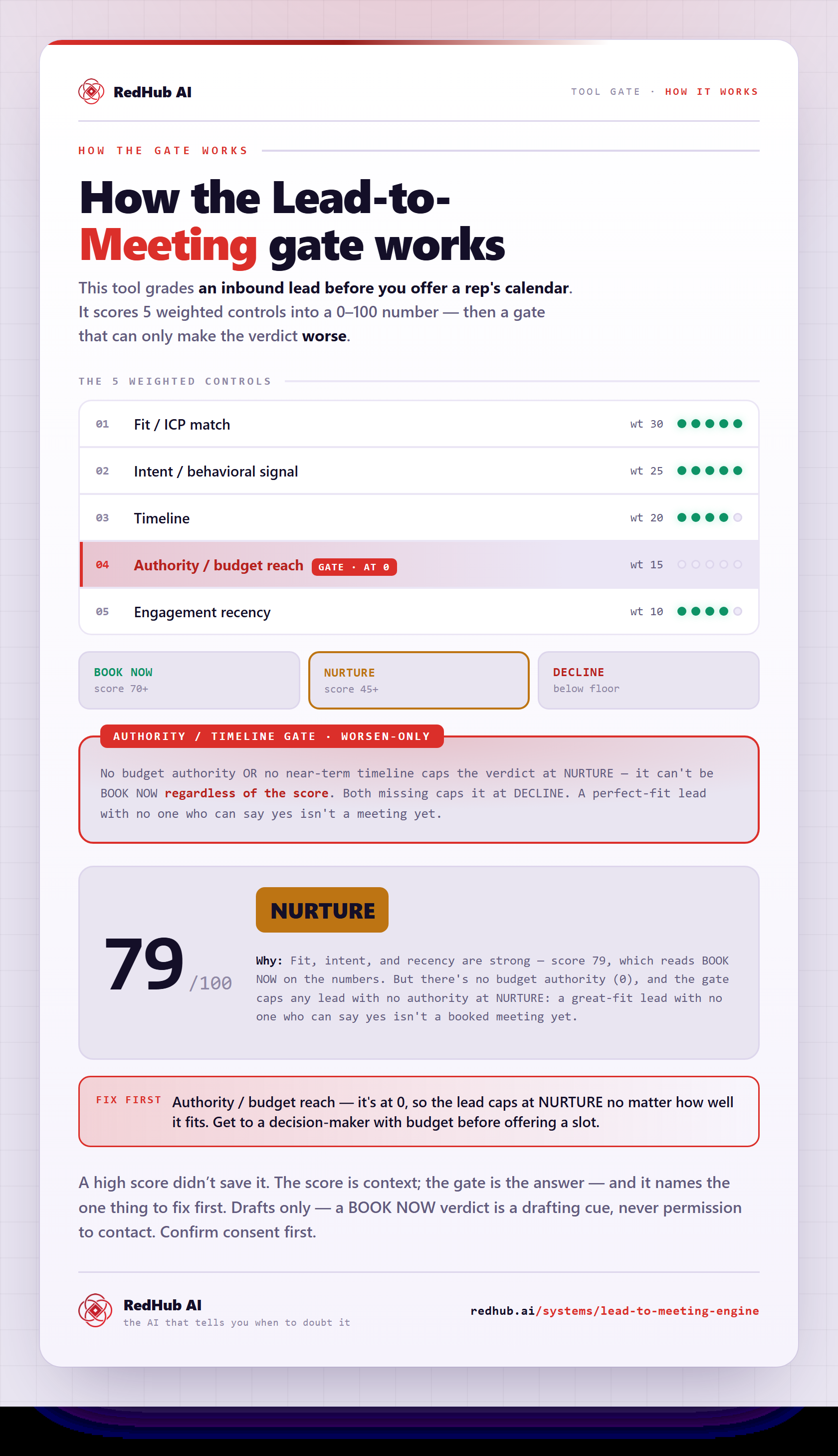
The gate this post refers to, drawn from the tool’s own logic. See the tool.