Meeting-Ready Leads: Who Gets Time on Your Calendar
Todd Brooks, Founder6 min read

Jump to a section9
Meeting-Ready Leads: Who Actually Gets a Slot
TL;DR
- What it is: Meeting-ready leads are the ones worth a slot on your calendar today — right fit, real intent, a live timeline, and someone who can fund the deal.
- Who it's for: Teams offering calls to everyone and wondering why the calendar is full but the pipeline isn't — part of the lead to meeting conversion series.
- How it works: Score five signals with readable weights, then apply one hard gate: no budget authority or no timeline means no slot yet.
- Bottom line: The gate isn't there to reject leads. It's there to protect the meetings from the maybes.
What are meeting-ready leads?
Meeting-ready leads are inbound leads that clear four bars at once: they match your ideal customer, they've shown real buying intent, they're deciding on a near-term timeline, and they can reach the person who controls budget. A lead can be enthusiastic and still not be meeting-ready — enthusiasm without authority or a timeline is a future deal, not a bookable one. The honest move is to score all of it before you offer a slot.
Best for: teams triaging real inbound flow — the Lead-to-Meeting Engine scores every new lead on this exact model and drafts the meeting outreach only for the ones that clear.
A full calendar feels like winning. It often isn't. If your slots are going to leads who can't buy this quarter — or can't buy at all — the meetings are the leak, not the fix. The question that matters isn't "who wants a call?" It's "who is meeting-ready right now?" Answering it takes a model you can read and one rule you won't bend.
Five signals, weighted out loud
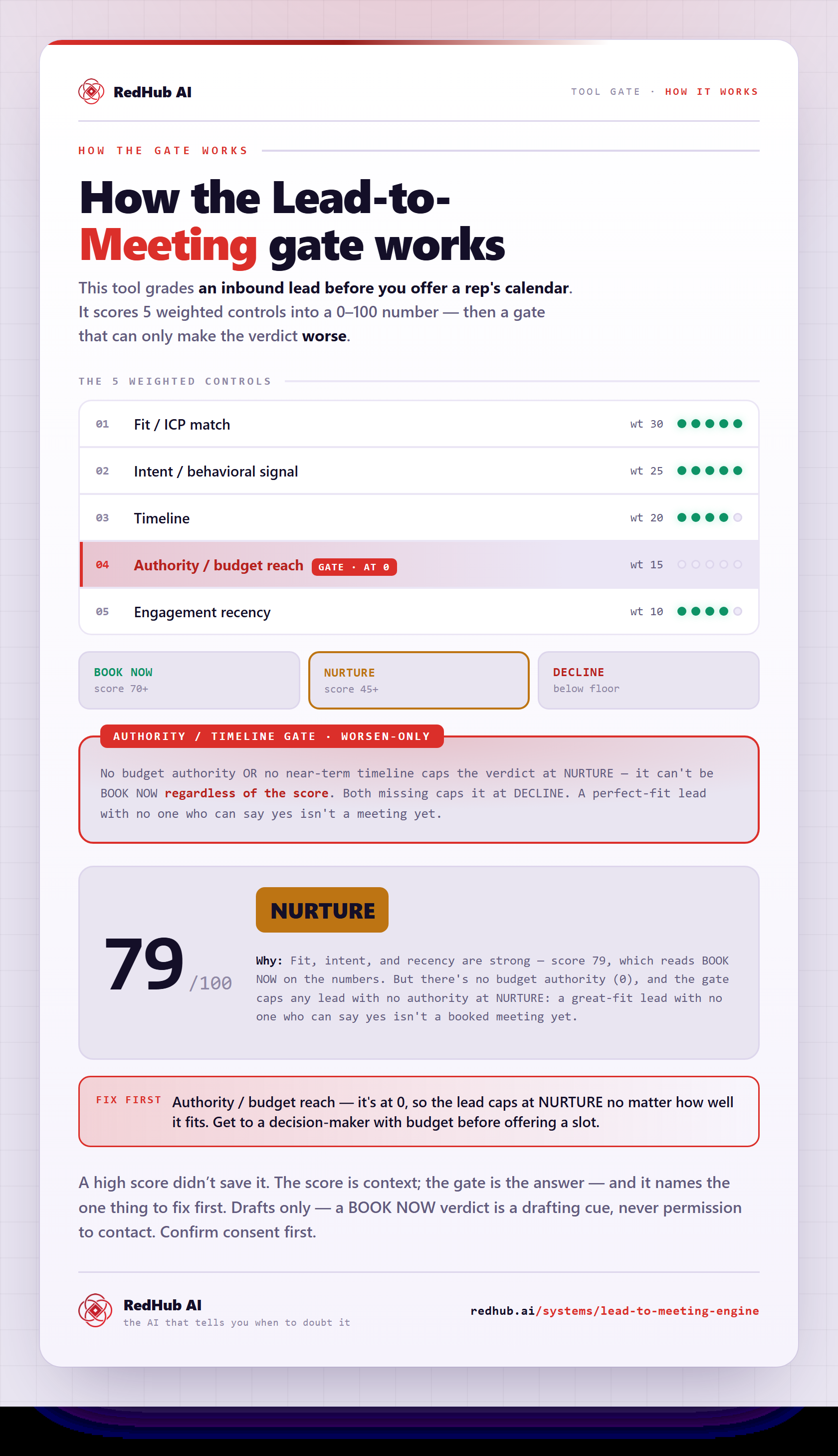
Gut feel scores leads too — it's just unreadable, inconsistent, and biased toward whoever wrote the most enthusiastic form-fill. A better approach: mark each lead 0–5 on five signals, multiply by weights that sum to 100, and get a score you can argue with. Here is the model the Lead-to-Meeting Engine ships:
| Signal | Weight | What you're reading |
|---|---|---|
| Fit / ICP match | 30 | Industry, size, and geography against your ideal customer |
| Intent / behavioral signal | 25 | Pricing-page visits, a demo request, repeat engagement |
| Timeline | 20 | Deciding in the next 30–90 days, or someday |
| Authority / budget reach | 15 | Reaching a decision-maker who can fund it |
| Engagement recency | 10 | Acted this week, or went quiet months ago |
Thresholds: 70 and above is book now — draft the reply, propose times. 45 to 69 is nurture — stay useful, no slot yet. Below 45 is decline — a polite acknowledgment and no rep time. No industry average, no hidden multiplier. Change a mark and the score moves, and you can see why.
The gate: the rule a high score can't buy past
Here's the part most scoring setups skip, and it's the part that protects your calendar. A weighted score can be gamed by strength in the wrong places. A lead with perfect fit and blazing intent can post a 79 — and still have no one who can sign and no date they're deciding by. That lead will take a great meeting. They will take three. Nothing will close, because nothing could.
So the model adds a hard gate on top of the score: no budget authority or no near-term timeline caps a lead below book-now, no matter the score. Both missing caps it at decline. In the engine's shipped eight-lead sample, this is visible in the output: a SaaS lead scoring 79 and a realty lead scoring 77 — both above the 70 threshold — are held at nurture by the gate, one for missing budget authority, one for missing timeline. The gate names its reason on each one.
Key insight: the gate holds and releases. It isn't a blacklist — the moment that 79-scoring lead gets budget authority, it clears to book-now cleanly. Capping a lead at nurture isn't rejecting them. It's booking the meeting at the only time it can actually go somewhere.
What each verdict gets
The verdict is only useful if it changes what you send. Three verdicts, three different next moves:
- Book now → the meeting ask, fast. A first-touch reply in your voice proposing two or three real open times, out inside the hour. Speed matters most for exactly these leads — see speed to lead, and the reply anatomy in the first email that books the meeting.
- Nurture → value first, no calendar link. A useful note that helps them whether or not they ever book, on a patient cadence — the structure is in the follow-up sequence that books meetings.
- Decline → one polite close. A courteous acknowledgment, no rep time, no sequence. Saying no to the wrong leads is what funds the first-hour sprint for the right ones.
That last point is the economics of the whole thing. Industry figures typically suggest a large share of sales hours go to leads that never had a shot. Every hour the decline verdict recovers is an hour your book-now leads get inside their first-hour window.
Running the model without a spreadsheet ritual
You could score every lead by hand each morning. Nobody keeps that up past week two. The Lead-to-Meeting Engine runs it as a workflow: four Claude Skills read new inbound leads through your own HubSpot or GoHighLevel CRM and Gmail, score each one on the five-signal model with the gate, draft the meeting outreach for the leads that clear, and assemble a prioritized queue. Under the Skills is a runnable Python engine — zero dependencies, works offline — and an .xlsx workbook that reproduces every number, so you can audit any verdict by hand.
It shares its five-signal model with the Inbound Lead Qualification Engine — that tool returns the verdict as a grading system; this one acts on the verdict and drafts the meeting outreach for the leads that clear. And one boundary worth repeating: a book-now verdict means a lead is worth your time, not that outreach is automatically permitted — for dormant or cold lists, run the Database Reactivation Readiness Engine first.
Give your calendar a bouncer
The Lead-to-Meeting Engine ($149, one-time) scores every new lead, applies the gate, and drafts the meeting ask only for the ones that can actually buy. Engine and workbook included — every number reproducible.
Get the Lead-to-Meeting Engine — $149 →Prioritization is one of three leaks between "lead in" and "meeting booked." The full map is in the pillar guide: how to turn leads into booked meetings.
Decision Guide
Use this model if: you get more inbound leads than you can meet with, and your calendar keeps filling with calls that go nowhere.
Skip it if: you get a handful of leads a month and can genuinely give every one a thoughtful reply — you don't need triage yet; you need speed.
Best first step: re-score last month's booked meetings against the gate. Count how many had no budget authority or no timeline when you booked them. That's your calendar leak.
FAQ
What makes a lead meeting-ready?
Four things at once: fit with your ideal customer, demonstrated intent, a decision timeline in roughly the next 30–90 days, and access to whoever controls the budget. Recency of engagement rounds it out. Strong on two and missing the others isn't ready — it's nurture.
Why shouldn't I just book everyone who asks for a call?
Because meetings with leads who can't buy consume the hours your buyable leads needed — and the fastest-decaying leads are the ready ones. A full calendar of unfundable conversations feels productive and produces nothing.
What if a lead scores high but has no budget?
The gate caps it at nurture, whatever the score. In the engine's shipped sample, a 79-scoring lead is held at nurture for exactly this reason, with the reason named. When budget authority appears, the same lead clears to book-now cleanly.
Can I change the weights and thresholds?
Yes — the model is exposed, not hidden. The five weights (30/25/20/15/10) sum to 100, and the .xlsx workbook reproduces the engine's scoring so you can see and audit exactly how each verdict was reached.
Is this the same as lead qualification?
It's qualification pointed at one decision: does this lead get a meeting slot today? The Inbound Lead Qualification Engine shares the same five-signal model as a grading system; the Lead-to-Meeting Engine takes the verdict and drafts the meeting outreach.
Does this score people, like job applicants or tenants?
No, and it shouldn't be used that way. It scores sales leads — companies and buying situations — never people in protected domains like hiring or tenant screening.
Score first. Then spend the calendar.
Five readable signals, one honest gate, and a drafted meeting ask for every lead that clears — reviewed and sent by you.
Get the Lead-to-Meeting Engine — $149 →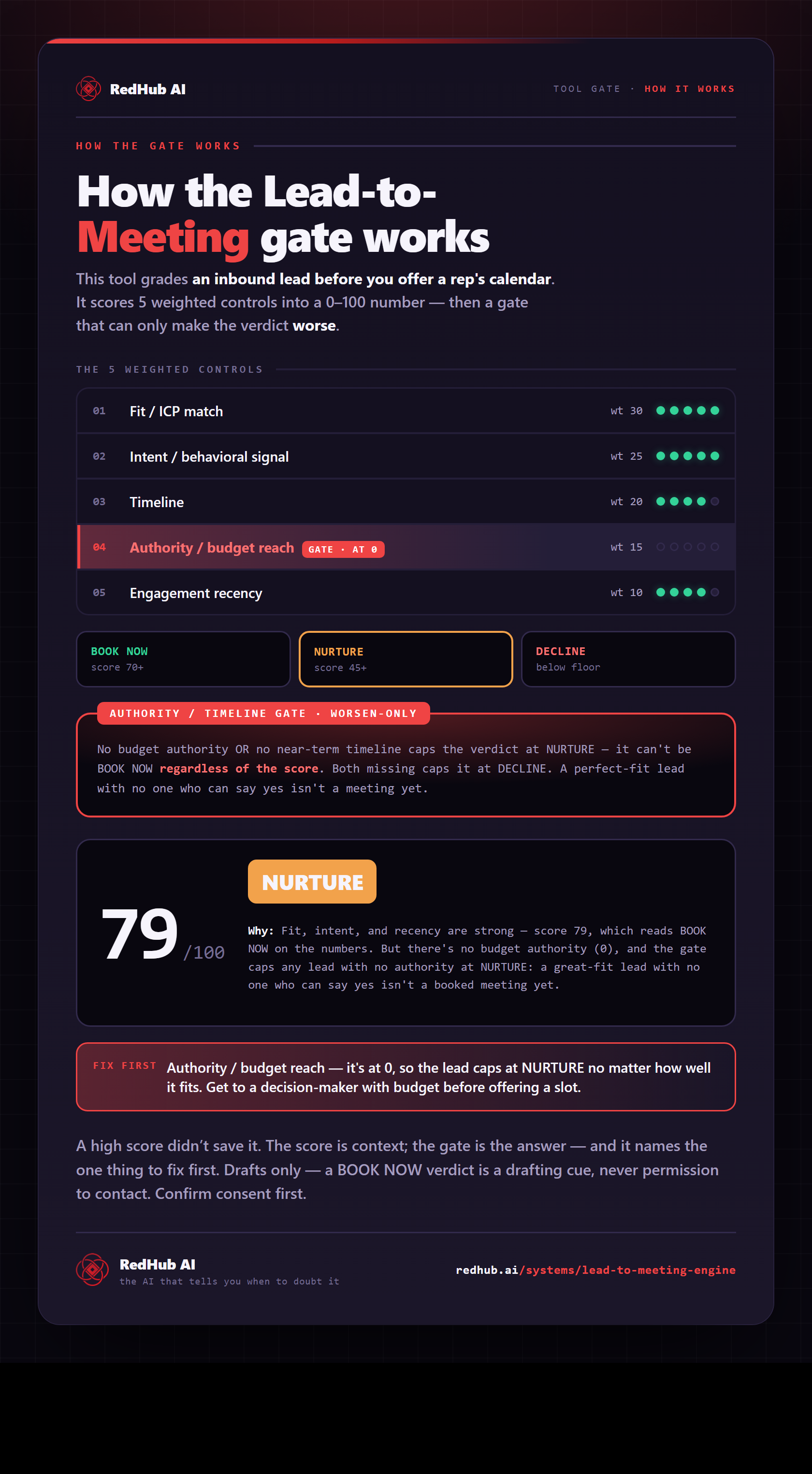
The gate this post refers to, drawn from the tool’s own logic. See the tool.