Max CPL: The Number That Decides Which Paid Channels to Keep
RedHub AI Editorialupdated October 7, 20265 min read

Jump to a section7
Max cost per lead is a per-channel number: your gross profit per new customer times the share of that channel's leads who become customers. It is the same math as breakeven cost per lead, put to a different use. Breakeven tells you where one line sits. Max CPL lets you rank channels against each other, because each channel's lead price is read against its own ceiling. Work it out with one blended conversion rate and the ranking can come out backwards, as the example below shows.
TL;DR: Max CPL = gross profit per new customer × that channel's lead-to-customer conversion rate. A channel well under its own max is a candidate to scale. One at or over it is a candidate to cut. A single blended line hides both. The Paid-Lead Breakeven Line ($49) computes a breakeven line and a profit line and reads each source against them; it uses one pair of rates, so run it per channel when yours differ. Start with the pillar: How to Find Your Cost-Per-Lead Breakeven.
One offer, three channels
A hypothetical business makes $500 of gross profit on each new customer. It runs the same offer on three channels. Each converts at a different rate, so each has a different max CPL.
| Channel (hypothetical) | Conversion rate | Max CPL | CPL paid | Call |
|---|---|---|---|---|
| Google Search | 5% | $25 | $18 | Scale: $7 under its max |
| Meta | 3% | $15 | $14 | Hold: $1 under its max |
| 2% | $10 | $22 | Cut: more than double its max |
Cover the Max CPL column and Meta looks like the best channel at $14. LinkedIn at $22 costs 57% more, which sounds like a premium you could live with. Now read each price against its own ceiling. Google has room. Meta is one dollar from losing money before any overhead. LinkedIn pays $22 for leads worth $10.
Turn the lead prices into what each channel spends on leads per customer and it gets plainer. Google spends $360 to win a customer worth $500. Meta spends about $467. LinkedIn spends $1,100 to earn $500.
What a blended line gets wrong
Suppose the three channels send the same number of leads and you use one conversion rate for all of them. The blended rate is about 3.3%, and the single max CPL is about $16.67.
Against that one line, Meta at $14 passes with room, and Google at $18 reads as over the line. That is the reverse of the truth. Google is the channel to grow and Meta is the one a dollar from the edge. A blended rate sets the ceiling too low for your best channel and too high for your worst.
The catch with per-channel rates
Splitting by channel is right, and it costs you sample size. A channel's 2% might be 1 customer from 50 leads. One more sale makes it 4% and doubles the max CPL from $10 to $20, which would put a $22 lead only just over the line. One sale changed the call from "cut" to "almost fine."
So the per-channel figure is the correct one to want and often the least certain one you have. Smaller channels get there last. Until a channel has enough leads to trust, treat its max CPL as a rough range, and be slower to cut on it than the table suggests. There is no clean rule for how many leads is enough. More than 10 is a floor, not a comfort.
What max CPL leaves out
Max CPL is a ceiling on the price of one lead. It does not include sales hours, tools or the time it takes for a customer to pay you back. Those belong to CAC and payback period, which our post on cost per lead vs cost per acquisition covers. A channel under its max CPL has passed the first test only.
How the Paid-Lead Breakeven Line handles it
The Paid-Lead Breakeven Line ($49) takes client value, qualified-lead rate, close rate and a target margin. It computes a breakeven cost per lead and a lower profit line, then reads each source PROFITABLE, THIN or UNDERWATER. A source under 10 leads reads INSUFFICIENT DATA. A source with zero clients reads UNDERWATER however cheap its leads are.
Know one thing going in: the kit sets one line for the whole business. Its rates are entered once, not per source, and a source's own close count only changes its verdict when that count is zero. To get the per-channel max CPL this post describes, enter one channel's rates, read that channel's row, and repeat. The workbook holds 12 source rows, and a bonus Python script grades a longer list from a CSV.
Read every source against your line
The Paid-Lead Breakeven Line computes your breakeven cost per lead and profit line from your own numbers and reads each source PROFITABLE, THIN or UNDERWATER, with the monthly spend sitting in underwater sources. One .xlsx. Not financial advice.
Get the Paid-Lead Breakeven Line — $49Pairs well with
The Lead Source ROI Scorecard ($49) grades each source after the fact on qualified-lead rate, cost per qualified lead, close rate and ROAS, and returns SCALE, FIX or CUT. The CAC & Payback Calculator ($49) adds CAC, payback period and LTV:CAC per acquisition channel. For a channel you decide to keep working on, the Paid Ads Creative & Testing System ($89) includes a one-variable test matrix and a significance check that says whether a winning ad is real yet.
More in this guide
What is max cost per lead?
It is the most you can pay for a lead on a channel before that lead costs more than it returns: gross profit per new customer times that channel's lead-to-customer conversion rate. At $500 of gross profit and a 5% rate, max CPL is $25.
Is max CPL different from breakeven CPL?
The math is the same. Breakeven is the name for the line itself. Max CPL is that line worked out per channel so you can compare channels by how far each one sits from its own ceiling.
Why not compare channels by cost per lead?
Because channels convert at different rates. In the example, a $14 lead is $1 under its $15 max while an $18 lead is $7 under its $25 max. The cheaper lead is the riskier buy.
Can I use one blended conversion rate for every channel?
It will mislead you when channels differ. In the example, a blended rate of about 3.3% gives one line of about $16.67, which reads the best channel as over the line and the channel a dollar from its limit as safe.
What should I do with a channel right at its max CPL?
Hold it and do not add budget. Max CPL is measured before sales time and tools, so a channel at the line loses money once those are counted.
How many leads does a channel need before I trust its max CPL?
There is no clean rule. With 50 leads, one extra sale moves a 2% rate to 4% and doubles the ceiling from $10 to $20. Treat a small channel's figure as a range and be slower to cut on it.
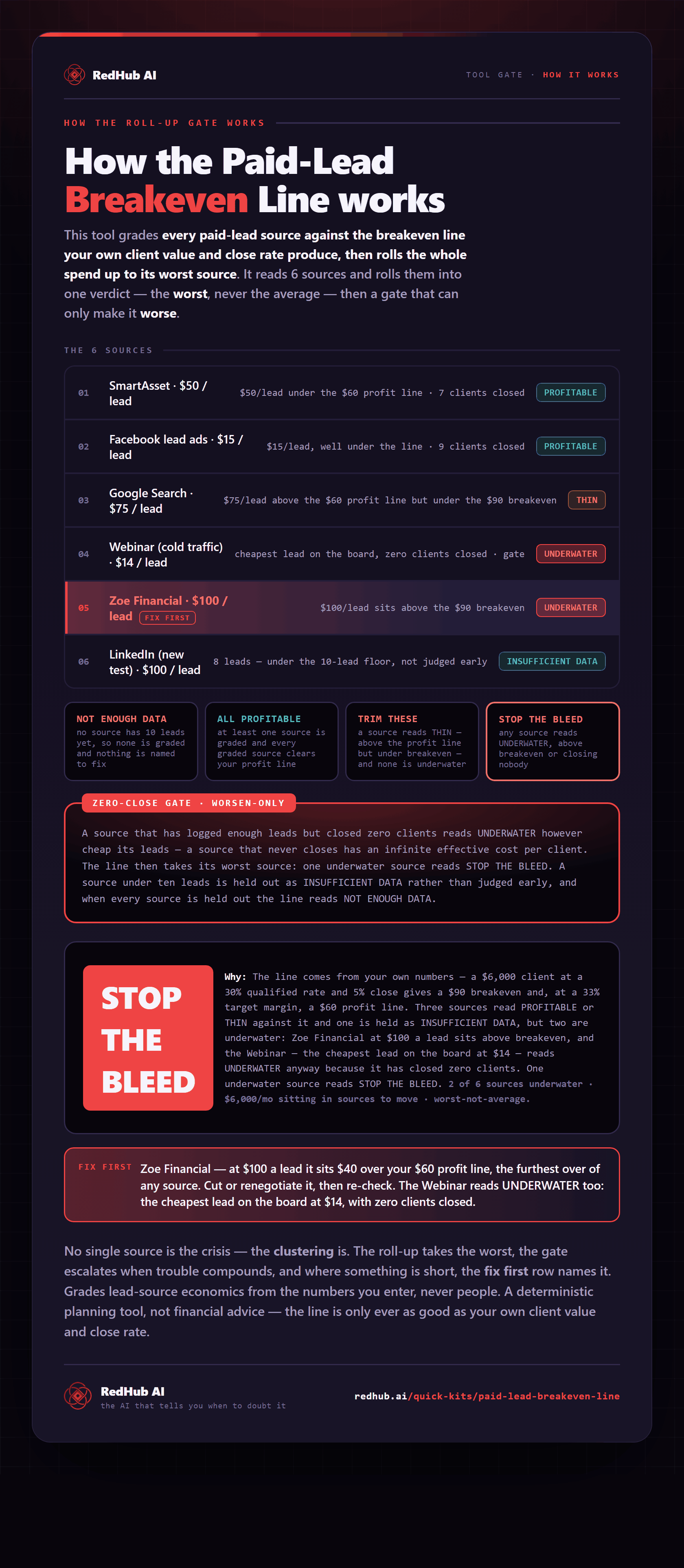
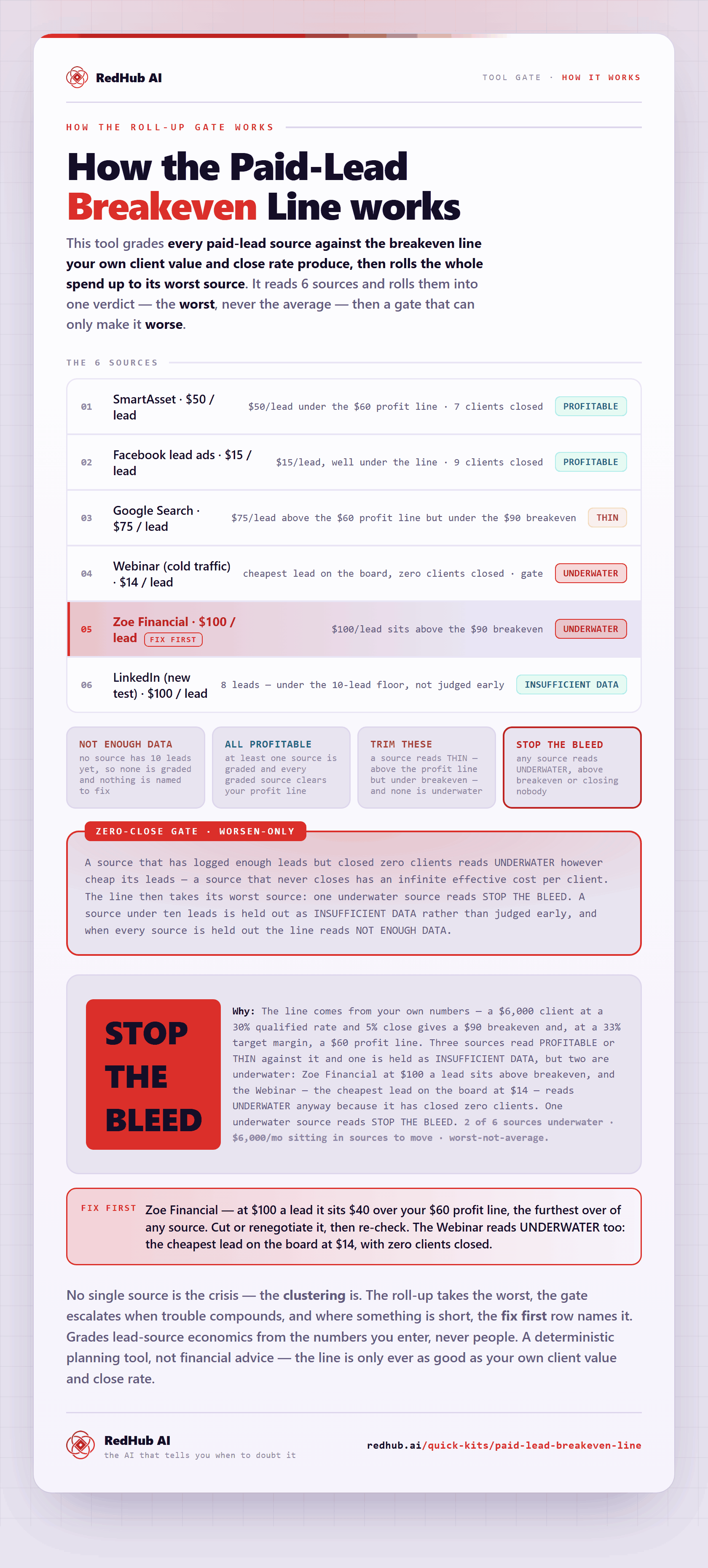
The gate this post refers to, drawn from the tool’s own logic. See the tool.