Cost Per Lead vs. Cost Per Acquisition: Know the Difference
RedHub AI Editorialupdated October 7, 20265 min read

Jump to a section7
Cost per lead vs cost per acquisition comes down to what you divide by and what you count as spend. Cost per lead (CPL) is one channel's ad spend divided by the leads it sent. Cost per acquisition, in the sense this post uses it, is customer acquisition cost (CAC): all sales and marketing spend divided by the customers you won. CPL stops at the form fill. CAC keeps counting until the sale closes, so it picks up sales hours and tools that CPL never sees. A channel can pass on one and fail on the other.
TL;DR: CPL prices one lead on one channel. CAC prices one customer across everything you spend to win them. A channel can sit under its breakeven CPL and still lose money once sales time is added. Check which one your ad platform is reporting, because its "cost per acquisition" may be a cost per lead. The Paid-Lead Breakeven Line ($49) handles the per-lead ceiling, and the CAC & Payback Calculator ($49) handles CAC and payback. Start with the pillar: How to Find Your Cost-Per-Lead Breakeven.
Side by side
| Cost per lead (CPL) | Cost per acquisition (CAC) | |
|---|---|---|
| Unit | One lead | One paying customer |
| Spend counted | That channel's ad spend | Ad spend, salaries, commissions, tools |
| Divided by | Leads received | New customers won |
| Question it answers | Can I afford this channel's lead price? | Does winning a customer pay? |
| Read it against | Breakeven CPL (gross profit × conversion rate) | Gross profit per customer and payback period |
CPL has a ceiling you can work out from two numbers. CAC is a sum of real costs with a judgment call inside it: what counts as spend. Our post on how to calculate customer acquisition cost walks through that choice.
How a passing CPL hides a failing CAC
Take a hypothetical business that makes $500 of gross profit per new customer. One channel converts 5% of its leads, so its breakeven CPL is $25. The channel delivers leads at $18. On the per-lead test it passes with $7 to spare.
Now follow those leads to the sale. At 5%, it takes 20 leads to win one customer, so the business spends $360 on leads per customer. That leaves $140 of the $500.
A rep spends 15 minutes on each of the 20 leads, which is 5 hours per customer won. At a loaded cost of $40 an hour, that is $200. CAC for this channel is $560 against $500 of gross profit. The channel loses $60 on every customer while its lead price looks healthy.
Your ad platform may be using the wrong word
Ad platforms report a cost per conversion, often labeled cost per acquisition or CPA. The conversion is whatever you told the platform to count. If yours is a form fill or a booked call, the platform's "cost per acquisition" is your cost per lead under another name.
The mix-up causes real trouble. A founder sees a $40 CPA in the ad account, compares it with $500 of gross profit, and concludes the channel is printing money. But $40 bought a lead. At a 5% conversion rate it takes 20 of them to win a customer, which is $800.
The fix sounds easy: send closed sales back to the platform and count those. In practice the sale often happens weeks later, on a phone call, in a CRM that is not connected to the ad account. That loop is easy to leave open. If you cannot close it, keep both numbers yourself and label them by what they count.
Which one to use for which decision
Use CPL against its breakeven for the fast call: is this channel's lead price one I can afford at all? It needs only ad spend and lead counts, so you can check it as often as new leads arrive.
Use CAC for the slower call: does this channel, with everything it costs me to work its leads, pay back? It needs closed sales and sales cost, which take longer to come in. Our post on CAC payback period covers how long that payback takes.
Neither replaces the other. A channel that fails the CPL test will not pass the CAC test on the same gross profit figure, since CAC only adds cost. A channel that passes CPL has earned a closer look.
Where the Paid-Lead Breakeven Line stops
The Paid-Lead Breakeven Line ($49) works on the lead side only. From your client value, qualified-lead rate, close rate and target margin, it computes a breakeven cost per lead and a lower profit line, then reads each source PROFITABLE, THIN or UNDERWATER. It does not ask for sales hours or tool costs, so it cannot see the $200 in the example above. The target margin is where you leave room for them. Its worked example sets that margin at 33%.
Set the lead-price ceiling first
The Paid-Lead Breakeven Line computes the most you can pay per lead from your own numbers and reads each paid source PROFITABLE, THIN or UNDERWATER against it. One .xlsx. It does not calculate CAC. Not financial advice.
Get the Paid-Lead Breakeven Line — $49Pairs well with
The CAC & Payback Calculator ($49) is the other half of this post: CAC, payback period, LTV and LTV:CAC per acquisition channel, with an invest, hold or cut verdict and a blended CAC. The Inbound Lead Qualification Engine ($99) scores each lead PURSUE NOW, NURTURE or DISQUALIFY, which helps decide where those 15 minutes go. The Lead Response-Time Revenue Calculator ($39) turns your current and achievable contact rates into the customers and revenue faster response would capture.
More in this guide
What is the difference between cost per lead and cost per acquisition?
Cost per lead is one channel's ad spend divided by the leads it sent. Cost per acquisition, or CAC, is all sales and marketing spend divided by new customers won. CPL stops at the lead. CAC includes the sales time and tools it took to close.
Can a channel have a good CPL and a bad CAC?
Yes. In the example, an $18 lead sits under a $25 breakeven, but 20 leads per customer cost $360 and 5 hours of sales time add $200. CAC is $560 against $500 of gross profit.
Is the CPA in my ad account the same as CAC?
Usually not. An ad platform's cost per acquisition is the cost of whatever conversion you set it to count. If that conversion is a form fill or a booked call, the figure is your cost per lead.
Which should I check more often?
CPL. It needs only ad spend and lead counts, so you can check it as often as new leads arrive. CAC needs closed sales and sales cost, which come in more slowly.
If a channel passes the CPL test, is it safe to scale?
Not yet. Passing means the lead price is affordable before sales cost. Add the cost of working those leads and check CAC before you raise the budget.
Does the Paid-Lead Breakeven Line calculate CAC?
No. It computes a breakeven cost per lead and a profit line and reads each source PROFITABLE, THIN or UNDERWATER. It does not take sales hours or tool costs. This is general information, not financial advice.
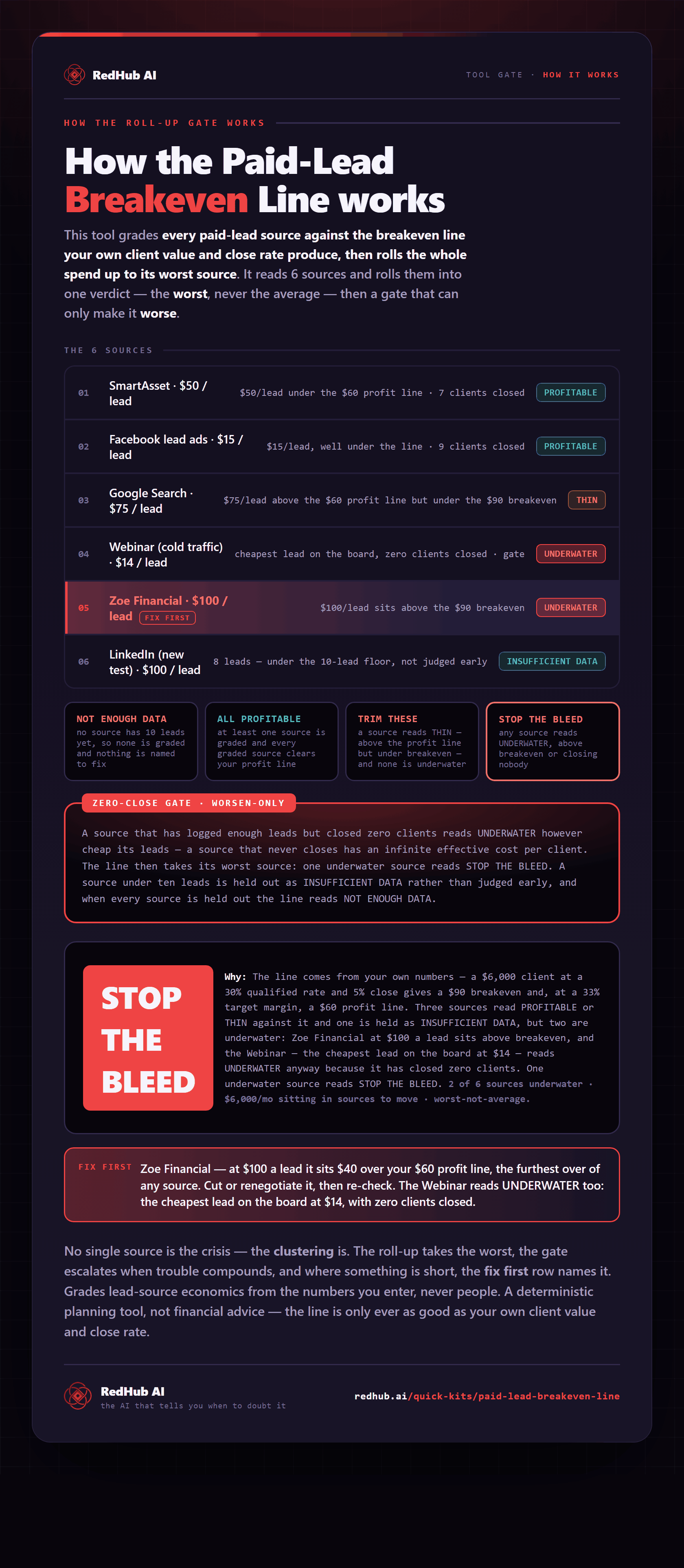
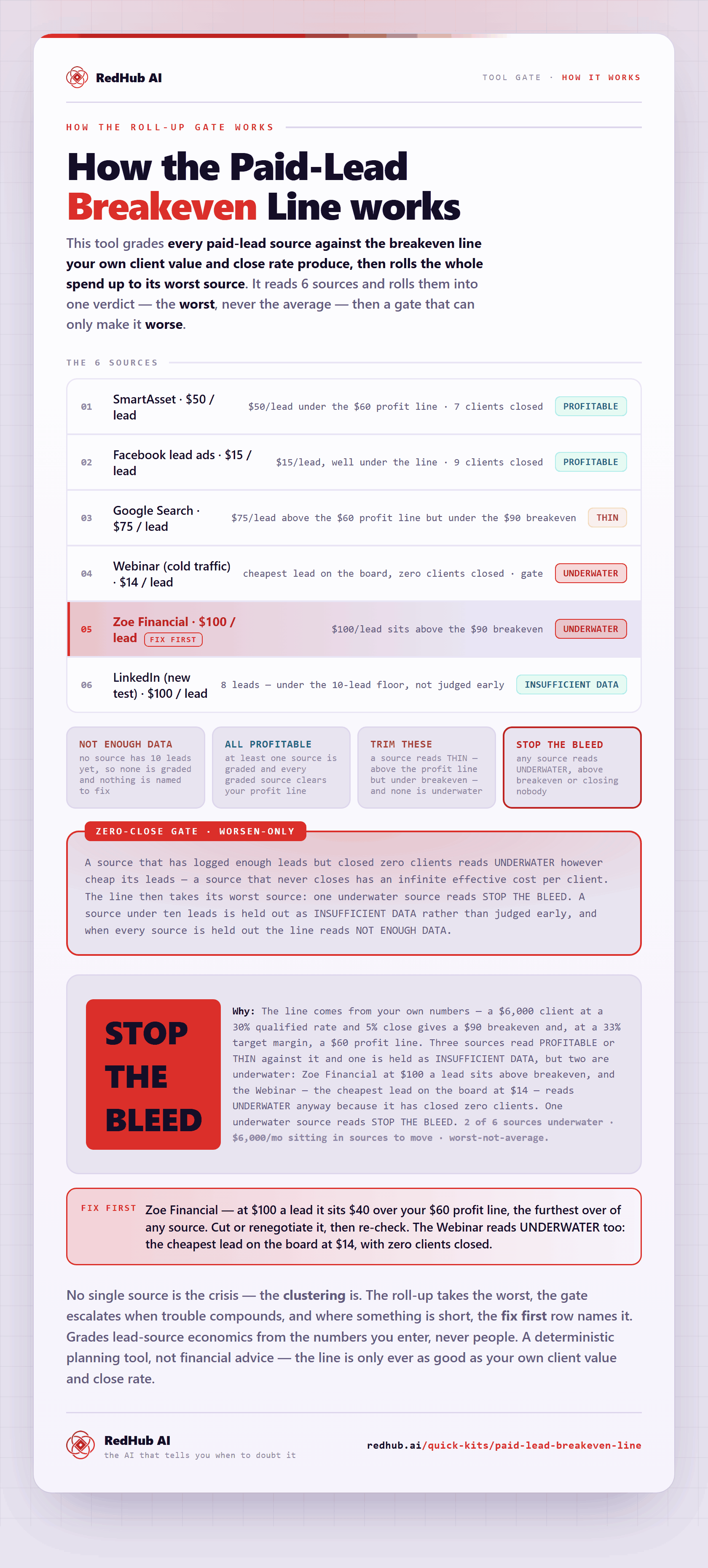
The gate this post refers to, drawn from the tool’s own logic. See the tool.