When to Scale (or Kill) a Paid Channel
RedHub AI Editorialupdated October 7, 20266 min read

Jump to a section7
The short rule for when to kill an ad campaign: cut it once its cost per lead has held at or above your breakeven for several checks in a row and you have ruled out a temporary cause. Scale it when the cost per lead sits well under breakeven and the trend is flat or falling. Both halves depend on a breakeven line you have worked out in advance. Without one, the call gets made on the day the chart looks bad. There is also one case where the rule misfires, and it catches new campaigns most often.
TL;DR: Check each channel on a schedule, against its breakeven cost per lead (gross profit per new customer × conversion rate). Well under the line and steady: scale. At or over the line for several checks with no temporary cause: cut. Right at the line: hold, with a deadline. Before cutting a new campaign for closing nothing, make sure its leads have had time to close. The Paid-Lead Breakeven Line ($49) reads each source PROFITABLE, THIN or UNDERWATER against your line. Start with the pillar: How to Find Your Cost-Per-Lead Breakeven.
Four questions, asked on a schedule
Let lead volume set the schedule. A channel is ready for a check when it has enough new leads to say something, and 10 is a bare minimum. A busy channel might reach that weekly. A small one might need a month.
- Where is cost per lead against breakeven? Well under, at the line, or over it.
- Which way is it moving? A channel $5 under breakeven and climbing $2 a check crosses the line on the third check. A channel flat at $5 under for two months is a different animal.
- Is there enough volume to matter? A channel under the line that sends three leads a month is not worth scaling effort, and not worth an urgent cut either.
- Did something outside your account change? A seasonal rush in the ad auction or a new competitor bidding on your terms can lift cost per lead for a few weeks and then pass.
The scale signal
Scale a channel that runs well under its breakeven, with a flat or falling cost per lead across your last few checks. "Well under" matters because breakeven is measured before sales time and tools. A channel $1 under the line has no room left once those are counted.
Decide the gap before you look at the channel. Pick the margin you want and draw a second line below breakeven. With a $20 breakeven and a 33% margin, that line is $13.40. A channel at $12 has cleared it. A channel at $17 is under breakeven and still not a scale candidate.
Scaling also changes the number you scaled on. More budget can mean colder audiences at higher prices, so raise spend in steps and run the check again after each one.
The kill signal
Cut a channel that has sat at or above breakeven for several checks in a row, once you have asked question four and found no temporary cause. Over the line, every lead costs more than it returns. That is true before overhead, so no amount of "the leads feel good" changes it.
Two reactions get this wrong. One is pausing the campaign the same afternoon a bad number shows up. The other is explaining the number away for three months. A schedule protects you from both.
When the rule misfires: leads that have not had time to close
Every number above depends on a conversion rate, and a conversion rate needs closed sales. If your sales cycle runs 45 days and a campaign is three weeks old, it has closed nothing. Its measured conversion rate is 0%. By the rule, it is the worst channel you have.
It may be. Or it may be your best channel, three weeks early. You cannot tell yet.
The honest options are both imperfect. You can judge a new campaign by an earlier step, such as the share of its leads that sales marks as qualified, and accept that a qualified lead is a guess about a customer. Or you can wait out one full sales cycle and accept the spend in the meantime. Capping the test budget makes the second option cheaper. It does not make the answer arrive sooner.
The same lag bends your older channels a little, too. Leads from the most recent weeks drag every rate down. When you can, measure conversion on leads old enough to have closed.
How the Paid-Lead Breakeven Line reads it
The Paid-Lead Breakeven Line ($49) computes a breakeven cost per lead and a lower profit line from your client value, qualified-lead rate, close rate and target margin. Each source reads PROFITABLE at or under the profit line, THIN between the two lines, or UNDERWATER above breakeven. Those bands sit close to the scale, hold and cut signals in this post. The kit also totals the monthly spend in UNDERWATER sources and, where a source is thin or underwater, names the one to cut first.
Two of its rules touch the lag problem directly. A source with fewer than 10 leads reads INSUFFICIENT DATA. A source with 10 or more leads and zero clients reads UNDERWATER however cheap its leads, and the kit does not know how long your sales cycle is. A three-week-old campaign with 40 leads and no closes will read UNDERWATER. Whether that is a verdict or just the calendar is your call.
The kit reads one period at a time against a date you type in. It does not chart a trend. For question two, save a copy at each check and compare them yourself.
Put a line under every paid source
The Paid-Lead Breakeven Line computes your breakeven cost per lead and profit line from your own numbers and reads each source PROFITABLE, THIN or UNDERWATER, with the monthly spend sitting in underwater sources. One .xlsx. Not financial advice.
Get the Paid-Lead Breakeven Line — $49Pairs well with
Before cutting a channel that is close to the line, the Paid Ads Creative & Testing System ($89) gives you a one-variable test matrix and a significance check for whether a new ad is a real winner. The Lead-Capture Page Kit ($79) grades the opt-in page the traffic lands on 0 to 100 and returns GO LIVE, TIGHTEN or REWORK. For a channel you scale, the Lead-to-Meeting Engine ($149) scores new leads BOOK NOW, NURTURE or DECLINE and drafts a first reply proposing open times read from your own Google Calendar. It reads and drafts only; you send and book.
More in this guide
When should I kill an ad campaign?
When its cost per lead has held at or above your breakeven for several checks in a row and no temporary cause, such as a seasonal auction rush or a new competitor, explains it. Over breakeven, each lead costs more than it returns.
When is it safe to scale a paid channel?
When its cost per lead sits well under breakeven with a flat or falling trend. Set the gap in advance with a margin. A $20 breakeven and a 33% margin give a working line of $13.40. Raise spend in steps and check again after each one.
How often should I run the check?
Let lead volume decide. Check a channel when it has enough new leads to say something, with 10 as a bare minimum. A busy channel may reach that weekly and a small one monthly.
What if a channel sits right at breakeven?
Hold it with a deadline. At the line it loses money once sales time and tools are counted. Give it one more check, then scale, hold or cut on the trend.
My new campaign has closed nothing. Should I cut it?
Not until its leads have had time to close. If your sales cycle is 45 days and the campaign is three weeks old, a 0% conversion rate says nothing yet. Judge it by an earlier step, or cap the budget and wait out one sales cycle.
Could a rising cost per lead be temporary?
Yes. A seasonal rush in the ad auction or a new competitor bidding on your terms can lift it for a few weeks. Rule those out before you cut, and do not use them as a reason to wait for months.
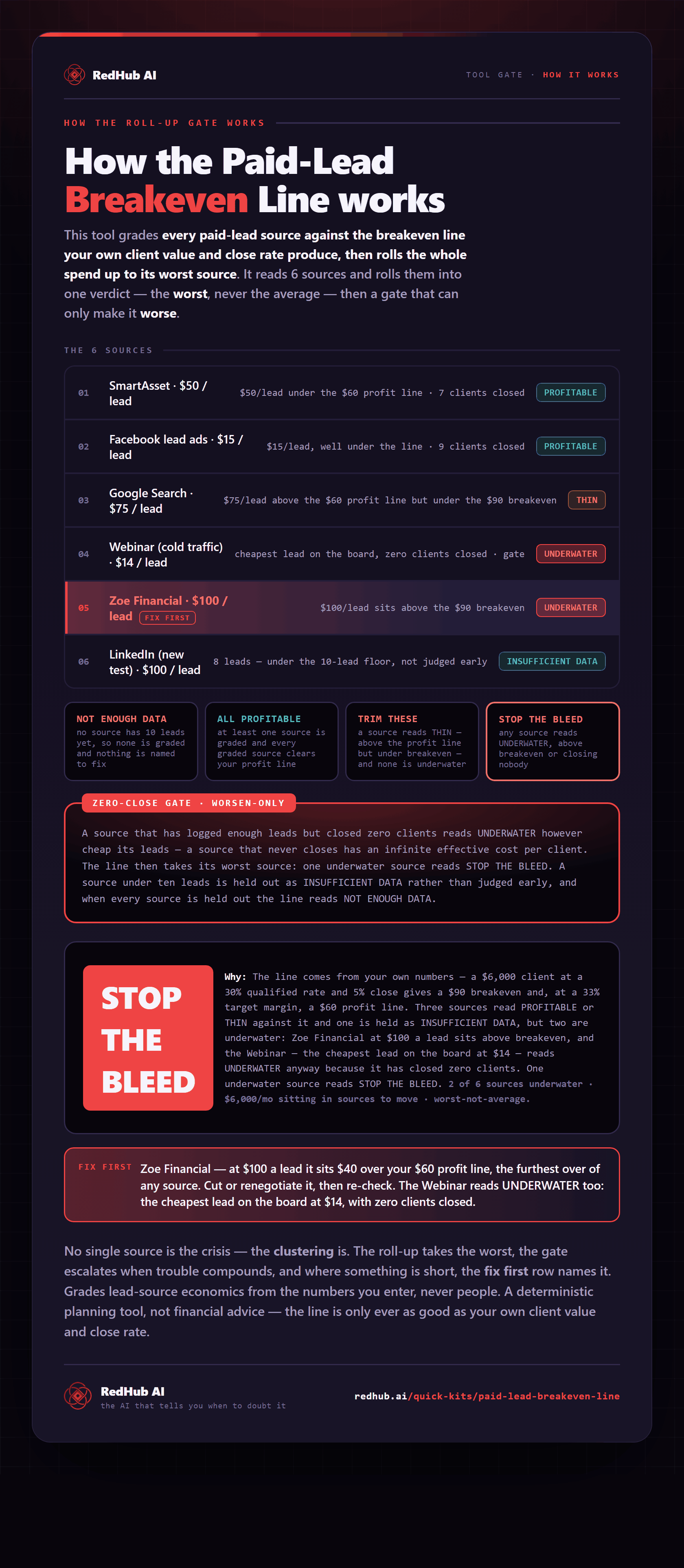
The gate this post refers to, drawn from the tool’s own logic. See the tool.