MCP Security: How to Vet a Server Before You Install It
RedHub AI Editorialupdated August 18, 20265 min read

Jump to a section10
- TL;DR
- What is MCP security?
- What is MCP, and why does it need its own security check
- The supply-chain risk: clean today, poisoned tomorrow
- What's worth checking before you install a server or skill
- Quick self-check: which agent attack surfaces are you exposed on?
- MCP security and the agentic kill-chain
- What a trust gate does — and doesn't do
- Decision Guide
- FAQ
TL;DR
- What it is: MCP security means grading a Model Context Protocol server or agent skill before you trust it with your agent — the supply-chain surface of agentic AI.
- Who it's for: anyone connecting a third-party MCP server, tool, or skill to an agent — see the MCP Server & Skill Trust Gate.
- How it works: a server can pass review clean and ship a malicious update later, so vetting has to be ongoing, not a one-time approval.
- Bottom line: every MCP server you install runs with your agent's trust and reach — treat it like a supply-chain decision, not a plugin toggle.
What is MCP security?
MCP (Model Context Protocol) is the emerging open standard that lets an AI agent connect to third-party tools and data sources. MCP security means grading a server or agent skill before you install it, because once connected, that server runs with the same trust and access as your agent — a compromised or later-poisoned server can act on the agent's behalf. It's the supply-chain attack surface unique to agentic AI: the risk isn't just what you write yourself, it's everything you plug in.
Best for: teams connecting any third-party MCP server or skill to a production agent — the MCP Server & Skill Trust Gate grades it before you install.
MCP security is the least talked-about of the four agentic attack surfaces, and it's also one of the easiest to skip past — installing a new tool for an agent often feels like flipping a switch, not making a security decision. But every MCP server or skill you connect is code you didn't write, running with your agent's own trust and reach. This guide covers what MCP is, why the supply-chain risk is different from a normal dependency, and what's worth checking before you install.
What is MCP, and why does it need its own security check
Model Context Protocol is an open standard that gives an AI agent a common way to connect to outside tools — a calendar, a database, a search engine, a company's internal system. Before MCP, every integration was custom and one-off. Now an agent can connect to any MCP-compatible server in minutes. That speed is the point, and it's also the risk: the same standard that makes connecting easy makes it easy to connect something you haven't actually vetted.
The supply-chain risk: clean today, poisoned tomorrow
The pattern security teams call a "rug pull" applies directly here. A server can pass your review clean — reasonable permissions, a legitimate-looking publisher, no red flags — and ship a malicious update months later, once enough agents depend on it that removing it is painful. Or the compromise happens further upstream, in a dependency the server itself relies on, without the publisher doing anything wrong. Either way, a one-time approval at install time doesn't cover the server's entire lifetime.
Key insight: the install decision isn't "is this server safe right now" — it's "how would I know if this server stopped being safe." If there's no good answer, that's the gap to close first.
What's worth checking before you install a server or skill
- Who publishes it, and can you verify that identity — not just a display name.
- What permissions it actually requests versus what your agent's task needs.
- Whether the version is pinned, or the server can silently update underneath you.
- Whether it can read or write outside the scope it was installed for.
- What track record or community signal exists beyond the publisher's own claims.
- How fast you could revoke its access if something looked wrong tomorrow.
Quick self-check: which agent attack surfaces are you exposed on?
MCP and skill trust is one of four surfaces an agent gets compromised through. Check the boxes that apply to your agent to see, directionally, how many surfaces are live for you right now — this is a self-check, not a security audit.
Does your agent do any of the following?
MCP security and the agentic kill-chain
An untrusted or compromised MCP server is one of the most common ways an attack reaches an agent in the first place — either by directly executing malicious actions, or by feeding the agent content that carries a hidden instruction. See Prompt Injection: What It Is and How to Stop It for how that plays out once it's inside. And whatever a compromised server can do is bounded by the credentials the agent holds — see Non-Human Identity Security.
What a trust gate does — and doesn't do
What it does
- Grades a server or skill on trust signals before install
- Names the one control to fix first where a control is short
- Gives a repeatable standard across every tool you connect
What it isn't
- Not a code audit of the server's source
- Not a guarantee against a future compromise
- Not a substitute for revocable access controls
Whatever a server exposes, the question underneath is what your agent can reach with it and what happens when it is wrong. The free AI Agent Security Audit (opens in a new tab) asks 24 questions about reach, stopping, reversal and attribution. Nothing in it touches an agent — a self-assessment, not a penetration test.
Grade a server before you connect it
The MCP Server & Skill Trust Gate scores a third-party server or skill on trust signals before install — so a clean-then-poisoned update can't reach your secrets unapproved.
Get the MCP Server & Skill Trust Gate — $79 →If your agent also reads untrusted content, keeps memory, or holds credentials, MCP trust is one of four surfaces worth covering together. See the Agentic AI Security pillar and the Agentic AI Security Bundle for all four.
Decision Guide
Gate this now if: your agent connects to any third-party MCP server, tool, or skill you didn't build yourself.
Lower priority if: your agent only calls tools you wrote and fully control, with no external servers in the loop.
Best first step: run the MCP Server & Skill Trust Gate against every server you've already connected, not just new ones.
FAQ
What is MCP (Model Context Protocol)?
An open standard that lets an AI agent connect to third-party tools and data sources through a common interface, instead of a custom integration for every tool.
What is MCP security?
Grading a Model Context Protocol server or agent skill before you install it, because it runs with your agent's own trust and access once connected.
Can a trusted MCP server turn malicious later?
Yes. A server can pass review clean and ship a poisoned update later, or be compromised further upstream. That's why vetting needs to be ongoing, not a one-time approval.
What should I check before installing a third-party skill?
Publisher identity, requested permissions versus actual need, version pinning, scope of read/write access, community track record, and how fast you can revoke access.
Does vetting a server guarantee it's safe forever?
No. A trust gate is a decision aid at install time and on re-checks — not a guarantee against every future compromise. Pair it with the ability to revoke access fast.
How does MCP security relate to prompt injection?
An untrusted MCP server is one of the common ways a prompt injection reaches an agent — either through the server's own actions or content it feeds the agent.
Where do I start if I already have agents running third-party tools?
Grade every server you've already connected, not just new installs — the risk from an existing tool is just as real as a new one.
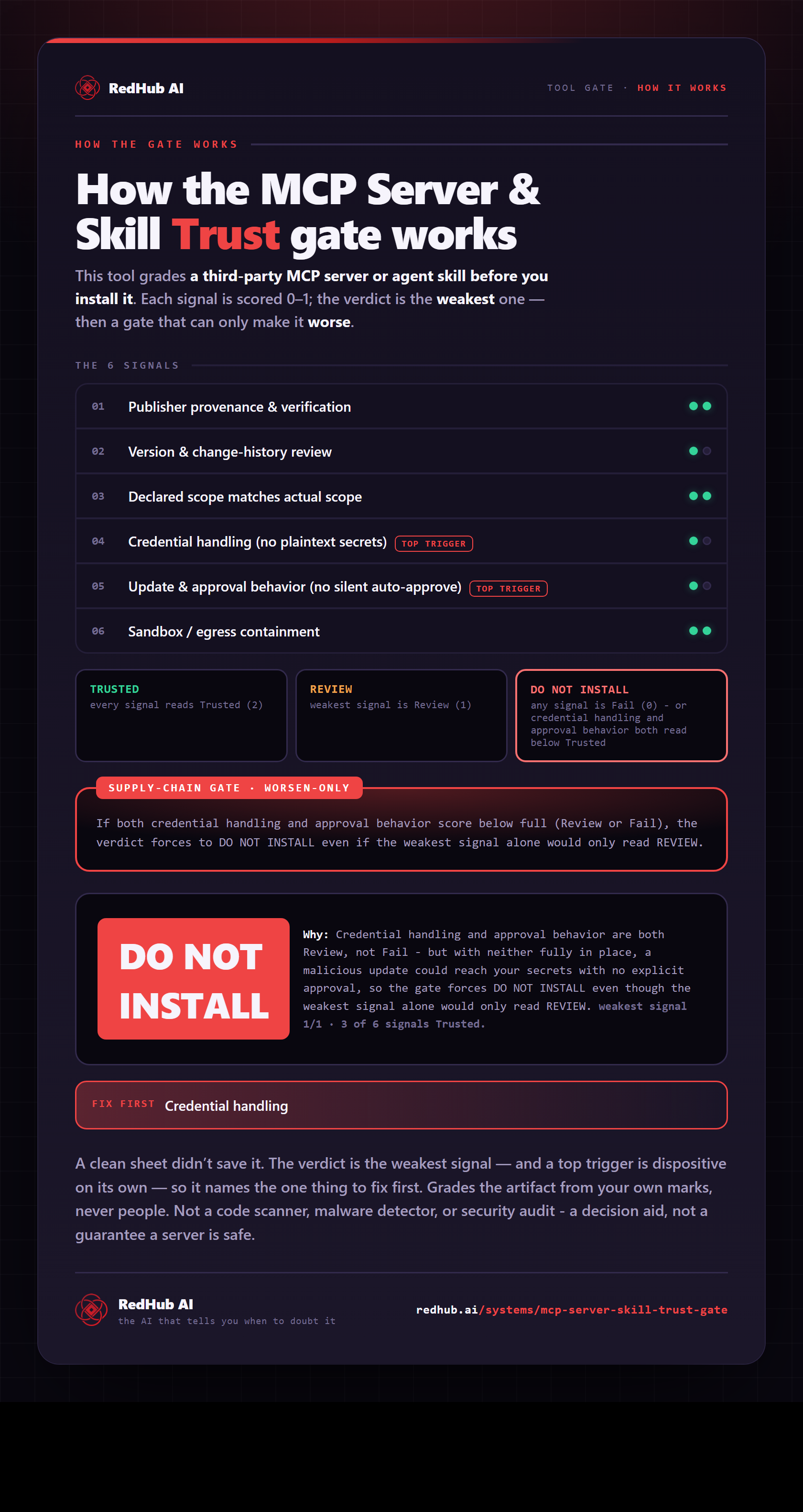
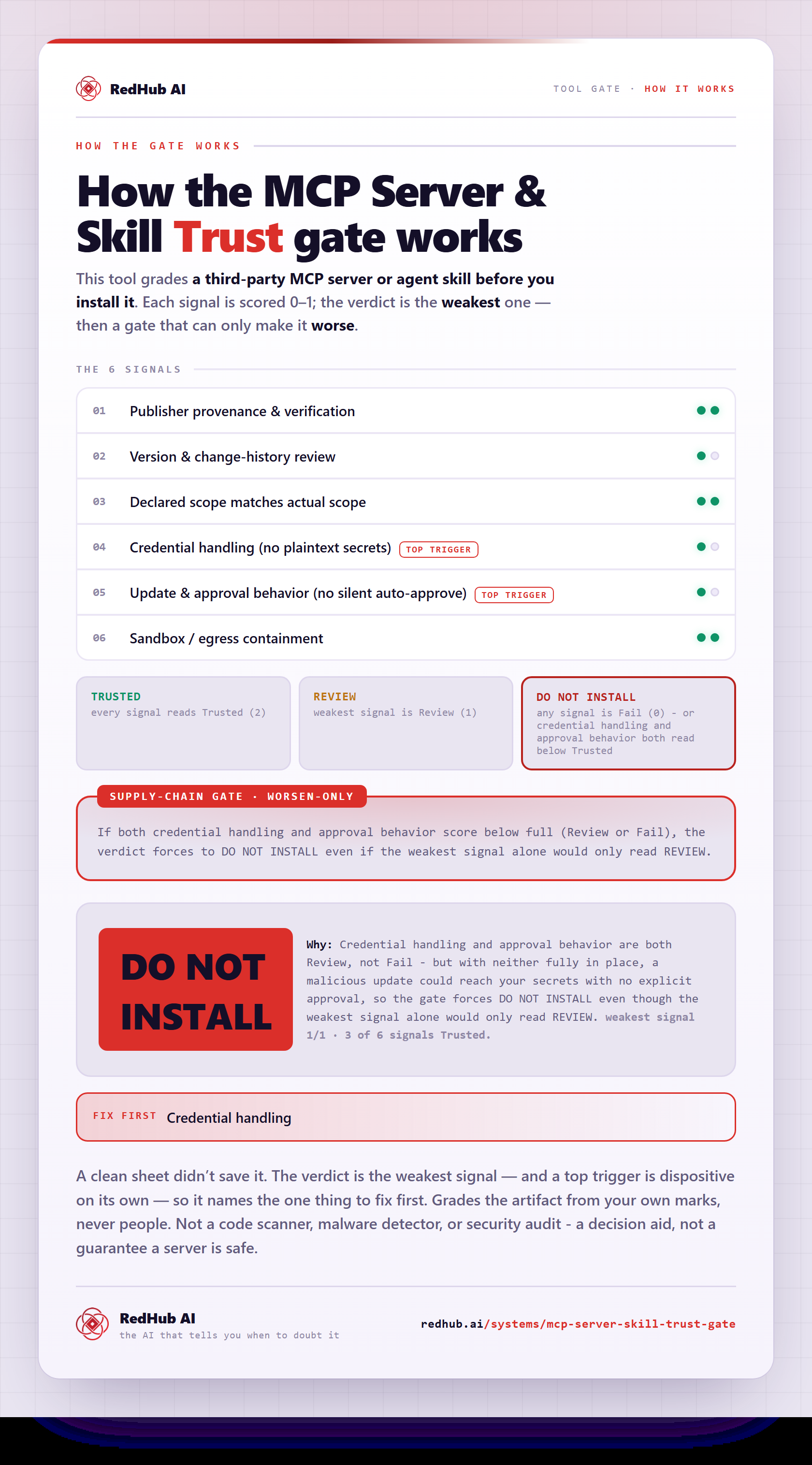
The gate this post refers to, drawn from the tool’s own logic. See the tool.