How to Run a Meeting Audit: Which Meetings to Keep, Shrink, or Kill
RedHub AI Editorialupdated September 20, 20265 min read
Jump to a section9
- Step 1 — inventory every recurring meeting, honestly
- Step 2 — price each one
- Step 3 — apply the three-question test
- Step 4 — sort into keep, shrink, kill
- The mistake that undermines most audits: auditing by feel
- How often to re-run the audit
- What replaces the meetings you kill
- Pairs well with
- More in this guide
A meeting audit is a one-time pass through every recurring meeting on a calendar, priced and scored against a fixed set of questions, that sorts each one into keep, shrink, or kill. It works because it forces every meeting through the same test at the same time — instead of the usual pattern, where meetings get evaluated one at a time, months apart, by whoever happens to be annoyed that week.
TL;DR: List every recurring meeting, price each one (attendees × fully-loaded rate × duration × frequency), then sort into keep / shrink / kill using purpose, decision output, and attendee necessity — not annoyance. Keep meetings that produce real decisions worth their cost; shrink meetings with the right purpose but the wrong size, length, or frequency; kill meetings that can't clearly answer "what decision does this produce that couldn't happen another way." Run the whole audit with the Meeting Cost Calculator ($29).
Step 1 — inventory every recurring meeting, honestly
Start with the full list, not the list you remember off the top of your head. Pull every recurring invite from the calendar for a real two-week period, including the ones you've stopped noticing because they've been there for years. The meetings people forget to list are usually the ones most overdue for a cut — invisibility and staleness go together.
Step 2 — price each one
For every meeting on the list, calculate attendees × average fully-loaded hourly cost × duration in hours × monthly frequency. This step alone changes how the rest of the audit goes, because it's the first time most meetings have ever had a dollar figure attached to them. A meeting audit without pricing is just a preference survey; pricing is what makes it a business decision.
Tip: price the meeting as it actually runs, not as it's scheduled. If a "30-minute" sync reliably runs 45, and 2 of the 6 invited attendees never actually show, use 45 minutes and 4 attendees — the real numbers, not the calendar's.
Step 3 — apply the three-question test
- What decision or output does this meeting produce that couldn't happen another way? If the honest answer is "an update everyone could read instead," it's a kill or a conversion to async, not a keep.
- Does every current attendee need to be in the room live? A meeting can be right-purposed but wrong-sized — the fix there is shrinking the invite list, not killing the meeting.
- Is the length and frequency matched to what actually gets covered? A meeting that reliably wraps in 20 minutes doesn't need a 60-minute slot; a meeting that's outgrown its slot needs either more time or a tighter agenda, not the status quo.
Step 4 — sort into keep, shrink, kill
| Verdict | When it applies | What changes |
|---|---|---|
| Keep | Clear decision output, right people, cost is justified by what it produces | Nothing — but re-audit in 6–12 months; purpose can drift even for good meetings |
| Shrink | Right purpose, wrong size — too many attendees, too long, or too frequent for what it covers | Cut the invite list, cut the length, or cut the frequency — pick the lever that matches the actual mismatch |
| Kill | No clear decision output, or the output could be delivered async without a live room | Cancel it, or convert it to a written update — don't let it quietly become "shrink" instead of the harder call |
The mistake that undermines most audits: auditing by feel
How often to re-run the audit
A meeting audit isn't a one-time fix — meeting load creeps back the same way it built up the first time: one new sync at a time, none of which feels significant on its own. Re-run the full audit on a fixed cadence (quarterly is common) rather than waiting until the calendar feels unmanageable again. Treating it as a recurring discipline, not a one-off cleanup, is what keeps the gains from quietly reversing.
What replaces the meetings you kill
A kill verdict works best when it comes with a replacement, not just an empty calendar slot. For status-update meetings specifically, an async alternative preserves the information flow without the live-room cost — the Inbox-to-Done Engine ($129) is built for exactly that conversion. And if the audit reveals your whole meeting rhythm needs redesigning, not just individual meetings pruned, that's the job of the Operating Cadence Engine ($299).
Pairs well with
Use the Operating Cadence Engine ($299) to redesign the meeting rhythm your audit uncovers problems with, and the Capacity & Utilization Planner ($49) to decide where the reclaimed hours go.
More in this guide
What is a meeting audit?
A structured review of every recurring meeting on a calendar — priced by real dollar cost and scored against a fixed set of questions — that sorts each one into keep, shrink, or kill instead of evaluating meetings one at a time by feel.
How do I decide whether to keep, shrink, or kill a meeting?
Ask whether it produces a decision or output that couldn't happen another way, whether every attendee needs to be there live, and whether its length and frequency match what it actually covers. Keep if all three hold; shrink if the purpose is right but the size is wrong; kill if there's no clear live-only output.
Should I price meetings before or after applying the three-question test?
Price first. The dollar figure changes how seriously each meeting gets evaluated in the next step and keeps the audit anchored to real cost instead of pure preference.
How often should I re-run a meeting audit?
Quarterly is a common cadence. Meeting load rebuilds the same gradual way it built up originally, so a one-time audit's gains erode without a repeat pass.
What if the audit says kill but the team insists on keeping the meeting?
That can be a legitimate exception — but name the specific reason out loud rather than letting inertia silently override the process. If no one can state a clear reason, that's itself informative.
What should replace a meeting I kill?
For status-update meetings, an async written update often covers the same ground without the live-room cost. For meetings that reveal a bigger rhythm problem, a full cadence redesign may be the better fix.
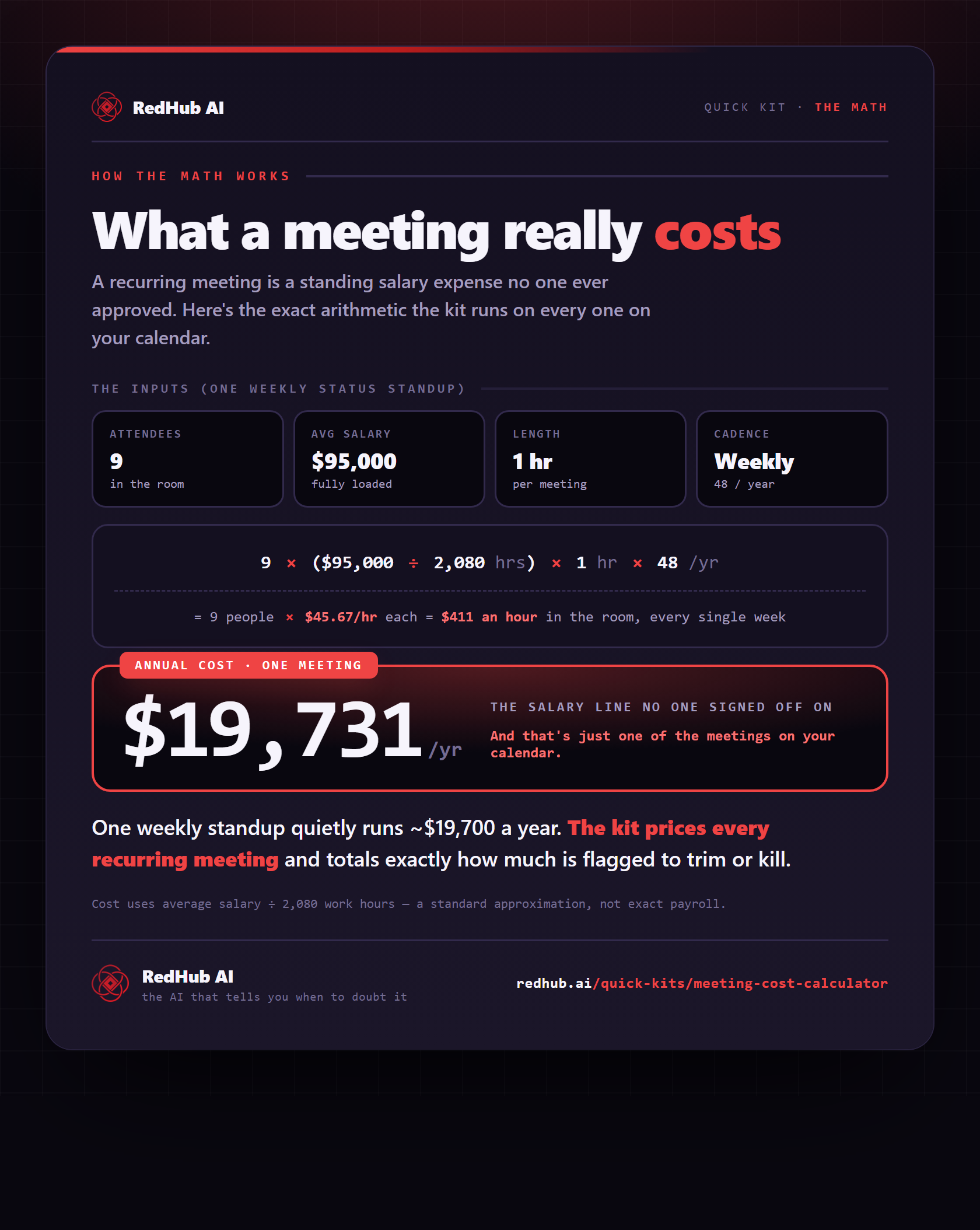
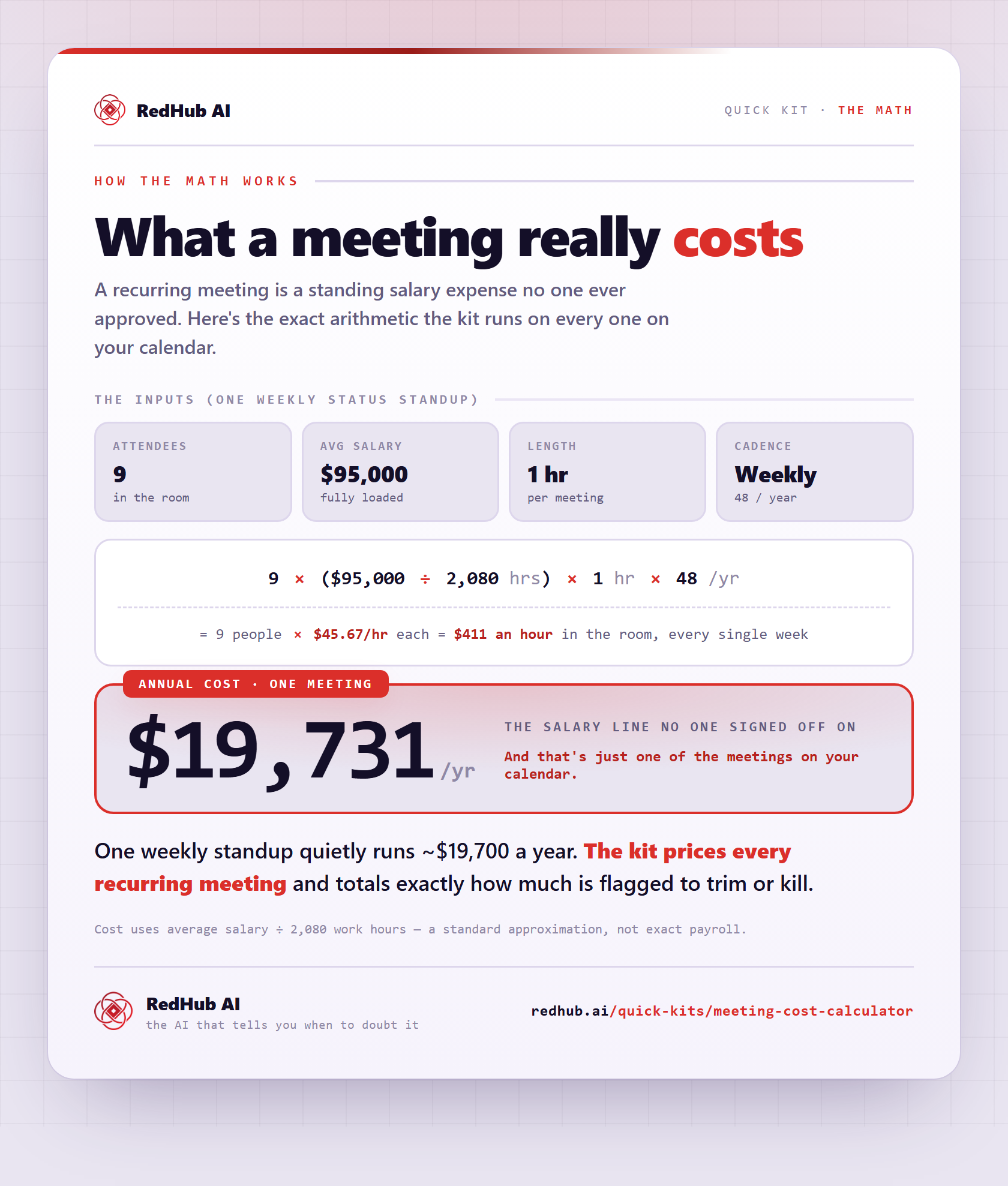
The gate this post refers to, drawn from the tool’s own logic. See the tool.