Meeting ROI: How to Tell If a Meeting Was Actually Worth It
RedHub AI Editorialupdated September 20, 20264 min read

Jump to a section9
- Why "it felt productive" isn't ROI
- The two-sided ROI question
- Naming the output before the meeting, not after
- Outputs that count vs. outputs that don't
- Recurring meetings need recurring ROI checks
- ROI at the individual-meeting level vs. the whole calendar
- What to do with a meeting that fails its ROI check
- Pairs well with
- More in this guide
A meeting's cost is only half the sentence. The other half is what it produced — and most teams never finish that sentence, because nobody writes down what a meeting was supposed to accomplish before it happens or checks afterward whether it did. Meeting ROI is that second half: cost against output, made explicit instead of assumed.
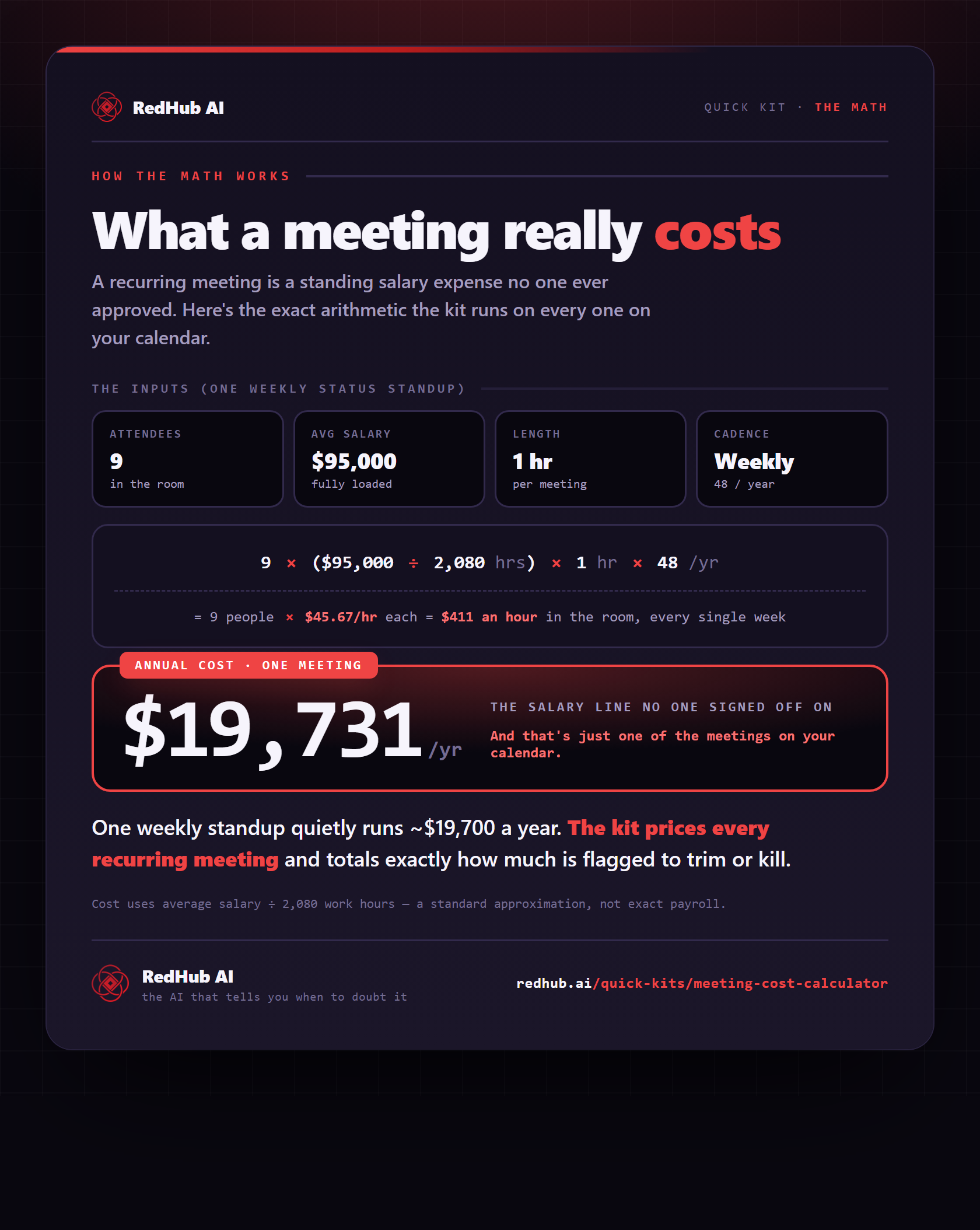
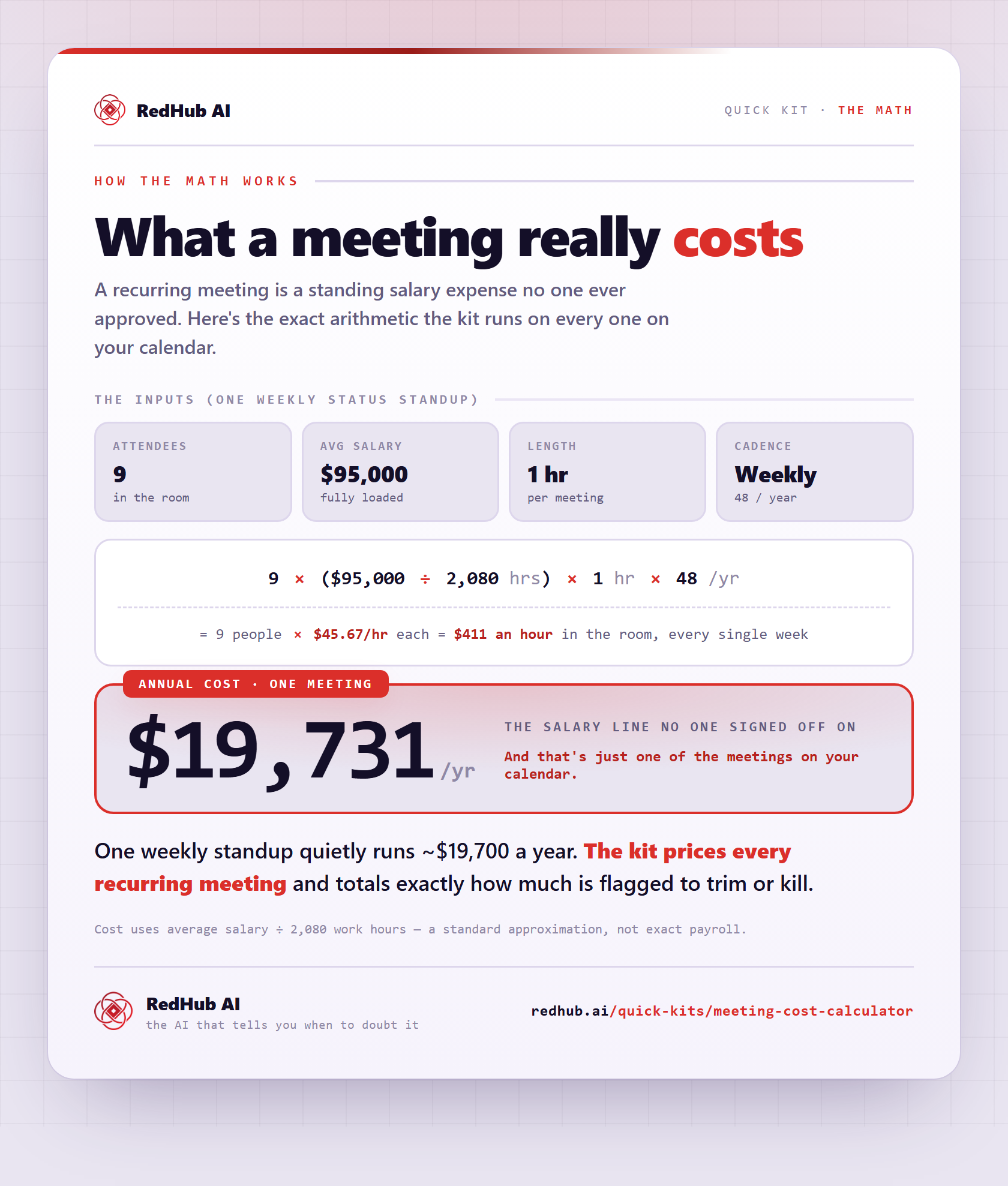
TL;DR: Meeting ROI = what the meeting produced against what it cost (attendees × fully-loaded rate × duration × frequency). A meeting is "worth it" when it produces a decision, unblock, or output that's genuinely hard to get another way and that decision is worth roughly what the meeting cost. Score it by naming the intended output before the meeting and checking afterward whether it happened — not by how the meeting felt in the room. Price the cost side with the Meeting Cost Calculator ($29).
Why "it felt productive" isn't ROI
A meeting can feel productive and produce nothing durable — lots of talking, general agreement in the room, and then everyone goes back to their desk with no new decision, no unblock, and no artifact that wouldn't have existed anyway. Feeling engaged during a meeting measures the meeting's social experience, not its output. ROI has to be measured against something that exists after the meeting ends, not how the room felt while it was happening.
The two-sided ROI question
- What did this meeting cost? Attendees × average fully-loaded hourly cost × duration in hours × how often it recurs — the same formula that prices any recurring meeting.
- What did it produce that's worth roughly that much? A decision that unblocks real work, a resolved disagreement that was actively stalling progress, information that genuinely required live back-and-forth to surface — these count. A status update that could've been a message doesn't.
Naming the output before the meeting, not after
The single highest-leverage habit for meeting ROI is deciding what "worth it" looks like before the meeting starts, not reconstructing a justification afterward. "This meeting is worth it if we leave with a decision on X" is a testable standard. "This meeting is worth it if it feels useful" is not testable at all — it can always be answered yes, which is exactly why so many low-value meetings survive indefinitely.
Practical version: before a recurring meeting's next occurrence, write one sentence: "This meeting is worth it if we leave with ___." Check it against reality afterward. If three occurrences in a row fail the check, that's a strong kill or redesign signal — regardless of how the meeting felt.
Outputs that count vs. outputs that don't
| Counts toward ROI | Doesn't count toward ROI |
|---|---|
| A specific decision was made that unblocks named work | General discussion happened and "alignment" was felt |
| A disagreement that was actively stalling progress got resolved | Information was shared that could have been a written update |
| Something genuinely required real-time back-and-forth to surface | Attendance itself, or "good energy in the room" |
Recurring meetings need recurring ROI checks
ROI at the individual-meeting level vs. the whole calendar
This post scores one meeting at a time — the right unit for deciding whether a specific recurring invite still earns its keep. If the question is bigger than one meeting — your whole calendar's total cost, or which of many meetings to cut first — that's a different exercise covered in The True Cost of Too Many Meetings. Both start from the same cost formula in How Much Does a Meeting Cost?.
What to do with a meeting that fails its ROI check
A failed ROI check has three honest outcomes: kill the meeting, shrink it (fewer attendees, shorter slot, lower frequency) to better match what it actually produces, or convert it to an async format for the cases where the output was really just information sharing. The Inbox-to-Done Engine ($129) is built for that last conversion — moving status-style content out of the live-meeting format entirely.
Pairs well with
Redesign the meetings that consistently fail their ROI check with the Operating Cadence Engine ($299), and redirect the time you reclaim with the Capacity & Utilization Planner ($49).
More in this guide
What is meeting ROI?
The comparison between what a meeting cost (attendees × fully-loaded rate × duration × frequency) and what it produced — a decision, unblock, or output genuinely worth roughly that much. It's a cost-vs-output measure, not a measure of how the meeting felt.
How do I measure whether a meeting was worth it?
Name the intended output before the meeting in one testable sentence, then check afterward whether it happened. If it consistently doesn't across several occurrences, that's a strong signal the meeting isn't earning its cost.
Does a meeting feeling productive mean it has good ROI?
No. Feeling productive measures the social experience of the meeting, not a durable output. ROI requires something that exists after the meeting ends — a decision, an unblock, a resolved disagreement.
Can a good meeting lose its ROI over time?
Yes. A meeting that started with a clear, valuable purpose can keep running on habit after that purpose is accomplished. Recurring meetings need recurring ROI checks, not a one-time verdict.
What should I do with a meeting that fails its ROI check?
Kill it, shrink it to better match its actual output, or convert it to an async format if the real content was information sharing rather than live decision-making.
Is meeting ROI the same as a meeting audit?
Related but different scopes: ROI scores one recurring meeting's cost against its output; an audit applies that kind of scrutiny across every meeting on a calendar at once to sort them into keep, shrink, or kill.
The gate this post refers to, drawn from the tool’s own logic. See the tool.