The True Cost of Too Many Meetings (and How to Cut Them)
RedHub AI Editorialupdated September 20, 20265 min read

Jump to a section8
- Why "too many meetings" is a totaling problem, not a vibe
- The compounding math of a full calendar
- The cost that doesn't show up in the formula: context switching
- How meeting load creeps upward without anyone deciding it should
- Cutting the right meetings, not just some meetings
- What to do with the money you free up
- Pairs well with
- More in this guide
No single meeting bankrupts a calendar. It's the stack of them — a status sync here, a check-in there, a recurring "quick alignment" that's been on the books for two years — that quietly adds up to real money and real lost focus time. The fix isn't banning meetings. It's totaling what your actual meeting load costs, then cutting from the total, not from whichever meeting you happen to resent that week.
TL;DR: Too-many-meetings cost is additive, not just one bad meeting's fault — total the monthly cost of every recurring meeting on a calendar (attendees × fully-loaded rate × duration × frequency, summed) before deciding what to cut. Cutting without totaling means you cut based on annoyance, not impact. The Meeting Cost Calculator ($29) totals and ranks every recurring meeting so the cut list is evidence-based.
Why "too many meetings" is a totaling problem, not a vibe
Ask most people which meeting is the biggest waste of money on their calendar and they'll name the one that annoys them most — usually the longest or the most poorly run. That's not the same question as which meeting costs the most. A short, well-run 30-minute meeting with eight senior people attending can cost more per month than a rambling hour-long meeting with three junior contributors. Annoyance and cost correlate loosely at best. If you're cutting meetings by feel, you're optimizing for mood, not budget.
The compounding math of a full calendar
Individually-cheap meetings compound the same way individually-small subscriptions compound into a surprising credit card bill. A 30-minute weekly meeting at $60/hr fully-loaded with 4 attendees costs about $520/month on its own — easy to shrug off. Stack five of those across a week and the number stops being shrug-off size. The formula per meeting is attendees × fully-loaded hourly rate × duration in hours × monthly frequency; the formula for your real meeting load is the sum of that across every recurring meeting you or your team attend.
Worked example: five different recurring meetings each individually priced under $600/month can sum to well over $2,500/month for a single person's calendar. None of the five looks expensive alone. All five together is a real number worth a real decision.
The cost that doesn't show up in the formula: context switching
How meeting load creeps upward without anyone deciding it should
- New initiative, new sync — every new project spins up its own check-in, and the check-in outlives the project.
- Org growth adds attendees, not scrutiny — as a team grows, more people get added to existing meetings before anyone asks whether the meeting itself still needs to exist at that size.
- Cancellation has no owner — starting a meeting takes one click. Ending one requires someone to actively decide it's no longer worth it, and that decision rarely gets made without a prompt.
None of this is anyone acting in bad faith. It's just what happens when adding costs nothing to do and removing costs a deliberate decision. Totaling the real cost is the prompt that forces the removal decision to actually happen.
Cutting the right meetings, not just some meetings
Once you have a ranked total — every recurring meeting with its real monthly cost, sorted highest to lowest — the cut list writes itself for the obvious cases: the $3,000/month meeting nobody can explain the purpose of goes first. The harder calls (a $1,800/month meeting that clearly drives real decisions) need a different lens than cost alone — see How to Run a Meeting Audit for the keep/shrink/kill framework, and Meeting ROI for scoring what a meeting actually produced against what it cost.
What to do with the money you free up
Cutting a meeting reclaims hours, but hours don't automatically become value — they become whatever fills the newly-open calendar slot, which left undirected is often just more meetings. Decide in advance where reclaimed capacity should go with the Capacity & Utilization Planner ($49), and for status-update meetings specifically, consider whether they need to be synchronous at all — the Inbox-to-Done Engine ($129) is built for turning status updates into an async flow instead of a standing invite.
Pairs well with
Once your meeting load is priced and trimmed, redesign the rhythm that replaces it with the Operating Cadence Engine ($299), and redirect the freed hours deliberately with the Capacity & Utilization Planner ($49).
More in this guide
How do I know if I have too many meetings?
Total the monthly cost (attendees × fully-loaded rate × duration × frequency) of every recurring meeting on your calendar. If the sum surprises you, or exceeds what you'd knowingly approve as a recurring expense, that's the signal — not a fixed hour count.
Which meeting should I cut first?
Start with the highest total monthly cost that nobody can clearly justify the purpose of. Cost ranking beats gut-feel annoyance ranking because the two don't reliably correlate.
Does cutting a meeting automatically save money?
It reclaims hours, not automatic value — what fills those hours determines whether the cut actually pays off. Plan where the freed capacity goes rather than letting it silently refill with other meetings.
Is context switching included in the cost formula?
No — the formula prices time spent in the meeting itself. The focus lost before and after a meeting is real but isn't quantified with a fabricated multiplier here; treat it as a qualitative reason fragmented calendars are worse than the dollar total alone shows.
Should every low-cost meeting stay on the calendar?
Not automatically, but low individual cost is a lower priority to cut than a meeting with a high cost and unclear purpose — total cost and clarity of purpose both matter to the decision.
What's the fastest way to total my whole meeting load?
The Meeting Cost Calculator prices every recurring meeting in one spreadsheet and ranks them by real monthly and annual cost, rather than pricing them one at a time by hand.
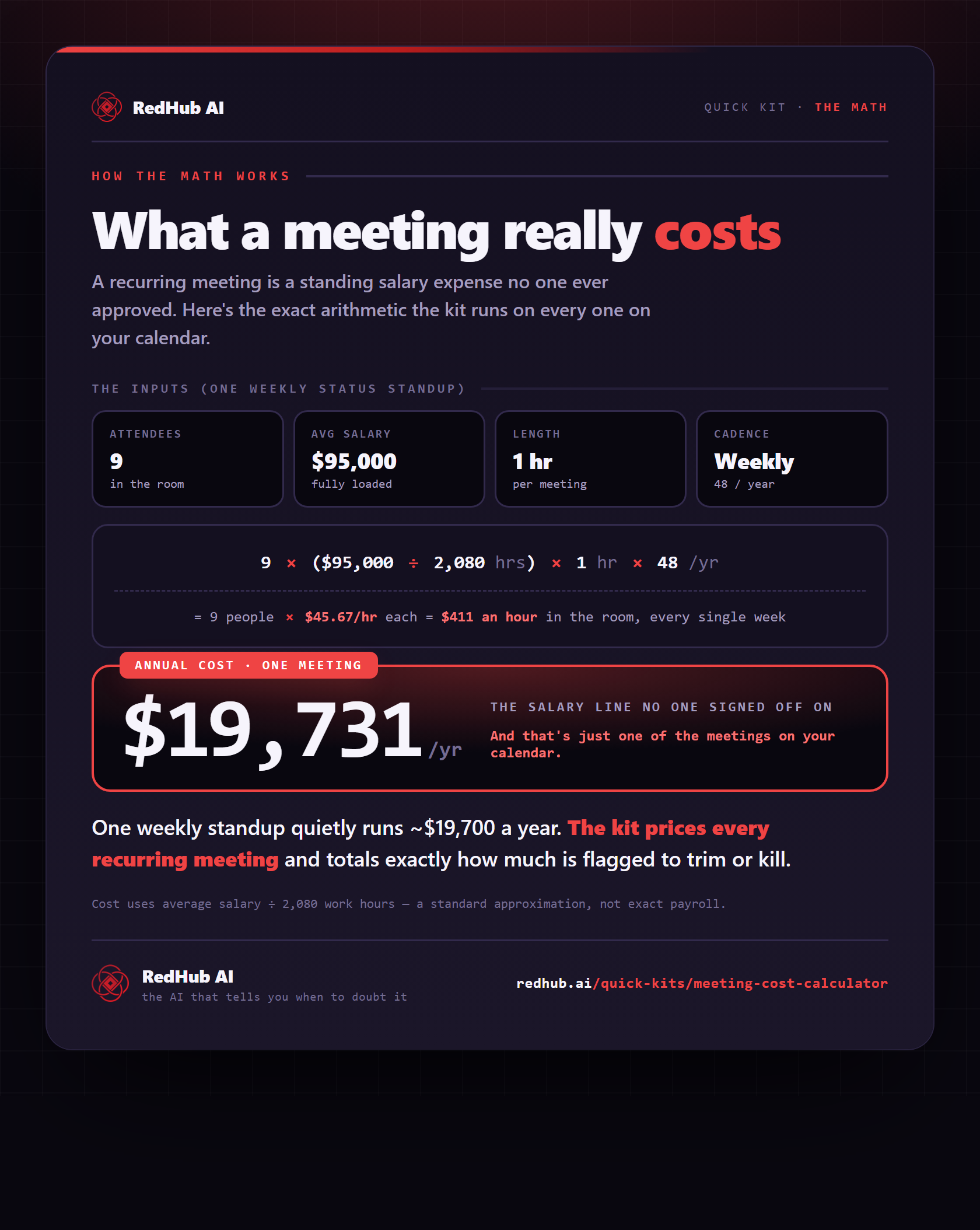
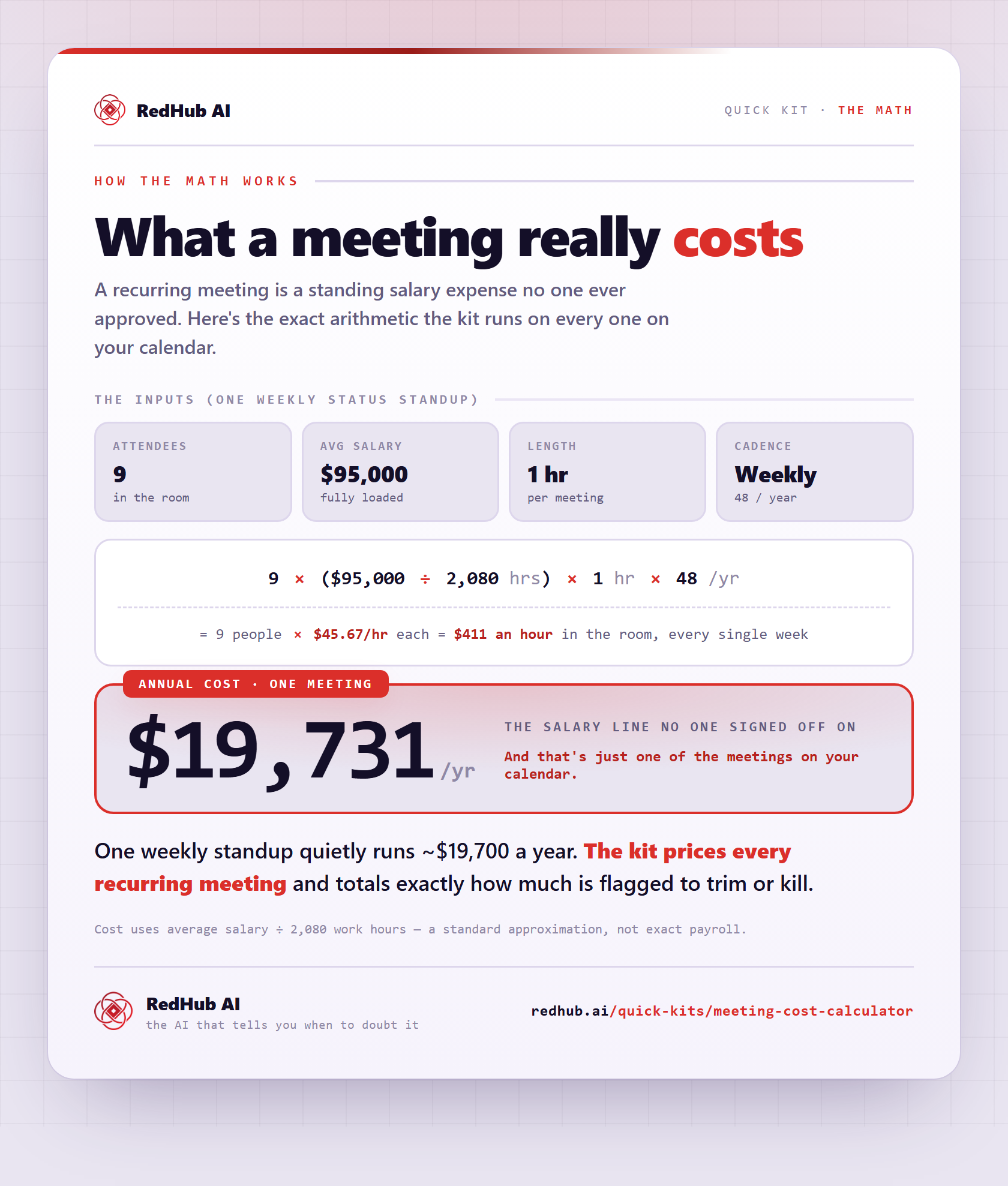
The gate this post refers to, drawn from the tool’s own logic. See the tool.