How to Write a Positioning Statement That Isn't Vague
RedHub AI Editorialupdated October 5, 20266 min read

Jump to a section8
A positioning statement stops being vague when it commits to three specifics: the buyer, the alternative that buyer uses today, and a reason to switch that a competitor could not honestly claim. Most statements fail the last part. "We help businesses grow faster with AI-powered tools" could sit on half the websites on the internet. A statement that isn't vague sounds almost uncomfortably narrow, and that discomfort is the sign it is working. The fill-in-the-blank format exists for this reason: it makes you name the parts you would rather leave fuzzy.
TL;DR: Name the target buyer, the alternative you replace, and a difference a competitor could not also claim. Strike the filler words ("innovative," "best-in-class") and see what is left. The common template comes from Geoffrey Moore's Crossing the Chasm, and it records decisions rather than making them, so decide first and fill in the blanks second. The Founder's Positioning Forge ($59) works through those decisions before it drafts the statement. The full guide starts at how to position your startup.
The template behind most positioning statements
Most positioning statements descend from a template Geoffrey Moore set out in Crossing the Chasm, first published in 1991. His version moves through six slots in order: the target customer, what they are dissatisfied with in the current alternative, the product category, the key problem-solving capability, the alternative the product is "unlike," and what sets the product apart from it. The version most teams use today is a shorter adaptation:
The power is in the blanks. You will rewrite the wording anyway, but you cannot complete the sentence honestly without naming a buyer, a category, an alternative and a difference. If you catch yourself writing "for businesses" or "unlike other solutions," the template just caught you being vague.
Fill each blank with something specific
- Target buyer. A person you can picture. "Freelance video editors" beats "creative professionals."
- The problem. Said the way the buyer would say it. "I spend hours chasing late invoices" beats "suboptimal receivables workflow."
- The category. The shelf they would look for you on. It sets expectations, so choose it on purpose; our post on product category positioning covers how.
- The alternative. What they use today: a named competitor, a spreadsheet, or nothing. This is the reference point that makes your difference legible.
- The difference. The one thing you do that the alternative does not, stated so a competitor could not honestly claim it too.
The words that quietly ruin a statement
Some words feel like strength and drain it. "Innovative," "cutting-edge," "seamless," "powerful," "best-in-class," "next-generation." Everyone uses them, so they read as noise, and they let you feel specific when you were not. Strike every one and see if the sentence still stands. If removing "innovative" leaves a hole, the statement was leaning on the adjective instead of a real difference. The fix is to go find the difference, not a better adjective.
A filled-in template can still say nothing
The template has a well-known critic. The page for April Dunford's book Obviously Awesome on her own site says that connecting a product with consumers "isn't a matter of filling in the blanks on an old-school positioning statement." Her method works through competitive alternatives, unique attributes, value, target customers and market category first, and captures the result only at the end.
She has a point. A team can fill every blank in one meeting, argue about adjectives for an hour, and leave with a grammatical sentence and no decisions. The template checks that each slot is filled. It cannot check that the filling is true. Still, one sentence is a handy way to write the result down where a skeptic can attack it. Whether you start from the blanks or end with them is a real disagreement, and teams that do good work land on both sides.
Use AI as the critic, not the author
Once the decisions are made, AI is good at the wording pass. Give it your filled-in blanks and ask for ten tighter phrasings, then react to them. It is better still as a critic. Paste your statement next to the first screen of a competitor's homepage and ask, "Which parts of my statement could this company also claim?" It will flag the filler. What it cannot do is choose your buyer or confirm your difference is real. Hand it an empty template and it fills the blanks with confident guesses about a market it has never sold into.
When it's done
A finished statement is short, specific and a little uncomfortable. Someone in the room will worry it leaves buyers out, and it does, on purpose. It is ready when it passes the swap test and a couple of real prospects in your target market say some version of "that's me." From there it becomes the source for your messaging framework, your homepage and your sales conversations.
Make the decisions, then draft the statement
In the Founder's Positioning Forge, the statement comes late. The 90-minute sprint first maps your alternatives, ranks your differentiators and narrows your ideal customer profile. Then its Claude prompt chain, with a ChatGPT version included, assembles a first-draft positioning statement from your inputs for you to polish, and a calibration checklist walks you through sharpness and specificity checks before you publish.
Get The Founder's Positioning Forge — $59Pairs well with
The Brand Voice Engine ($59) keeps every page that restates your position in one voice, using a Voice Spec and an On-Brand Writer. The AI Offer & Landing-Page Conversion Kit ($79) turns the statement into landing copy and logs every claim against its proof. The Sales Enablement Battlecard Builder ($79) builds competitor battlecards from your own intel, so the "unlike" line holds up when a rep is asked about it on a call.
More in this guide
What is a positioning statement?
A short internal statement that names your target buyer, their problem, your category, the main alternative and your key difference. It is the decision behind your marketing and sales copy, and it usually is not customer-facing copy itself.
What's a good positioning statement format?
A common one reads: "For [target buyer] who [problem], [product] is a [category] that [benefit]. Unlike [alternative], we [key difference]." Its value is the blanks, because you cannot fill them honestly without making each decision.
Who created the positioning statement template?
The widely used template traces to Geoffrey Moore's 1991 book Crossing the Chasm. His version names the target customer, their dissatisfaction with the current alternative, the category, the key capability, and how the product differs from that alternative.
Why does my positioning statement sound generic?
Usually it leans on filler words such as "innovative" or "seamless" and a broad target such as "businesses." Strike the adjectives and narrow the buyer to a person you can picture. If a competitor could say the same sentence, it describes the category.
Can AI write my positioning statement for me?
It can sharpen the wording and flag filler once you have made the decisions. It cannot choose your buyer or confirm your difference is real. Given an empty template, it fills the blanks with plausible guesses about a market it does not know.
How do I know when my statement is finished?
When it survives the swap test, so putting a rival's name in makes it false, and a couple of real prospects react with "that's me." It should feel a little too narrow.
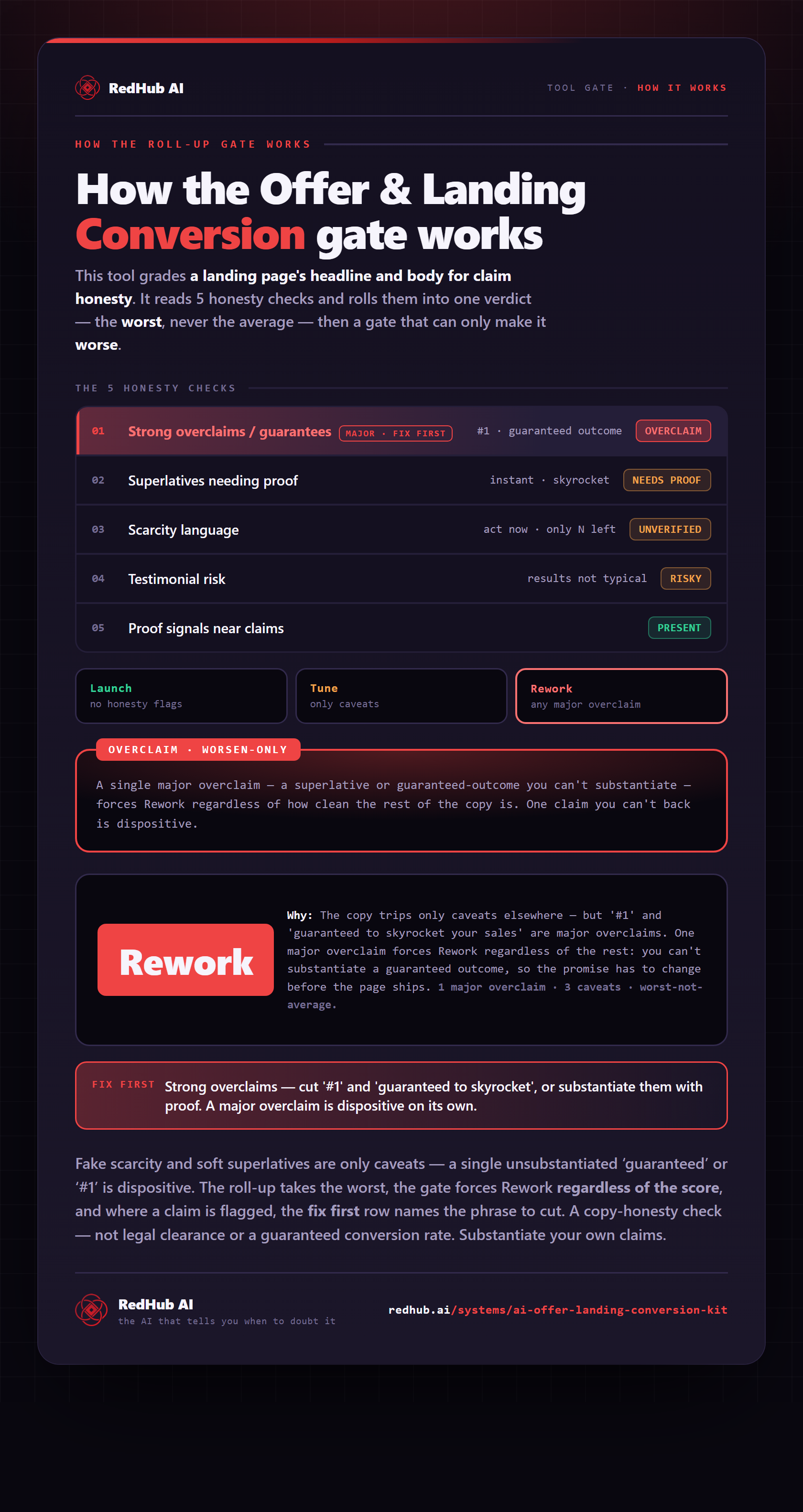
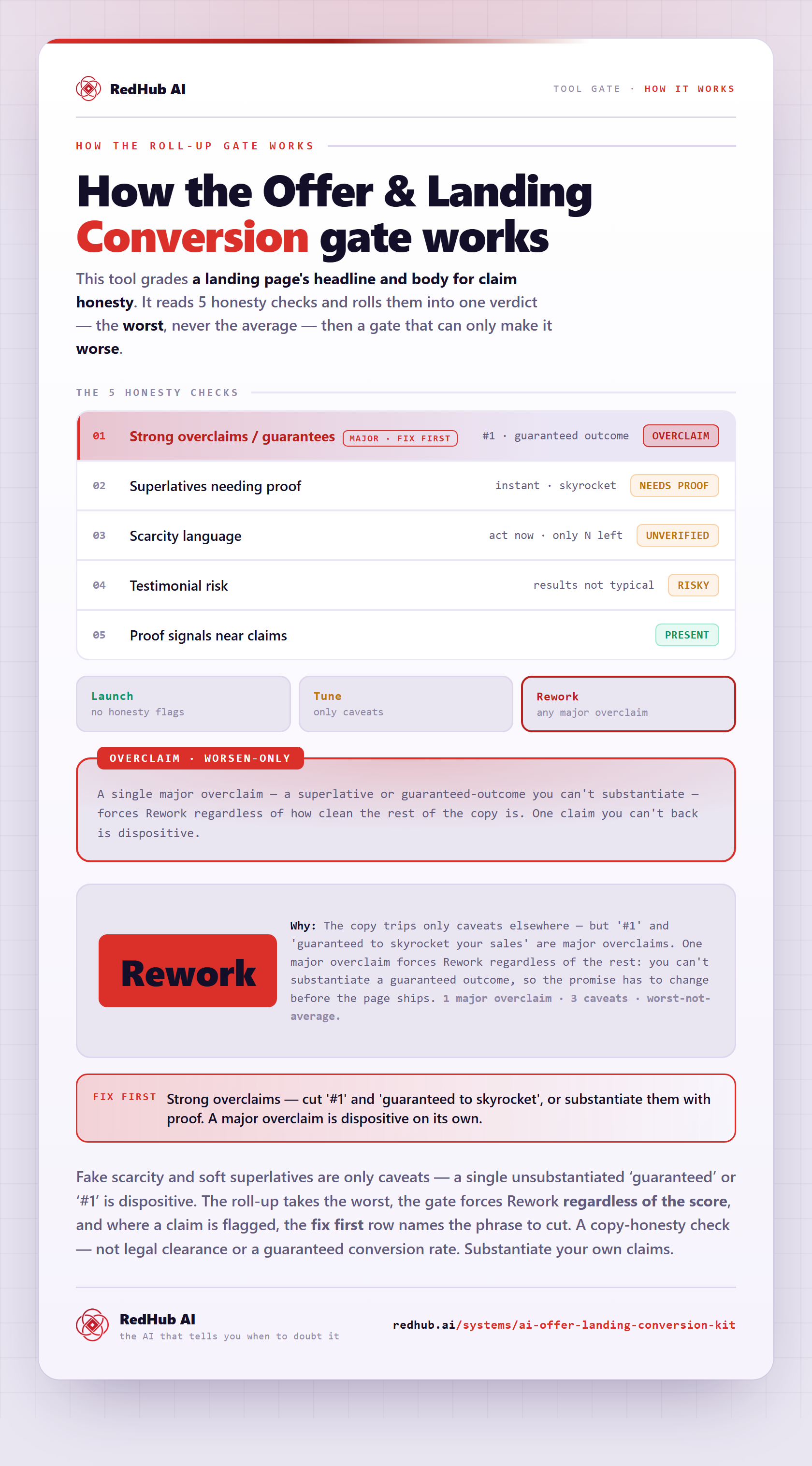
The gate this post refers to, drawn from the tool’s own logic. See the tool.