Messaging Framework: Turning Positioning Into Words That Sell
RedHub AI Editorialupdated October 5, 20266 min read

Jump to a section8
When the homepage says one thing, the sales deck says another and the ads say a third, the company is missing a messaging framework. A messaging framework is the approved language that turns a positioning decision into words: a one-liner, two to four message pillars, the proof under each pillar, and the answers to the objections everyone hears. It lets ten people write copy that sounds like one company. Without one, the positioning lives in a founder's head and leaks out a little differently on every surface. Build it from the position downward, and keep every claim provable.
TL;DR: A messaging framework holds a one-liner, a few message pillars, proof points and objection responses, so everyone says the same thing on every channel. Build it down from your positioning, not up from a feature list. Early startups often lack proof for a pillar, and the honest move is to mark that pillar as a bet, not to invent evidence. Test the one-liner on real prospects before you roll it out. The Founder's Positioning Forge ($59) drafts three messaging pillars from your positioning statement. Start with the guide to startup positioning.
What goes in a messaging framework
- The one-liner. One sentence that says what you are and who it is for, in the buyer's language. It is your positioning made speakable.
- Message pillars. Two to four themes that support the one-liner, each a main reason the buyer should care. Everything you publish should connect to one of them.
- Proof points. The evidence under each pillar: a feature, a fact, a demonstration. A pillar without proof is just an adjective.
- Objection responses. Honest answers to the "but what about…?" questions, so everyone handles them the same way.
- Words to use and avoid. The vocabulary that keeps you on-position, and the terms that drift you off it.
Build it down from the position
The common mistake is to list everything the product does and look for themes. That produces a feature dump with a headline on top. Build the other way. Start from your positioning, meaning the buyer, the alternative and the difference, and ask: "What does this person need to believe to choose us over what they use now?" The answers become your pillars. Only then do you attach the features that prove each one.
Take a made-up scheduling tool for dental offices, where the alternative is the front desk answering the phone. One thing the office manager has to believe is that patients will book themselves after hours. That belief is a pillar. Its proof might be the online booking flow plus the share of bookings made after 6 p.m. in your own customers' data. The pillar came from the buyer's doubt, and the feature came second.
When a pillar has no proof yet
That rule runs into trouble at an early startup. A company with eight customers may have a strong pillar and nothing under it: no case study, no usage data, no named reference. The temptation is to fill the gap with confident copy, and it is where overclaiming sneaks in, because marketing seems to expect a little exaggeration. A framework full of claims you cannot back wins the deal and loses the customer.
There are honest options. A live demo or a free trial can be the proof, since the buyer checks the claim themselves. A design partner who agrees to be named is proof. Or you can mark the pillar as a bet in the framework, so nobody on the team states it as fact while you collect evidence. None of these is as strong as real results, and whether a pillar with only a demo behind it belongs on the homepage yet is a call you make with the numbers you have.
Consistency is the point
Your homepage, cold emails, onboarding, sales calls and ads should all trace back to the same one-liner and the same pillars. That does not mean identical wording everywhere. It means the same substance in each channel's natural voice. The framework governs what you say. Voice governs how it sounds, and our guide to writing a brand voice guide people actually use covers that half.
Keep AI on a short leash
The fastest way to damage a messaging framework is to let AI write its proof points. Ask a model for "three proof points for this pillar" and it will produce plausible statistics and customer outcomes, and none of them will be yours. Use it the other way around. Once the pillars and proof exist, give them to the model and ask for an email, a landing section or a social post that stays on-message. It is good at applying a framework and bad at supplying facts. Check every number and promise in its draft against your own records before it ships.
Test it on real people
A framework is done when prospects hear the one-liner and get it, and when the pillars answer the questions they ask, however good it looks in a document. Read your one-liner to five people in your target buyer's shoes and watch for the blank stare or "wait, so what do you do?" That reaction is data. Refine until the message lands on the first try, then roll it out to your landing page and sales materials.
Get the pillars from a sharp position
The last five minutes of the Founder's Positioning Forge, a guided 90-minute sprint, generate three messaging pillars and a homepage hero rewrite from the positioning statement you built earlier in the session. It does not write your proof points or objection responses; those come from your own customers and records.
Get The Founder's Positioning Forge — $59Pairs well with
The Brand Voice Engine ($59) handles the "how it sounds" half, with an On-Brand Writer and a 100-point QA Checker. The AI Offer & Landing-Page Conversion Kit ($79) turns pillars into landing sections and keeps a Claim & Proof Log, the same discipline as your proof points. The Sales Enablement Battlecard Builder ($79) builds objection-handling cards, so the objection responses reach the reps who need them.
More in this guide
What is a messaging framework?
A reusable set of approved language that turns your positioning into words: a one-liner, message pillars, proof points, objection responses and preferred vocabulary. It lets a whole team say the same thing on every channel.
How is a messaging framework different from positioning?
Positioning is the strategic decision about who you are for, what you replace and why you are different. The messaging framework turns that decision into the language you use. Positioning is the source, and the framework is how it gets spoken.
What should a messaging framework include?
A one-liner, two to four message pillars, proof points under each pillar, honest objection responses, and a list of words to use and avoid. Build it down from your positioning, not up from a list of features.
What if I don't have proof for a message pillar yet?
Use proof the buyer can check, such as a demo or a free trial, or a design partner willing to be named. If you have none, mark the pillar as a bet so nobody states it as fact, and collect evidence before it goes on the homepage.
Can AI write copy from my messaging framework?
Yes, once the framework exists. AI is good at drafting on-message emails, page sections and posts from your pillars and proof points. Check every fact and claim it produces, because it will invent proof points and inflate promises.
How do I know my messaging works?
Read the one-liner to five people in your target buyer's shoes. If they get it right away, it is working. If you get blank stares or "so what do you do?", refine it until it lands on the first try.
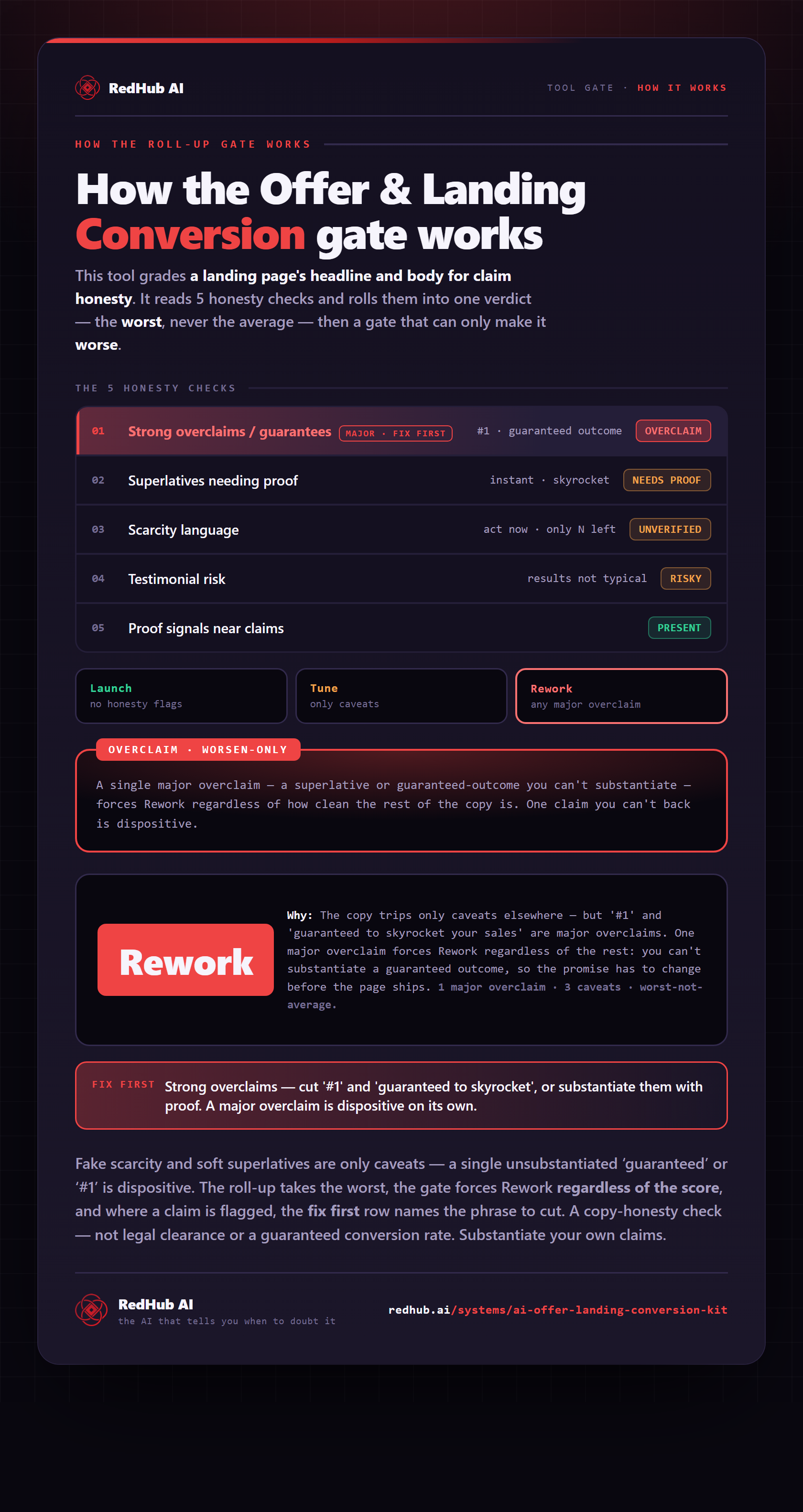
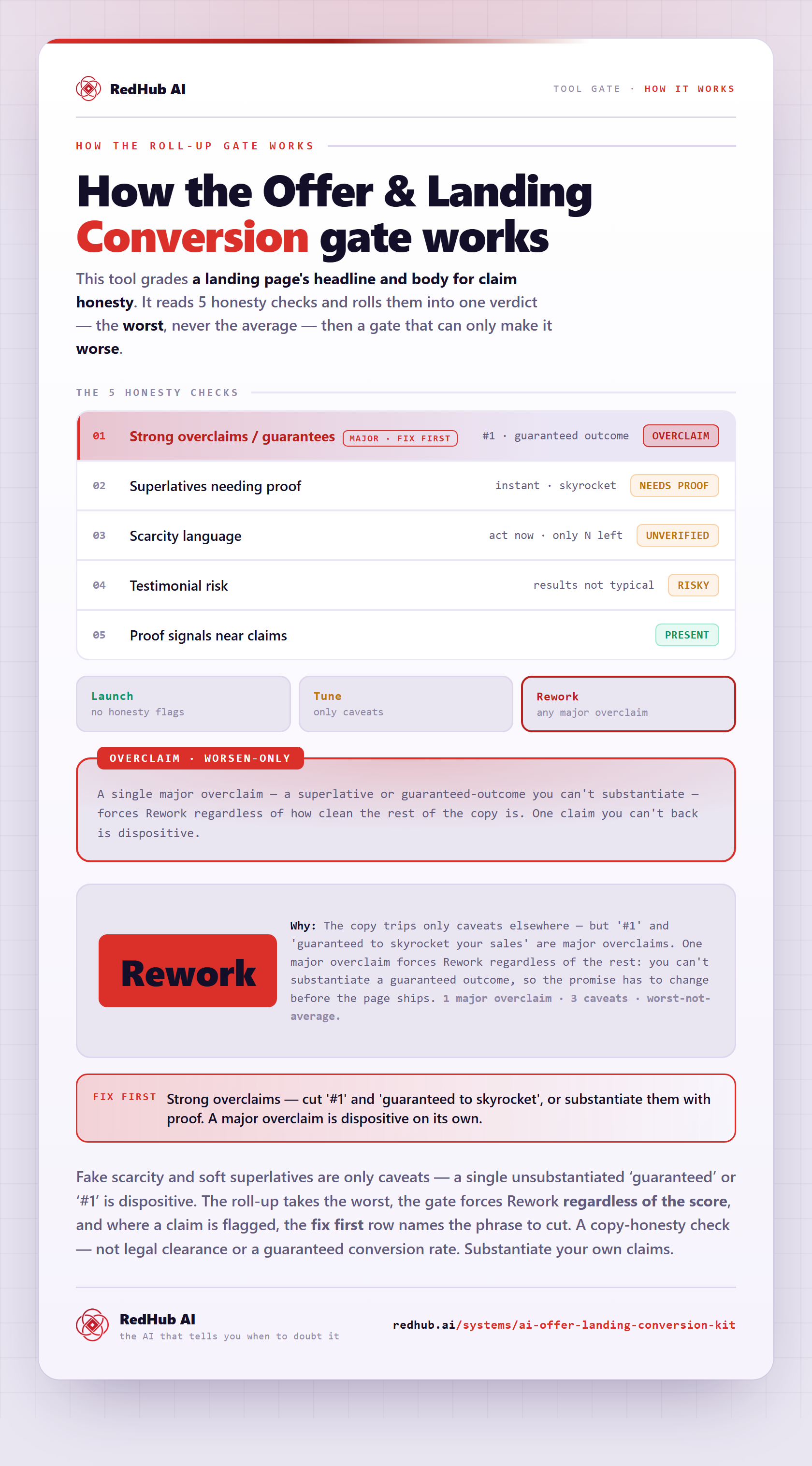
The gate this post refers to, drawn from the tool’s own logic. See the tool.