How to Announce a Price Increase (Scripts That Don't Backfire)
RedHub AI Editorialupdated October 4, 20265 min read

Jump to a section9
A price increase announcement that doesn't backfire does three things: it gives real advance notice, it states the new price and effective date plainly with no apology, and it gives one honest, concrete reason. Below are scripts for email, for a call or an in-person conversation, and for a short questions page you can point long-term customers to. Adapt the specifics, keep the structure.
TL;DR: Give real notice, put the new price and date in the first two sentences, give one real reason, and keep apology out of it. An apology reads as guilt, and guilt invites negotiation. Check any contract's notice terms before you pick a date. Decide your exception policy before you send anything, so a live objection doesn't turn into an improvised discount. The scripts below follow that structure for email, a conversation and a short questions page.
The four beats of a good price-increase message
Every script below follows the same four beats, in this order:
- The plain fact: new price, effective date.
- One honest reason.
- What stays the same: the team, the turnaround, the support.
- A clear next step if they have questions.
Lead with the fact. A number buried in paragraph three, after two paragraphs of soft language, reads as evasive even when it isn't meant to.
How much notice, and who decides it
Two to four weeks suits many month-to-month service relationships: enough time to plan around, not so long that the announcement hangs over every conversation. Your paperwork may already have decided for you. A written contract can set its own notice period or fix a price until renewal, and some places have rules about changing the price of a subscription. Read your agreements before you choose a date. This is general information, not legal advice.
Email script: existing customers, advance notice
Subject: A price update, effective [date]
Hi [Name],
Starting [effective date], our price for [service] is moving from [$old] to [$new]. [One honest reason, such as "This reflects the [capability/tools] we've added over the past year" or "Our costs for [input] have risen, and this keeps us able to deliver the same level of service."]
Everything else about working together stays the same: same team, same turnaround, same support. If you have questions about this change, reply here or book time on my calendar [link].
Thanks for being a customer,
[Name]
Notice what's missing: no "we're so sorry to have to do this," no multi-paragraph justification, and no discount offer at the bottom undercutting the message before anyone has objected. If you want to soften the landing for your highest-value customers, do it deliberately through grandfathering, covered in raising prices without losing customers, not by apologizing in the announcement.
Call or in-person script
"I wanted to give you a heads-up directly. Starting [date], the price for [service] goes to [$new]. [One reason.] Everything else stays the same. I wanted you to hear it from me first rather than see it on an invoice. Any questions?"
Say the number without a preceding apology. If they push back, listen fully, then hold the line, unless you decided in advance that this customer qualifies for a grandfathered exception.
A short questions page for your site or customer portal
Why is the price changing? [One honest reason: costs, capability or capacity.]
When does it take effect? [Date.]
Does this change what I'm getting? [No, or exactly what changes.]
Who do I talk to with questions? [Contact.]
Linking this page from the announcement cuts down the individual "why?" replies you'd otherwise field one at a time.
What to avoid
- Apologizing too much. An apology reads as guilt, and guilt signals the price is negotiable even when you don't mean it to.
- Burying the number. If a customer has to read three paragraphs to find the new price, the message reads as evasive.
- Vague reasons. "Costs" with no specifics sounds like an excuse. "Our [named input] costs rose" sounds like a fact.
- Offering a discount up front. Lead with "but we can work something out" and you've told every customer the price is soft before anyone asked.
- No notice at all. A new price that first appears on an invoice gives the customer no time to plan, and it turns a pricing decision into a billing surprise.
Handling pushback without caving
Some pushback is normal and doesn't mean the increase was wrong. Decide your grandfathering and exception policy before you send the announcement. If a high-value customer pushes back and you'd already planned an exception for exactly that kind of account, offer it calmly.
The hard case is the one you didn't plan for: a customer you can't afford to lose says no. Holding the line can cost the account. Caving tells every customer who hears about it that the price is negotiable. There's no script that removes that trade-off. Know which accounts sit in that position before you hit send, and run their numbers through your break-even first.
Check the number before you send the words
The Should I Raise My Prices? Decision Kit shows how much volume loss your increase can absorb against the loss you expect, and returns a Raise, Hold / test or Restructure verdict. Its playbook tab carries copy-paste scripts: the customer notice, a grandfather offer and a pushback reframe.
Get the Should I Raise My Prices? Decision Kit — $49Pairs well with
The Profit Leak Finder ($49) ranks every client by true profit after the cost to serve, with a keep, reprice, fix or fire verdict, so you know which accounts earn a phone call instead of an email. The Discount & Promo Profit Analyzer ($39) prices a discount against running no promo at all and returns keep, limit or kill, before you offer one to the first customer who objects. The Devil's-Advocate Board ($199) red-teams one big decision, such as a price change, from five skeptical lenses and returns GO, GO WITH CONDITIONS, NOT YET or NO-GO.
More in this guide
How much notice should I give before a price increase?
Two to four weeks suits many month-to-month service relationships. A written contract or your subscription terms may set a different notice period, and some places have rules about changing a subscription's price, so check those first. This is general information, not legal advice.
Should I apologize when announcing a price increase?
Keep it out. An apology reads as guilt and can signal the price is negotiable, which invites more pushback than a plain, confident announcement.
Do I need to explain why I'm raising prices?
Yes. One honest, concrete reason, such as rising costs, added capability or more demand for your time, fills the gap a customer would otherwise fill with a less charitable guess.
Should I offer a discount to customers who complain?
Decide your exception policy before you announce, not in reaction to the first complaint. Discounting for whoever pushes back first signals that every future price is negotiable.
Is email or a phone call better for announcing a price increase?
Email works for most customers and leaves a clear written record. A direct call or in-person conversation is worth the extra effort for your highest-value relationships.
What's the biggest mistake in a price increase announcement?
Burying the new number under paragraphs of soft language, or giving no notice at all. Both turn a pricing decision into a trust problem, whatever the size of the increase.
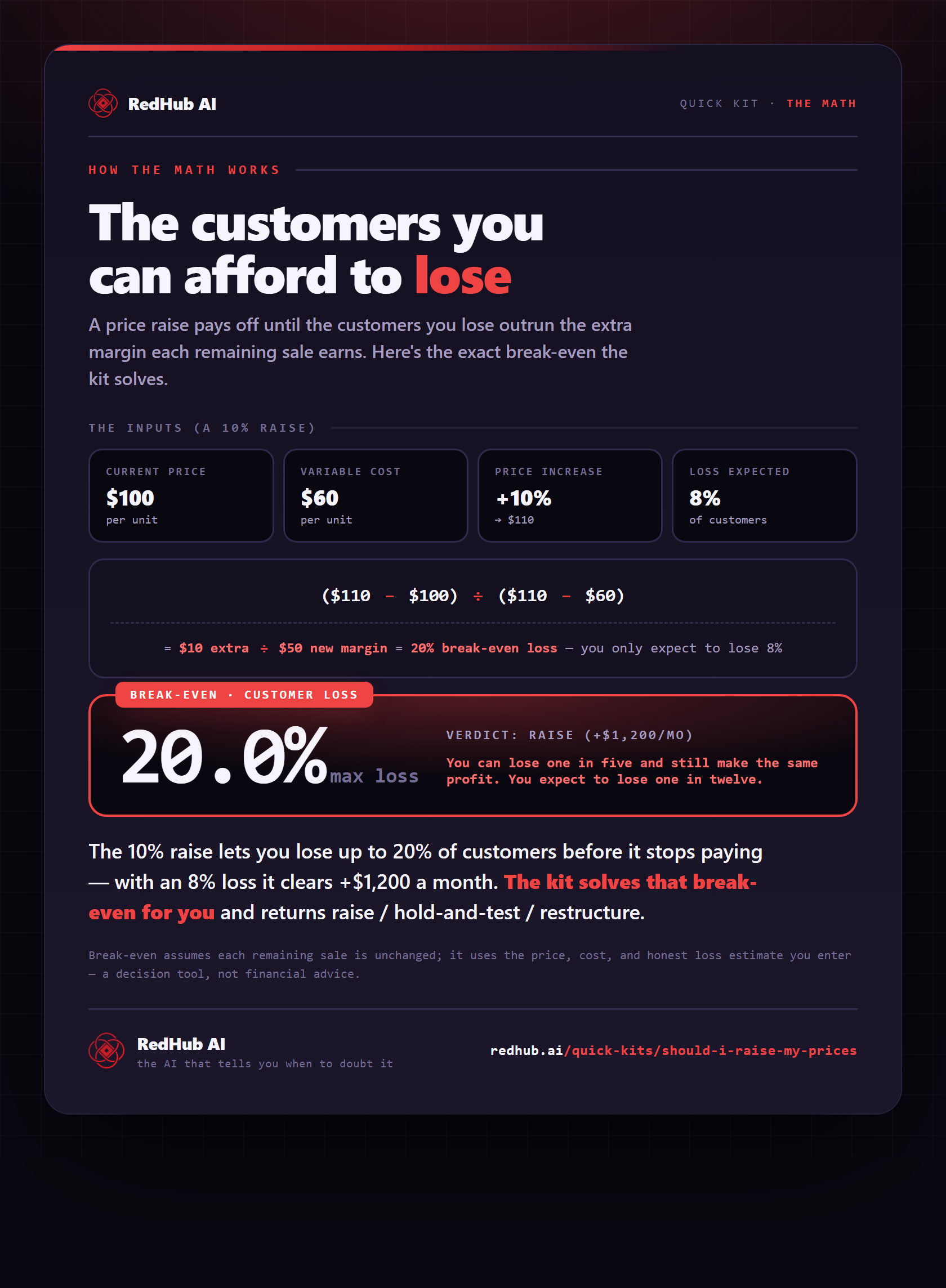
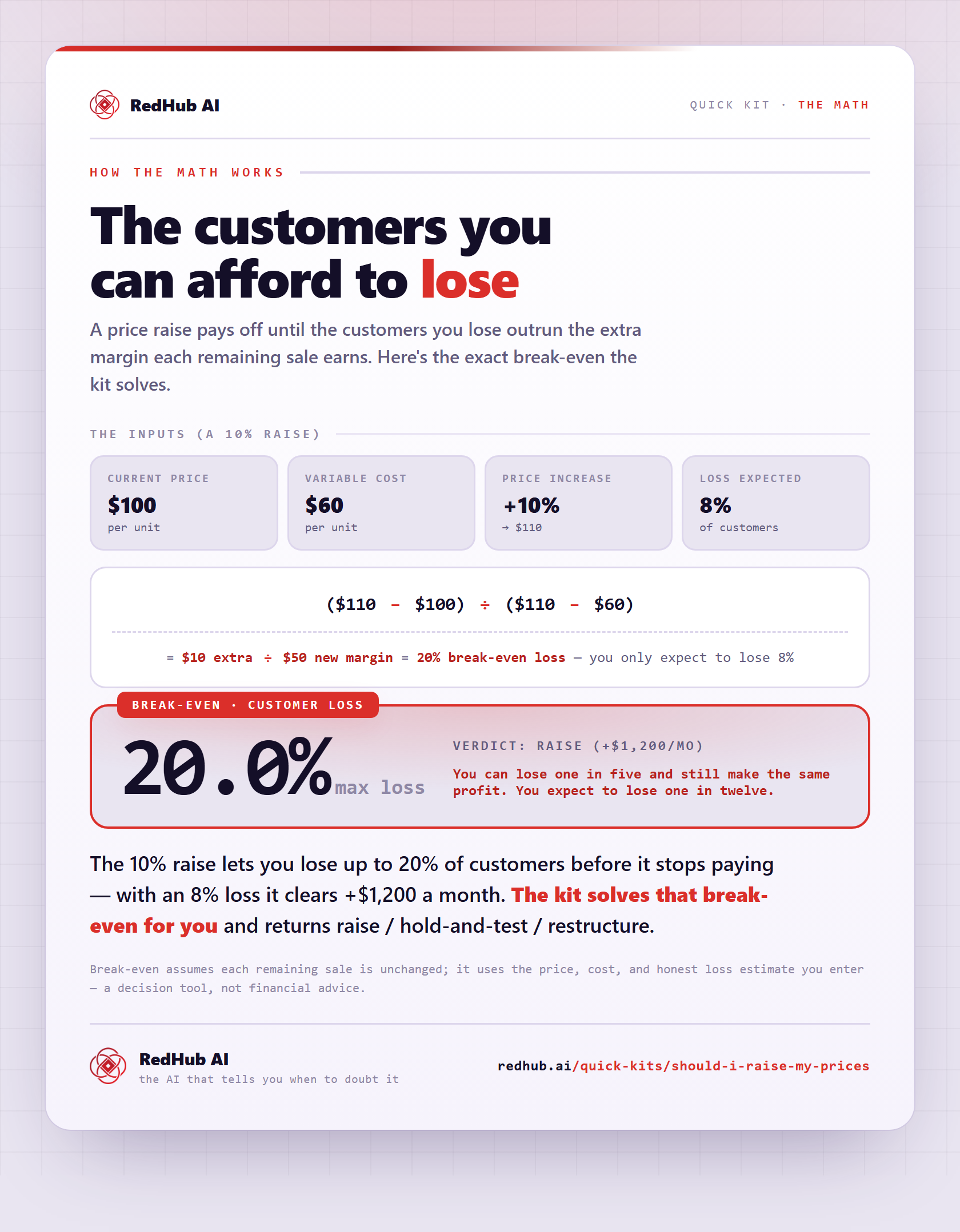
The gate this post refers to, drawn from the tool’s own logic. See the tool.