When to Raise Your Prices: The Signals That Say It's Time
RedHub AI Editorialupdated October 4, 20265 min read

Jump to a section9
- Signal 1: You haven't raised prices in 12+ months
- Signal 2: You're consistently at or near capacity
- Signal 3: Your input costs have risen
- Signal 4: You're winning almost every quote
- Signal 5: You're priced below comparable competitors
- What isn't a strong signal on its own
- Once the signal is there, run the math
- Pairs well with
- More in this guide
Knowing when to raise prices comes down to signals that stack. Five are worth watching: a price untouched for a year or more, a calendar that's consistently full, input costs that have risen, a win rate near 100% on quotes, and comparable competitors charging noticeably more. Any one of them earns a look. Two or more at once make a real case that your price has fallen behind your business.
TL;DR: The clearest signals are time since your last increase, being at capacity, rising input costs, winning nearly every quote, and being priced below comparable competitors. No single signal proves it. Together they build a case. Each one also has an innocent explanation worth ruling out, such as a staffing bottleneck or a pipeline full of referrals. Once the case is there, run the break-even math on how much volume you can afford to lose before you pick the number.
Signal 1: You haven't raised prices in 12+ months
This is the simplest signal and the easiest to miss. A price set 18 months ago was set against 18-month-old costs. Pull last year's invoices for your three biggest costs, whether that's payroll, software, materials or rent, and compare them with this year's. If you can't remember the last time you changed your price, that alone justifies the check.
Signal 2: You're consistently at or near capacity
Turning down work, running a waitlist or routinely saying "we're booked" is a demand signal. It suggests buyers want more of your time than your current price rations. A higher price in that position does two things: it earns more from the people willing to pay, and it eases demand back toward a level you can deliver well.
Being booked solid can also mean something else. A scheduling or staffing bottleneck fills a calendar too, and a price increase won't fix it. Before you read capacity as underpricing, check whether the hours you sell match the hours your team can actually bill.
Signal 3: Your input costs have risen
If the tools, materials, subcontractors or software you rely on cost more than when you last set your price, your margin has been shrinking while your top-line number looks unchanged. This is the most defensible reason to raise, because it's the easiest to explain in one sentence. "Our costs went up" is a story every customer already understands.
Signal 4: You're winning almost every quote
If you rarely lose a deal on price, you probably haven't found the ceiling. A win rate with some losses in it tells you where buyers start to say no. Winning nearly everything tells you only that the ceiling is higher than where you are.
Split the count before you trust it. Referrals can arrive half-sold and close at almost any reasonable price, so count cold quotes separately. If you close 18 of 20 referrals but 6 of 20 cold quotes, the cold number is the one telling you about price.
Signal 5: You're priced below comparable competitors
If you know from direct comparison, not guesswork, that businesses offering similar work at similar quality charge noticeably more, that gap is either a deliberate low-price strategy or an accident of never revisiting the number. If it's an accident, close at least part of the gap. Compare against published prices or real quotes you've seen, not a figure someone mentioned once.
What isn't a strong signal on its own
A single complaint about being expensive, one slow month or a competitor running a promotion are all weak signals in isolation. Reacting to any one of them alone tends to produce anxious, badly timed pricing moves. Wait for a pattern of two or more of the five signals above.
Once the signal is there, run the math
A signal tells you a price increase is worth considering. It doesn't tell you how big an increase you can make or how much customer loss you can absorb. That's a separate calculation. Our pillar post on deciding whether to raise your prices walks through it, and the formula itself is in price increase break-even math. At a 60% margin, for example, a 10% increase still breaks even if you lose 14.3% of volume.
Turn the signal into a number
The Should I Raise My Prices? Decision Kit runs +5% through +25% side by side on your own price, unit cost and volume, shows the loss each increase can absorb, and returns a Raise, Hold / test or Restructure verdict for each step.
Get the Should I Raise My Prices? Decision Kit — $49Pairs well with
The Capacity & Utilization Planner ($49) shows a billable team's real utilization and sellable bench with a sell / hire / turn-away verdict, which tells you whether "we're booked" is true. The AI Service Pricing Kit ($79) gives agencies adding AI services sourced market rates across 25+ service categories and a pricing-model decision tree, for checking a competitor gap against real figures. The Margin Leak Auditor ($79) includes a cost-change impact analyzer that finds which products flip underwater when a cost rises.
More in this guide
How often should I raise my prices?
No fixed schedule fits every business. A review once or twice a year keeps the decision on the calendar instead of in the back of your mind. If you can't remember your last increase, that alone is a signal worth checking.
Is being fully booked a sign I should raise prices?
Often, yes. Consistent capacity limits suggest buyers want more of your time than your price rations. Rule out a staffing or scheduling bottleneck first, because a full calendar can come from either.
Does winning every quote mean I'm underpriced?
Probably. If you rarely lose on price, you likely haven't found the ceiling. Count cold quotes separately from referrals, since referred buyers can close at almost any reasonable price.
What if only one signal applies to me, not several?
A single signal is worth noting but makes a weaker case than two or more together. A slow month or one complaint about price isn't a reliable reason to act in either direction.
Should rising costs alone justify a price increase?
Rising input costs are one of the more defensible standalone reasons to raise, because you can explain them to customers in a single honest sentence. Run the break-even math before you pick the size of the increase.
I see the signal. Now what?
Confirming the signal tells you a raise is worth considering. It doesn't tell you how big a raise you can afford. Run the break-even math on how much volume loss you can absorb, then compare it with the loss you expect.
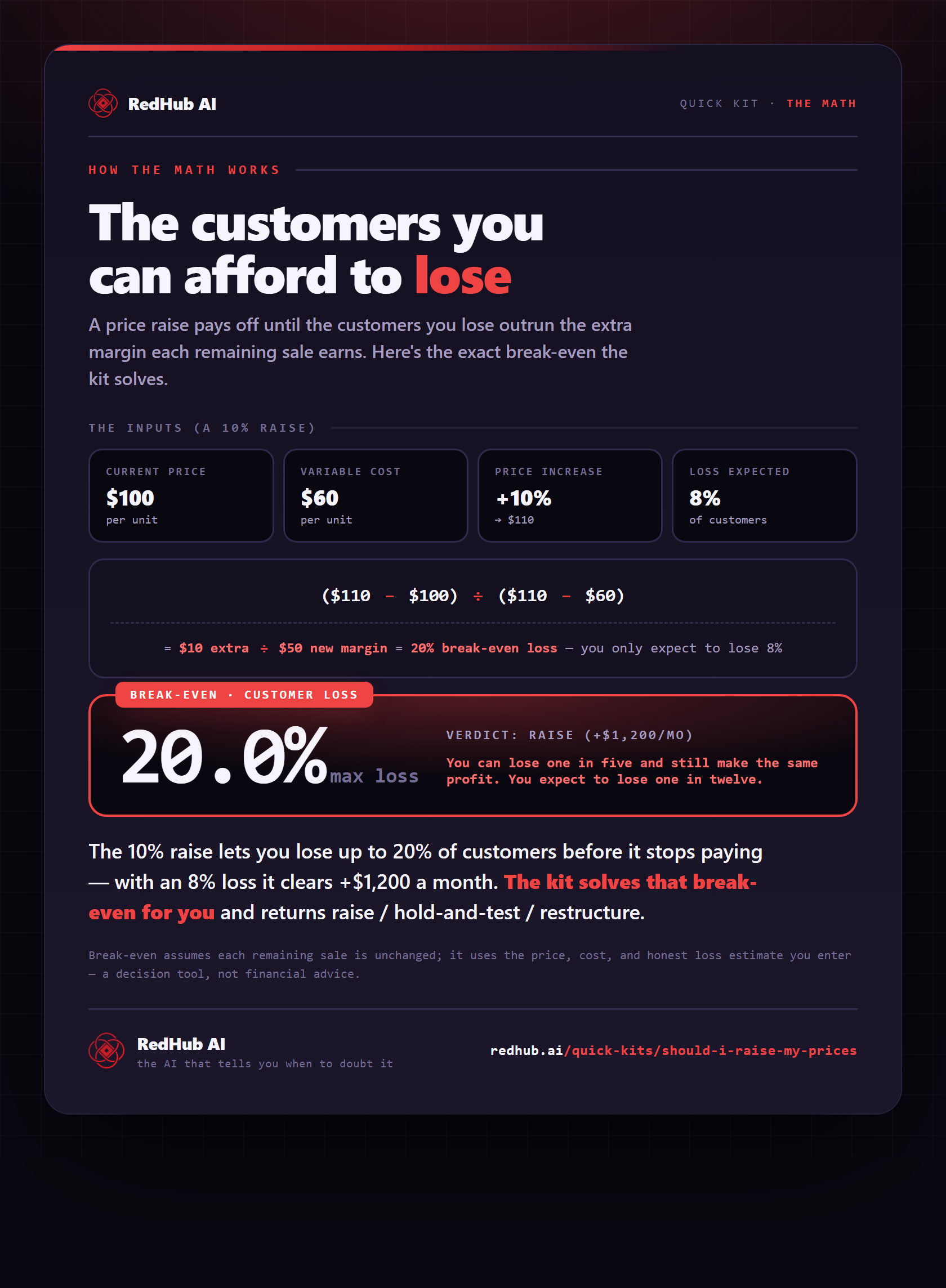
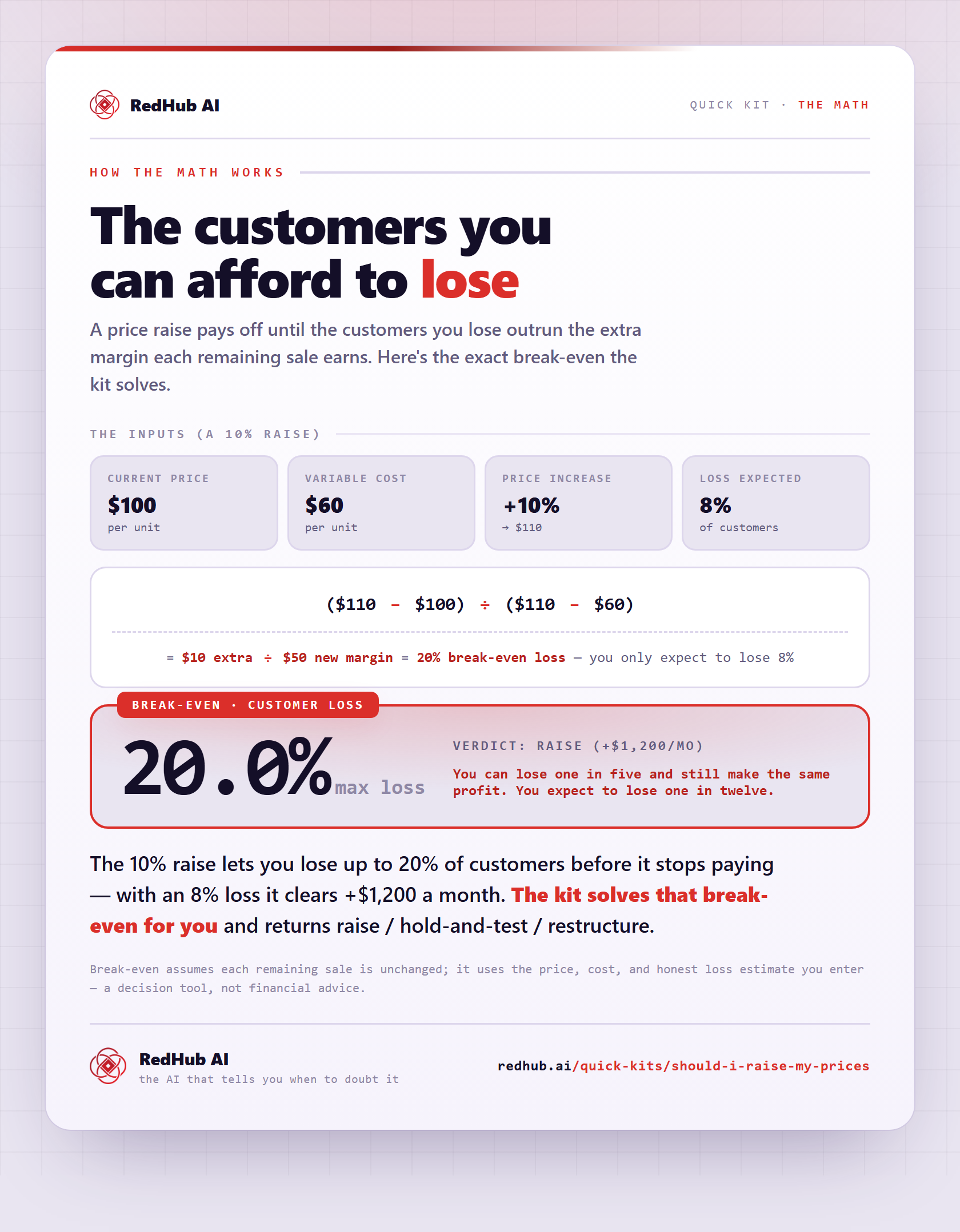
The gate this post refers to, drawn from the tool’s own logic. See the tool.