How to Raise Prices Without Losing Customers
RedHub AI Editorialupdated October 4, 20265 min read

Jump to a section9
To raise prices without losing customers you'd regret, settle three things before anyone hears the new number: who sees it first, how big each step is, and what reason you give. No price increase loses nobody. The realistic goal is losing fewer than your break-even allows, and keeping the customers who value the work rather than the low price.
TL;DR: Customers react to how an increase arrives as well as to its size. Being surprised, singled out or given no reason all make it worse. Give advance notice, apply the increase consistently within a tier, and attach one concrete reason. Raise for new customers first where you can. Phase a big jump into two steps only if your headroom can pay for the delay, and grandfather selectively, with an end date. Then judge the result against your break-even, not against your fear.
The same increase, two reactions
Take two customers who have each paid $500 a month for a year. One gets a two-line email on the first of the month saying prices are going up. The other gets a note a month ahead, from someone they've dealt with before, naming the new price, the date and the reason. The dollar change is identical. The second message leaves fewer questions open, and an open question is where a customer starts shopping around. The wording itself is in our post on price increase announcements. This post covers the choices you make before that email goes out.
Know your headroom first
How generous you can be with phasing and grandfathering depends on headroom: the gap between the volume loss your increase can absorb and the loss you expect. The break-even formula gives the first number. A 10% raise at a 50% margin can absorb a 16.7% loss. If you expect to lose 5%, you have almost 12 points of room to spend on longer notice or a softer rollout. If you expect 15%, you have under 2 points to spend, and the increase needs to land on nearly everyone. That argues for a clean, consistent rollout over a soft one.
Segment: new customers first
The lowest-risk order is usually to raise for new customers immediately and give existing customers advance notice with a later effective date. You start collecting the higher price on new business right away. You also get a live read on how the market takes the new number before your whole existing base is on it. If new-customer conversion holds steady at the higher price, that's evidence you didn't have before.
Phase a big jump, if you can afford the wait
A single 25% jump is hard to swallow, even for a loyal customer. Two steps six months apart are each easier to explain. Get the arithmetic right, though: to land on the same 25%, each step is about 11.8%, because two 12.5% steps compound to 26.6%.
Phasing has two costs. You collect less than the full increase for six months. And you announce a price increase twice, which gives every customer two moments to reconsider instead of one. Reach for phasing when your headroom can pay for the delay, not when margin is urgent.
Give one reason, not a defense
"Prices are increasing" invites the question "why?" If you don't answer it, the customer fills in an answer of their own, and it's rarely kinder than the truth. Tie the increase to something concrete: capability you've added since they signed up, a named input cost that rose, more demand for your time, or a price that hasn't moved in two years while everything around it has. One clear sentence beats a defensive paragraph.
Grandfather deliberately, with an end date
Letting long-term or highest-value customers keep the old price for a set period can hold on to the accounts you'd most regret losing. It also costs money. If a third of your revenue keeps the old price for a year, a third of the increase arrives a year late. Model grandfathering the same way you modeled the increase. Grandfather selectively and with an end date, not indefinitely and for everyone.
Watch the response
Track actual churn against your break-even line, not against the fear you started with. Count it for a full billing cycle after the effective date, since some customers leave at renewal rather than on the day they read the email. Below the line, the increase is paying for itself, even if it doesn't feel that way yet. Above it, pause any planned second step and ask the customers who left what drove them out before you decide the whole approach failed.
Know your headroom before you announce
The Should I Raise My Prices? Decision Kit takes your price, unit cost, monthly units, the raise you're weighing and the loss you expect, then returns a Raise, Hold / test or Restructure verdict. Its playbook tab includes a customer notice script and a grandfather offer.
Get the Should I Raise My Prices? Decision Kit — $49Pairs well with
The Profit Leak Finder ($49) ranks every client by true profit after the cost to serve and gives each a keep, reprice, fix or fire verdict, which tells you whose loyalty is worth a grandfathered price. The Discount & Promo Profit Analyzer ($39) prices every discount against running no promo at all and returns keep, limit or kill for each one. A grandfathered price is a discount too. The Margin Leak Auditor ($79) sweeps your deal book for realized margin below your floor, so a new price doesn't quietly leak back out through discounts and freight.
More in this guide
Will I lose customers if I raise my prices?
Some, almost certainly. How many depends on your customers and on how the increase reaches them. Advance notice, one clear reason and consistent treatment all help. Compare the loss you see with your break-even line, which tells you how much loss the increase can absorb.
Should I raise prices for existing customers or only new ones?
Raising for new customers first is the lower-risk order. It brings in the higher price on new business right away and gives you a live read on how buyers respond before you move existing customers to the same price.
Is it better to raise prices all at once or in phases?
Phasing a large increase into two smaller steps makes each step easier to explain, but you collect less for longer and announce twice. To reach 25% in two equal steps, each step is about 11.8%, not 12.5%. Phase only if your headroom can afford the delay.
Should I explain why I'm raising prices?
Yes. An unexplained increase invites customers to assume the worst. One clear, concrete reason, such as a named cost that rose, added capability or more demand for your time, answers the question before they ask it.
Should I grandfather existing customers at the old price?
Selectively, for your highest-value customers, and with a defined end date. Grandfathering everyone indefinitely gives away the margin the increase was meant to capture, so model its cost the same way you modeled the increase.
How do I know if my price increase worked?
Compare actual churn over a full billing cycle with the break-even volume loss your margin can absorb, not with the fear you started with. If churn lands under that line, the increase is paying for itself.
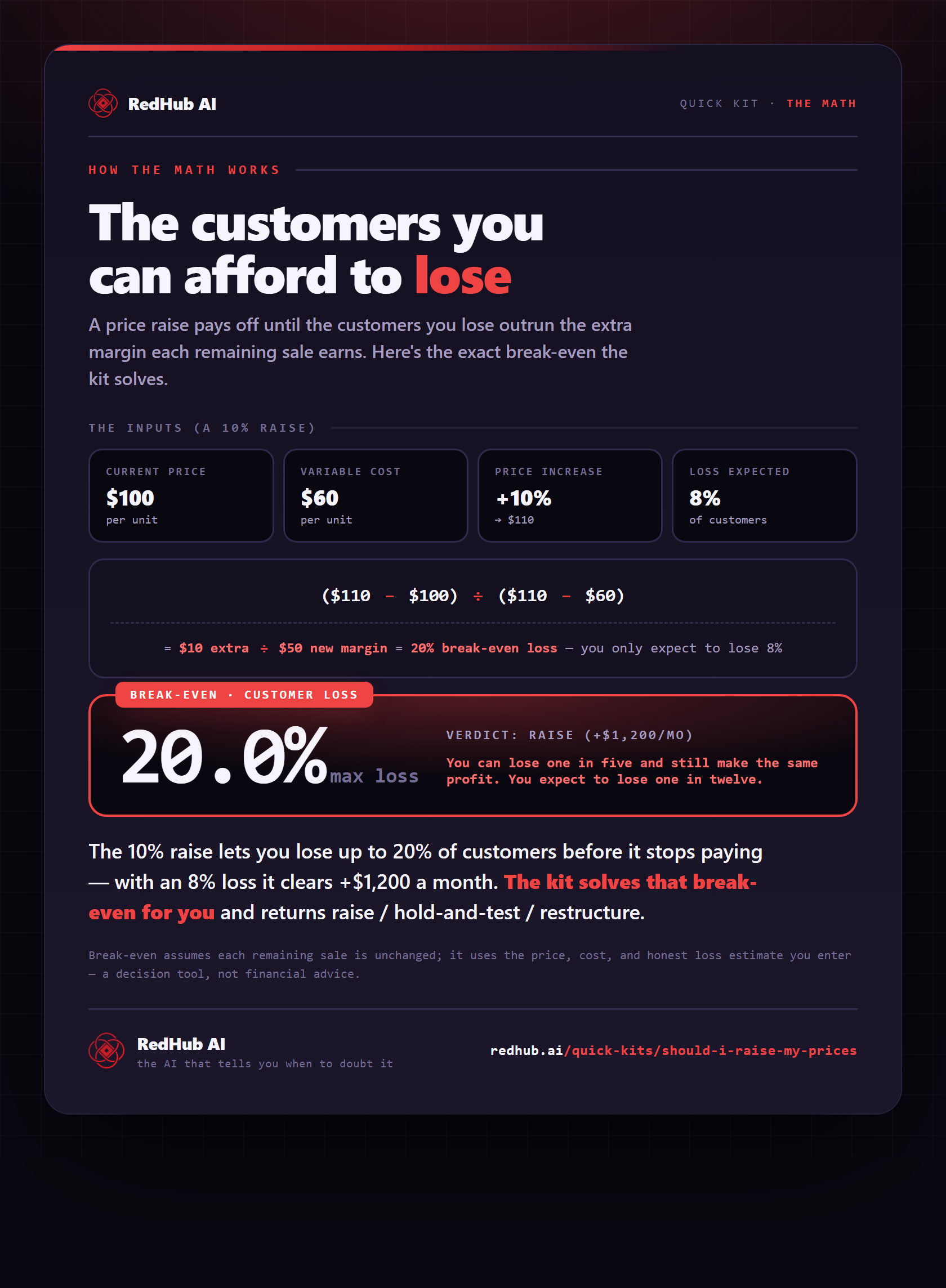
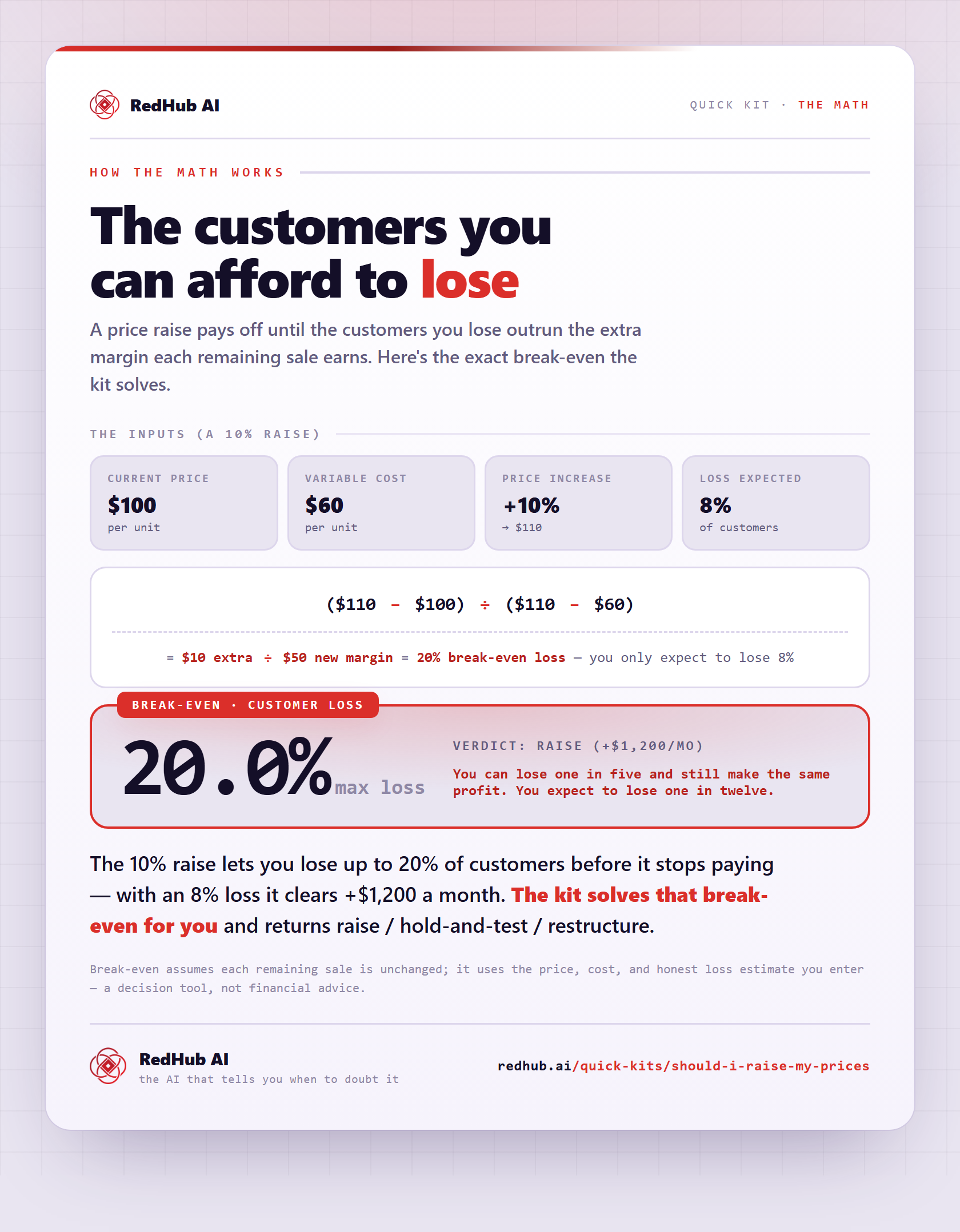
The gate this post refers to, drawn from the tool’s own logic. See the tool.