How to Reduce Cart Abandonment (Without Discounting)
RedHub AI Editorialupdated October 4, 20265 min read

Jump to a section6
To reduce cart abandonment without discounting, change the checkout instead of the price. Show the full total before the last step, let people buy as guests, cut the form to what you need, make the payment step look safe, and accept the ways your customers already pay. A discount sent after the cart is gone treats the symptom: it pays margin to fix a problem the checkout created, and it does nothing for the next shopper who hits the same wall. Fixing the flow usually costs less and keeps working, so find the one driver costing you the most and remove that first.
TL;DR: Discounts recover some carts but cost margin, can teach customers to abandon on purpose, and leave the cause in place. Fix the flow instead: show the true total early, offer guest checkout, shorten the form, add trust signals and cover the payment methods people expect. One caveat: if your extra cost is shipping, showing it earlier is free, but making it smaller is a pricing decision. The Checkout Friction & Abandonment Exposure Gate ($79) tells you which driver to fix first when one is short. Part of the guide on cart abandonment.
What a recovery discount costs
The usual reflex is a "come back for 10% off" email. It does bring some shoppers back. The cost is easy to miss, because part of the discount goes to people who would have come back anyway.
There is a second cost. Once shoppers learn that leaving a cart produces a coupon, some can start abandoning on purpose to get one. And the checkout that lost them is still losing the next shopper in the same way. If you do run promotions, the Discount & Promo Profit Analyzer ($39) separates sales a promo created from sales it only discounted.
The fixes, cheapest first
Baymard Institute's (opens in a new tab) survey of US online shoppers, with the just-browsing answer set aside, puts a number on each of these. Most cost a store nothing but development time.
- Show the true total early. Put shipping, tax and fees in the cart, not on the final screen. Extra costs were the top reason at 40%, and 12% left because they couldn't see or work out the total up front.
- Offer guest checkout. 18% left because the site wanted them to create an account. Offer to save their details on the confirmation page, after the order is in.
- Shorten the form. 17% left over a too long or complicated checkout. Ask only for what you need to deliver and charge.
- Add trust at the payment step. 19% didn't trust the site with their card details. Show the return policy, the accepted payment logos and a secure-payment note where the card number goes.
- Cover the payment methods people expect. 9% left because there weren't enough payment methods. An express wallet such as Apple Pay, Google Pay or PayPal also skips typing card details.
When the fix does cost margin
The first fix has a catch. If the extra cost is shipping, showing it in the cart is free, but it does not make shipping cheaper. Some shoppers who used to leave at checkout may now leave at the cart instead. Your checkout abandonment can look better while orders stay flat, because the same people are leaving one screen earlier.
Making shipping free, or folding it into the product price, does reach those shoppers, and it costs real margin on every order. That is a pricing decision, not a checkout fix, and it deserves its own arithmetic. A store selling $25 items with $9 shipping faces a very different choice from one selling $400 items with the same $9 fee, and no general rule settles it for both.
Fix the cause you have
All five fixes are sound, and doing all five at once is still guesswork, because your checkout probably leaks mostly from one. The Gate's worked sample includes a Wholesale portal that offers no guest checkout at all. It scores full marks on five of its other six signals and still reads HEMORRHAGING. The fix note is one change: offer prominent guest checkout and move account creation to after purchase. Then walk the full list in checkout optimization.
Fix the driver you have, not the one everyone cites
The Checkout Friction & Abandonment Exposure Gate scores each checkout flow you describe on seven friction signals and returns SMOOTH, LEAKING or HEMORRHAGING, with the signal to fix first where one is short. A partial failure on total-cost transparency or guest checkout forces HEMORRHAGING on its own. It reads nothing live, processes no payments and guarantees no recovery rate.
Get the Checkout Friction & Abandonment Exposure Gate — $79Pairs well with
The Discount & Promo Profit Analyzer ($39) prices every promo against running none and gives a keep, limit or kill verdict per promo. The Cart-Recovery Sequence Effectiveness Gate ($49) grades your recovery email flow, including how disciplined its discounts are, and returns OPTIMIZED, UNDERPERFORMING or DORMANT. The Returns & Refund Profit Analyzer ($39) shows true profit per SKU after returns, with a keep, fix or drop verdict.
More in this guide
How do I reduce cart abandonment without discounting?
Remove the friction that stopped ready buyers: show the true total early, offer guest checkout, shorten the form, add trust signals at the payment step and cover the payment methods your customers use. Then fix the single driver costing you the most first.
Why not just send a discount to recover abandoned carts?
Because it treats the symptom. Part of the discount goes to shoppers who would have returned anyway, it can teach customers to abandon on purpose to get a coupon, and it does nothing for the next shopper who hits the same friction.
What is the highest-impact fix?
For many stores it is showing the true total early. In Baymard Institute's survey of US online shoppers, extra costs such as shipping, tax and fees were the top reason for abandoning, at 40%. Your own biggest leak may still be somewhere else, so check before you assume.
Does free shipping reduce cart abandonment?
It removes the surprise cost for shoppers who would have left over shipping, but it costs margin on every order. Showing shipping early costs nothing and may only move some abandonment from the checkout to the cart. Treat free shipping as a pricing decision and run the numbers for your order values.
Should I force account creation to capture the customer?
No. In Baymard's survey, 18% of shoppers abandoned because the site wanted them to create an account. Offer guest checkout and invite people to save their details after the order is placed.
Are cart-recovery emails worth it?
As a backstop for distracted shoppers, yes. If they are doing heavy lifting, the checkout is leaking. Fix the flow first, and try a plain reminder before a reflexive discount.
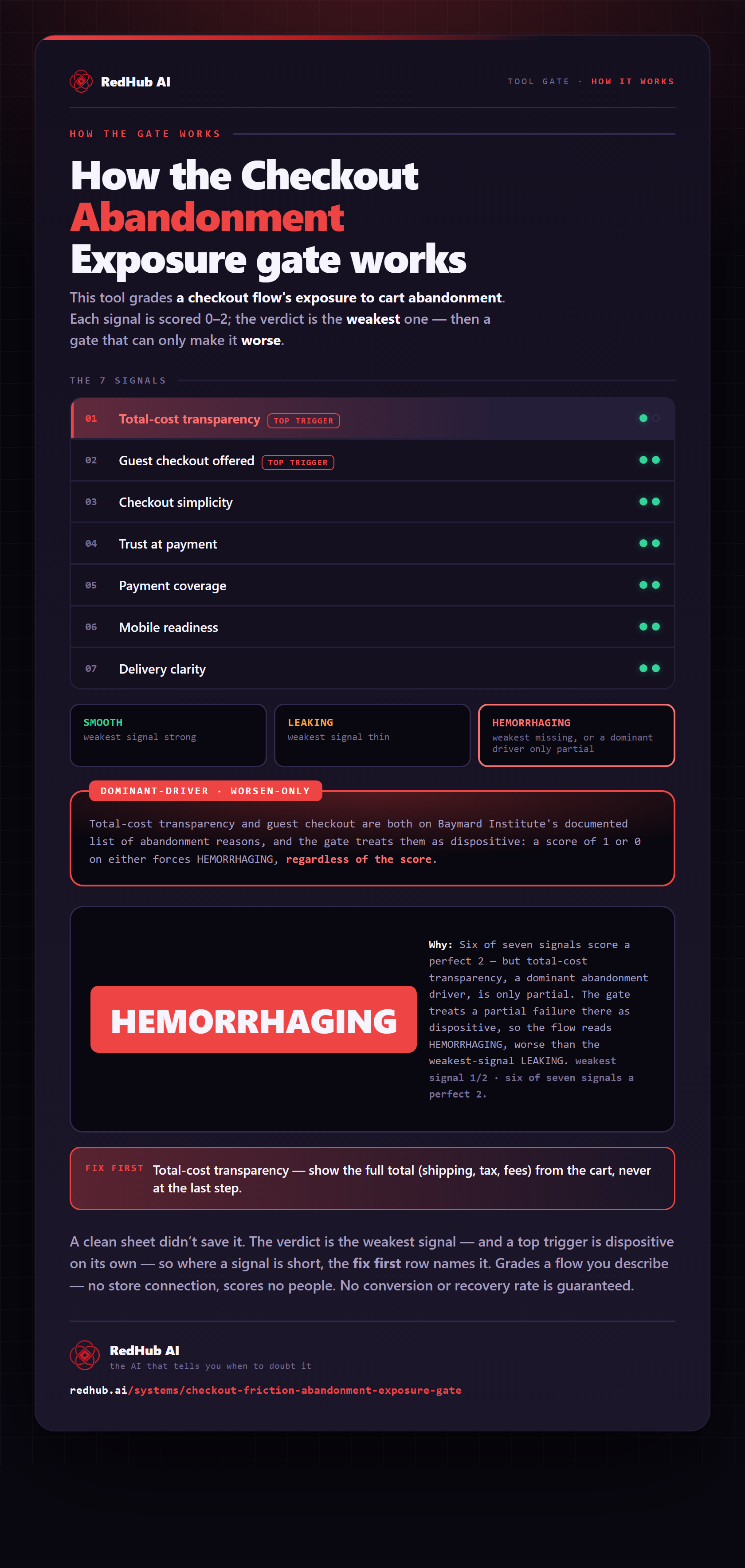
The gate this post refers to, drawn from the tool’s own logic. See the tool.