Refresh, Rewrite, or Retire: When to Republish Old Content (and When Not To)
RedHub AI Editorialupdated September 7, 20265 min read

Jump to a section9
TL;DR
- What it is: the decision behind every old post — refresh it, rewrite it, or retire it — and why "republish it" isn't always the answer.
- Who it's for: anyone tempted to slap a new date on old content. See the refresh engine.
- How it works: refresh what's sound, rewrite what's broken but valuable, retire what has no business being live.
- Bottom line: refusing to republish junk for a ranking is the whole discipline. A fresh date doesn't fix bad content.
Should you refresh, rewrite, or retire an old post?
Refresh a post when it's fundamentally sound but decaying — the facts need updating and the structure needs sharpening, but the page is accurate and valuable. Rewrite it when the topic still matters to your business but the existing page is inaccurate, thin, or off-strategy — too broken to patch. Retire it (unpublish or redirect) when the topic no longer serves your business and the page earns little. The one thing you should never do is fast-track a weak post to republish just because it ranks — a fresh date on inaccurate or worthless content only puts a bigger problem back in front of readers.
Best for: deciding the hard cases honestly — the Content Refresh & Publishing Engine forces inaccurate or worthless posts to Rewrite-or-Retire regardless of ranking. It stages a draft; you publish.
Every old post presents the same fork: refresh, rewrite, or retire. Most refresh advice pushes you toward "just republish it" because a fresh date can nudge rankings. But that shortcut is exactly where content programs lose their integrity — and their readers' trust. The honest discipline is knowing which of the three a post actually needs, and being willing to say "none of the above, retire it."
The three paths
| Path | When | What you do |
|---|---|---|
| Refresh | Sound page, decaying | Update facts, intro, structure, links — same URL |
| Rewrite | Valuable topic, broken page | Rebuild the page properly from the ground up |
| Retire | Low value, off-strategy | Unpublish, or redirect to a stronger page |
Refresh when the page is sound
Refreshing is for pages that are basically right but aging: accurate at their core, valuable to your business, ranking or close to it — they just have stale facts, a weak intro, or dated examples. This is the highest-return move because you're building on existing authority. If a post passes the "would I stand behind this as-is, once the facts are current?" test, it's a refresh.
Rewrite when the topic matters but the page is broken
Some pages cover a topic you genuinely want to own, but the existing article is inaccurate, thin, or built for a different strategy. You can't patch your way to good — a few updated stats won't save a fundamentally weak page. That's a rewrite: keep the URL and the topic, but rebuild the content properly. It costs more than a refresh, which is exactly why you reserve it for topics worth the investment.
Key insight: the tempting mistake is to "refresh" a page that actually needs a rewrite — a light touch-up on a broken page, published with a fresh date. It looks like progress and ranks for a while, but you've just re-shipped weak content. Match the effort to what the page actually needs.
Retire when it no longer serves you
Retirement is the option teams resist most, and it's often the right one. A page on a topic you no longer pursue, or a thin post that never earned its place, isn't worth refreshing or rewriting — keeping it live can even dilute your site's focus. Retiring means unpublishing it, or redirecting it to a stronger, related page so any authority it holds flows somewhere useful. A smaller library of pages you stand behind beats a large one padded with content debt.
Make the honest call, at scale
The Content Refresh & Publishing Engine won't fast-track an inaccurate, unsalvageable, or zero-value post to republish, however well it ranks — it routes those to Rewrite or Retire, so your refresh program stays honest.
Get the Content Refresh Engine — $129 →Why "never republish junk" is the whole point
It's tempting to treat a refresh program as a ranking hack: touch up old posts, stamp a new date, watch the freshness signal bump you up. But that logic ends with you republishing content you don't fully stand behind — which erodes reader trust and, increasingly, gets you nowhere as search and AI engines get better at judging quality. The discipline that makes a refresh program worth running is the willingness to say "this one isn't ready" and rewrite or retire it instead. Refusing to republish junk for a ranking isn't a limitation of the process — it is the process.
For the full method, read the pillar on content refresh, and prioritize the whole library with a content audit. Once a page is refreshed and sound, the GEO / AI Visibility Playbook helps it get cited by AI answer engines.
Decision Guide
Use it if: you're staring at old posts unsure whether to update, rebuild, or kill them.
Skip it if: your library is all current and accurate — there's nothing to triage yet.
Best first step: ask of each page, "would I stand behind this once the facts are current?" — yes means refresh, no-but-valuable means rewrite, no-and-low-value means retire.
FAQ
Should I republish old blog posts?
Only the ones that earn it. Refresh a sound-but-decaying page and republish that; rewrite a valuable-but-broken one; retire a low-value or off-strategy one. Never fast-track a weak post to republish just because it ranks — a fresh date doesn't fix bad content.
What's the difference between refresh and rewrite?
A refresh updates a page that's fundamentally sound — facts, intro, structure, links. A rewrite rebuilds a page that's inaccurate, thin, or off-strategy from the ground up, keeping the URL and topic. Refresh builds on what's there; rewrite replaces what's broken.
When should I retire content instead of updating it?
When the topic no longer serves your business and the page earns little. Retiring — unpublishing or redirecting to a stronger page — is often the right call. A smaller library of pages you stand behind beats a big one padded with content debt.
Does a fresh publish date improve rankings?
A genuine update can help, because freshness is a signal. But stamping a new date on content you didn't actually improve is a shortcut that puts weak content back in front of readers and, as engines get better at judging quality, increasingly doesn't work. Freshness rewards real updates, not date changes.
Isn't retiring content bad for SEO?
Not when it's done right. Redirecting a retired page to a stronger, related one passes along any authority it held, and removing thin or off-strategy pages can sharpen your site's overall focus. Keeping dead weight live to preserve a URL count doesn't help you.
How does a tool decide refresh vs rewrite vs retire?
By gating on accuracy and value, not just ranking. An honest engine routes inaccurate, unsalvageable, or zero-value posts to rewrite-or-retire regardless of how well they rank, and only sends sound-but-decaying pages to the refresh queue — with a human reviewing before anything publishes.
A fresh date doesn't fix bad content
Refresh what's sound, rewrite what's broken, retire what doesn't serve you — and never republish junk for a ranking. It stages a draft; you publish.
Get the Content Refresh Engine — $129 →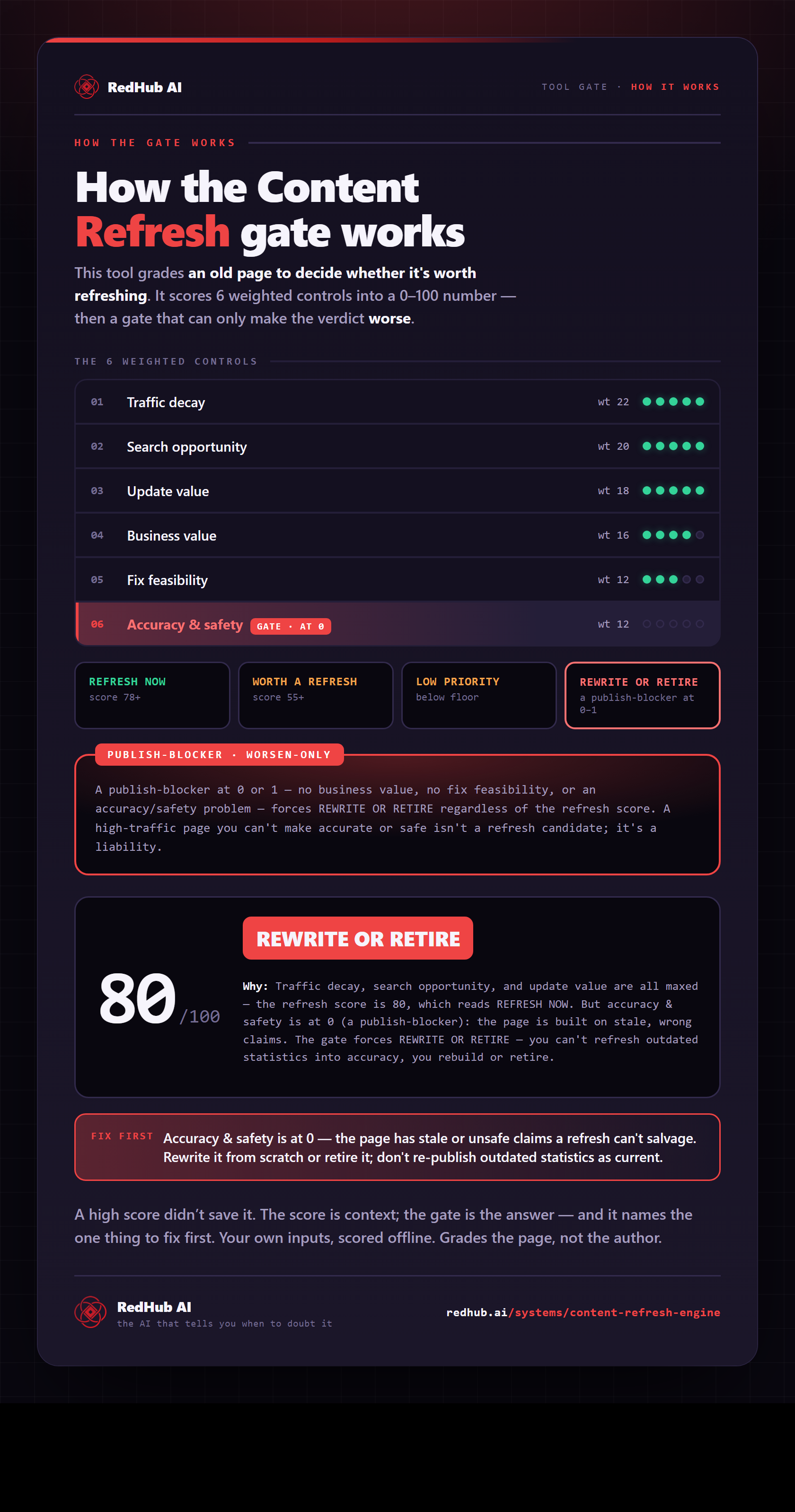
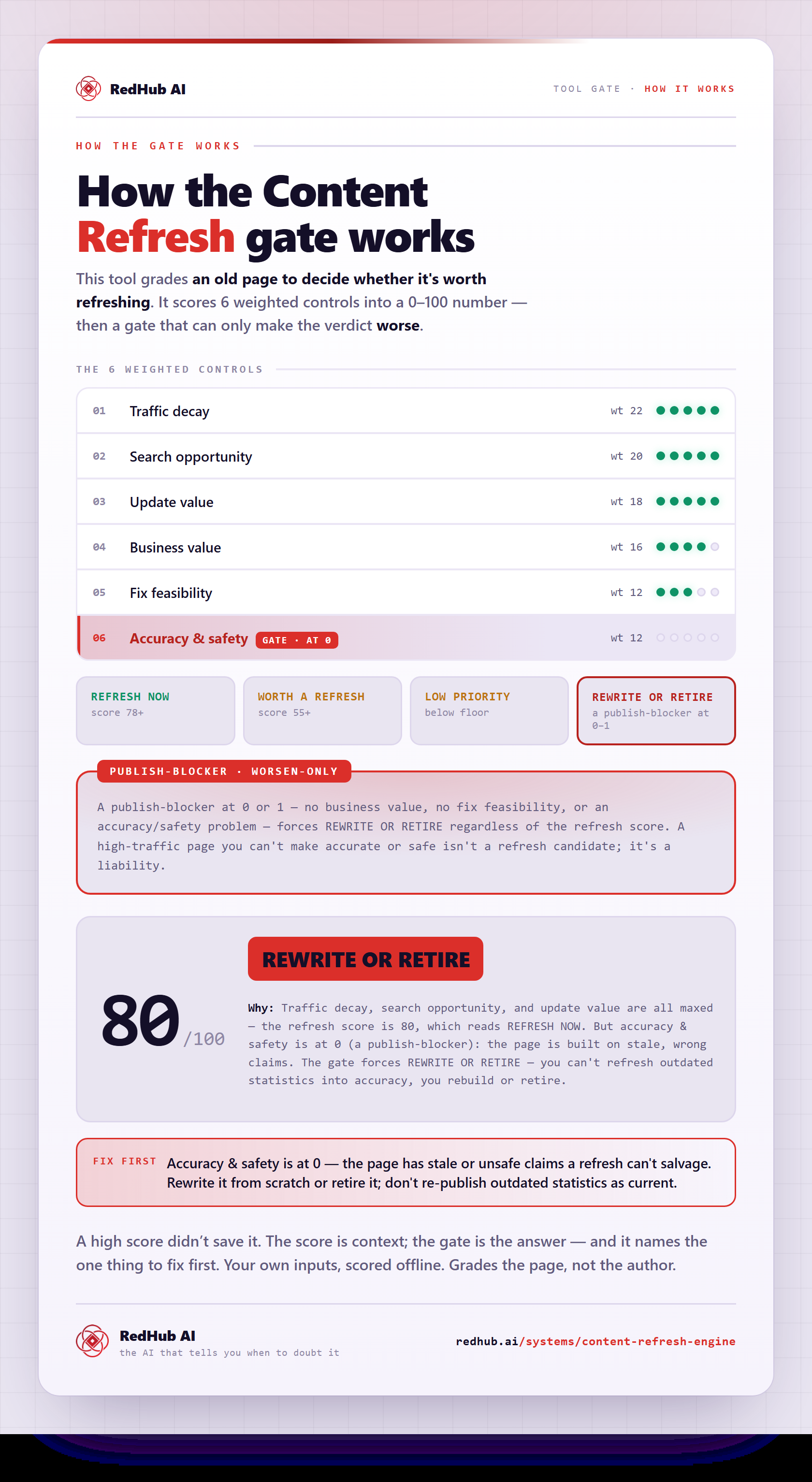
The gate this post refers to, drawn from the tool’s own logic. See the tool.