What "Separate Environments" Actually Requires
RedHub AI Editorialupdated November 5, 20266 min read

Jump to a section6
Separate environments for a small app means your development work and your live app use different accounts, projects, or workspaces underneath, not just different mode settings on top of one. A test mode and a live mode inside the same account are one thing with two labels. Whoever can reach that account can reach both sides, and the only thing between them is a setting. Real separation is when your development side has no way to reach the account your customers depend on.
TL;DR: "Keep your environments separate" sounds like one check. It is two. Does each side have its own mode setting? Usually yes, and usually checked. Is each side in its own account? Often never checked. The second is the one that counts. If you cannot tell, treat the account as shared. A service with no second mode is not a gap. Where it still carries testing risk, separation comes from a second account, a hard cap, or a person who checks.
The setting is not the separation
Ask someone whether their environments are separate and they usually check one thing: does this service have a test mode and a live mode, and are both filled in? That is a useful check. It tells you the service offers two modes. It does not tell you whether the two lead anywhere different.
The account is what holds your money, your customer records, and your ability to undo a bad command. Two mode settings in one account give you one account's worth of risk, labeled as two. Your development environment holds credentials for that account, and so does any agent you hand that environment to. A copied config line or a rushed "just use the live key for this test" crosses over, and nothing at the account level stands in the way.
How firmly a provider walls off its modes inside a single account varies, so read that provider's own documentation. Until you have, treat one account as no separation.
| What you see on the settings page | What sits underneath | Separated? |
|---|---|---|
| A test database and a live database, two connection strings | Two separate projects | Yes. This is the standard. |
| A test database and a live database, two connection strings | Two databases in one project, one set of admin credentials | No. Whoever administers one administers both. |
| A payment test mode and live mode, both filled in | One account holding both modes | No. One account, two labels. |
| A payment test mode and live mode, both filled in | You could not find out | Treat as no until you check. |
The first two rows look the same from the settings page. So do the last two. The difference is one level down, and it only shows up when you go and look at the account itself.
The question that finds the difference
Ask it per service. If I did something destructive from my development setup right now, deleted a record, issued a refund, sent a thousand messages, could it touch the account my real customers depend on? If the honest answer is yes, the two modes are not separate environments, whatever the labels say.
If you cannot answer it, that is an answer too. Treat an account you cannot confirm as shared. An answer you cannot produce is not evidence the two sides are apart.
Background jobs and queues fall through here most often. Nobody decided whether they share an account with anything, because nobody thought to ask. Silence on the question is not a pass.
When there is no second mode
Some services only ever had one copy. Your domain has one. So does a public status page, and so do some analytics setups that just record what happens. For those there is nothing to separate. That is an ordinary answer, not a corner you cut.
The complication is the service that has only one copy and still carries real risk when you test against it. A messaging service with no test mode will text a real phone. Pretending a sandbox exists does not help. The honest fallbacks are:
- A second account used only for testing, so there is a real account boundary even without a built-in mode switch.
- A hard cap on what the live account can do, such as a spending or sending limit, so a mistake has a ceiling.
- A manual guard: a person who checks before anything real goes out.
None of these is as good as a real sandbox, and which one fits depends on what a mistake there would cost. A second account is the closest, and it is also the one people skip because it means a second login to manage.
Where this overlaps with your keys, and where it doesn't
Whether a key has leaked, ended up somewhere public, or needs rotating is a real question with its own answer. The Keys & Secrets Sorting Drill ($49) covers it, four questions per key, without ever asking for the key value. Separation is a different question. A key nobody has ever seen can still be aimed at the live account. This post only asks where each key is pointed. Both questions apply to the same service, and answering one does not answer the other.
Check the account under every service at once
The Test Mode vs Live Mode Line-Up asks four questions per service: does it have two modes, where does your work point, where does your live app point, and do both sides share an account. A shared account, or one you could not confirm, reads DEV ON LIVE no matter what the mode settings say, and the Dashboard counts the ones whose development side points at test as "separate in name only." A service with no second mode reads NO SEPARATE MODES and is never counted against you. One .xlsx, offline, and it only reads back what you type.
Get The Test Mode vs Live Mode Line-Up — $49If the separation checks out and you have not looked at the rest of your app, The Vibe-Coded App Hardening Kit ($79) is the wider pass: auth, rate limits, error handling, secrets, and cost ceilings. If a real charge turns up because the separation was only ever a label, what to do about it is between you, your provider, and whoever keeps your books. Nothing here is accounting, tax, or financial advice.
More in this guide
Frequently asked questions
Isn't having a test mode and a live mode enough to call environments separate?
Not on its own. Two mode settings separate your environments only if each side also has its own account, project, or workspace. A service can have both modes filled in correctly and keep both in one account, in which case anyone who can reach that account can reach both sides, and the setting is a label, not a boundary.
How do I check whether two modes share an account?
Ask whether something destructive done from your development setup, such as a delete, a refund, or a bulk send, could touch the account your real customers depend on. Then look at the account itself, not the mode setting. If the answer is yes, or you cannot find out, treat that service as not separated.
What counts as separate environments for a service with no test mode?
There is no mode to separate, so if testing against it carries real risk, separation has to come from elsewhere: a second account used only for testing, a hard cap on what the live account can spend or send, or a person who checks before anything real goes out. If it carries no testing risk, there is nothing to do.
Is checking account separation the same as checking whether my keys are safe?
No. They are related but different questions. A key that has never leaked can still be aimed at the live account. Whether a key is exposed or needs rotating is one check. Whether it points at the right account is another, and passing one tells you nothing about the other.
What if I can't tell whether two modes share an account?
Treat them as shared. Not being able to confirm a separation carries the same risk as a confirmed shared account until you find the real answer, and the real answer may turn out to be better once you look at the account directly.
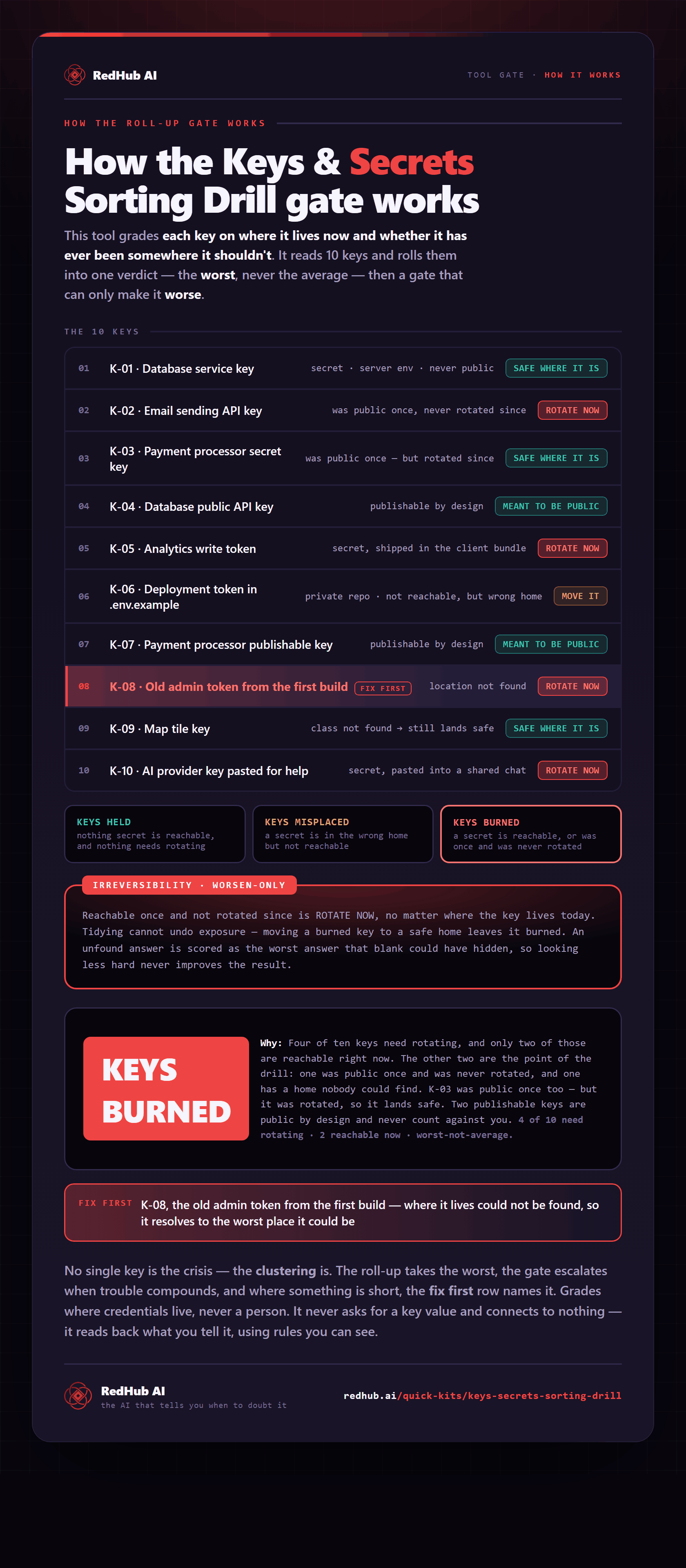
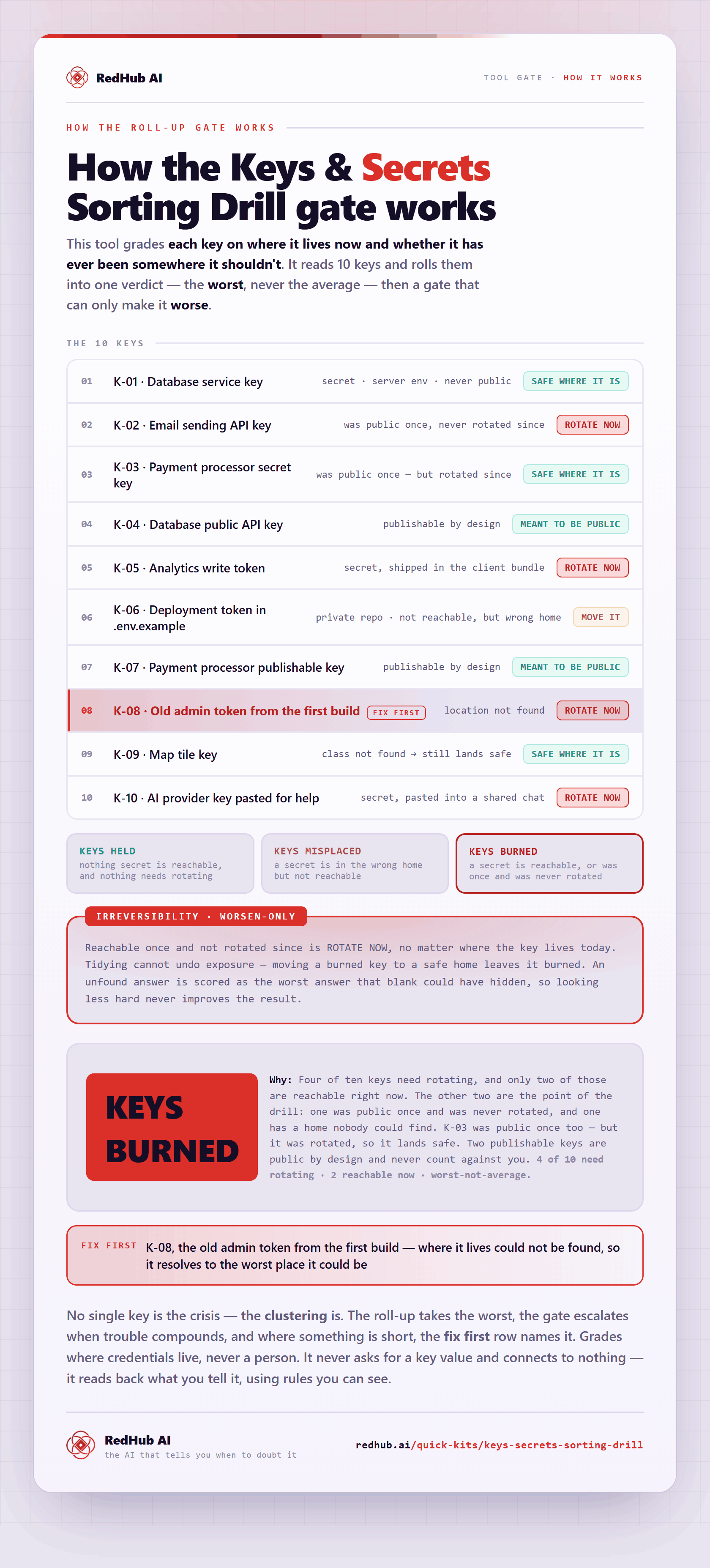
The gate this post refers to, drawn from the tool’s own logic. See the tool.