How to Use Sound Design to Make Short-Form Video Feel Pro
RedHub AI Editorialupdated September 20, 20264 min read
Jump to a section8
Short-form video runs on a tight budget of attention — most viewers decide whether to keep watching in the first couple of seconds. Sound is doing more of that work than creators usually credit. A hook with no audio cue underneath it doesn't land the same as one with a well-timed sting, and a cut with no sound under it reads as unfinished even at 15 seconds.
TL;DR: Sound design for short-form is about pacing effects to your cuts, using silence deliberately, and layering just enough sound to support the story without cluttering it. It's a handful of small habits, not a production overhaul: sound your hook, sound your transitions, leave the punchline clean. The AI Sound Design & SFX Kit ($59) turns this into a repeatable workflow you can run on every edit.
Sound your hook, not just your visuals
The first one to two seconds of a short-form video carry the most weight. If your hook is a visual surprise, a sting, whoosh, or impact sound underneath it makes the surprise register faster — sound reaches the brain slightly differently than image, and a well-timed audio cue sharpens a visual beat instead of just decorating it.
Pace effects to your cuts, not to the clock
Short-form edits move fast, and sound effects need to move with them. An effect that lingers half a second past its cut feels sloppy; one that's clipped too early feels abrupt. Align the effect's onset to the cut itself, and trim the tail rather than letting it ring out — precision here is most of what separates "edited" from "produced."
Use silence on purpose
Not every cut needs a sound. A beat of near-silence right before a punchline or reveal makes the next sound — or the next line of dialogue — land harder. Constant sound effects flatten the dynamics of a video; strategic silence is a sound-design choice, not an absence of one.
Layer under dialogue and music, never over it
Sound effects support the story — they shouldn't compete with your voiceover or your music bed for attention. Keep effects a few dB under dialogue in the mix, and check the full edit with headphones before publishing; effects that sound fine solo often sit too loud once dialogue and music are layered in.
A four-beat checklist for a short-form sound pass
- Hook (0–2s): does the opening moment have an audio cue that sharpens it?
- Transitions: is every hard cut supported by a sound, or is silence there on purpose?
- Punchline/reveal: is there a beat of quiet right before it lands?
- Mix check: with headphones, do effects sit under dialogue and music, not over them?
More effects isn't more professional
It's tempting to sound-design every single cut once you start noticing how much it helps. Resist it. A video with a sound on every transition and every text pop-in starts to feel noisy rather than polished — the goal is supporting specific story beats, not filling every second with audio. Fewer, well-placed effects consistently read as more professional than more, evenly-spaced ones.
Pairs well with
For where to actually source the effects you're pacing into your cuts, see Where to Get Sound Effects for Video. For the video content and hook strategy side of short-form, the Organic Social & Short-Form Video System ($79) is the companion system.
More in this guide
Does short-form video need different sound design than long-form?
The principles are the same, but the timing is tighter — with only a few seconds to earn attention, sound needs to be precisely paced to cuts and hooks rather than loosely placed.
How many sound effects should a 15–30 second video have?
Cover the key beats — the hook, major transitions, a punchline — rather than every cut. A handful of well-placed effects reads as more professional than sound on every frame.
Should I add sound to my hook even if it's already visually strong?
Yes, generally. An audio cue underneath a strong visual hook sharpens it further — sound and image reinforcing each other lands better than either alone.
Is silence a legitimate sound design choice?
Yes. A deliberate beat of quiet before a punchline or reveal makes what follows land harder — it's a technique, not a gap in the edit.
How loud should sound effects be relative to dialogue and music?
Effects should sit under both in the mix. Check the full edit with headphones — effects often sound fine in isolation but too loud once layered with dialogue and music.
Does better sound design guarantee a video performs well?
No. Sound design removes a subtle reason viewers disengage, but it doesn't guarantee reach or virality on its own — it supports a good video, it doesn't replace one.
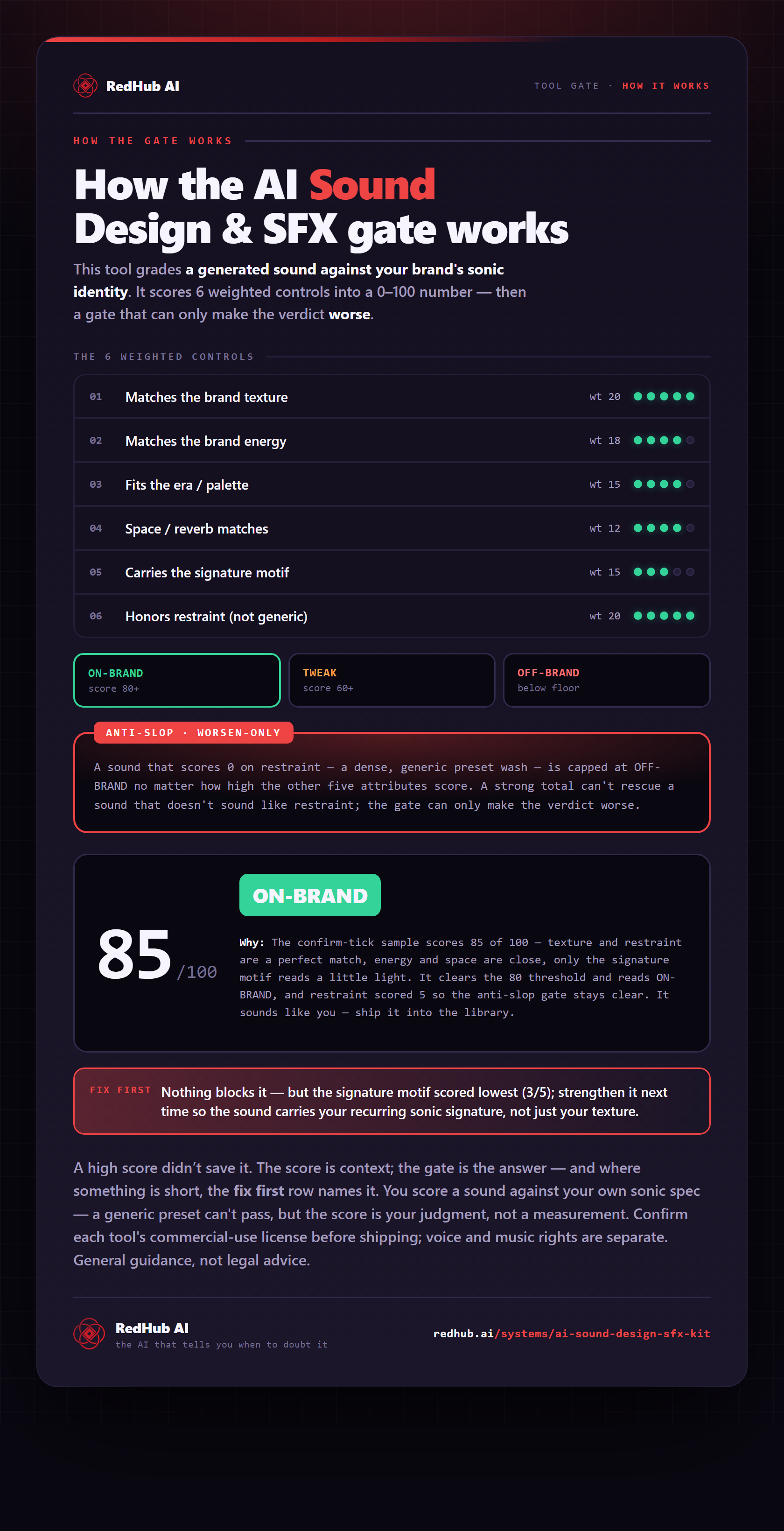
The gate this post refers to, drawn from the tool’s own logic. See the tool.