Are AI Sound Effects Royalty-Free? What You Can Actually Use
RedHub AI Editorialupdated September 20, 20264 min read

Jump to a section7
"Royalty-free" gets used loosely around AI-generated sound effects, and it's not one clean answer — it depends on the specific tool, its terms of service, and how it's licensed the output it generates for you. Some tools grant broad commercial rights out of the box. Others restrict commercial use, require attribution, or leave ownership ambiguous. The only way to know is to read that tool's actual license.
TL;DR: Whether an AI-generated sound effect is yours to use commercially depends entirely on that specific tool's terms — there's no single rule that applies across every AI sound generator. The copyright status of purely AI-generated audio is also still an evolving legal area in many jurisdictions, so treat "AI-generated" as a starting point for research, not a guarantee of clearance. Read the tool's license before you publish, and for the deeper rights question across music and audio generally, see the AI Music & Audio Rights Kit ($89).
"Royalty-free" doesn't mean "no restrictions"
Royalty-free typically means you don't pay a fee every time you use the sound — it does not automatically mean unrestricted commercial use, no attribution required, or exclusive ownership. A tool can call its output royalty-free while still restricting certain use cases (paid ads, resale, use in another AI training set) in its actual terms of service. The label on the tool's marketing page is not the license.
What actually determines what you can use
- The tool's terms of service — this is the actual license, not the homepage copy or a FAQ blurb.
- Whether the tool grants you commercial rights, personal-use-only rights, or something in between.
- Whether the tool claims any ownership or rights over what you generate — some retain broad rights to reuse your outputs; others don't.
- The underlying legal status of AI-generated content in your jurisdiction, which is still developing and varies — this is a genuinely unsettled area, not a solved one.
A simple checklist before you publish
- Find the tool's actual terms of service — not a summary, the real document.
- Confirm it explicitly covers commercial use, not just personal or non-commercial use.
- Check whether attribution is required, and if so, where it needs to appear.
- Check whether the tool claims any rights to reuse or redistribute what you generate.
- Keep a record of which tool and license version you used, in case terms change later.
Free and paid libraries aren't automatically safer
It's tempting to assume a traditional sound effect library sidesteps this whole question, but the same rule applies there too: read the specific license. Some free library clips restrict commercial use or require attribution; some paid libraries include broader rights than others. The AI-versus-library distinction doesn't change the underlying obligation — check the license, every time, regardless of source.
When to go deeper than this post
This post covers sound effects specifically. If you're also using AI-generated or licensed music in your videos — a much higher-stakes rights question, since music licensing disputes are far more common than sound-effect disputes — that's covered in depth in the AI Music & Audio Rights Kit ($89), which walks through licensing checks, disclosure language, and a rights record-keeping system across music and audio generally.
Pairs well with
For the deeper rights and licensing system covering music and audio across your whole channel, see the AI Music & Audio Rights Kit ($89). For where to source sound effects in the first place, see Where to Get Sound Effects for Video.
More in this guide
Is this legal advice?
No. This is general guidance on how to think about AI sound effect licensing, not legal advice. Always read the specific tool's terms of service, and consult a licensing attorney for anything high-stakes or ambiguous.
Are all AI-generated sound effects royalty-free?
No — "royalty-free" is a marketing term that doesn't guarantee unrestricted commercial use. The actual rights depend on that specific tool's terms of service, which you need to read directly.
Can I use AI-generated sound effects in monetized YouTube videos or client work?
It depends entirely on the tool's license. Some explicitly permit commercial use, including monetized content; others don't, or require conditions like attribution. Check before you publish, not after.
Is AI-generated audio copyrightable?
The copyright status of purely AI-generated content is a genuinely evolving legal question in many jurisdictions, and treatment differs by region. Don't assume either "yes, fully protected" or "no, public domain" — verify current guidance rather than relying on assumptions.
Does a free sound effect library have fewer licensing restrictions than an AI tool?
Not necessarily. Free libraries have their own varying terms — some restrict commercial use or require attribution. The source (AI vs. library) doesn't change the obligation to check the specific license.
What's the difference between this kit and the AI Music & Audio Rights Kit?
This kit focuses on sound design and sound effects workflow, with a light rights checklist for effects specifically. The AI Music & Audio Rights Kit ($89) is the deeper, dedicated resource for music and audio licensing across your whole channel.
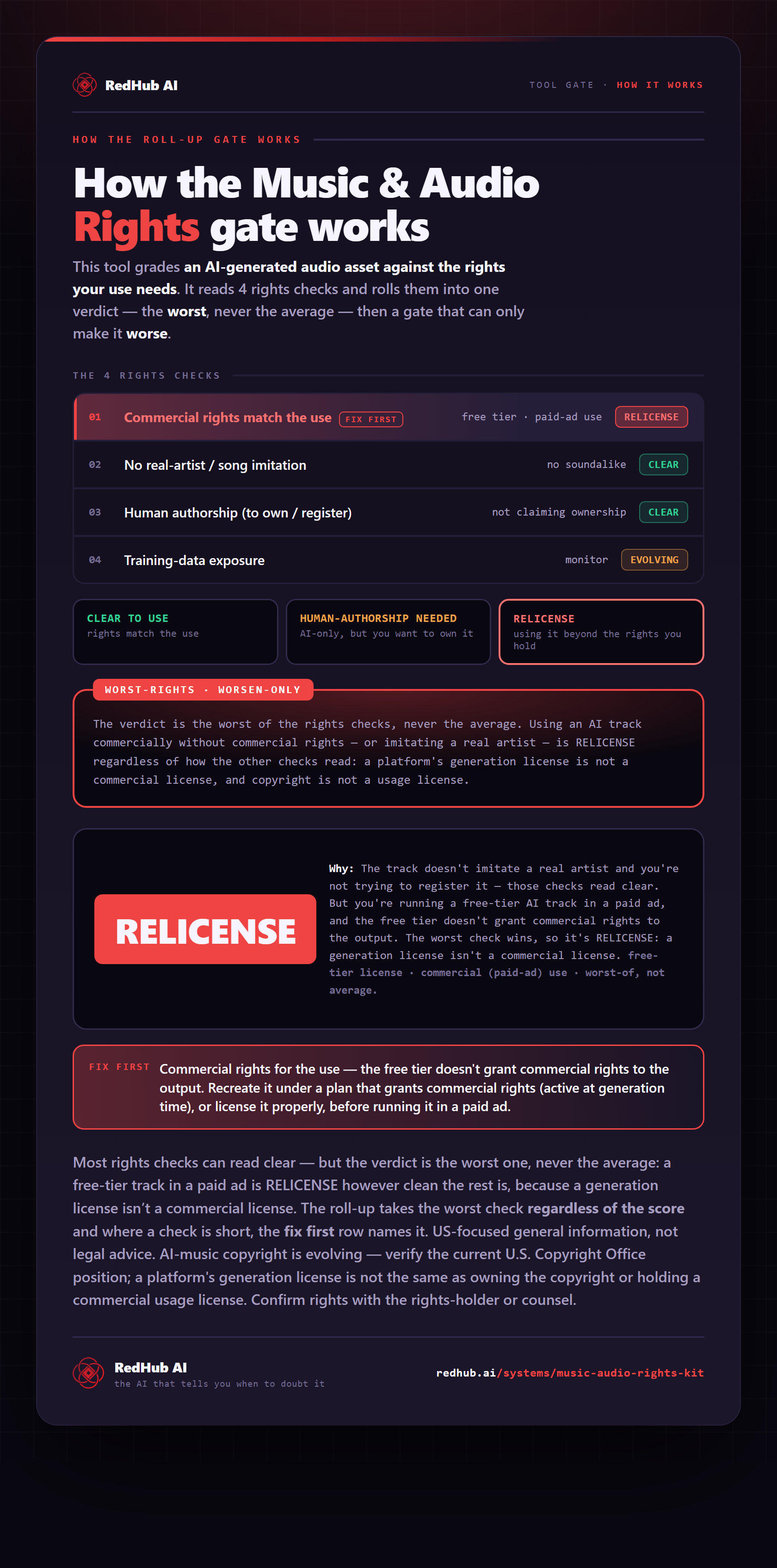
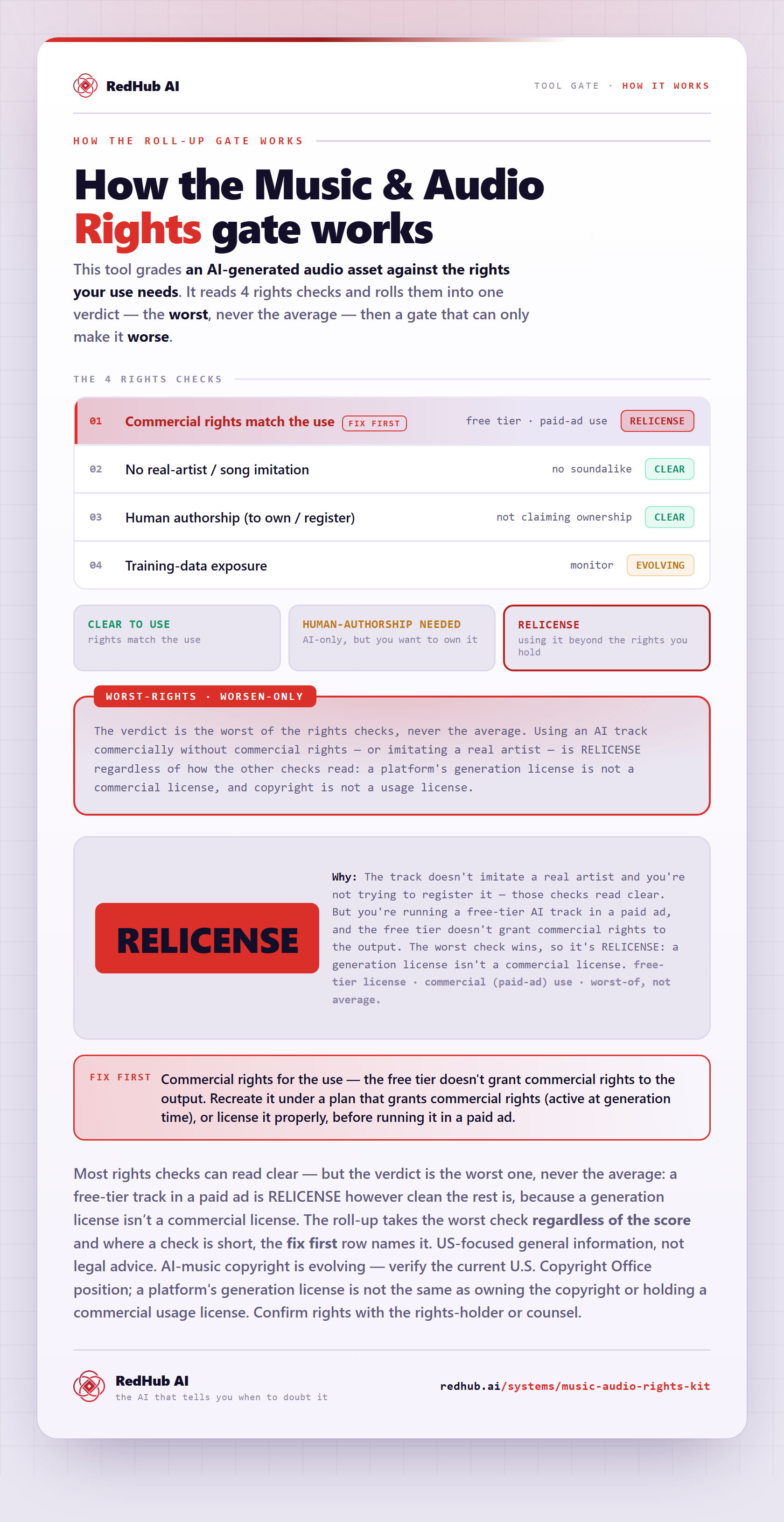
The gate this post refers to, drawn from the tool’s own logic. See the tool.