AI Sound Effects: What They're Good For (and What They're Not)
RedHub AI Editorialupdated September 20, 20264 min read

Jump to a section6
AI sound effect tools generate audio from a prompt or reference instead of pulling a pre-recorded clip. That's a real capability — but it's not a universal replacement for sound libraries, and treating it like one is how creators end up with effects that sound slightly off in the mix.
TL;DR: AI-generated sound effects are strongest for sounds that don't exist as clean recordings anywhere — stylized, abstract, sci-fi, or brand-specific tones — and for iterating quickly when you need a sound tuned to an exact beat in your edit. They're weaker on realistic, everyday sounds, where a well-recorded library clip usually wins on both quality and speed. The honest answer is: use AI generation for the sounds libraries can't cover, not as a blanket replacement. The AI Sound Design & SFX Kit ($59) helps you make that call per sound, not per project.
Where AI sound generation genuinely helps
The clearest win is sounds that simply don't exist pre-recorded — an abstract UI tone for a brand you're building from scratch, a sci-fi weapon or ambience, a transition sound tuned to a very specific cut length. In these cases you're not competing against a library; you're filling a gap a library can't fill.
- Novel or abstract sounds — nothing pre-recorded matches what you're imagining.
- Brand-specific audio — a signature notification tone or sting unique to your channel.
- Precise timing — a sound generated or adjusted to fit an exact beat, rather than trimming a stock clip to fit.
- Fast iteration — testing several variations of a stylized effect quickly, without downloading a dozen library files.
Where AI sound generation is weaker
For everyday, realistic sounds — footsteps on gravel, a specific car door, rain on a window — a well-recorded library clip usually beats generation on both realism and speed. These sounds have been recorded thousands of times already; generating a new one from a prompt is often slower and less convincing than searching a library for three seconds.
- Realistic foley — footsteps, doors, everyday object sounds — libraries are typically more convincing.
- Sounds requiring exact real-world accuracy — a specific vehicle, a specific tool, a recognizable environment.
- Anything where "close enough" isn't good enough — viewers notice when a common sound feels slightly synthetic.
A simple test before you reach for AI generation
Ask one question: does this sound already exist, recorded well, in a library I can search in under a minute? If yes, use the library — it's faster and usually more convincing. If no — because the sound is abstract, stylized, brand-specific, or needs to hit an exact beat — that's your signal to generate it.
- Describe the sound in one sentence — realistic or stylized?
- If realistic, search a library first. Don't default to generation out of habit.
- If stylized, abstract, or nonexistent elsewhere, prompt an AI tool and iterate on the result.
- Layer the result into your mix the same way you'd layer any sourced clip — under dialogue and music, not over it.
AI sound effects don't replace sound design judgment
Generating a sound is one step in a workflow, not the whole workflow. The judgment calls — which moments in your edit actually need sound, how loud an effect should sit under dialogue, whether an effect is helping the story or competing with it — are still yours to make, tool or no tool. More AI-generated effects layered into a cut isn't automatically better sound design; it's often the opposite.
Pairs well with
For the full sourcing comparison across free, paid, and AI options, see Where to Get Sound Effects for Video. For applying sound design specifically to short-form content, see How to Use Sound Design to Make Short-Form Video Feel Pro.
More in this guide
Are AI-generated sound effects better than library sound effects?
Neither is universally better — it depends on the sound. AI generation wins on unique, abstract, or brand-specific sounds; libraries generally win on realistic, everyday sounds.
Can AI generate realistic foley like footsteps or doors?
It can attempt to, but a well-recorded library clip is usually more convincing for common real-world sounds. Save AI generation for sounds libraries genuinely can't cover.
Do I need a specific AI tool to do this?
No. This guide and the AI Sound Design & SFX Kit are tool-agnostic — the decision framework applies to whatever AI sound generator you already use.
Will using AI sound effects make my video sound more professional automatically?
No single tool does that. Professional-sounding video comes from matching the right source — library or AI — to each specific sound, then mixing it correctly under dialogue and music.
How do I know if a sound is a good candidate for AI generation?
If it's abstract, stylized, brand-specific, or doesn't exist as a clean recording anywhere, it's a good candidate. If it's a common real-world sound, check a library first.
Can I use AI-generated sound effects commercially?
It depends on the specific tool's license, and this is an evolving area — see Are AI Sound Effects Royalty-Free? and the AI Music & Audio Rights Kit for the deeper rights guidance.
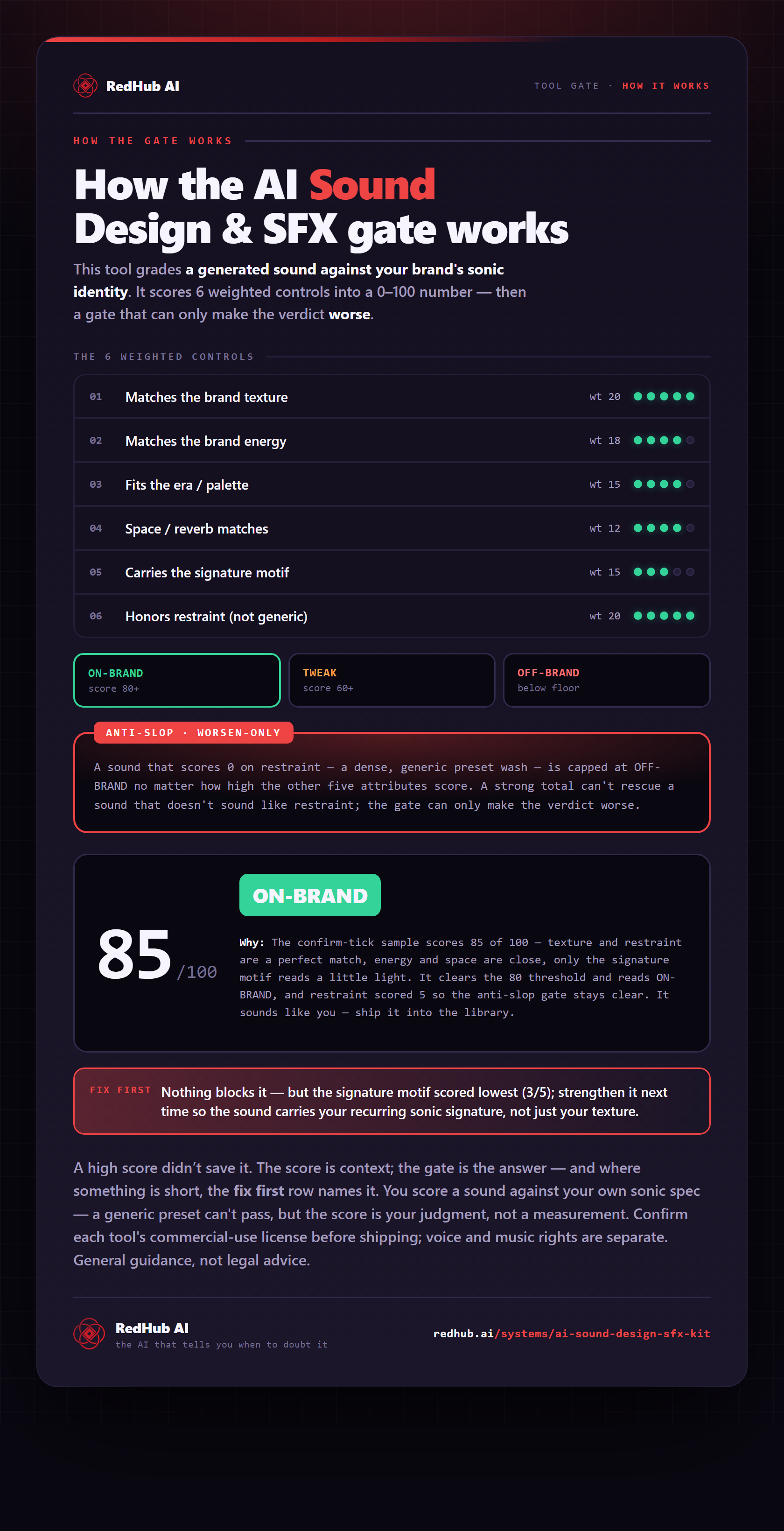
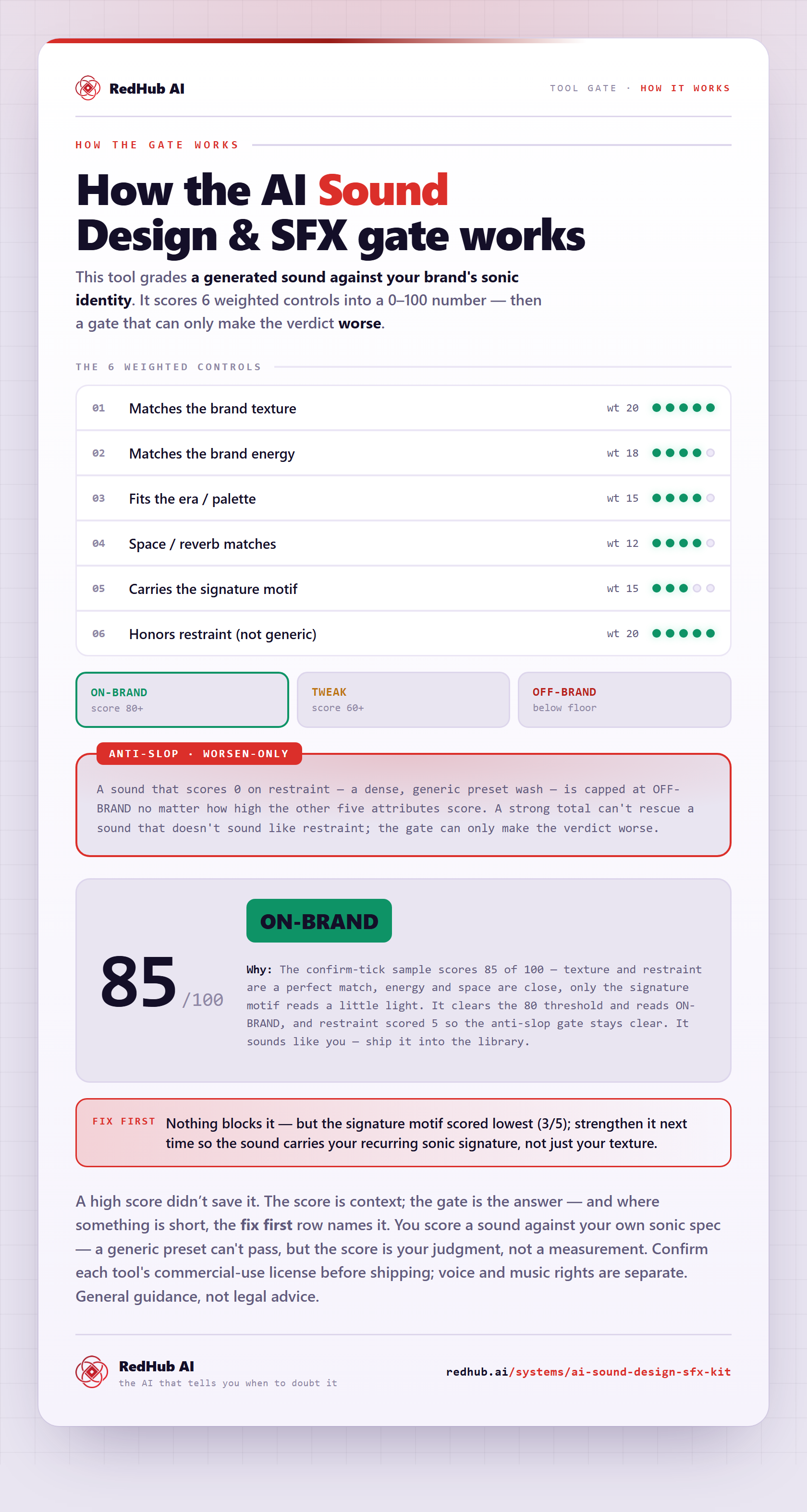
The gate this post refers to, drawn from the tool’s own logic. See the tool.