Where to Get Sound Effects for Video (Free, Paid, and AI)
RedHub AI Editorialupdated September 20, 20264 min read

Jump to a section7
There are exactly three places a sound effect can come from: a free library, a paid library, or an AI generation tool. None of the three is universally "best" — each is right for a different kind of sound, and picking wrong is how creators end up with a folder of mismatched effects that don't sit together in the mix.
TL;DR: Free libraries are best for common, real-world sounds where uniqueness doesn't matter (footsteps, doors, notification pings). Paid libraries earn their price on consistent quality across a whole project and cleaner licensing terms. AI-generated effects are strongest for sounds that don't exist pre-recorded anywhere — stylized, abstract, or tuned to an exact edit pace. Most creators end up using a mix of all three. The AI Sound Design & SFX Kit ($59) gives you the decision framework for which source to reach for and when.
Free sound effect libraries
Free libraries are the right call for common sounds: footsteps, door creaks, clicks, whooshes, notification tones, ambient room noise. These sounds exist in huge volume across free libraries because they're recorded once and reused constantly — that's fine for a functional sound effect, since the audience isn't listening for originality on a doorbell.
- Strength: zero cost, huge selection for generic sounds, fast to search.
- Weakness: licensing terms vary wildly by site and even by individual clip — some require attribution, some restrict commercial use, some are genuinely public domain. Read the specific license every time, not just the site's homepage claim.
- Best for: UI sounds, everyday foley, background ambience, anything where the sound just needs to be functionally correct.
Paid sound effect libraries
Paid libraries (subscription or per-clip) trade cost for quality control and cleaner licensing. You're generally buying two things: better-recorded, better-edited source audio, and a license that's actually written for commercial content rather than ambiguous free-tier terms.
- Strength: consistent audio quality across an entire project, clearer commercial licensing, often organized into cohesive sound packs (a whole "sci-fi UI" pack, a whole "kitchen foley" pack) so your effects sit together tonally.
- Weakness: cost adds up per project or per seat if you're not on a flat subscription; still not unique to you — other creators are drawing from the same pack.
- Best for: projects where sound quality is part of the brand (podcasts, tutorials, product demos) and you need several effects to sound like they belong together.
AI-generated sound effects
AI sound generation tools create an effect from a text prompt or reference rather than pulling a pre-recorded clip. This is genuinely useful for one specific case: a sound that doesn't exist as a clean recording anywhere, or one you want tuned to an exact moment in your edit. We cover exactly where this helps — and where it doesn't — in AI Sound Effects: What They're Good For (and What They're Not).
- Strength: can produce something genuinely unique to your project, fast iteration if the first result isn't quite right, good for stylized or abstract sounds.
- Weakness: weaker on realistic, everyday sounds than a well-recorded library clip; licensing/ownership terms differ by tool and are still an evolving area — see Are AI Sound Effects Royalty-Free? before you rely on it commercially.
- Best for: sci-fi/fantasy sounds, brand-specific notification tones, anything abstract or stylized that a stock library won't have.
Side-by-side comparison
| Source | Cost | Best for | Uniqueness | Licensing clarity |
|---|---|---|---|---|
| Free library | $0 | Common, everyday sounds | Low — widely reused | Varies by clip — always check |
| Paid library | Per-clip or subscription | Cohesive, high-quality project sets | Low-medium — shared pack | Generally clear, written for commercial use |
| AI-generated | Varies by tool | Unique, abstract, or stylized sounds | High | Still evolving — verify each tool's terms |
How to actually decide, per sound
- Is this a common, real-world sound (footstep, door, click)? Reach for a free or paid library first.
- Does it need to match a specific brand tone or sit alongside several other effects consistently? Consider a paid pack.
- Does it not exist as a clean recording anywhere, or does it need to be tuned to an exact beat in your edit? That's where AI generation earns its place.
- Whichever source you pick, confirm the license covers your actual use case before you publish.
Pairs well with
For the full sourcing-to-mix workflow, start with the pillar guide, AI Sound Design: How to Add Pro Sound Effects to Your Videos. If you're also handling music in your videos, the AI Music & Audio Rights Kit ($89) covers that licensing layer in depth.
More in this guide
Are free sound effect libraries safe to use commercially?
Many are, but not all — terms vary by site and even by clip. Always check the specific license before using a free effect in a commercial video, rather than assuming the whole library is cleared.
Is a paid sound library worth it over free?
If you need several effects to sound like they belong together, or you want clearer commercial licensing without checking every clip, yes — that consistency and clarity is what you're paying for.
When should I use AI to generate a sound effect instead of a library?
When the sound doesn't exist as a clean recording anywhere, or you need it tuned precisely to a moment in your edit — abstract, stylized, or brand-specific sounds are where AI generation is strongest.
Can I mix free, paid, and AI-generated effects in one video?
Yes, and most creators do. Just make sure the levels and tone are consistent in the final mix, and that each source's license is checked individually.
Do AI-generated sound effects sound as realistic as recorded ones?
For everyday, real-world sounds, a well-recorded library clip is generally more realistic. AI generation tends to shine on stylized or abstract sounds rather than realism.
What does the AI Sound Design & SFX Kit include?
A sourcing decision framework across free, paid, and AI options, a sound-design workflow for laying effects into a cut, and a rights/disclosure checklist — tool-agnostic, so it works with whatever library or AI tool you already use.
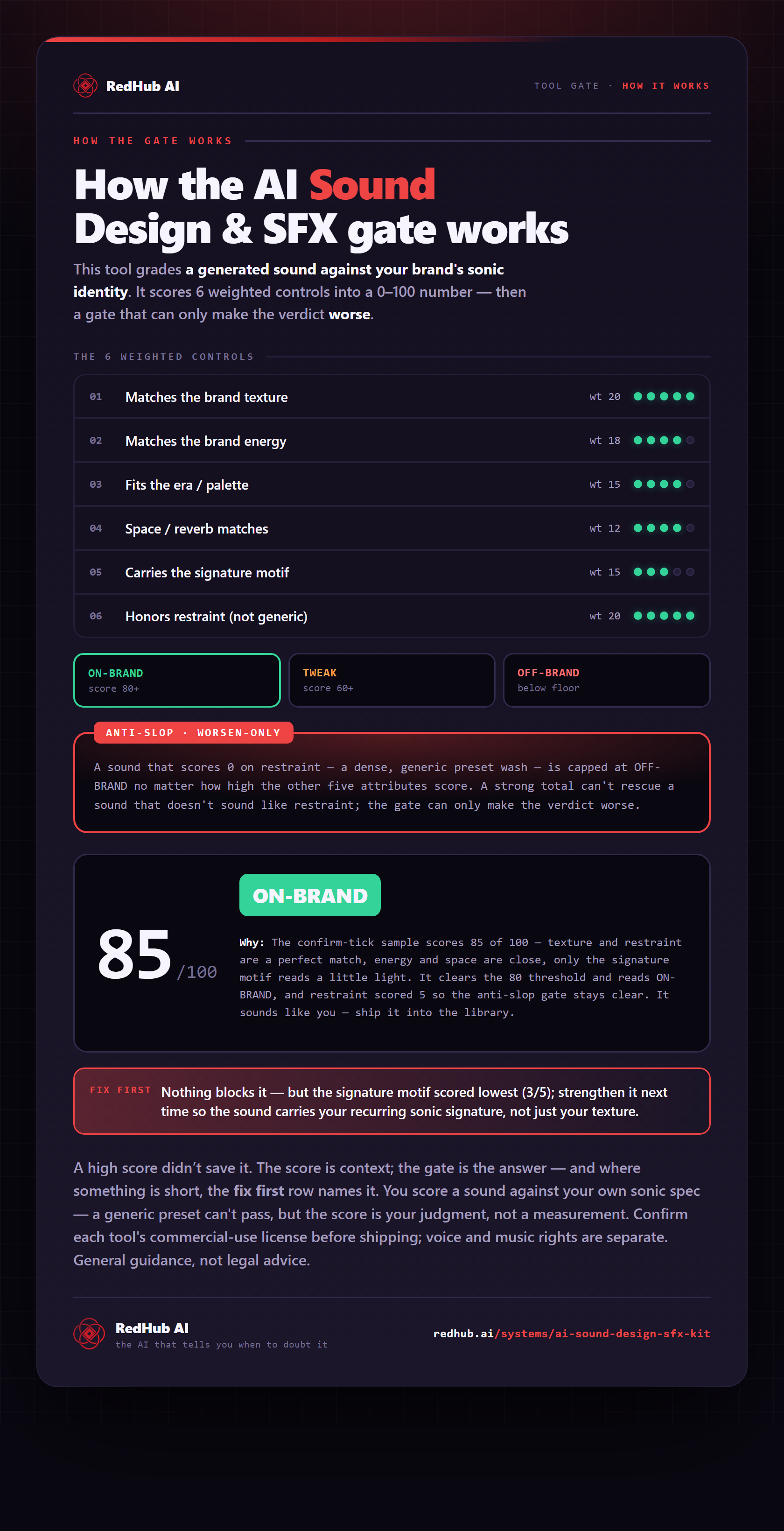
The gate this post refers to, drawn from the tool’s own logic. See the tool.