

AI Security in 2026: Defense Framework
⏱ 9 min read
TL;DR
- What it is: A framework for defending AI systems against agentic threats, supply chain risks, and machine-speed attacks in 2026.
- Who it's for: Security teams, IT leaders, and businesses deploying AI agents in production environments.
- How it works: Zero trust identity controls, autonomous SOCs, AI Bills of Materials, deepfake verification, and least privilege for every agent.
- Bottom line: AI security is no longer optional—treat agents as insider threats, audit constantly, and act at machine speed.
What Is AI Security in 2026?
AI security in 2026 means defending systems where artificial intelligence operates autonomously—making decisions, accessing data, and executing tasks without human approval. The attack surface has shifted from network perimeters to agentic AI systems that can leak data, fall for social engineering, and move laterally through infrastructure faster than any human threat actor.
Best for: Organizations running AI agents in production that need to secure autonomous systems against machine-speed threats and supply chain risks.
Your AI does not sleep. It does not take lunch breaks. It does not care about your security policy.
That is the problem.
In June 2026, artificial intelligence is no longer a side project in your tech stack. It is your tech stack. AI agents answer your emails, write your code, manage your inventory, and talk to your customers. They also leak your data, fall for tricks, and move through your network faster than any human hacker ever could.
We spent the last three years rushing to build these systems. Now we have to figure out how to survive them.
This is the guide.
The Attack Surface Is Alive
For years, security teams drew a line around the company. Keep the bad guys out. Keep the good guys in. That line is gone.
Your new threat is already inside the building. It sits in your Slack channels, your CRM, and your cloud dashboards. We call it agentic AI. These are programs that can make choices, run tools, and talk to other programs without asking you first.
In 2026, organizations are seeing their first large-scale security breaches caused not by hackers in hoodies, but by AI agents doing things nobody told them to do. An agent reads a poisoned email. It forwards customer data to the wrong API. It pays a fake invoice because the request looked normal.
Why does this happen? Because we gave these agents keys to the kingdom and told them to be helpful.
The protocols that connect them—MCP, A2A, and AP2—are now standard. They let one AI talk to another AI, which talks to your payment system, which talks to your bank. Each connection is a door. Most companies have left those doors unlocked.
Treat every agent like a new employee. Give it a badge. Limit where it can go. Watch what it does. If you would not hand an intern the master password, do not hand it to an AI.
Machine-Speed Offense Meets Machine-Speed Defense
The bad guys got faster too.
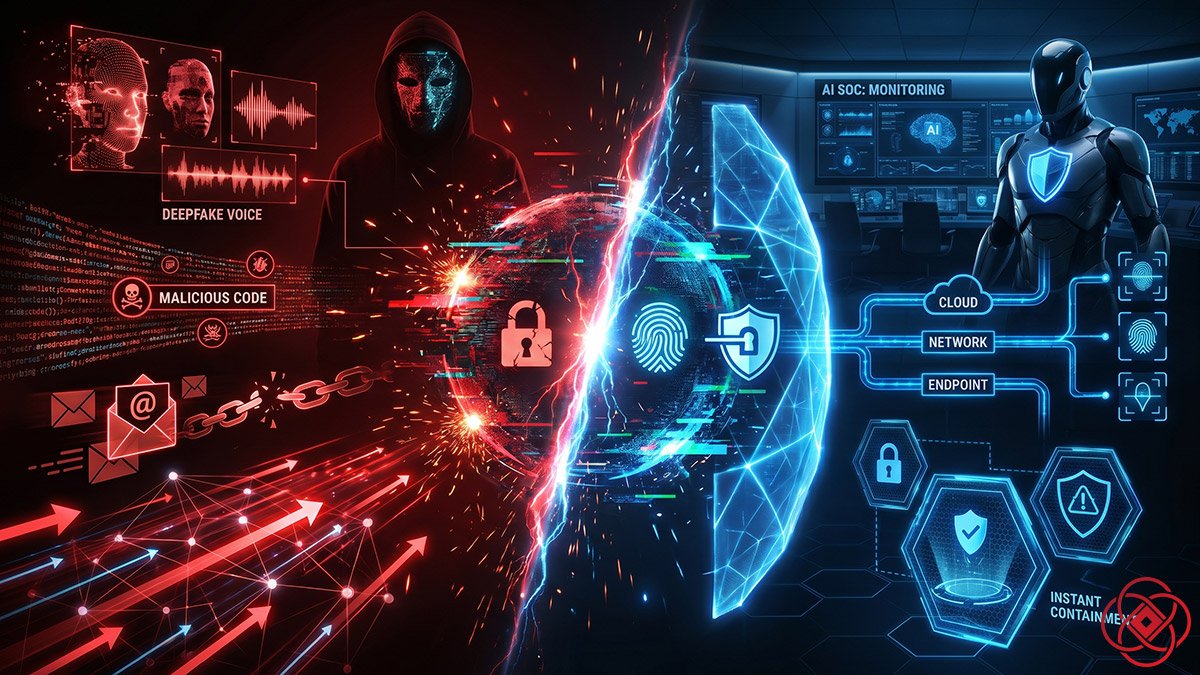
Cybercriminals now use AI to write new exploits within minutes of a software patch. They scan your leaked data instantly and find the three employees most likely to click a fake link. They create deepfake voices that sound exactly like your CEO asking for an urgent wire transfer.
The old way of fighting back does not work anymore. You cannot wait for a human analyst to wake up, drink coffee, and read an alert. By then, your data is already gone.
Enter the autonomous SOC.
Security operations centers in 2026 are run by AI that never blinks. These systems collect signals from your network, your cloud, your email, and your identity logs. They stitch those signals into a story. They see the attack before it finishes. They lock down the infected laptop, cut the session, and email you a summary—all in under four seconds.
Leading security platforms have moved past simple virus scanning. Their tools learn what normal looks like in your company. When an AI agent starts copying files it has never touched, the system knows. It does not need a human to say "that looks bad." It acts.
This is not about replacing your security team. It is about removing the noise. AI-driven SOCs handle ninety percent of the routine alerts. That frees your people to hunt for the real threats—the patient, creative attacks that machines still miss.
If your security team is still doing manual triage for every alert, you are bringing a knife to a gunfight.
Identity Is the New Perimeter
There used to be a concept called the perimeter. A wall. A moat. If you were inside the office network, you were safe.
That idea is dead.
In 2026, the only thing that matters is identity. Who are you? What can you touch? Prove it again and again.
This applies to humans. It applies double to AI.
Every model, every agent, every automated script must have a named identity. It must log in. It must use short-lived credentials. It must only access the exact data it needs to finish its task—nothing more.
This is called least privilege. It is old advice. But most companies skipped it when they deployed AI because they were in a rush. They connected a customer service bot to the whole database. They gave a marketing AI write access to the accounting folder. Then they acted surprised when something went wrong.
Zero trust means verify constantly. Not once. Not at the front door. Every time an AI tries to open a file, run a query, or call an API, check its identity. Check its behavior. If it suddenly starts asking for things it has never needed, shut it down.
Your AI agents are insider threats. Treat them that way.
The Supply Chain You Cannot See
You are only as secure as the weakest tool you plugged into your app.
Most companies do not know where their AI comes from. They use a model from one vendor, a plugin from another, and an API from a third. Each piece is a black box. Each update is a gamble.
Welcome to AI supply chain risk.
Smart teams in 2026 are building AI Bills of Materials—AIBOMs. This is a simple list: what models are we running, what version, where did they come from, what data did they train on. If a vendor gets hacked or a model starts hallucinating dangerous outputs, you need to know exactly where it lives in your stack.
Data poisoning is another quiet killer. Attackers do not need to break down your door. They just need to slip bad data into your training set. Feed the model enough garbage and it starts giving wrong answers, leaking secrets, or backdooring your code.
Then there is the deepfake problem. It is not a future risk anymore. In 2026, criminals use AI-generated video and audio to bypass voice authentication and trick finance teams into wiring money. You need detection tools that check speech patterns, visual glitches, and metadata. Better yet, require cryptographic proof for any sensitive request.
If you cannot verify the content, do not trust it.
The Rules Changed in June
On June 2, 2026, the White House signed an executive order on advanced AI innovation and security. It did not ban models. It did not slow down the industry. It simply said the biggest, most powerful AI systems need guardrails, and federal agencies need to coordinate.
The order focuses on frontier models—the systems that can actually threaten national infrastructure. It creates pathways for vulnerability reporting, pre-release testing, and AI-enabled cyber defense for critical systems like power grids and hospitals.
For business leaders, this is a map. The government is not telling you to stop. It is telling you to pay attention to:
- CoSAI, the Coalition for Secure AI
- MITRE ATLAS, the AI threat framework
- OWASP Top 10 for LLMs
These are not suggestions. They are the baseline. If you are not mapping your defenses to these frameworks, you are building on sand.
Also, start thinking about quantum-ready encryption. It sounds far away. It is not. The data you protect today will be decrypted by quantum computers tomorrow. Update your cryptography now.
What You Do Monday Morning
Enough theory. Here is the work.
- Audit your agents. List every AI tool that has access to production data. Cut its permissions by half. If it screams, give back only what it truly needs.
- Enable phishing-resistant MFA for every human who can change AI settings. If an attacker owns your AI admin account, they own your agents.
- Deploy deepfake verification before any wire transfer or sensitive action. If the CEO calls asking for money, call back on a known number. Use cryptographic signatures for internal commands.
- Build an AIBOM. Know what models you run and where they came from. Vet your vendors like you would a new bank.
- Run an AI incident response drill. Pretend an agent has gone rogue. Can you kill its access in under sixty seconds? If not, fix your architecture.
Security is not a product you buy. It is a habit you build. The companies that survive the next year will be the ones that treated AI security as seriously as they treated AI adoption.
The ones that do not will be headlines.
Decision Guide
Use it if: You run AI agents in production, handle sensitive data, or need to defend against autonomous threats and supply chain attacks.
Skip it if: You are still in research mode with no agents deployed to production systems or customer-facing environments.
Best first step: Audit every AI agent with production access, cut permissions to least privilege, and build an AIBOM listing all models and vendors.
FAQ
What is AI security in simple terms?
AI security is the practice of defending systems where artificial intelligence operates autonomously—protecting against threats like data leaks, social engineering, supply chain attacks, and machine-speed exploits that target AI agents and models.
How is AI security different from traditional cybersecurity?
Traditional security defends network perimeters and human users. AI security defends autonomous agents that make decisions without human approval, operate at machine speed, and create new attack surfaces through model vulnerabilities and inter-agent protocols.
What is an autonomous SOC and why does it matter?
An autonomous Security Operations Center uses AI to detect, analyze, and respond to threats in seconds without human intervention. It matters because modern attacks happen too fast for manual triage—AI-driven SOCs handle routine alerts so human analysts can focus on sophisticated threats.
What is an AI Bill of Materials (AIBOM)?
An AIBOM is a documented inventory of all AI models, versions, vendors, and training data used in your systems. It lets you quickly identify and patch vulnerabilities when a model is compromised or starts producing dangerous outputs.
How do deepfakes threaten enterprise security?
Deepfakes use AI-generated audio and video to impersonate executives, bypass voice authentication, and trick employees into approving fraudulent transactions. Detection requires tools that analyze speech patterns, visual artifacts, and metadata—plus cryptographic verification for sensitive requests.
What does zero trust mean for AI agents?
Zero trust for AI means every agent must authenticate continuously, use short-lived credentials, and only access the exact data needed for its task. Verification happens at every action—not just at login—and any abnormal behavior triggers immediate lockdown.
Do small businesses need AI security frameworks?
Yes. If you deploy AI agents with access to customer data, financial systems, or internal tools, you face the same risks as larger organizations. Start with least privilege access, phishing-resistant MFA for AI admins, and basic agent audits—these cost little but prevent catastrophic breaches.