A Leaked API Key Can Bill You Overnight
RedHub AI Editorialupdated August 18, 20265 min read

Jump to a section8
TL;DR
- What it is: A leaked API key is a credential exposed in a public repo, a shared doc, or a client-side bundle — usable by anyone who finds it, billing to your account until it's revoked.
- Who it's for: Anyone with an AI API key in code, a script, or a shared environment — see the AI Spend Runaway & Billing-Safeguard Gate.
- How it works: Detect fast with anomaly alerts, revoke immediately, and scope keys ahead of time so any single leak is contained.
- Bottom line: Without a hard cutoff, a leaked key bills for as long as it takes you to notice — and that's entirely up to your own detection.
How does a leaked API key become a huge bill?
A leaked API key becomes a large bill because whoever finds it can use it immediately, and most platforms don't automatically stop a key from being used just because it's been exposed. The key keeps billing to your account at whatever rate the finder's requests run — which, for automated abuse, can be very fast — until either you notice and revoke it, or a hard cutoff you built yourself steps in. Detection speed and key scope are the two things that determine how bad the damage gets.
Best for: anyone who has an API key sitting in a repo, a script, or a shared config file right now — the AI Spend Runaway & Billing-Safeguard Gate grades whether a leak would actually be contained.
A leaked API key is one of the most common ways an AI bill runs away — and one of the most preventable. Keys end up in public GitHub repos, pasted into shared Slack channels, or embedded directly in client-side code where anyone with a browser's dev tools can read them. Once a key is out, using it requires no special skill. It works exactly the way it would for you, at whatever volume the person running it wants to push.
How a leak actually turns into a bill
The mechanics are simple, which is exactly what makes them dangerous. A key gets exposed — often by accident, in a commit, a log, or a config file that shouldn't have been public. Someone finds it, either by manually scanning public repos or with automated scanners built for exactly this purpose. They start making calls with it. Every call bills to your account, at your rate, until the key stops working. If nothing revokes it automatically, "until the key stops working" means "until you notice."
Key insight: the cost of a leaked key isn't set by how the leak happened. It's set by how long it takes you to detect it and how fast the abuse runs. A leak caught in minutes costs little. A leak caught after a long weekend can cost a great deal — with no natural ceiling in between.
Estimate what an undetected leak could cost
This is a simple, illustrative estimate — not a prediction of what will happen to you. Enter a rough hourly cost if a key were being abused, and how many hours it might run before someone notices.
Estimate exposure cost
Illustrative only — actual exposure depends entirely on the rate of abuse and your own detection speed, which is exactly why detection and a hard cutoff matter more than any single dollar estimate.
Detect a leak fast
Detection speed is the single biggest lever you control. Two things make it fast: anomaly alerts that compare current usage to your normal pattern and flag a spike immediately, and cost attribution that breaks spend out by key so a spike is traceable to one specific credential instead of buried in a combined invoice. Without both, a leak can run for days before anyone happens to glance at a bill.
Revoke and contain
- Revoke the key immediately. The moment abuse is suspected, revoke the key — don't wait to confirm with certainty. A false alarm costs a few minutes of reissuing a key. A confirmed leak left active costs far more.
- Scope keys narrowly ahead of time. If each key is limited to one project with the minimum permissions it needs, a leak of that key can only do damage within that narrow scope — not across your whole account.
- Rotate on a schedule, not just after a scare. Keys that sit unrotated for months are more likely to have been exposed somewhere along the way without anyone noticing.
- Check every place a key could live. Repos, CI/CD configs, logs, error trackers, and client-side bundles are the most common accidental exposure points — audit all of them, not just your main codebase.
- Confirm a hard cutoff sits behind all of it. Detection and revocation both depend on a human noticing. A real hard cutoff is what limits the damage even if nobody notices right away — see why API spending limits don't stop runaway bills for how to build one.
Would your setup contain a leaked key — or just email you about it?
The AI Spend Runaway & Billing-Safeguard Gate ($49, one-time) grades key hygiene, anomaly alerts, attribution, and the hard cutoff behind them, with a dispositive gate: no real cutoff means RUNAWAY RISK regardless of the rest.
Get the Gate — $49 →A leaked key is one specific trigger among several — see the fuller picture in how to stop a runaway AI bill before it happens, and the everyday cost controls that reduce your normal spend in the controls that actually cap LLM API spend.
Decision Guide
Act now if: any of your API keys are shared across projects, unrotated for months, or possibly present in a public repo or client-side bundle.
Skip it if: every key is scoped to one project, rotated on a schedule, monitored by anomaly alerts, and backed by a tested hard cutoff.
Best first step: search your codebase and repos right now for any hardcoded key string. It takes ten minutes and it's the single most common way keys leak.
FAQ
How do API keys usually leak?
Most commonly through public GitHub repos, shared documents or chat messages, and client-side code where the key is visible to anyone using a browser's developer tools. Logs and CI/CD configs are also common accidental exposure points.
How fast can a leaked key run up a bill?
As fast as automated abuse can make requests, which can be very quick. There's no fixed number — it depends on the rate of abuse and how long the key stays active, which is why detection speed and a hard cutoff matter more than any specific dollar figure.
What should I do the moment I suspect a leak?
Revoke the key immediately, before waiting to confirm with certainty. Reissuing a key over a false alarm costs a few minutes. Leaving a confirmed leak active costs far more.
Does scoping keys actually help if one leaks?
Yes. A key scoped to one project with minimal permissions can only do damage within that scope. A single shared key with broad access turns one leak into an account-wide problem.
Can a spending limit protect me from a leaked key?
Only if it's a real hard cutoff, not a notify-only alert. A notification will eventually tell you abuse is happening — after it's already billed. See why API spending limits don't stop runaway bills.
How often should I rotate my API keys?
On a regular schedule, not just after a scare — an unrotated key sitting still for months has had more time to be exposed somewhere without anyone noticing. Pair rotation with narrow scoping for the strongest protection.
Grade whether a leaked key would actually be contained
Key hygiene, anomaly alerts, and the hard cutoff behind them — graded in one deterministic pass.
Get the AI Spend Runaway & Billing-Safeguard Gate — $49 →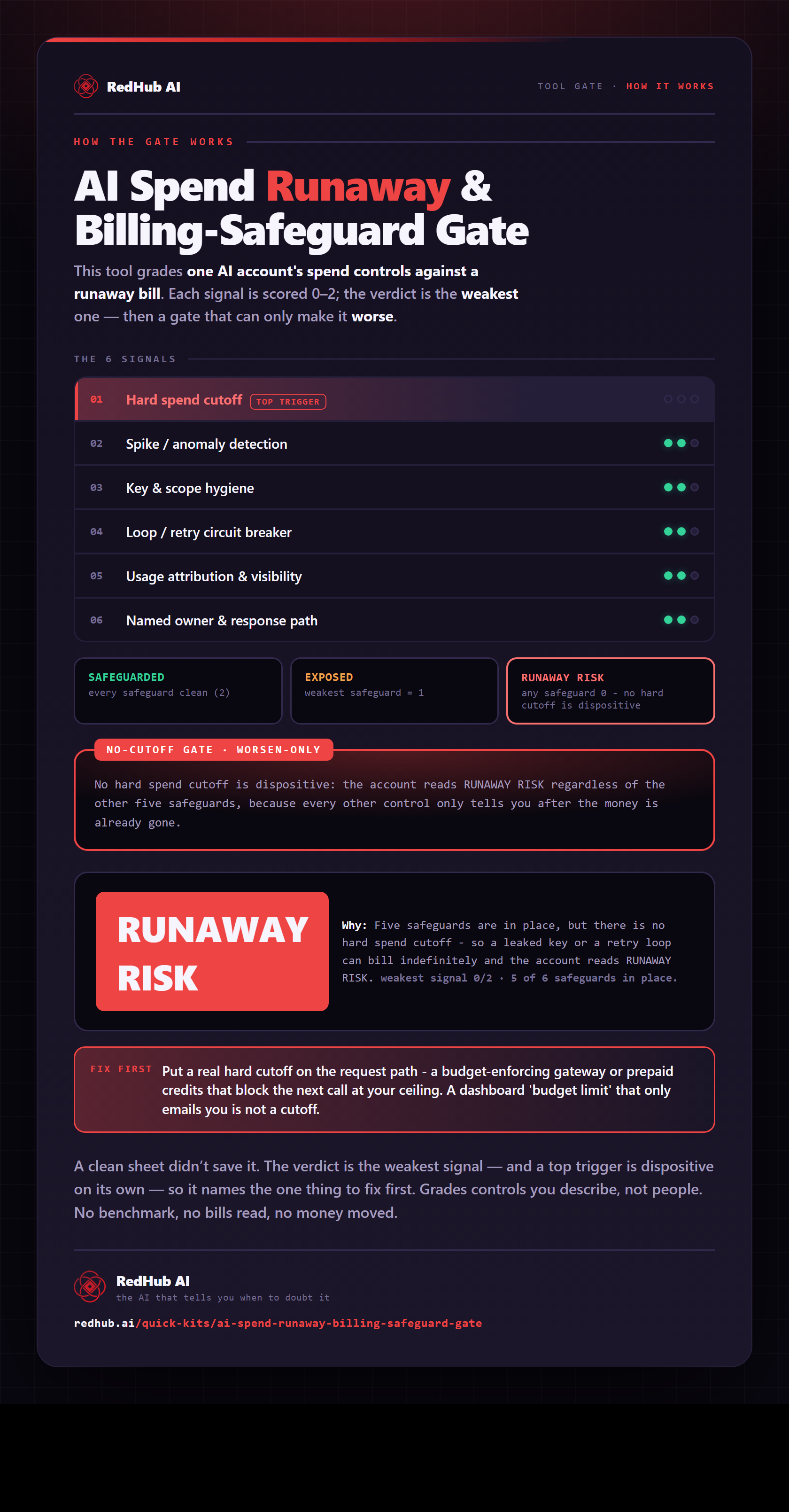
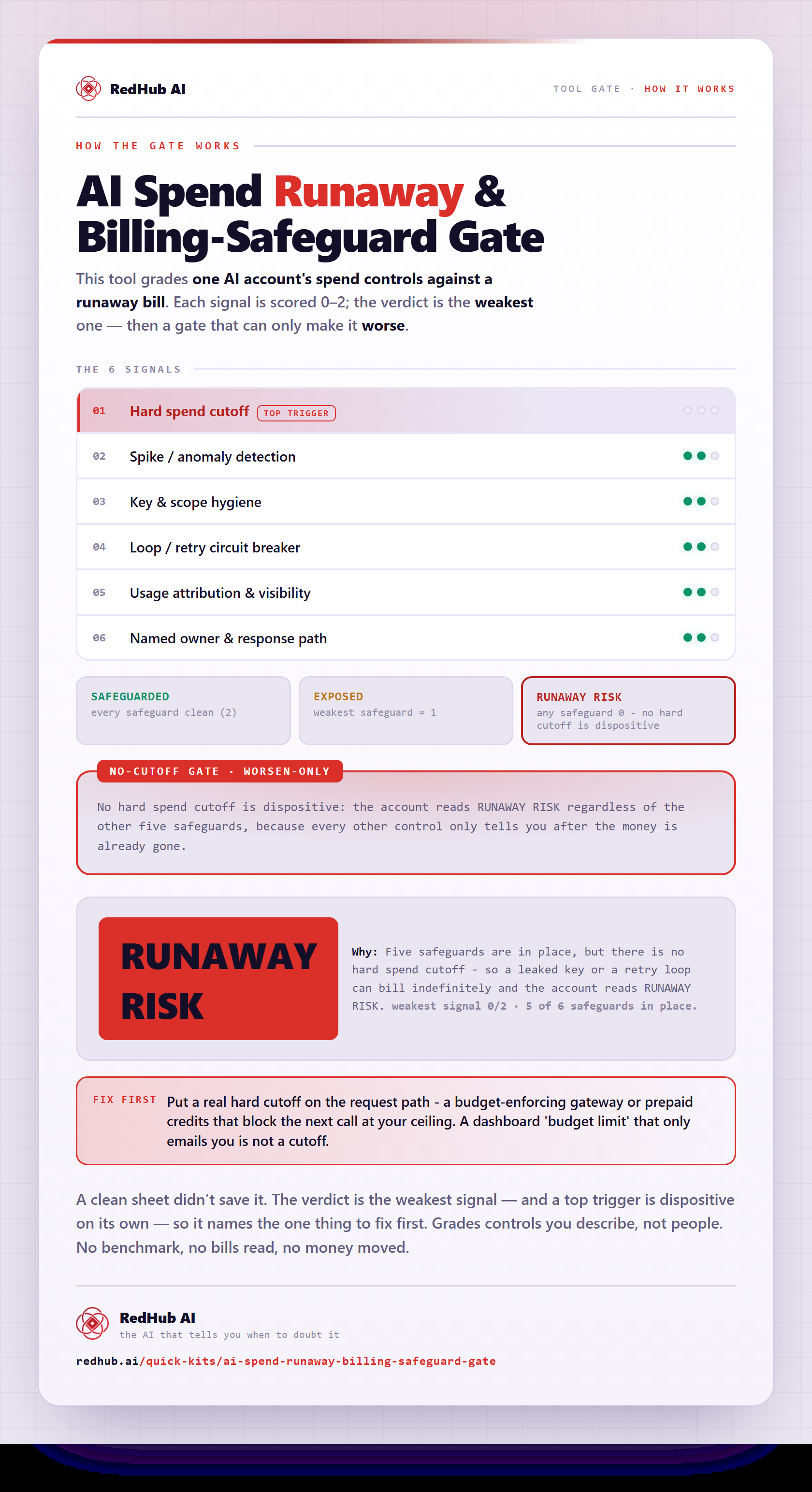
The gate this post refers to, drawn from the tool’s own logic. See the tool.