Every Action Item Needs an Owner and a Date
RedHub AI Editorialupdated October 4, 20267 min read

Jump to a section9
Give every task an action item owner and due date before the meeting moves to the next topic: one person's name, and one day on the calendar. With both, someone can be asked about the item on a specific day. Without the name, there is no one to ask. Without the date, there is no day to ask on, so the item waits behind everything that has both. It sounds too simple to count as a method, which is a big part of why teams skip it.
TL;DR: An owner is one person who said yes, never a team. A date is a day on the calendar, never "soon." Write each item as [Owner] will [verb] [deliverable] by [date]. When the work is too uncertain for an honest finish date, date the next checkpoint instead. When nobody will own an item, park it openly. The Meeting-to-Action Handoff Gate ($49) checks owner and date along with three other handoff checks. Start with the pillar: How to Actually Get Meeting Action Items Done.
The two-question test
Before an item leaves the meeting, ask two questions. Who, by name? By when, as a date? If either answer is missing, the item isn't finished being discussed. It only feels finished because the conversation moved on.
The test takes about ten seconds an item. A planning meeting that produces ten decisions spends under two minutes on it. That is cheap, and cheapness is the trap: a step this small is the first one dropped when the meeting runs over. Ten good decisions that skip the test can leave the room with nothing anyone has to do by any particular day.
Why "the team" is not an owner
An owner is one person who agreed to the item and can be asked about it. "The team," "marketing" and "whoever has bandwidth" describe groups. Each person in the group has a fair reason to assume someone else is handling it, a pattern our post on why action items don't get done traces to a 1968 study of bystanders.
Naming an owner doesn't mean one person does all the work. Three people can build the onboarding deck. One of them owns it, which means one person answers for whether it moved. Getting there is uncomfortable for a moment, because someone has to raise a hand. That moment is the whole point.
Why "soon" is not a date
A date gives the item a day to compete on and gives everyone else a day to ask about it. "Soon," "next sprint" and "when things calm down" put the item up against every task that has a real deadline, and undated work usually loses that contest. It isn't less important. Nothing pulls it to the top of anyone's list on any particular morning.
Vague timeframes also mean different things to different people. "Next sprint" is a two-week window to an engineering lead and an unknown to the sales rep waiting on the fix. A real date is what lets an item be checked on, moved up or flagged as late instead of quietly aging.
When an honest finish date doesn't exist yet
Some work can't be dated well in the room. "Find out why invoices from the new billing system fail" might take an hour or three weeks, and nobody knows which until someone looks. Force a finish date on it and you get a number someone made up to end the silence. It gets missed, gets re-dated, and every date on the list means a little less.
The better move is to date the next checkpoint: "Sam reports what he found by Thursday." That is a real deliverable with a real day, and Sam can hit it. It has a weakness, though. A checkpoint can be renewed every week for a month while the actual problem never closes. We don't have a rule for when to stop renewing. A team that sees the same checkpoint come back three times should at least ask out loud whether the item still has an owner who can finish it.
Turning vague language into a one-line commitment
Every action item can be rewritten in the same shape: [Owner] will [verb] [deliverable] by [date]. The table puts each rewrite next to the phrasing it usually replaces.
| Vague (as said in the meeting) | One line (as it should be written down) |
|---|---|
| "The team will handle the follow-up email." | "Jordan will send the follow-up email by Wednesday, November 4." |
| "We'll get to the pricing page soon." | "Priya will update the pricing page by Tuesday, November 10." |
| "Someone should look into the churn spike." | "Sam will pull the churn report and share findings by Thursday, November 5." |
| "Let's revisit this next time." | "Alex will bring a recommendation to the November 12 planning meeting." |
Nothing in the right-hand column needs new software or a longer meeting. It needs someone to ask "who, and by when?" out loud before the topic changes.
What to do when nobody will own it
Sometimes the room goes quiet when it's time to name an owner. That silence is information. It usually means the item isn't a priority for anyone present right now. Say so, and park it explicitly: "not owned, revisit at the next planning meeting." Don't let it fall to the person running the meeting by default.
An item that is openly unowned beats a falsely assigned one, because at least nobody believes it's covered. If the same unowned item keeps coming back, that is a sign it belongs higher up. Our post on leadership team meeting rhythm describes an escalation rule for exactly that: what a meeting can't resolve moves up one level, in writing.
Owner and date are two of five checks
The Meeting-to-Action Handoff Gate scores five checks per item: named owner, due date, the owner's acceptance, a system of record, and a definition of done. The two this post covers don't carry equal weight. An item with no owner comes back DROPPED, however complete the rest is. An item that has an owner but no date comes back CHASE, as long as at least one of the other checks holds. The logic is simple: an owner can go find the missing date, but a date can't find an owner.
Grade the owner, the date and the three checks behind them
One .xlsx. Mark the five checks for each action item, and every item returns TRACKED, CHASE or DROPPED, with the meeting rolled up to ALL TRACKED, GAPS or HANDOFF BROKEN. Where an item is short, it names the item and check to fix first.
Get the Meeting-to-Action Handoff Gate — $49Pairs well with
When owners and dates go missing because nobody captured them in the first place, the Meeting Intelligence System ($49) lists every action item with the owner and due date as stated in the meeting, and marks it UNCONFIRMED when either wasn't said. Items that come up in every meeting usually belong in a written process instead, and the AI-First SOP Engine ($79) turns a recording into an SOP whose standard format includes an owner for the task. And if the gaps keep landing in the same few areas of a business, the Operating Cadence Engine ($299) grades each area against the target you set as ON TRACK, WATCH or OFF TRACK in a one-page report to a founder's inbox every Monday.
More in this guide
What does every action item need?
An action item owner and due date: one named person who agreed to it, and one specific day on the calendar. An item with a date but no owner, or an owner but no date, tends to slip.
Can a team or department own an action item?
No. Several people can do the work, but one person has to own it and answer for whether it moved. A group assignment gives each member a reason to assume someone else has it.
Why isn't "soon" good enough as a deadline?
Undated work competes with every task that has a real deadline, and it usually loses. "Soon" also means different things to different people, so nobody can tell when the item is late.
What if nobody knows how long the work will take?
Date the next checkpoint instead of the finish, such as "Sam reports what he found by Thursday." That is a real commitment the owner can keep. Watch for the same checkpoint being renewed week after week.
What should we do if nobody volunteers to own an item?
Say so and park it as unowned, to be revisited at a set meeting. An honestly unowned item is more useful than one that looks assigned but isn't anyone's priority.
How does the Handoff Gate treat a missing owner versus a missing date?
A missing owner makes the item DROPPED no matter what else is in place. A missing date on an owned item makes it CHASE, as long as at least one other check holds, because the owner can still go set the date.
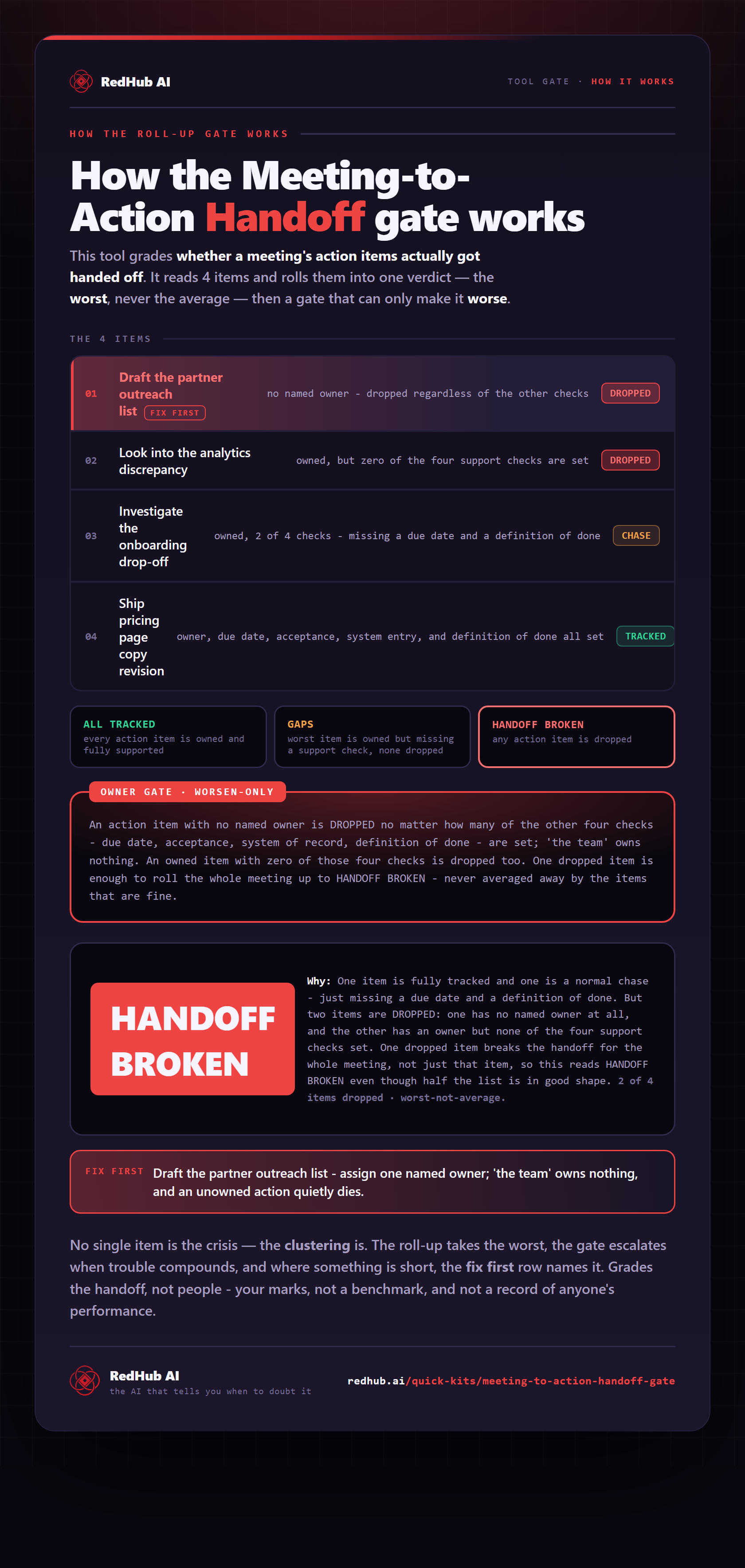
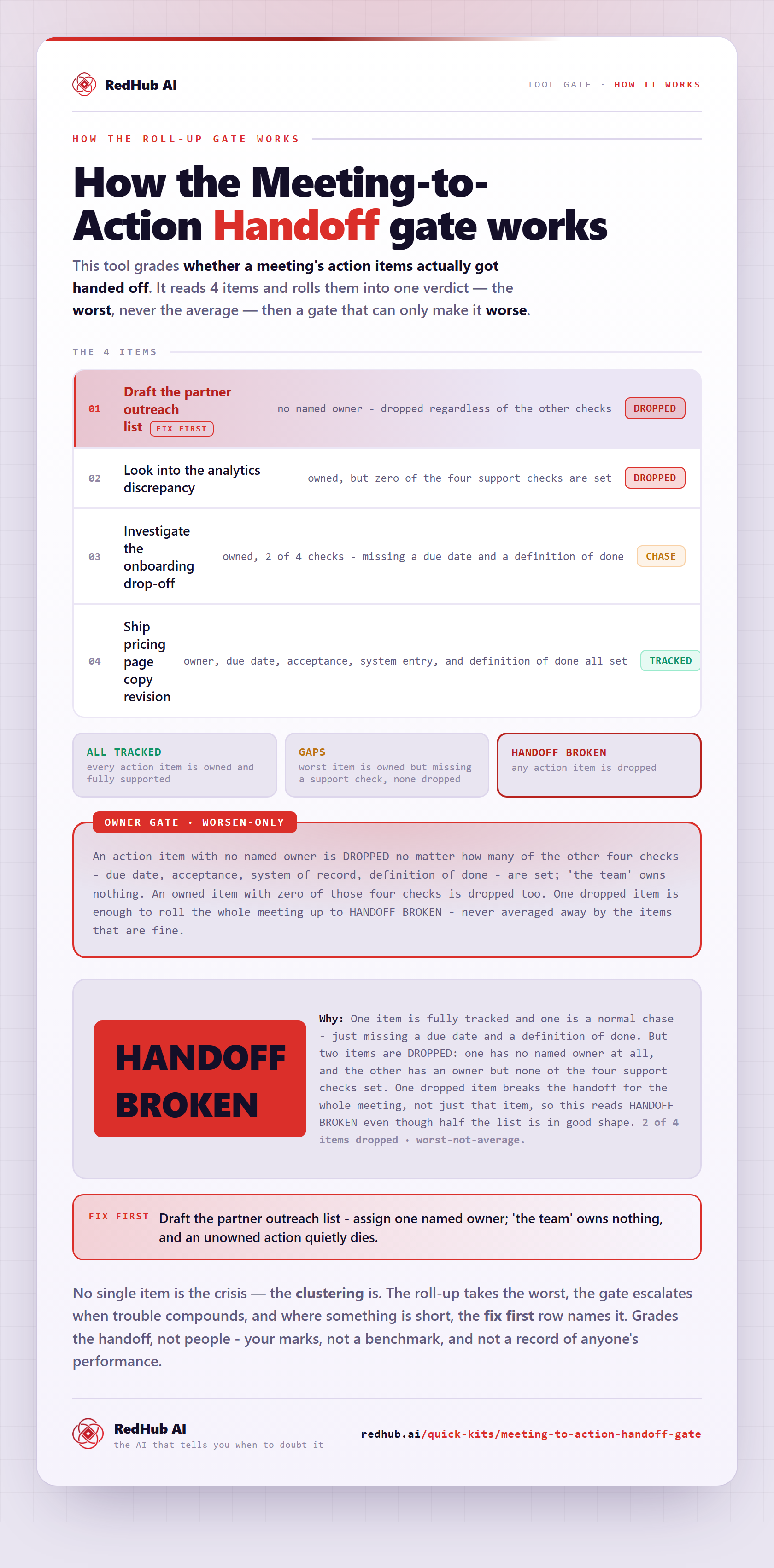
The gate this post refers to, drawn from the tool’s own logic. See the tool.