Leadership Team Meeting Rhythm: The Cadence Stack
Todd Brooks, Founder6 min read

Jump to a section10
- The Leadership Team Meeting Rhythm That Actually Compounds
- TL;DR
- What is a leadership team meeting rhythm?
- The four layers, and what each one owns
- The escalation rule: decisions rise, they don't repeat
- What does your current rhythm cost?
- Right-sizing the stack for a small company
- Feed the rhythm, don't starve it
- Decision Guide
- FAQ
The Leadership Team Meeting Rhythm That Actually Compounds
TL;DR
- What it is: A leadership team meeting rhythm is the four-layer stack — daily, weekly, monthly, quarterly — where each meeting answers one question and produces one artifact.
- Who it's for: Founders and leadership teams building a full business operating cadence.
- How it works: Keep every meeting at its own altitude. Blockers stay daily, grades stay weekly, trends stay monthly, direction stays quarterly.
- Bottom line: A meeting with no artifact is a calendar block. Kill it or give it an output.
What is a leadership team meeting rhythm?
A leadership team meeting rhythm is the fixed schedule of leadership meetings — usually a daily sync, a weekly business review, a monthly review, and a quarterly planning session — where each layer answers one question at one altitude and must produce a named artifact. The daily clears blockers. The weekly grades the company and sets three priorities. The monthly reads trends and adjusts the plan. The quarterly resets direction. When every meeting stays in its lane, decisions stop repeating and the company compounds week over week.
Best for: teams whose weekly layer needs a graded pre-read — the Operating Cadence Engine builds it from your real systems every Monday.
Ask a leadership team what is wrong with their meetings and you will hear "too many." That is usually the wrong diagnosis. The real problem is that all their meetings run at the same altitude — everything is a status update — so the same topics resurface every week and nothing is ever finally decided. The fix is not fewer meetings. It is a rhythm where each meeting owns one question and cannot poach another meeting's job.
The four layers, and what each one owns
| Layer | Length | Owns | Must produce | Banned topics |
|---|---|---|---|---|
| Daily sync | 10–15 min | Today's blockers | Unblocked people | Strategy, metrics debates |
| Weekly business review | 45–60 min | The grade + this week's priorities | Graded scorecard, 3 priorities, 1 decision | Deep trend analysis, re-litigating the plan |
| Monthly review | Half-day | Trends + resource shifts | Adjusted targets, killed/funded initiatives | Daily-level details |
| Quarterly planning | Full day | Direction | Next quarter's goals and red lines | This week's fire drill |
The "banned topics" column is the part most teams skip and the part that makes the rhythm work. When a trend question comes up in the weekly review, it gets parked for the monthly — written down, not debated. When a fire drill invades the quarterly, it goes back down the stack. Altitude discipline is what keeps the weekly under an hour, and the full weekly agenda is covered in how to run a weekly business review.
The escalation rule: decisions rise, they don't repeat
The layers connect through one rule: anything a layer cannot resolve escalates up exactly one level, in writing, and does not come back down unresolved. A blocker the daily can't clear becomes a weekly flag. A weekly flag that persists three weeks becomes a monthly agenda item. A monthly pattern that questions the plan becomes a quarterly topic.
The carried-problem test: the most expensive item in any meeting rhythm is the problem that appears every week and never escalates. If your weekly notes show the same flag four weeks running, the rhythm is broken — the problem is circling instead of rising. A week-over-week log that names carried problems out loud is the cheapest fix; it is also why a written record beats memory.
What does your current rhythm cost?
Leadership meeting time is the most expensive time the company buys. That is not an argument against meetings — it is an argument for artifacts. Run your own numbers:
Annual cost of your leadership meeting rhythm
Your inputs, your math — nothing invented. The point of the number is not to shrink it to zero. It is to ask, for every recurring meeting inside it: what artifact does this hour produce? A graded scorecard, three priorities, and a decision are worth the hour. A go-around is not.
Right-sizing the stack for a small company
You do not need all four layers on day one. Scale the stack to headcount:
- 1–3 people: the weekly business review plus a quarterly reset. The daily sync happens in chat; the monthly folds into the weekly once a month with a longer trend section.
- 4–10 people: add the daily sync for the delivery team and keep the weekly at leadership level. The monthly becomes its own half-day.
- 10+: the full stack, with the escalation rule enforced in writing — this is the size where carried problems start hiding.
Whatever the size, the weekly layer is the one you never cut. It is the heartbeat — the layer where the grade happens. And the grade is only as honest as the scorecard behind it, which is its own craft: targets, red lines, and a floor gate that refuses to let a crossed line hide. That is covered in building a company scorecard that tells you the truth.
Feed the rhythm, don't starve it
Every layer of the rhythm runs on the same fuel: an honest, current picture of the company. If assembling that picture takes hours, the rhythm starves. This is where automation genuinely earns its keep — not by making decisions, but by doing the collection and grading so the humans spend their meeting time deciding. The Operating Cadence Engine reads a founder's calendar, inbox, CRM, and metrics through their own connectors and delivers the graded one-page report every Monday — the weekly layer's pre-read, built while you slept. It reports only to your own inbox and never touches a record; the meetings, and the calls, stay yours.
Give the weekly layer its pre-read — automatically
The Operating Cadence Engine ($299, one-time) grades your week against the targets and red lines you set and delivers one honest page to your inbox every Monday: the verdict, the flags, what slipped, three priorities, one decision. Four Claude Skills, a scoring engine, a workbook, and the scheduling playbooks — yours to keep.
Get the Operating Cadence Engine — $299 →Decision Guide
Use it if: your meetings all run at the same altitude, the same topics resurface weekly, and nobody can name the artifact each meeting produces.
Skip it if: you are a solo operator with no team meetings — start with the weekly review alone and grow the stack with headcount.
Best first step: write the "owns / must produce / banned topics" line for every recurring leadership meeting. Any meeting you can't fill it in for gets killed or merged.
FAQ
What is a leadership team meeting rhythm?
The fixed four-layer schedule of leadership meetings — daily, weekly, monthly, quarterly — where each layer answers one question at one altitude and produces a named artifact. It is the meeting skeleton of a business operating cadence.
How many leadership meetings is too many?
Count artifacts, not meetings. If every recurring meeting produces a real output — unblocked people, a graded scorecard, adjusted targets, a quarterly plan — the count is right. Any meeting without an artifact is the one that is too many.
Which layer should a small company build first?
The weekly business review. It is frequent enough to catch drift and structured enough to force decisions. Add the daily sync when a delivery team forms, and split out the monthly when trend questions start crowding the weekly.
What is the escalation rule?
Anything a layer cannot resolve moves up exactly one level, in writing, and does not return unresolved. It is the rule that stops the same problem circling the weekly meeting for a month.
Should the whole company attend the weekly review?
No — only the people who own scorecard areas. An audience turns the review into a performance, and performances avoid bad news. Share the output afterward instead.
Can software run the rhythm for us?
Software can assemble and grade the picture; it should not make the calls. The Operating Cadence Engine reads your calendar, inbox, CRM, and metrics and delivers the graded Monday report to your own inbox — it reads and synthesizes, and you act.
Make every leadership hour produce an artifact
Start with the weekly layer: one graded page every Monday, from your own systems, $299 once.
See the Operating Cadence Engine →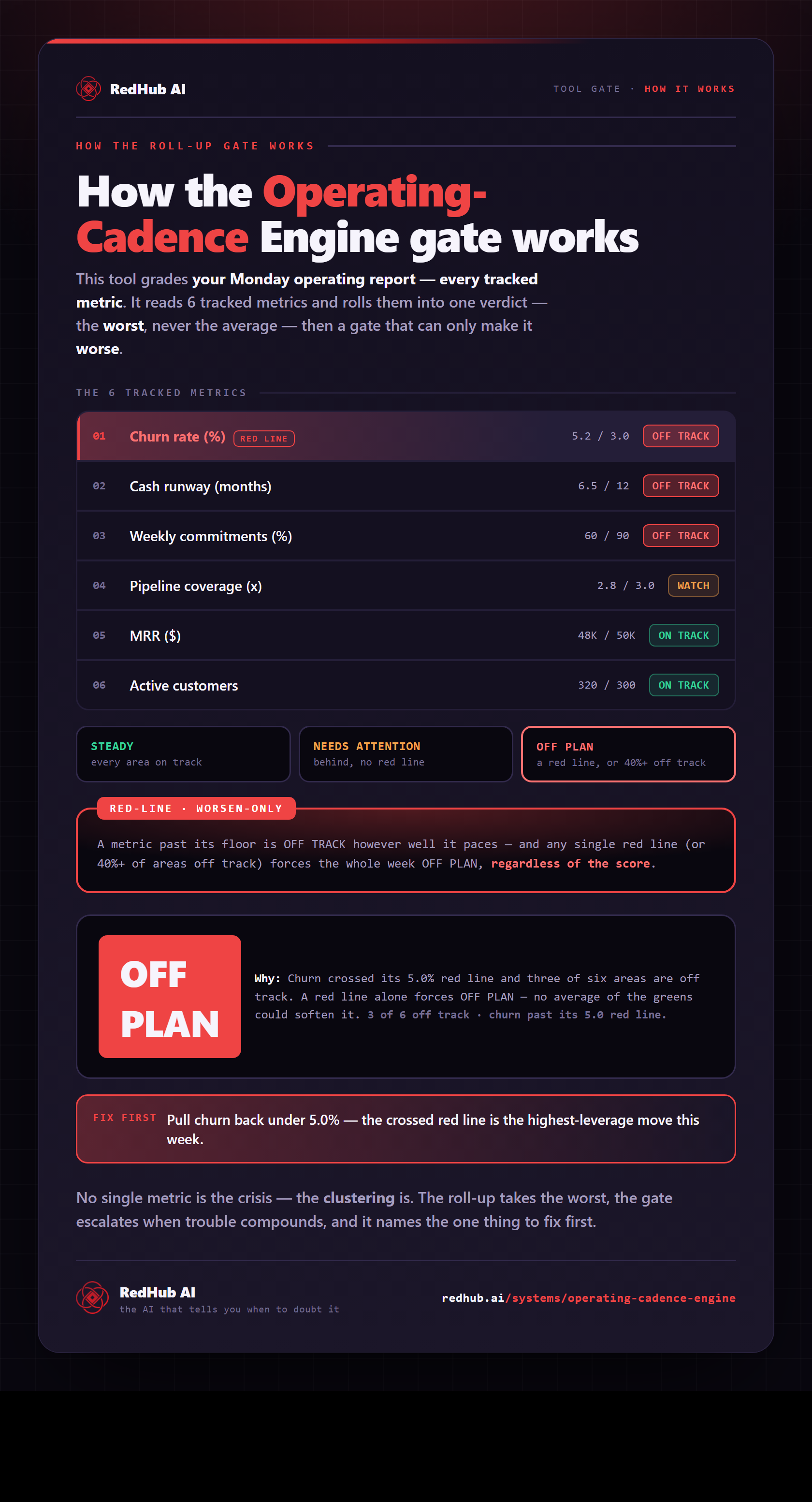
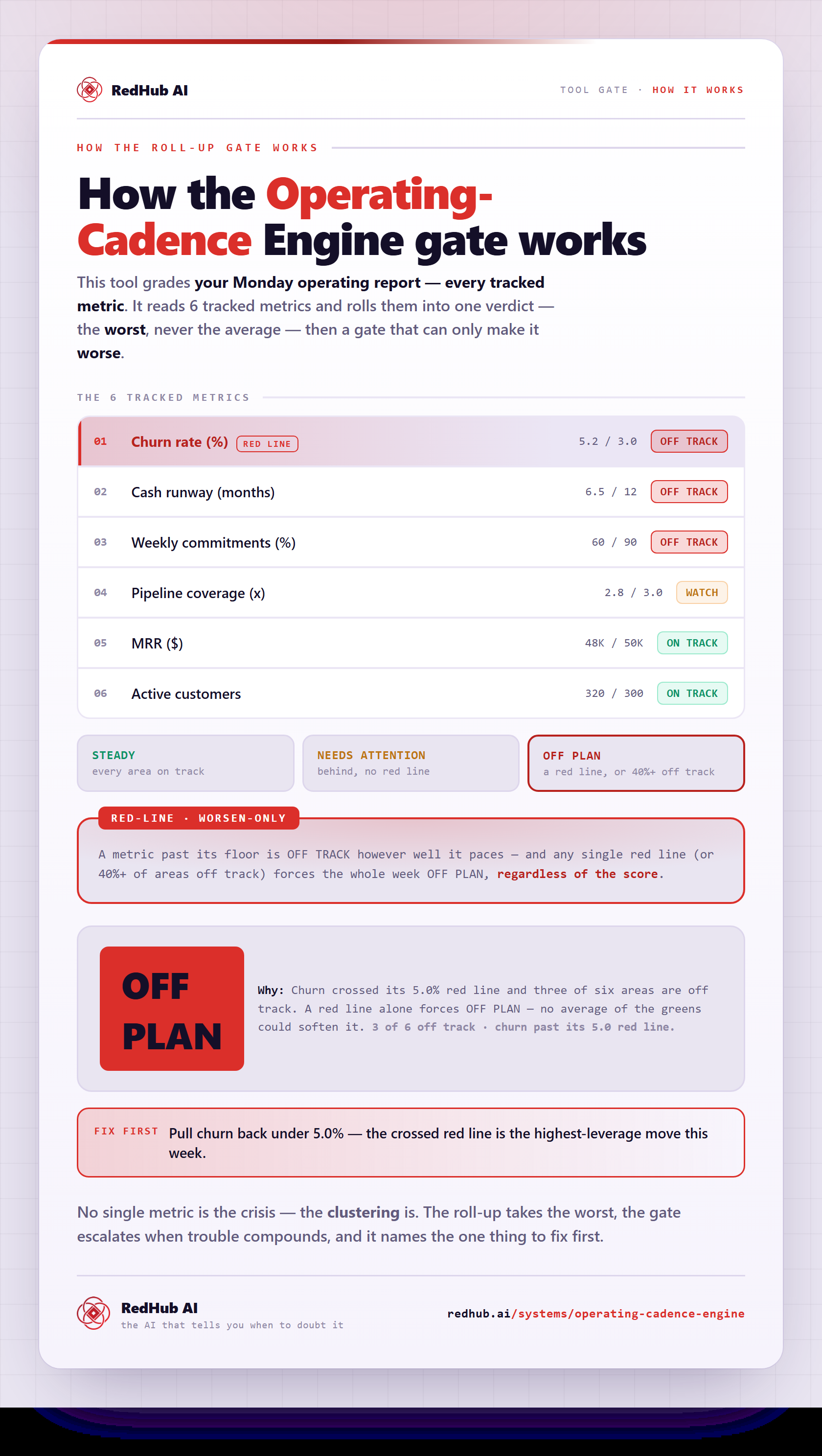
The gate this post refers to, drawn from the tool’s own logic. See the tool.