Why Meeting Action Items Never Get Done
RedHub AI Editorialupdated October 4, 20266 min read

Jump to a section7
The short answer to why action items don't get done is that many of them leave the meeting without one person's name on them. "Marketing will look at the churn numbers" hands the work to a group, and in a group each person can reasonably wait for someone else to start. Nobody decides to drop the item. It never becomes part of anyone's week. Busy calendars and weak tools get the blame, but neither explains why the same people finish the items that carry their own name.
TL;DR: Spreading a task across a group makes each member less likely to act on it, a pattern psychologists call diffusion of responsibility. Listen for the phrases that close a topic without assigning it, and give every item one named owner before the meeting ends. The Meeting-to-Action Handoff Gate ($49) drops any item that has no owner. Start with the pillar: How to Actually Get Meeting Action Items Done.
What the 1968 bystander study found
In 1968, John Darley and Bibb Latané ran an experiment with New York University students who believed they were in a group discussion over an intercom. Partway through, another "participant" appeared to have a seizure. When a student believed they were the only listener, 85% reported it before the recording cut off. When they believed four other people were also listening, 31% did. Writing in the Journal of Personality and Social Psychology, Darley and Latané called the cause diffusion of responsibility: the more people who could act, the less any one of them felt it was theirs to do.
The same paper has a detail that matters for meetings. Every student who thought they were alone reported the seizure eventually. In the six-person groups, 62% ever did. A crowd didn't make help impossible. It made help slower and less certain, and that is a fair description of a shared action item. It might still get done. Nobody can say when.
Why that lab result only goes so far
The students were strangers, they couldn't see each other, and the event was an emergency. A sales team that eats lunch together and runs the same pipeline review every Monday is a different situation. The study shows the direction of the effect. It doesn't tell you how big it is in your Tuesday meeting. A small team with a strong habit of claiming work out loud may close most of the gap without any checklist.
What the result does undercut is a comfortable assumption: that more people on an item means more chances it gets done. A meeting adds something the intercom didn't have: everyone can see who else heard the task. That could cut either way. It makes it easy to assume a colleague has it, and it also makes a silent pass visible to the whole room. We don't know of a study that settles which effect wins in a work meeting.
The phrases that end a topic without assigning it
Certain lines show up wherever follow-through breaks down. Each one sounds reasonable when a meeting is running long. Each one closes the topic while leaving the work unowned.
| What gets said | What it means |
|---|---|
| "We'll circle back on that." | No owner, no date, no next step. The topic is tabled with no day to return to it. |
| "Let's take that offline." | Two people may talk later, or nobody will, and no one in the room can tell which. |
| "I think we're all on the same page." | Nobody has said what the page says. Agreement is assumed, not confirmed. |
| "Someone should look into that." | A task with the owner field left blank. |
None of these are said in bad faith. They are what people say when a topic needs to end. The trouble is that the topic ends and the ambiguity stays, and the item survives as a hope while the room believes it was handled.
Three names on an item, each waiting on the others
Assign "update the pricing page" to the three people in marketing and watch how each one reasons. Priya thinks Sam has the newest numbers. Sam thinks it's Priya's page, since she built it. Lee assumes one of them already started. All three are being sensible, and the page doesn't change. One name breaks the loop: "Priya will update the pricing page by Tuesday, and Sam sends her the numbers Monday."
Headcount feeds the problem. Every extra person in the room is one more person who heard the task and can assume a colleague will take it. A meeting audit asks whether every attendee needs to be there live, and that question pays off twice: fewer listeners, fewer places for a task to hide.
The handoff is where it breaks
A meeting can have sharp discussion and good decisions and still produce no movement, because the decisions are lost in the last few minutes. That is a smaller fix than "run better meetings." Before anyone leaves, go through the open items and put one name and one date on each. The Meeting-to-Action Handoff Gate turns that pass into five checks per item and returns DROPPED for any item without a named owner, however complete the rest looks.
Catch the unowned item before the room empties
The Gate is one .xlsx. You mark five checks for each action item: named owner, due date, acceptance, system of record and definition of done. Any item without an owner comes back DROPPED, and one dropped item rolls the meeting up to HANDOFF BROKEN.
Get the Meeting-to-Action Handoff Gate — $49Pairs well with
The Meeting Intelligence System ($49) builds the action-item list from a transcript and puts every item with no clear owner in an "Owner watch" line instead of inventing one. The same diffusion shows up between departments, and the MQL → SQL Definition & Handoff Kit ($49) scores your MQL and SQL definitions and the handoff between the two teams, including a named owner on each side, and returns TIGHT, LEAKY or BROKEN. When a task reaches someone by email instead, the Inbox-to-Done Engine ($129) sorts each thread, and a thread marked DELEGATE comes with a suggested owner.
More in this guide
Why don't action items from meetings get done?
Many leave the meeting assigned to a group with no date, so no one person feels the item is theirs. That is diffusion of responsibility. The fix is to name one owner and one date before the meeting ends.
What is diffusion of responsibility?
It is the pattern where people are less likely to act when they know others could act too. Darley and Latané's 1968 study found that 85% of students who thought they were alone reported an apparent seizure before the recording ended, against 31% who thought four others were listening.
Does a 1968 lab study apply to work meetings?
Partly. The study used strangers in an emergency, not coworkers with a task list. It shows that spreading responsibility makes action slower and less likely. How strong the effect is on your team depends on your team.
Is "we'll circle back on that" a bad sign?
Usually. It ends a topic without an owner or a date, so the item feels settled in the meeting and leaves nothing anyone can act on afterward.
Does assigning an item to two or three people help?
It tends to make it worse, because each person can assume another has started. Several people can work on an item, but one of them should own it and answer for it.
Would better meeting notes fix this?
Not by themselves. Notes record what was said. A perfectly captured meeting can still leave every item unowned if no one puts a name and a date on each line before the meeting ends.
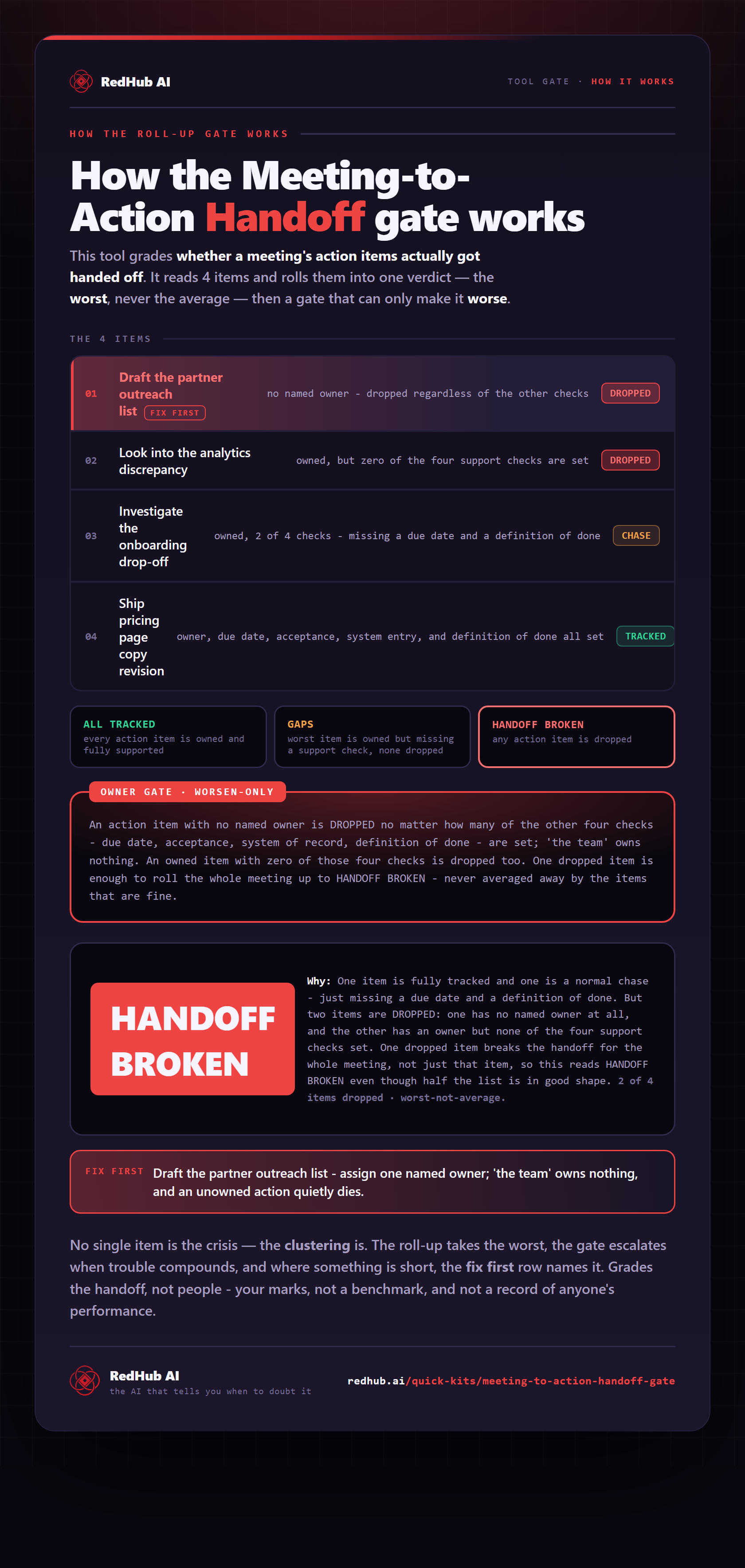
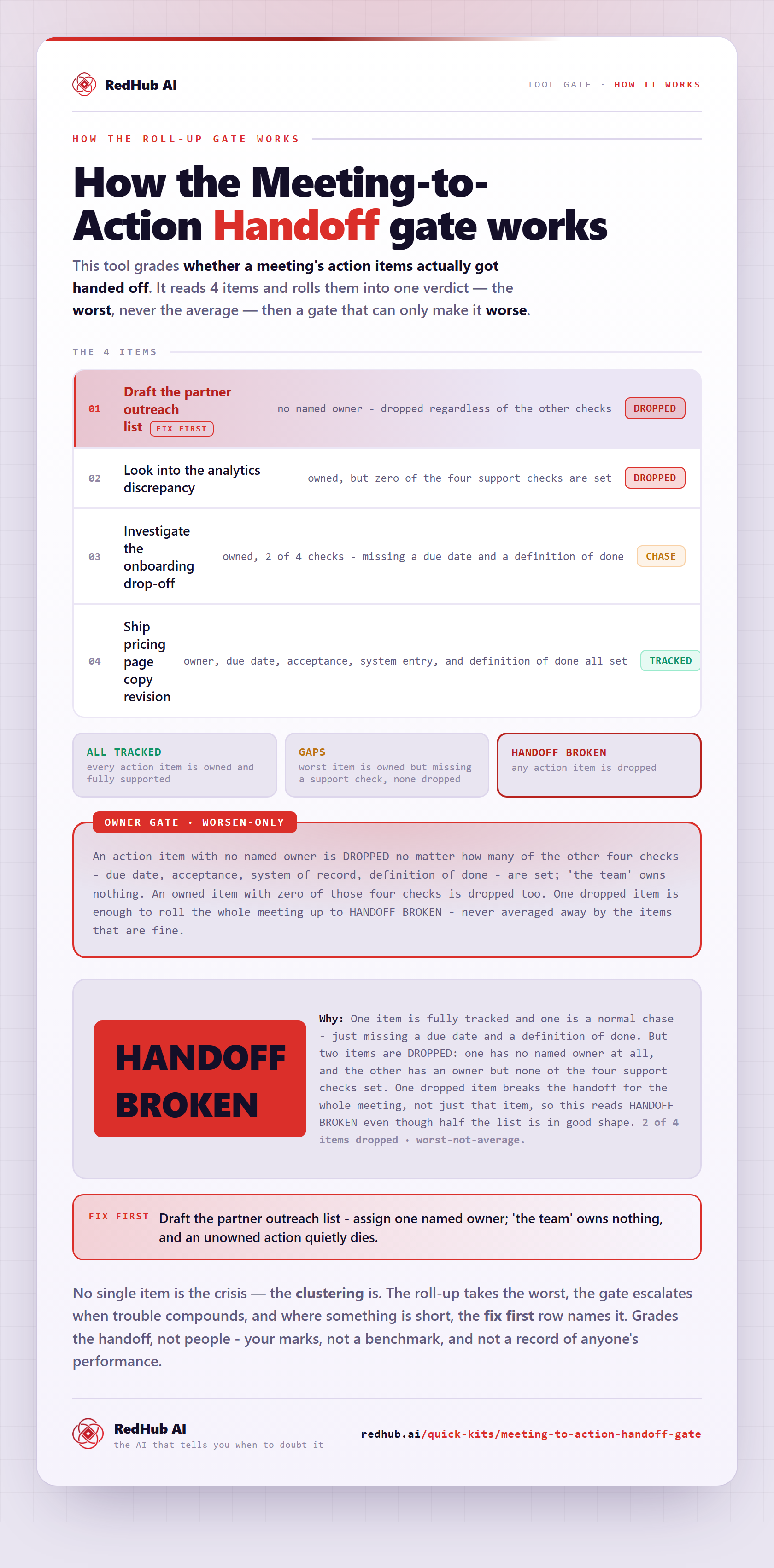
The gate this post refers to, drawn from the tool’s own logic. See the tool.