AI for Marketers: Where It Helps and Where to Keep Your Hands on the Wheel
RedHub AI Editorialupdated September 20, 20266 min read

Jump to a section9
- What AI is actually good at for a marketing role
- Where marketers have to stay in control
- A day in the life of an AI-assisted marketer
- The four skills worth building first
- Producing content without losing your voice
- Research and analysis — verify before you trust it
- Prompts that work for a real campaign
- Pairs well with
- More in this guide
AI helps marketers move faster on the parts of the job that used to eat a whole afternoon — research summaries, first-draft copy, campaign outlines. It does not replace the parts that make marketing actually work: the strategy call, the brand judgment, and the fact-check on every claim you put in front of a customer. Use it as a fast first draft, not a final answer.
TL;DR: AI is a strong research assistant, drafting partner, and campaign-structuring tool for marketers — it is a weak fact-checker and has no brand instincts of its own. The marketer who wins isn't the one who lets AI run the campaign; it's the one who uses AI to get to a better first draft faster, then applies real judgment before anything ships. The AI for the Marketer Kit ($39) is a role-based starting point built for exactly this split.
What AI is actually good at for a marketing role
Strip away the hype and AI is good at a short, specific list of marketing tasks: summarizing long research documents into a usable brief, generating a batch of headline or subject-line variants to react to, outlining a campaign structure from a one-line goal, and pulling a first pass at competitor positioning language. All four of these have something in common — they produce a draft you react to, not a decision you ship.
That's the useful mental model. AI is a fast drafting partner. It removes the blank-page problem and the "I have to read twelve tabs" problem. It does not remove the "is this actually true" problem or the "does this sound like us" problem — those stay with you.
Where marketers have to stay in control
Three places routinely go wrong when a marketer hands AI too much rope:
- Fabricated or misremembered stats. Ask an AI tool for "the average email open rate in SaaS" and it will give you a confident number — sometimes right, sometimes invented, and it won't flag the difference. Never publish a statistic an AI gave you without an independent source.
- Off-brand voice. Default AI output reads like default AI output — competent, generic, and interchangeable with every other brand using the same tool. If your brand has a specific voice, that voice has to be built into the process, not hoped for.
- Unverified claims about your own product. AI doesn't know your actual feature set, your actual pricing, or what changed last sprint. It will happily write a landing page that promises something engineering shipped six months ago — or never shipped at all.
A day in the life of an AI-assisted marketer
Picture a solo marketer prepping a SaaS feature launch. Morning: AI summarizes ten support tickets and three sales call transcripts into a one-page "what customers actually said" brief — a research task that used to take two hours now takes fifteen minutes of reading, plus a skim of the source material to make sure nothing got flattened or misquoted. Midday: AI drafts six subject-line options for the launch email based on that brief; the marketer picks two worth A/B testing and rewrites both so they sound like the brand, not like a template. Afternoon: AI drafts a landing-page headline block; the marketer checks every feature claim against the actual product doc before it's approved. Nothing goes live that a person hasn't personally verified.
Notice what didn't change: the marketer still decided what to say, still owned whether it was true, and still owned whether it sounded right. AI compressed the busywork. It didn't make the decisions.
The four skills worth building first
Not every AI skill is equally useful to a marketer, and trying to learn all of them at once is how people give up. There's a short list that pays off fastest — writing a brief AI can actually work from, summarizing research without losing the nuance, drafting variants you edit rather than ship, and structuring a campaign outline from a rough goal. The AI marketing skills worth building first breaks down each one with the order to learn them in.
Producing content without losing your voice
The fastest way to make AI-assisted content look like AI-assisted content is to skip the step where you teach it your brand. There's a real difference between "AI wrote this" and "AI drafted this and I made it sound like us." How to use AI for marketing content without sounding like a robot covers the editing habits that close that gap — and where to go if brand-voice consistency across every piece of content is the actual bottleneck, not just one blog post.
Research and analysis — verify before you trust it
AI is genuinely useful for chewing through research faster: summarizing customer interviews, pulling patterns out of survey data, drafting a first-pass competitor comparison. It is not a reliable source of numbers on its own. Using AI for marketing research and analysis walks through exactly which research tasks are safe to hand off and which numbers you still have to check by hand.
Prompts that work for a real campaign
Most AI marketing output disappoints because the prompt asked for too little — "write me a launch email" gives you generic filler. A prompt with a brief, an audience, and a request for options gives you something worth editing. AI marketing prompts that actually work for a real campaign has the patterns, with real before-and-after examples from an actual campaign.
Pairs well with
Once the role-level habits are set, three deeper tools cover the specific jobs a marketer runs into every week: the AI Marketing Measurement Kit for building an honest read on what's actually driving results, the Brand Voice Engine for locking a consistent voice across every piece of content your team ships, and the Content Engine for One Person for producing content at volume without a content team.
More in this guide
Is AI going to replace marketers?
No — it replaces some of the busywork inside the job, not the job itself. Strategy, brand judgment, and verifying claims still require a person; those are the parts that make marketing actually work.
What should a marketer never let AI do unsupervised?
Publish a statistic, make a claim about your own product, or send anything customer-facing without a human review. AI doesn't know what's actually true about your business — only you do.
Where should a marketer start with AI?
With the highest-friction, lowest-risk tasks first — summarizing research and drafting first-pass variants you'll edit anyway. Save higher-stakes tasks like final copy approval for after you've built the habit of checking AI output.
Does AI-written content hurt SEO?
Search engines don't penalize AI-assisted content for being AI-assisted — they penalize thin, inaccurate, or unhelpful content, which AI can produce just as easily as a person can. The fix is the same either way: verify claims and edit for real value before publishing.
How is this different from the Content Engine for One Person kit?
This kit covers the marketer's role broadly — research, drafting, campaign structure, and the judgment calls that go with each. The Content Engine for One Person is a deeper, dedicated system for producing content at volume when you're the whole content team.
How is this different from the AI Marketing Measurement Kit?
This kit is about the day-to-day marketing role. The AI Marketing Measurement Kit is specifically for building a trustworthy read on attribution and ROI — a deeper, more technical job that deserves its own dedicated tool.
What's actually in the AI for the Marketer Kit?
A role-based micro-brief that covers the marketing tasks AI genuinely speeds up, the guardrails to keep it from producing off-brand or inaccurate work, and a starting set of habits for reviewing AI output before it ships.
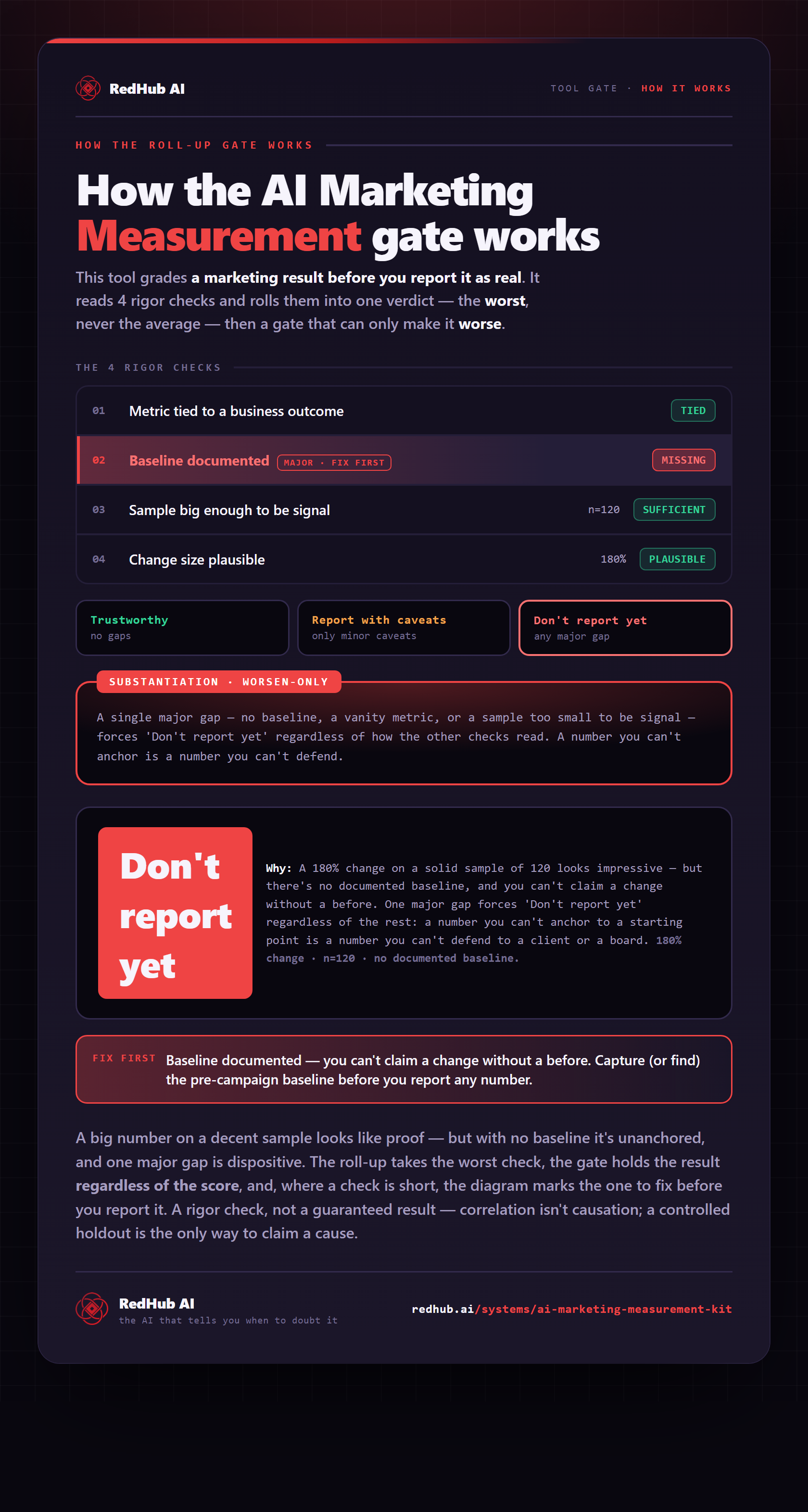
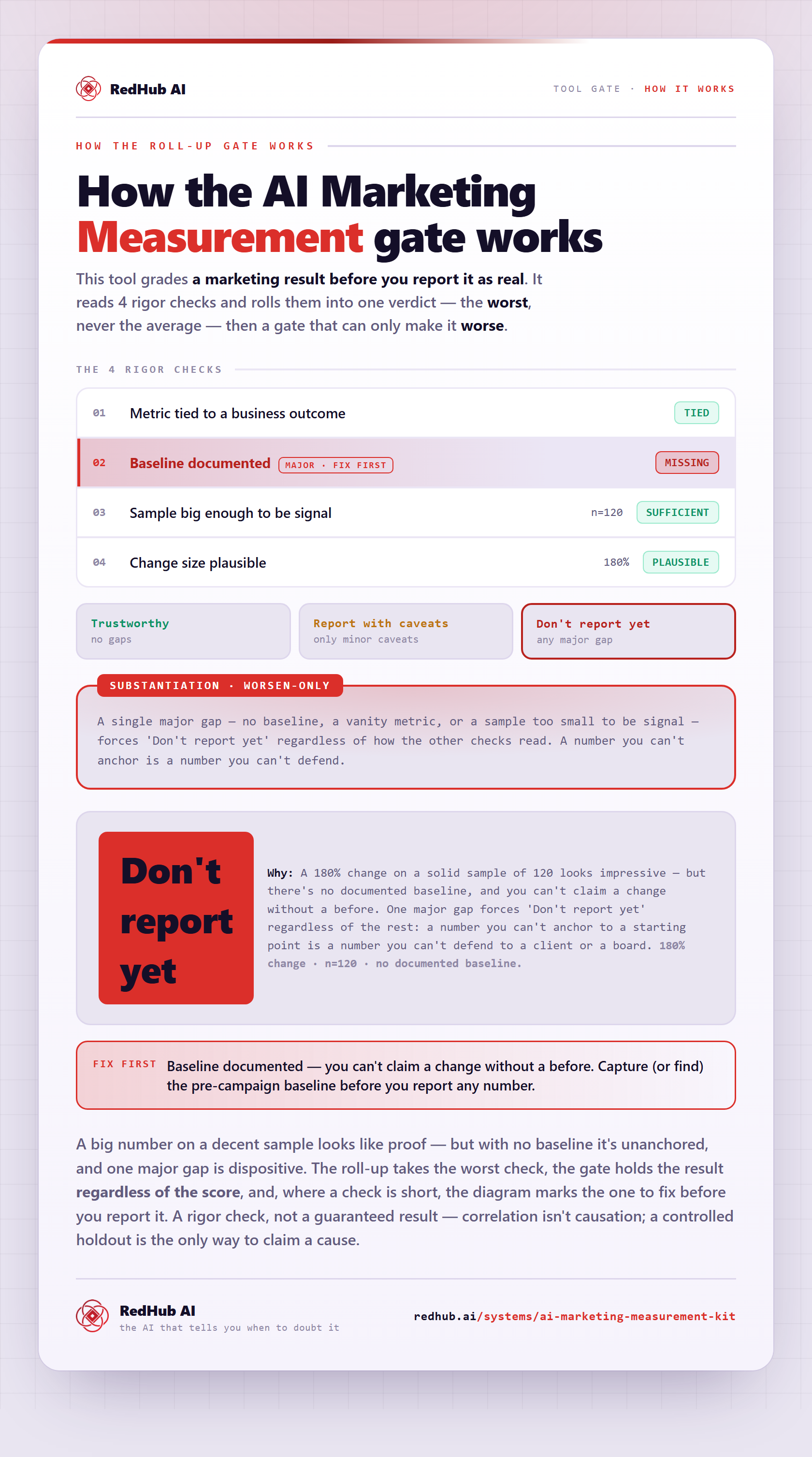
The gate this post refers to, drawn from the tool’s own logic. See the tool.