Using AI for Marketing Research and Analysis (Double-Check the Numbers)
RedHub AI Editorialupdated September 20, 20265 min read

Jump to a section8
AI is genuinely useful for marketing research — summarizing interviews, spotting patterns across survey responses, drafting a first-pass competitor comparison. It is not a reliable source for numbers on its own. Any statistic, market size, or data point an AI tool gives you needs an independent source before it goes anywhere near a deck, a report, or a piece of content.
TL;DR: Use AI to speed up the reading and summarizing side of research — it's fast and generally reliable when it's working from documents you gave it. Never trust a specific number it produces on its own; AI invents statistics confidently and won't tell you it did. The AI for the Marketer Kit ($39) covers where the line is.
Where AI research help is genuinely reliable
When you give an AI tool a document — customer interview transcripts, a survey export, a stack of support tickets — and ask it to summarize or find patterns, it's working with real information you provided. That's a fundamentally different, more trustworthy task than asking it to recall a statistic from memory. Feed it real data and it's a solid research assistant. Ask it to generate a number from nothing and it becomes a liability.
Good uses of AI in research:
- Summarizing ten customer interviews into a one-page "what we heard" brief you then verify against the raw transcripts.
- Spotting recurring themes across open-ended survey responses.
- Drafting a first-pass structure for a competitor comparison, which you then fact-check feature by feature against the competitor's actual site and pricing page.
- Turning a messy pile of sales call notes into a shortlist of common objections to investigate further.
Where AI research help breaks down
The failure mode is specific and predictable: ask an AI tool a factual question it doesn't actually have grounded data for — "what's the average customer acquisition cost in B2B SaaS," "what percentage of marketers use AI daily" — and it will answer with a confident-sounding number. Sometimes that number is roughly right. Sometimes it's outdated. Sometimes it's fabricated outright. The tool has no reliable way to flag which case you're in, and it will present all three with the exact same tone of confidence.
A concrete example: competitor research
Say you're building a competitor comparison for a sales deck. AI can draft the structure fast — categories to compare, a rough first pass at how competitors position themselves based on their public messaging. That's a legitimate time-saver. What it can't reliably do is tell you a competitor's actual pricing, actual customer count, or actual feature roadmap unless you feed it a source document with that information in it. Use AI to build the skeleton. Fill in every real data point yourself, from the competitor's actual site, actual pricing page, or actual public filings.
A simple verification habit
- Ask where the number came from. If AI can't point to a specific source it was given, treat the number as unverified.
- Search for the claim independently before using it anywhere customer-facing.
- If you can't verify it in a few minutes, cut it. A vague-but-true statement beats a specific-but-fabricated one every time.
- When you do use AI-assisted summaries, spot-check them against a sample of the raw source material — not the whole thing, just enough to confirm nothing important got dropped or distorted.
This habit costs a few extra minutes per number. It's cheaper than publishing a wrong statistic and having a customer, a competitor, or a journalist catch it before you do.
When research needs to become real measurement
Everything above covers ad hoc research — interviews, surveys, competitor scans, one-off questions. It's a different job from building an ongoing, trustworthy measurement system that tells you what's actually driving revenue: which channels, which campaigns, which content. That's a deeper, more technical problem than research summarization, and it deserves a dedicated tool — the AI Marketing Measurement Kit is built specifically for getting attribution and ROI numbers you can actually trust, rather than AI's best guess at industry averages.
The bigger picture
Research is one piece of the marketer's AI toolkit. See AI for marketers: where it helps and where to keep your hands on the wheel for how it fits alongside drafting content and building core skills. The short version for research specifically: AI reads fast. You verify. Neither step is optional.
Pairs well with
For research that feeds one-off decisions, this workflow is enough. For an ongoing, defensible read on marketing ROI and attribution, use the AI Marketing Measurement Kit. To keep the drafts that come out of this research on-brand, pair it with the Brand Voice Engine.
More in this guide
Can I trust statistics AI gives me for marketing research?
Not without independent verification. AI can produce a confident-sounding number that's outdated, wrong, or entirely invented, with no built-in way to flag which one you're getting.
Is AI good for summarizing customer interviews?
Yes, when it's working from real transcripts you gave it — that's a reliable, fast use of AI. Spot-check the summary against the raw material before building a campaign on it.
How do I know if an AI-generated stat is safe to use?
Find the original source yourself. If you can't independently verify it in a few minutes, don't use it — a true, vague statement is safer than a specific, unverified one.
Can AI do competitor research for me?
It can draft the structure and categories fast. The actual data — pricing, features, positioning — needs to come from the competitor's real public sources, not AI's memory.
What's the difference between this and the AI Marketing Measurement Kit?
This post covers ad hoc research — interviews, surveys, competitor scans. The AI Marketing Measurement Kit is a dedicated system for ongoing attribution and ROI measurement, a deeper and more technical problem.
Why does AI make up statistics instead of saying it doesn't know?
AI language models are built to produce a plausible-sounding answer to almost any question, which means they'll generate a number even when they have no reliable data behind it — without flagging the uncertainty.
How much time does verifying AI research actually take?
Usually just a few minutes per claim — a quick search for the original source. It's a small cost compared to publishing a wrong number and having someone else catch it.
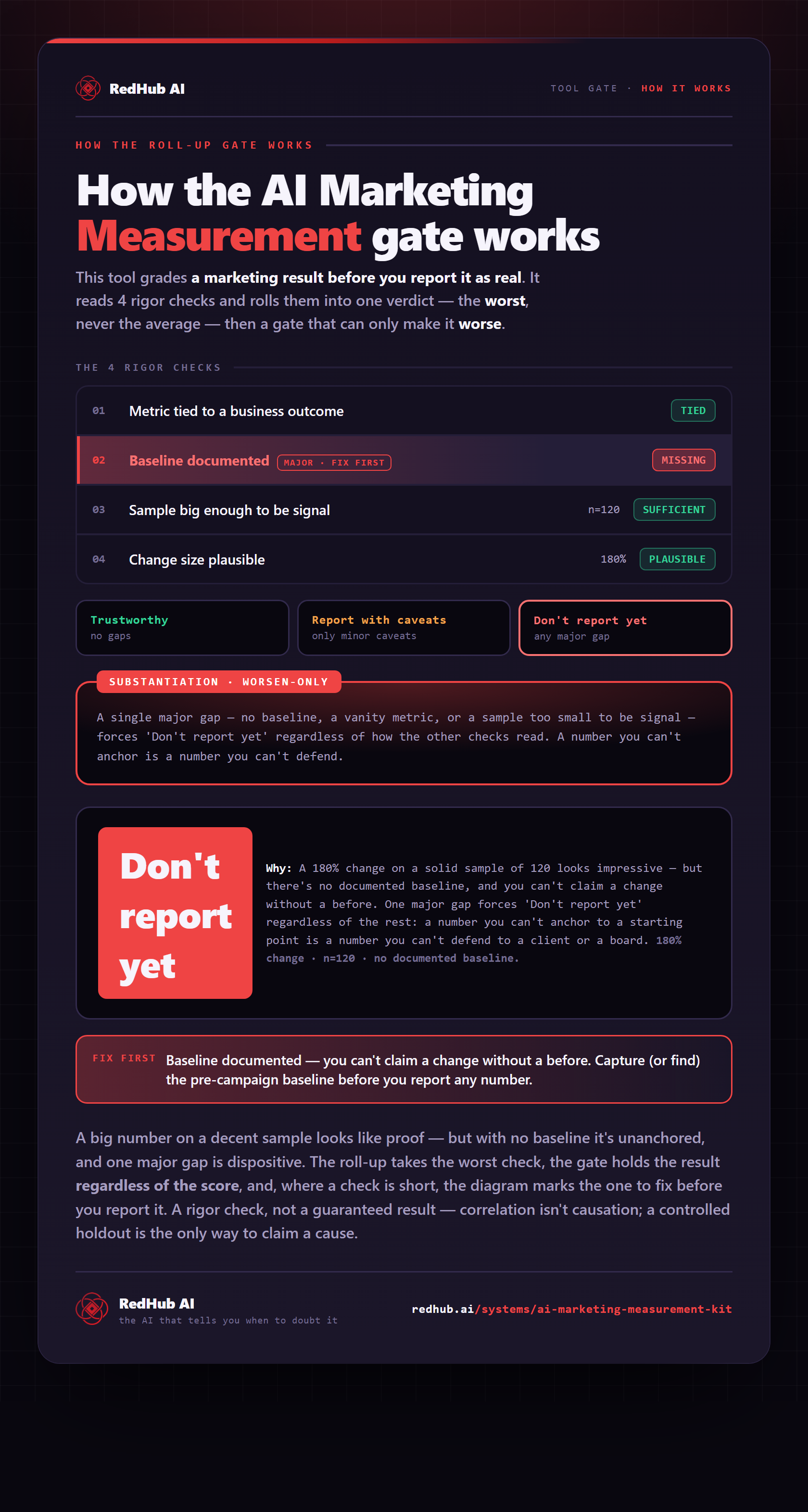
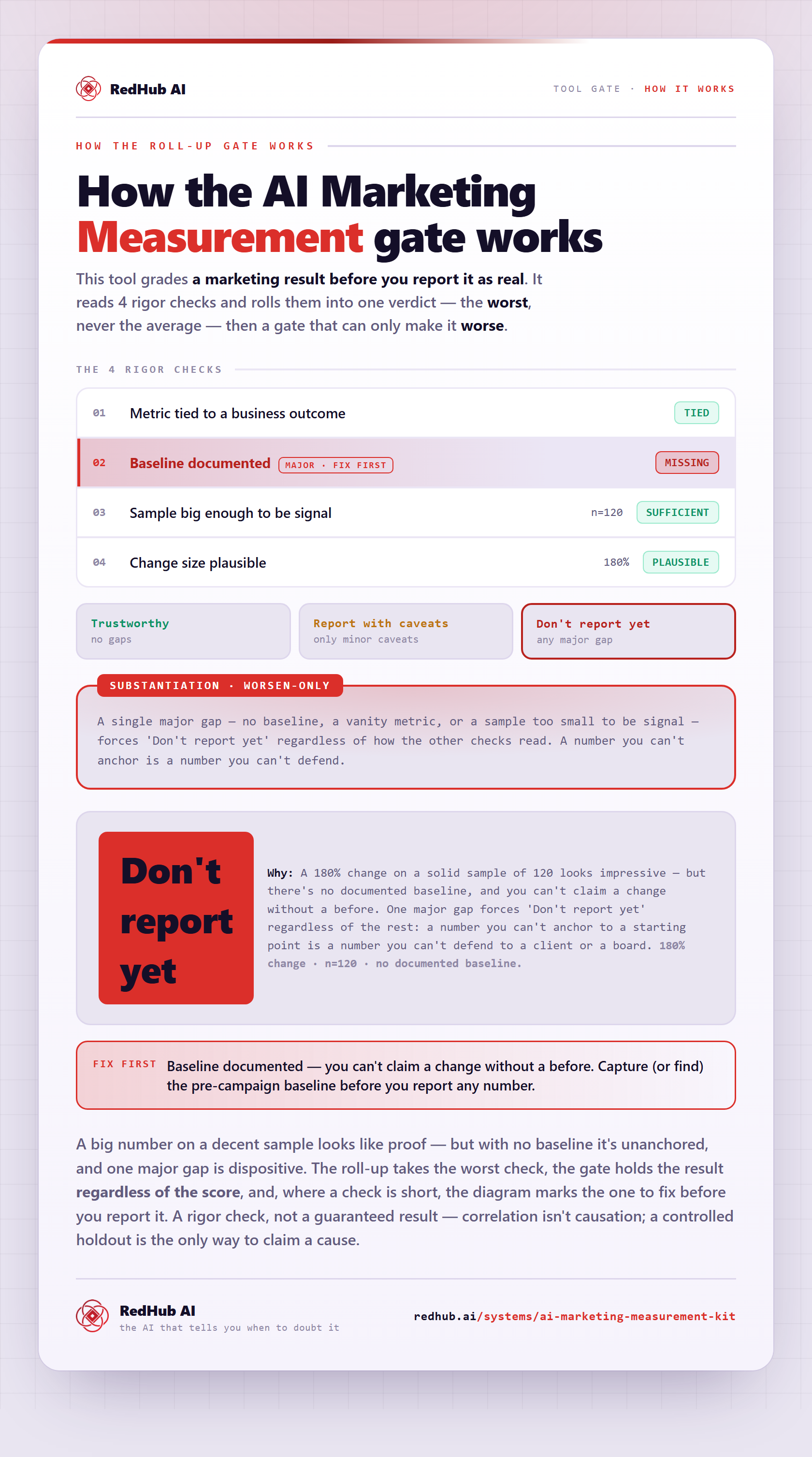
The gate this post refers to, drawn from the tool’s own logic. See the tool.