Why AI Model Upgrades Break Production Workflows
RedHub AI Editorialupdated October 2, 20267 min read
Jump to a section9
AI model upgrades break production workflows because a model does more than supply answers. It shapes how the whole workflow behaves: the format of its output, the tools it picks, what it refuses, how long it takes and how many tokens it spends. A newer model can be smarter, faster or cheaper on a vendor's tests and still change one thing your system depends on. Tests that only check whether answers are accurate will not see it. The fix is to treat an upgrade like a database or API migration, with written acceptance criteria and a gradual rollout.
TL;DR: Seven things drift when a model changes: formatting, instruction following, tool behavior, refusals, tone, latency and token use, and the kind of mistakes it makes. Most break nothing loudly. Find the hidden contracts between the model and the rest of your system, define what "acceptable" means before you test, and move traffic in stages. The AI Agent Quiet-Failure & Drift Monitor Kit ($49) shows when a multi-step agent has quietly slipped. Start with the pillar: AI Model Lifecycle: Your AI Stack Has an Expiration Date.
A benchmark win is not a production guarantee
Teams often expect an upgrade to improve a workflow on its own. Sometimes it does. But a benchmark measures the vendor's tasks, scored the vendor's way. Your workflow is a chain of prompts, parsers, tools and downstream rules that were all tuned to the old model's habits, often without anyone writing those habits down.
Anthropic's migration guide for Claude Sonnet 5.5 documents one such change in plain terms. On Sonnet 5.5, notes longer than a sentence or two that the model writes between tool calls come back as thinking blocks instead of text, empty at the default display setting. "No request fails," the guide says, "but an interface that shows those notes goes quiet." That is a vendor describing, in its own docs, an upgrade that breaks nothing loudly.
What can drift
- Formatting. JSON, tables, tags, markdown or the order of fields can change.
- Instruction following. The model may read the same prompt more strictly or more loosely.
- Tool behavior. An agent may pick different tools, different parameters or a different sequence.
- Refusals. The line between what it will and will not do can move between versions.
- Tone and style. Customer-facing replies can get longer, more formal or more cautious.
- Latency and token use. A better model can still be slower or more expensive on your specific task.
- Error pattern. Mistakes can get rarer while a new kind of mistake appears.
Only the first one throws an error, and only when a parser is strict enough to reject bad output. The rest pass every check that asks "did we get an answer?"
The hidden dependency
Take a hypothetical. A property-management company runs a maintenance agent. It reads tenant messages, classifies each one, picks a vendor from a tool, and writes a work order with a priority field. The old model always wrote that field in capitals: URGENT. Nobody asked it to. A dispatch rule written a year later pages the on-call plumber when the field equals URGENT, exact match.
The company upgrades. The new model writes Urgent. Every work order still looks right to a person reading it. Classification accuracy went up in testing. And for burst-pipe messages, the on-call page stops firing, with no error anywhere in the system, until a tenant calls the office the next morning.
Production prompts carry dependencies like this. A workaround may only exist because the old model misread a field. A parser may expect one field order. These are contracts between the model and the rest of your system, and nobody signed them. Finding them is the first step of any upgrade.
Why the slip looks like noise
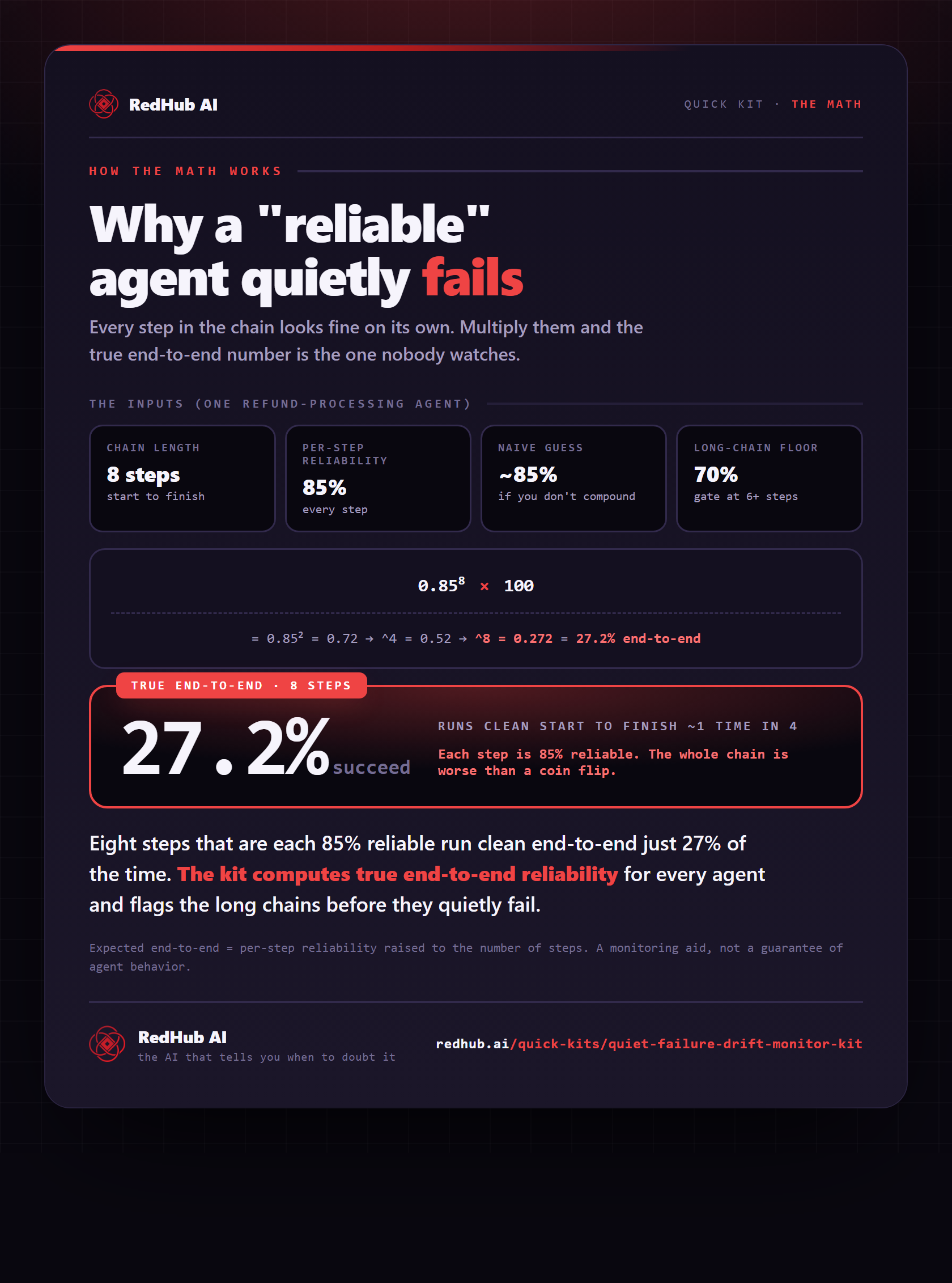
Quiet failures are hard to see in a multi-step agent because errors compound across steps. If each of an agent's 8 steps succeeds independently 85% of the time, the whole run succeeds about 27.2% of the time (0.85 to the eighth power).
That is why the comparison that catches drift is expected against observed, step by step. A whole-run success rate alone hides which step slipped. Our post on AI agent reliability covers how these failures show up after launch, and long-horizon AI agents covers the checkpoints that contain them.
How to upgrade safely
Treat the upgrade as a migration with stages, and move to the next stage only when the current one passes.
| Stage | What to do |
|---|---|
| Discover | Inventory workflows, prompts, model IDs, tools, parsers and downstream dependencies |
| Baseline | Capture real tasks and expected outcomes from the current model |
| Compare | Run old and new models on the same evaluation suite |
| Inspect | Review failures by type: accuracy, format, tool, latency, cost, safety |
| Pilot | Route limited traffic to the new model |
| Monitor | Track production metrics and user feedback |
| Roll out | Expand only after predefined thresholds are met |
In the maintenance example, Discover is where someone reads the dispatch rule, and Inspect is where the priority field shows up as a format failure.
Define acceptance criteria before testing
Do not ask whether the new output "looks better." Two reviewers will disagree, and both will be judging the outputs they happened to read. Write down what acceptable means first, with a threshold for structured-output validity, completion rate, tool success, answer quality, response time, cost per task, escalation rate and safety failures. In the maintenance example, one line would have caught the failure before launch: the priority field matches one of the dispatch rule's exact values on every test work order. Written before the results come in, thresholds like that settle the argument in advance. Written afterward, they tend to fit the results.
Not every drift is the model's fault
In the maintenance example, which part is broken? The new model's output is better English, if anything. The dispatch rule was fragile from the day it was written, and it worked by luck. You can pin the old behavior back by adding "write the priority in capitals" to the prompt, which is fast and keeps the next upgrade just as fragile. Or you can fix the rule to ignore capitalization, which is the better repair but touches a system the AI team may not own.
An upgrade can turn up several of these. Some are regressions in the model. Some are old bugs the old model hid. Deciding which is which takes judgment, and the answer is not always to make the new model behave like the old one.
See when a multi-step agent has quietly slipped
The AI Agent Quiet-Failure & Drift Monitor Kit computes each agent's expected end-to-end success from its steps and per-step reliability, compares it with the rate you observe, and returns STABLE, SHORTEN or CHECKPOINT per agent, rolled up to a fleet posture of HOLDING, WATCH or DRIFTING. One .xlsx; you enter numbers from your logs.
Get the Quiet-Failure & Drift Monitor Kit — $49Pairs well with
The Prompt Regression Lab ($89) covers the Baseline and Compare stages: it snapshots a baseline and fails CI on any regression with a ship, hold or regressed verdict. The Agent Reliability Harness ($149) is where the maintenance agent's vendor pick would get checked, since it evaluates tool choice, argument validity, step efficiency, cost and policy across a run. The AI Agent Go-Live Readiness Gate ($79) returns READY, FIX or DO NOT DEPLOY across five controls, and one of them is a tested rollback path, the thing to have in hand before the Pilot stage.
More in this guide
Why do AI model upgrades break workflows?
Because the rest of the system was tuned to the old model's habits: output format, tool choices, tone, refusals and token use. A new model can change any of those while still giving accurate answers, usually without an error.
If a new model scores higher on benchmarks, is it safe to switch?
Not by itself. A benchmark measures the vendor's tasks, not the behavior your workflow depends on. Run your own real tasks through the new model and compare against written acceptance criteria.
What is a hidden dependency on a model?
It is something in your system that only works because of a habit of the current model, such as a parser expecting one field order or a rule matching an exact word the model always used. Nobody wrote it down, so an upgrade breaks it without warning.
Why is drift in a multi-step agent hard to notice?
Errors compound across steps, so one step getting worse moves the end-to-end rate by less than you might expect. In an illustrative 8-step agent at 85% per step, one step falling to 75% moves end-to-end success from about 27.2% to about 24.0%.
What should acceptance criteria for a model upgrade include?
Thresholds for structured-output validity, completion rate, tool success, answer quality, response time, cost per task, escalation rate and safety failures, written down before testing starts.
Should I make the new model behave exactly like the old one?
Not always. Some drift is a real regression. Some exposes a fragile rule or parser the old model happened to satisfy. Fix the regressions in the model's setup, and fix the fragile parts of your own system where you can.
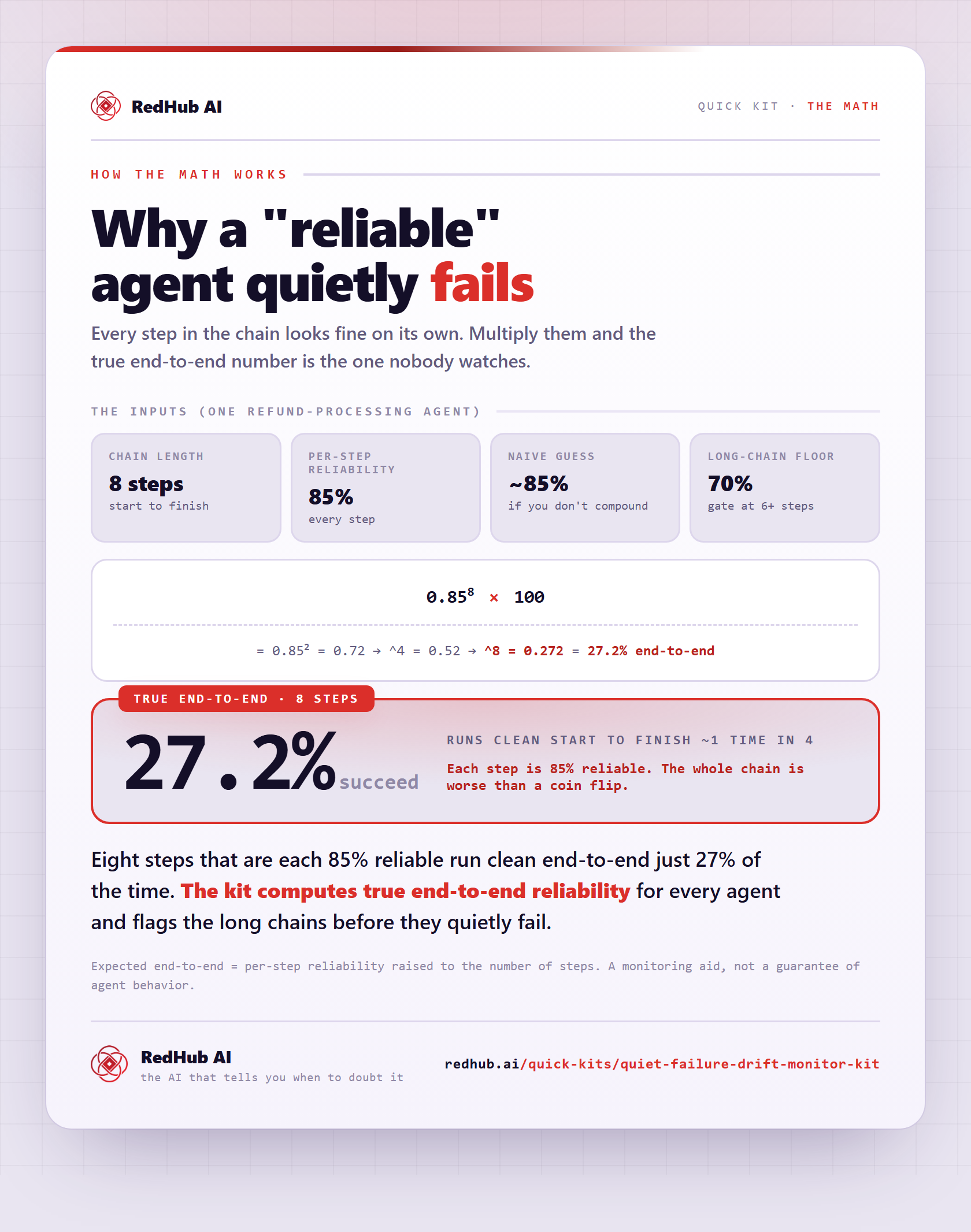
The gate this post refers to, drawn from the tool’s own logic. See the tool.