Claude Sonnet 4.5 Retirement: Your Migration Checklist
RedHub AI Editorialupdated October 2, 20267 min read

Jump to a section8
The Claude Sonnet 4.5 retirement is set for November 30, 2026. Anthropic deprecated the model, claude-sonnet-4-5-20250929, on September 30, 2026, and names claude-sonnet-5-5 as its replacement. After the retirement date, requests to the old model fail. That is about eight weeks from the date of this post, as of October 2026, on Anthropic's own platforms. If you call Sonnet 4.5 through Amazon Bedrock or Google Cloud, your date may be different, because Anthropic says those platforms set their own retirement schedules.
TL;DR: Find every caller first: Claude Console's Usage page exports a CSV of usage by API key and model. Then fix the settings Anthropic's migration guide says Sonnet 5.5 rejects, such as assistant prefill. Those fail loudly. Behavior changes do not, so run the same real tasks through both models before you switch, and plan a rollback that still exists after November 30. The Prompt Regression Lab ($89) gates the swap. Start with the pillar: AI Model Lifecycle: Your AI Stack Has an Expiration Date.
The dates, as of October 2026
Everything in this table comes from Anthropic's model deprecations page (opens in a new tab).
| Item | What Anthropic lists |
|---|---|
| Deprecated model | claude-sonnet-4-5-20250929 |
| Deprecated on | September 30, 2026 |
| Retires on | November 30, 2026 |
| Recommended replacement | claude-sonnet-5-5 |
| After retirement | Requests to the model fail |
| Platforms these dates cover | Claude API, Claude Platform on AWS, Microsoft Foundry |
| Amazon Bedrock and Google Cloud | Set their own retirement schedules; check their model tables |
Anthropic also warns that deprecated models "are likely to be less reliable than active models." So the eight weeks are a migration window, not a period of normal service.
Step one: find everything still calling it
Consider a sales team that finds a summary of every recorded call in its CRM each morning. A contractor built the job in 2025, on its own API key, and it runs at 2 a.m. A search of the main app's repository will not find it. On November 30 the summaries stop, and the first alarm is a sales rep asking where they went.
Anthropic's page describes the fix. In Claude Console, open the Usage page, click Export, and read the CSV, which breaks usage down by API key and by model. Every key with Sonnet 4.5 traffic is a caller to migrate or switch off. Then search code, config and environment variables for the model string, including scheduled jobs and evaluation scripts. Our post on model deprecation explains how to tell a pinned version from an alias while you are in there.
If any of your traffic runs through Bedrock or Google Cloud, check those accounts too, along with each platform's own retirement date for the model.
The settings that will fail outright
Anthropic's Sonnet 5.5 migration guide (opens in a new tab) lists request settings that return an error on the new model. As of October 2026, the ones most likely to hit a Sonnet 4.5 integration are:
- A prefilled last assistant turn. Sonnet 4.5 accepts one, and Sonnet 5.5 rejects it with a 400 error.
- Forced tool choice. A
tool_choiceof typeanyortoolreturns a 400 error. The guide's replacement isautowith strict tools, and saying in the prompt when to use the tool. On Amazon Bedrock, the guide says to sendautowithout strict and validate the tool input in your own code. - Non-default
temperature,top_portop_kvalues, which also return a 400 error. - Thinking budgets. Sonnet 4.5 uses
thinking: {"type": "enabled", "budget_tokens": N}for all thinking. Sonnet 5.5 returns a 400 error and wants an effort level instead. - Thinking turned off with
{"type": "disabled"}, which Sonnet 4.5 accepts and Sonnet 5.5 rejects with a 400 error. The guide's way to run without up-front thinking on Sonnet 5.5 is{"type": "between_tools"}.
The guide's checklist has more, and it is the source to work from. These errors are the good news: a 400 error shows up in your first test run. The changes that do not throw errors are the ones that reach customers, and the biggest is quiet. On Sonnet 4.5, a request with no thinking field ran without thinking. On Sonnet 5.5, the guide says, the same request runs with adaptive thinking.
Why a clean swap can still fail
Anthropic lists Sonnet 5.5 at $2 per million input tokens and $10 per million output tokens. It says Sonnet 5.5 "generates outputs 30%+ faster than Sonnet 5" and "costs up to 30% less per task than its predecessor." Read the comparison carefully: the speed claim is measured against Sonnet 5 and the cost claim against "its predecessor." Neither names Sonnet 4.5, and neither was measured on your work.
The migration guide adds a number that points the other way. Sonnet 5.5 uses Sonnet 5's tokenizer, and against Sonnet 4.5 the guide says the same text produces about 30% more tokens, depending on the content. Thinking tokens are billed as output tokens, and thinking now runs on requests that never asked for it. The guide ties both to cost, and its checklist tells every migrating team to re-baseline it. Formatting can drift too, tool choice can change, and refusal boundaries can move. A workflow that leaned on one of Sonnet 4.5's habits can fail without an error. Our post on why AI model upgrades break production workflows goes through what drifts and why.
The migration checklist
- Inventory every caller. Code paths, agents, integrations, prompts and scheduled jobs, from the Console export plus a code search.
- Freeze real tasks. Normal cases, edge cases and known failures, with the outcome you expect from each.
- Run both models on them. Same prompts, same tools, Sonnet 4.5 and Sonnet 5.5, while 4.5 still answers.
- Compare what you pay for. Accuracy, structured output, tool calls, latency, tokens, cost and the minutes of human review.
- Update the request. Model ID, the settings the migration guide flags, and any provider-specific features.
- Canary first. Send a small slice of live traffic to Sonnet 5.5 and watch it.
- Keep a way back. Hold a rollback path until results are stable.
Step three has a deadline of its own. Once Sonnet 4.5 retires, you can no longer run your tasks through it, so capture its outputs now as your baseline. A comparison you start in December has nothing to compare against.
Step seven has the same problem. On most migrations, rolling back means returning to the old model. Here the old model is gone after November 30. A rollback path for this migration has to point somewhere that still exists: another active model you have tested on the same tasks, the previous version of your prompt on Sonnet 5.5, or a manual queue where people handle the work for a few days. Pick one before the canary starts, because a rollback you design during an incident is a guess.
Test tools and structured output first
If your application uses JSON, function calls, strict schemas or tool-selection logic, test those before anything else. A small change in output shape breaks a parser outright, and a different tool order can produce a confident answer built on missing data. The migration guide names two traps a Sonnet 4.5 integration is likely to hit. A response can now begin with thinking blocks, so code that reads content[0].text breaks. And escaping in tool call arguments can differ, so parse tool input with a standard JSON parser. Then test timeouts, retries, caching and logging. The upgrade is done when the whole workflow produces a result the business accepts, not when the API returns a response.
Catch the regression while Sonnet 4.5 still answers
The Prompt Regression Lab snapshots a baseline, runs deterministic checks and an A/B compare, and fails CI on any regression, with a ship, hold or regressed verdict. Python and TypeScript.
Get the Prompt Regression Lab — $89Pairs well with
The Prompt Evaluation & Versioning System ($49) gives you an eval framework, a dashboard and a Notion war-room for treating prompts like code. The Agent Reliability Harness ($149) evaluates an agent's whole run, covering tool choice, argument validity, step efficiency, cost and policy, and returns ship, hold or fix. The AI Unit-Economics & Token-Shock Exposure Kit ($59) computes the fully loaded cost per successful outcome for each workflow from your own numbers, which is the figure to re-baseline after the swap.
More in this guide
When does Claude Sonnet 4.5 retire?
Anthropic lists November 30, 2026 as the retirement date for claude-sonnet-4-5-20250929 on the Claude API, Claude Platform on AWS and Microsoft Foundry. It was deprecated on September 30, 2026. After retirement, requests to it fail.
What replaces Claude Sonnet 4.5?
Anthropic's recommended replacement is claude-sonnet-5-5, released on September 28, 2026 and listed at $2 per million input tokens and $10 per million output tokens.
Does the November 30 date apply on Amazon Bedrock and Google Cloud?
Not necessarily. Anthropic says its dates apply to its own platforms, and that Amazon Bedrock and Google Cloud set their own retirement schedules. Check the model table for the platform you use.
How do I find out which apps still use Sonnet 4.5?
In Claude Console, open the Usage page, click Export, and review the CSV, which shows usage by API key and model. Then search your code and config for the model string, and check any Bedrock or Google Cloud accounts separately.
Can I just change the model ID to claude-sonnet-5-5?
Not safely. Anthropic's migration guide lists settings Sonnet 5.5 rejects, such as assistant prefill and forced tool choice, and output format, tool use and cost can shift too. Test real tasks first.
What should my rollback plan be if Sonnet 4.5 is retiring?
Rolling back to Sonnet 4.5 stops being possible after November 30, so plan one that still exists: another tested active model, an earlier prompt version on Sonnet 5.5, or a manual queue. Capture Sonnet 4.5's outputs on your test tasks before it retires.
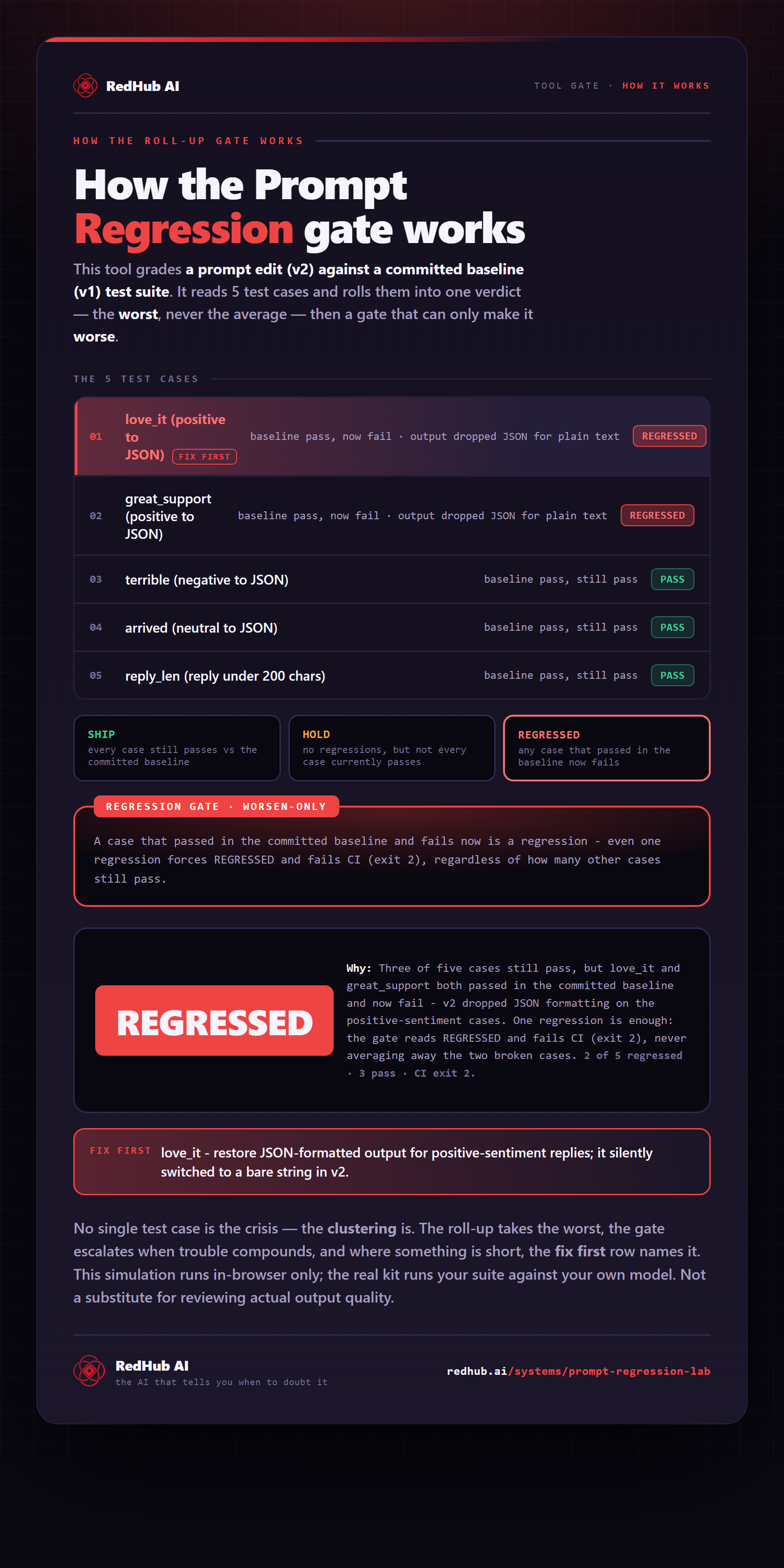
The gate this post refers to, drawn from the tool’s own logic. See the tool.