AI Vendor Lock-In: 7 Signs One Model Owns Your Workflow
RedHub AI Editorialupdated October 2, 20267 min read

Jump to a section7
You have AI vendor lock-in when one model provider holds your workflow so tightly that you cannot switch, or credibly threaten to switch, when the price, the terms or the model itself changes. It rarely starts as a decision. A team writes a prompt that works, wires in one provider's tool features, tunes around one model's habits and ships. The cost shows up months later, when the provider raises a price or retires a model, and the only choices left are pay or rebuild.
TL;DR: Lock-in is a pricing problem before it is a technical one: if you cannot move, a price rise is a bill, not a negotiation. Seven signs show it, from no inventory of model IDs to no fallback model. Before you sign or renew, settle five terms: pricing changes, caching, rate limits, portability and retirement notice. The AI Vendor Claim & Contract Scrutiny Kit ($69) checks whether a vendor's promises are proven and in the contract. Start with the pillar: AI Intelligence Costs: Your Automation Math Is Out of Date.
Why lock-in is a pricing problem
Google announced Gemini 4 Argon at an introductory $2 per million input tokens and $10 per million output tokens, and says the price rises to $4 and $20, without saying when. A workflow priced at the launch rate will cost twice as much per token after that.
The same logic applies to every term a vendor can change, from a cache discount to a retirement date. Your leverage on each one is the cost of leaving. Our comparison of Argon and Claude Sonnet 5.5 shows how much one price row can hide.
Seven warning signs
- The workflow lives in one provider's format. Your business logic sits inside one provider's prompt format or agent framework, so moving means rewriting.
- Nobody has a list of model IDs. No inventory of the exact model versions you call, such as
claude-sonnet-4-5-20250929, or of which workflows use them. You cannot price a change you cannot see. - You cannot run the same task elsewhere. Sending one task to another model means rewriting the integration, not changing a setting.
- You have no golden test set. That is a fixed batch of real tasks with known good answers. Without one, you cannot prove an alternative is good enough, so the threat to switch is empty.
- Tools depend on vendor-only functions. Your tools and data access rely on one vendor's features, with no documented interface another model could use.
- Nobody watches the vendor. You do not track pricing, deprecations, availability or policy changes, so you learn an introductory price ended from the invoice.
- There is no plan B. No fallback model, no manual process and no migration playbook. When the model retires, the workflow stops.
The signs escalate. The first five make leaving slow and expensive. The sixth means you will not see the change coming. The seventh turns a price change or a retirement into an outage.
Five terms to settle before you sign
When prices are moving, the terms around the price matter as much as the price. The table pairs each question with what the two big labs have published as of October 2026.
| Term | What to ask | What is on the record |
|---|---|---|
| Pricing changes | Is this price introductory? How much notice comes before it changes? | Google lists Argon's $2 and $10 as introductory, rising to $4 and $20. It has not said when the introductory period ends. |
| Caching | What is the discount on repeated input, and what must a prompt look like to get it? | Google prices Argon's cached input at 95% off. Anthropic lists Sonnet 5.5 cache reads at $0.20 per million tokens. |
| Rate limits | What are the caps on requests and tokens per minute at your tier, and how do they rise? | Set per provider and account. Get yours in writing. |
| Portability | Can you export prompts, logs, evaluation results and any customized model? | Depends on your agreement. |
| Retirement terms | How much notice comes before a model retires, and on which platforms? | Anthropic gives "at least 60 days' notice" for publicly released models. Claude Sonnet 4.5 was deprecated September 30, 2026 and retires November 30, 2026. |
A cache discount rewards prompts built the way one provider's cache works, so part of your savings may be tied to one vendor. Retirement terms have a catch too. Anthropic's deprecation page says its dates apply to its own platforms, while partner platforms such as Amazon Bedrock and Google Cloud "set their own retirement schedules." If you reach a model through a cloud partner, the date that matters is the partner's.
How to reduce the dependency
Start with visibility: map your models, prompts, tools, data and owners. For Claude, Anthropic's deprecations page points to the Usage page in Claude Console, whose Export gives a CSV of usage by API key and model. Then work through five changes:
- Centralize routing. One place in your code decides which model gets a request, so a swap is a setting. Our post on model-agnostic AI architecture covers how to build that layer.
- Move policies out of prompts. Approval rules and data boundaries live in your system.
- Standardize output formats. Every model must return the same structure, so the code after it does not change.
- Keep your evaluation data. The golden test set and past results let you judge a replacement in days.
- Build a small fallback path for the critical workflows, even if it is slower or more manual.
Do not try to rebuild every workflow at once. Begin with the ones that touch customers, revenue, regulated data, production systems or high volume. Our posts on model deprecation and LLM API cost control cover baseline tests and routing. A routing service can turn a swap into a configuration change, as our post on Stripe's OpenRouter acquisition describes, but it is one more vendor in the chain.
When staying put is the cheaper choice
Portability costs money. A fallback model needs its own test runs, its own prompt tuning and an account kept in working order, and a golden test set needs upkeep as the work changes. For an internal summarizer that a person reads before acting, all of that can cost more than the lock-in it prevents. There, a price rise is annoying and a retirement means a week of rework.
The money is better spent where a forced switch would stop revenue or reach customers. Most workflows sit between those two cases, and where to draw the line is a judgment about what an outage would cost, made one workflow at a time.
Check a vendor's promises before you sign
The AI Vendor Claim & Contract Scrutiny Kit has you mark each claim a vendor makes on two axes from 0 to 3: is there proof, and is it in the agreement with a remedy. The lower mark decides, so a claim that is proven but not in the contract cannot read SUBSTANTIATED. Each claim reads SUBSTANTIATED, GET IN WRITING or RED FLAG, and the vendor rolls up to VENDOR CLEAR, GET IT IN WRITING or WALK AWAY. It is not legal advice, so have counsel review any agreement before you sign.
Get the AI Vendor Claim & Contract Scrutiny Kit — $69Pairs well with
At renewal, the AI Vendor Reliability & Spend-Justification Scorecard ($79) scores each AI vendor on reliability and value and returns RENEW, RENEGOTIATE or DO NOT RENEW. The Vendor Auto-Renewal & Contract-Trap Tripwire ($49) computes each contract's notice deadline from the terms you confirm and reads it ACT NOW, WINDOW OPEN or LOCKED IN. When you test a replacement model, the Prompt Regression Lab ($89) A/B compares its outputs against a saved baseline and gives a ship, hold or regressed verdict.
More in this guide
What is AI vendor lock-in?
The term means one AI model provider holds your workflow so tightly that you cannot switch, or credibly threaten to, when its prices, terms or models change.
What are the signs of AI vendor lock-in?
Workflow logic tied to one provider's format, no inventory of model IDs, no way to run a task on another model without a rewrite, no golden test set, vendor-only tool functions, nobody watching pricing and deprecations, and no fallback model or migration plan.
Why does lock-in cost money?
Your leverage on price, caching, rate limits and retirement terms is the cost of leaving. If you cannot move, a price rise such as Gemini 4 Argon's announced increase from its introductory $2 and $10 to $4 and $20 per million tokens is a bill, not a negotiation.
How much notice do AI providers give before retiring a model?
Anthropic says it gives at least 60 days' notice for publicly released models, and that partner platforms such as Amazon Bedrock and Google Cloud set their own schedules. Check each provider and platform you use.
How do I reduce AI vendor lock-in?
Inventory your models and workflows, centralize routing, standardize output formats, keep a golden test set, and build a fallback path, starting with workflows that touch customers or revenue.
Is it ever fine to stay locked in?
Yes, for low-stakes work. For an internal summary a person reads before acting, a fallback model and test set can cost more than the lock-in.
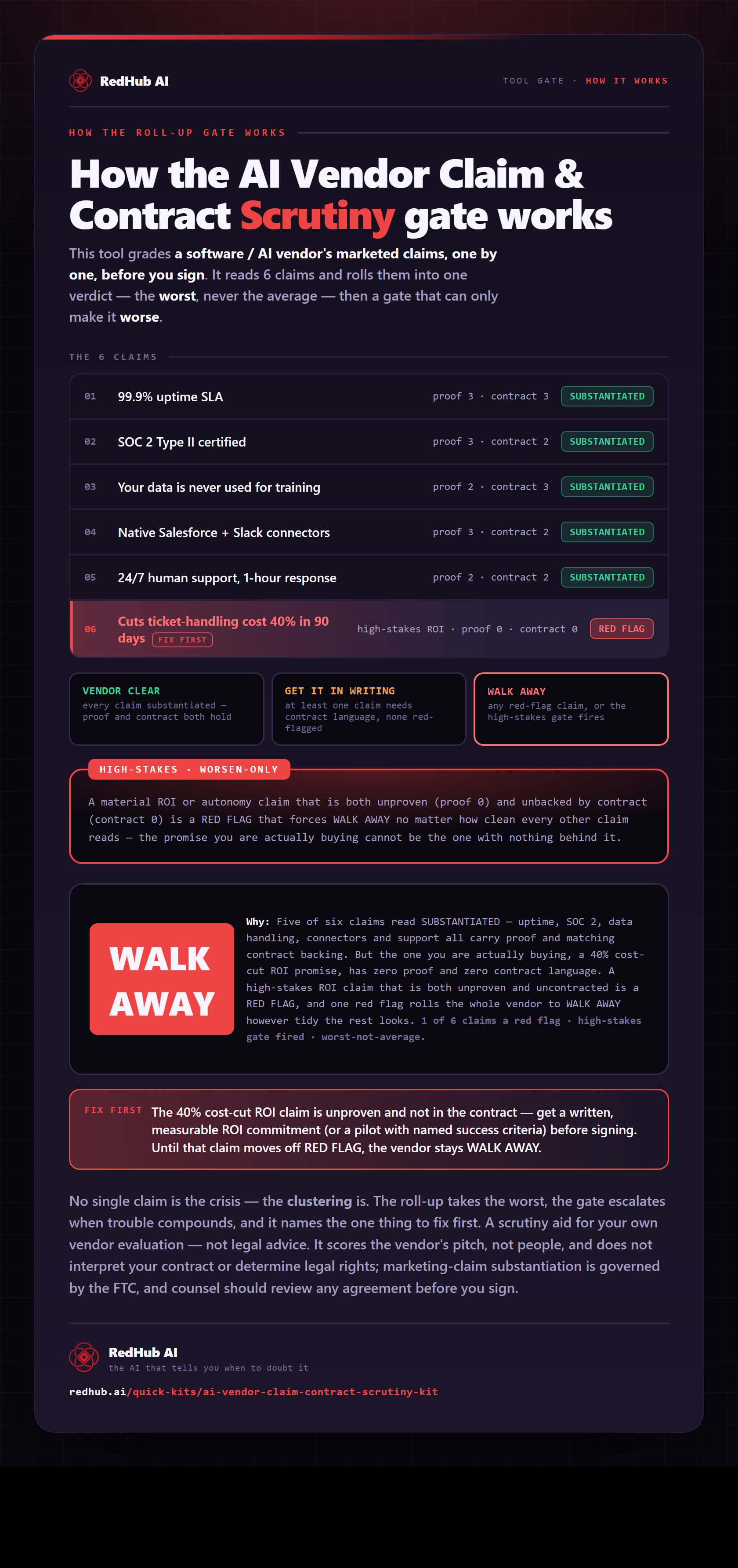
The gate this post refers to, drawn from the tool’s own logic. See the tool.